You clean the kitchen on Saturday, and by Wednesday it looks like nothing happened. The mail is in three piles, there is a chair you cannot sit on because it holds clean laundry, and you keep buying scissors because the last four are “somewhere.” If you have ADHD, ADHD home organization can feel like a job that resets to zero every few days, no matter how hard you try.
That is not a sign that you are lazy or careless. Household tasks are almost perfectly designed to be hard for an ADHD brain: they are repetitive, never finished, rarely urgent and easy to put off. The good news is that systems built around how ADHD actually works tend to hold up better than systems built on willpower. This guide covers why keeping a home organized is harder with ADHD, what research says helps, and a realistic five-step system for cleaning, chores and clutter.
The short version: aim for “functional,” not “perfect.” Start with a 10-minute reset instead of a deep clean, give everything a visible home, keep a tiny daily routine plus one zone per week, put chores on a chart you can see, and clear doom piles in short, timed batches. Kindness is part of the system, not an extra.
Why ADHD home organization is so hard
Most organizing advice, including a lot of ADHD home organization advice, assumes that once you know what to do, you will remember to do it and feel motivated to start. ADHD affects exactly those two things. Here is what tends to get in the way.
Out of sight really is out of mind
Working memory, the mental notepad that holds information while you use it, is often stretched thin with ADHD. That has a very practical effect at home: things you cannot see tend to stop existing. Bills go in a drawer and are forgotten. Groceries at the back of the fridge go bad. So many people with ADHD start leaving things out on surfaces so they will remember them, and surfaces fill up fast.
Research on hoarding offers an interesting clue here. In a study of 32 people with hoarding disorder and 26 healthy controls, inattention symptoms were linked to lower confidence in one’s own memory, which in turn was linked to saving more possessions as reminders, and then to more clutter and impairment (Hallion, Diefenbach & Tolin, 2015). That study was about hoarding disorder, which is a specific condition and not the same as ordinary ADHD clutter. But the pathway it describes, “I keep it out because I do not trust myself to remember it,” will sound familiar to many adults with ADHD.
Inattention and clutter are linked
Another study compared people with hoarding disorder, people with obsessive-compulsive disorder (OCD) and healthy controls. After accounting for general negative mood, OCD symptoms did not predict the core features of hoarding. Inattentive ADHD symptoms did: they predicted the severity of clutter, difficulty discarding and acquiring new things. Hyperactive and impulsive symptoms did not (Tolin & Villavicencio, 2011).
Again, most adults with ADHD do not have hoarding disorder, and these studies do not show that ADHD causes clutter. What they do suggest for ADHD home organization is that the attention side of ADHD, more than impulsivity, is connected to how possessions pile up. That is useful, because it points to ADHD home organization solutions built around attention: visibility, simple decisions and short bursts.
A cluttered home can feel more stressful
Clutter is not only a practical problem. In one study, couples gave recorded tours of their homes, and researchers counted how often they used words describing clutter or unfinished projects. Wives who described their homes in more stressful terms showed a flatter daily cortisol pattern, a profile linked with poorer health, and their depressed mood increased over the day. Wives who described their homes as more restful showed the opposite pattern (Saxbe & Repetti, 2010). The study was not about ADHD and it shows a correlation, not cause and effect. Still, it fits what many people report: walking into a chaotic room can make you feel tired and defeated before you have done anything.
Chores are the hardest kind of task for ADHD
Think about what makes a task easy to start with ADHD: it is interesting, new, urgent or rewarding. Now think about chores. Dishes are boring. Laundry is never finished. Wiping the counter has no deadline. Nobody congratulates you for putting the scissors back. Housework is low on novelty, low on urgency and high on repetition, which is why it slides to the bottom of the list until it becomes a crisis.
Chores also involve a hidden chain of steps. “Do the laundry” really means gather, sort, wash, move to the dryer, fold, put away. Each handoff is a chance for attention to drift, which is how a load of wet laundry ends up sitting in the machine overnight. If facing the whole house leaves you frozen, our guide to ADHD overwhelm covers that freeze response in more depth.
What the research says actually helps
There are no large clinical trials of ADHD home organization or “ADHD cleaning routines” as such. But the strongest evidence for non-medication support in adult ADHD comes from structured skills programs that teach organization, planning and follow-through, and those skills apply directly to a home.
- CBT for adults already on medication. In a randomized trial of 86 adults with ADHD who still had significant symptoms despite medication, 12 sessions of cognitive-behavioral therapy (CBT) focused on organization, planning and managing distractibility led to more improvement than a relaxation and education program. On one rating scale, 67% responded to CBT compared with 33% in the comparison group (Safren et al., 2010).
- Meta-cognitive therapy. A 12-week group program built around time management, organization and planning improved inattention symptoms more than supportive therapy in 88 adults with ADHD (Solanto et al., 2010).
- The bigger picture. A meta-analysis of 32 studies of CBT for adult ADHD found small-to-medium benefits compared with control groups for symptoms (g = 0.65) and daily functioning (g = 0.51) (Knouse et al., 2017).
Two findings from general psychology research (not specific to ADHD) also shape the system below:
- Tracking progress helps people reach goals. A meta-analysis of 138 studies with 19,951 participants found that interventions that increased progress monitoring improved goal attainment (d = 0.40). The effect was larger when progress was physically recorded or shared with others (Harkin et al., 2016). That is a good argument for a visible chore chart.
- If-then plans make starting easier. A meta-analysis of 94 studies found that specific if-then plans, called implementation intentions, had a medium-to-large effect on reaching goals (d = 0.65) compared with simply setting the goal (Gollwitzer & Sheeran, 2006).
The common ingredients are clear: break big jobs into small concrete steps, make the system visible, link tasks to cues that already happen, track progress where you can see it, and practice the routine until it becomes automatic. The ADHD home organization method below uses exactly those ingredients. It is a self-help structure, not a substitute for treatment.
An ADHD home organization system in 5 steps
If you have ever wondered how to be organized with ADHD when motivation is low, this is the core idea: this ADHD home organization system is designed to work on bad weeks, not just good ones. You do not need to buy anything to start, and you do not need to finish the whole house before it helps.
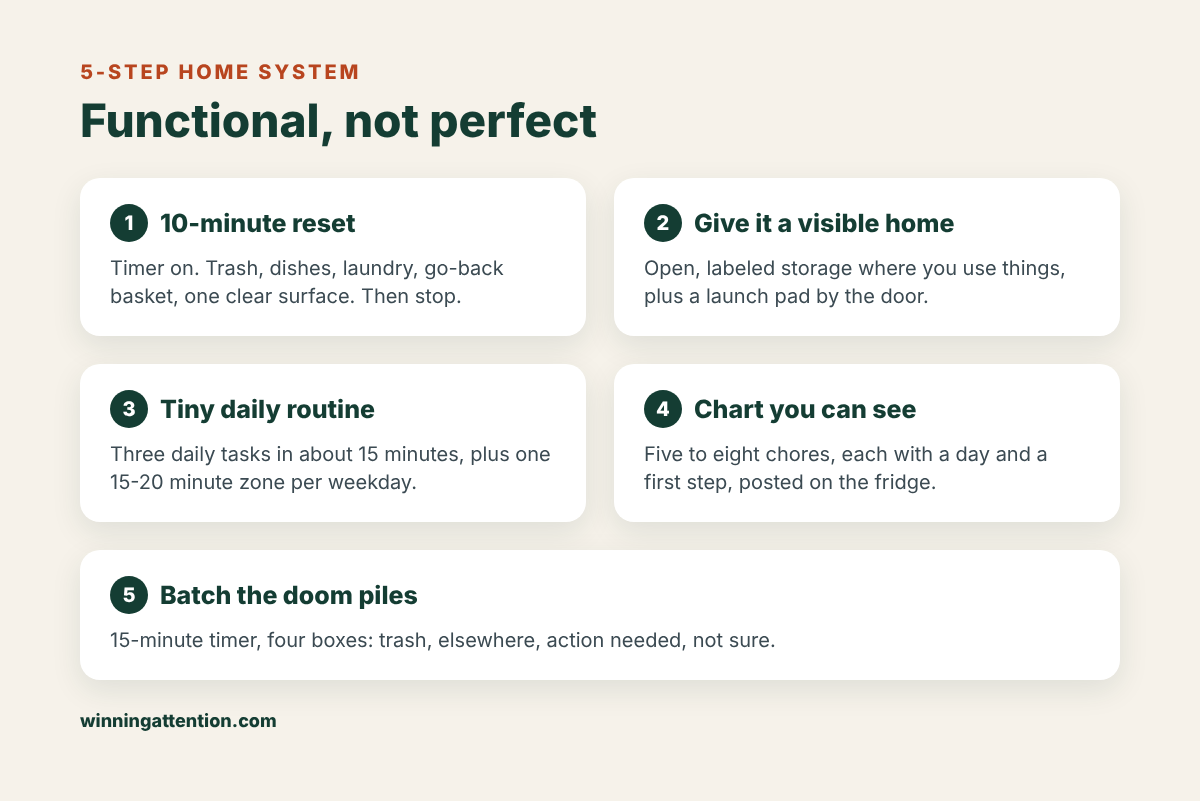
Step 1: Start with a 10-minute reset, not a deep clean
When the whole home feels like a disaster, the instinct is to plan a huge cleaning day. Huge cleaning days are hard to start, exhausting to finish, and easy to postpone. A 10-minute reset is small enough to begin right now.
Set a timer for 10 minutes. Pick one room, or even one surface. When the timer ends, you are allowed to stop. Often you will want to keep going; that is a bonus, not a requirement.
The reset order: biggest visual change first
- Trash. Grab a bag and collect anything that is obviously garbage: wrappers, empty bottles, old mail you know is junk. This takes no decisions and makes a big difference fast.
- Dishes. Gather every cup and plate into the sink or dishwasher. You do not have to wash them yet.
- Laundry. Every piece of clothing goes into one basket. Clean or dirty can be sorted later.
- Things that live elsewhere. Put them in a “go-back” basket and carry it around at the end.
- Clear one surface. A clear counter or table makes the room look and feel different.
This order works because it starts with tasks that require almost no decisions. Decision fatigue is one of the biggest hidden costs in ADHD home organization, so save the decision-heavy work for later.
Step 2: Give everything a visible home
Much of ADHD home organization comes down to one idea: clutter is often just objects without a home. If the scissors do not have one specific spot, they will live wherever you last used them. The fix is to give frequently used things a home that is easy to reach, easy to see and close to where you use them.
- Store things where you use them, not where they “should” go. If you always open mail at the kitchen counter, the mail station belongs at the kitchen counter, not in the office.
- Prefer open or clear storage. Open shelves, clear bins and hooks beat closed cabinets and opaque boxes, because you can see what is there.
- Label everything you can. Labels remove the “where does this go?” decision for you and for anyone else in the home.
- Use one-step storage. A basket you can toss things into is far more likely to be used than a drawer you have to open, a lid you have to remove and a folder you have to file in.
Example: the launch pad
Choose one spot by the front door for everything you need to leave the house: keys, wallet, bag, badge, headphones, sunglasses. Add a hook, a small tray and a charging cable. Make an if-then plan: “When I walk in the door, I will drop my keys and wallet in the tray before I take off my shoes.” It is a small change that can save a lot of frantic searching each week.
Step 3: Build a minimum viable cleaning routine
A good ADHD cleaning routine is short enough that you can do it on a hard day. Think of it as the minimum that keeps the home from sliding, plus one small extra each week.
Daily: the “three things” routine (about 15 minutes total)
- Kitchen reset. Dishes in the dishwasher or sink, counter wiped. Linked to a cue: “After dinner, before I sit on the couch.”
- One-basket pickup. Walk through the main room with a basket and collect anything that does not belong. Five minutes.
- Launch pad check. Keys, bag and tomorrow’s essentials in place.
Weekly: one zone per day
Instead of cleaning the whole home on Saturday, assign one small zone to each weekday, for 15–20 minutes. Monday bathroom, Tuesday floors, Wednesday laundry, Thursday fridge and groceries, Friday paperwork and mail. The weekend stays mostly free, which makes the routine more sustainable.
Attach each routine to something you already do. Habits stick more easily when they ride on an existing cue (after coffee, after dinner, before bed) than when they rely on memory. Our guide to building an ADHD routine explains how to stack small habits so they last.
Step 4: Make chores visible with a chart you will actually use
Do chore charts work for adults with ADHD? They can, if they are simple and visible. Think of the chart as a simple ADHD cleaning planner rather than a scorecard. A chart turns invisible chores into something you can see, and research on progress monitoring suggests that physically recording progress helps people follow through (Harkin et al., 2016).
What a good adult chore chart includes
- Few items. Five to eight recurring chores, not thirty. If it looks like homework, it will be ignored.
- A when, not just a what. “Bathroom: Monday after work” is far more likely to happen than “clean bathroom weekly.”
- Tiny, concrete steps. “Wipe sink and mirror, swap towels” instead of “clean bathroom.”
- A place to tick off. Checkboxes or stickers make progress visible and satisfying.
- A visible location. On the fridge or by the door, not in an app you never open.
For ADHD home organization, paper works well for many people because it stays in view. An app can work if it sends a reminder at the moment you can act, labeled with the first step. If you want a printable starting point, the free ADHD Daily Planner Starter Kit includes a one-page daily planner and a 2-minute reset card that pair well with a chore chart.
Step 5: Defuse doom piles in short batches
A “doom pile” is the ADHD community’s name for a stack of mixed stuff (mail, receipts, chargers, random objects) that you did not know what to do with, so you put it down. It is called doom because facing it feels overwhelming. Doom piles are not a moral failing. They are what happens when every item needs a decision and you are out of decision energy.
The four-box method
Set a timer for 15 minutes and grab four boxes or bags labeled:
- Trash or recycling
- Belongs elsewhere (carry these around at the end)
- Action needed (bills, forms, returns: these go to one place with a date)
- Not sure (it is fine to postpone some decisions)
Work from the top of the pile down. Do not read every letter; just sort. When the timer ends, empty the trash box, deliver the “belongs elsewhere” box and put the action items in your mail station. The “not sure” box can wait a week. Many piles shrink by half in one session simply because so much of it is trash.
Preventing the next doom pile
- Put a recycling bin right where you open the mail.
- Give paper one inbox tray, and empty it into your planner once a week.
- When you feel the urge to “just put it down,” ask: “Where does this live?” If it has no home, it goes in the go-back basket, not on the table.
ADHD cleaning routine: a sample week
Here is how the daily and weekly pieces of an ADHD home organization routine might fit together. Adjust times to your schedule and energy; the goal is roughly 15–30 minutes a day, not hours.
| Day | Daily three (about 15 min) | Zone of the day (15–20 min) |
|---|---|---|
| Monday | Kitchen reset, basket pickup, launch pad | Bathroom: sink, mirror, toilet, towels |
| Tuesday | Kitchen reset, basket pickup, launch pad | Floors: vacuum or sweep main rooms |
| Wednesday | Kitchen reset, basket pickup, launch pad | Laundry: one load from wash to put away |
| Thursday | Kitchen reset, basket pickup, launch pad | Fridge clear-out and grocery list |
| Friday | Kitchen reset, basket pickup, launch pad | Mail, paperwork and one doom pile batch |
| Saturday | Kitchen reset | Optional: bedding, or nothing at all |
| Sunday | Kitchen reset, launch pad | 10-minute weekly look-ahead and chart reset |
Missing a day does not break an ADHD home organization system. Skip it and do the next day’s zone. Never try to “catch up” on a missed week; it is the fastest way to give up on a routine.
Putting it together: one week, step by step
Here is how this approach to ADHD home organization could look for a fictional example: Priya, a 29-year-old nurse with ADHD who works rotating shifts and lives with a roommate. Her apartment cycles between “fine” and “I cannot have anyone over.”
- The 10-minute reset. On Sunday evening Priya is overwhelmed by the living room. She sets a timer for ten minutes and does the reset order: trash bag first, then mugs to the sink, then all clothes into one basket. When the timer rings, the couch and coffee table are clear. She stops there, on purpose.
- A visible home. Her keys and badge are always lost before shifts. She sticks a hook and a small tray by the door and writes an if-then plan on a sticky note: “When I walk in, badge and keys go in the tray.”
- Minimum routine. She picks a daily three she can do even after a 12-hour shift: dishes in the sink rinsed, a two-minute basket pickup, launch pad check. Her zone days shift with her schedule, so she writes them on the chart only for her days off.
- A visible chart. She puts a one-page chart on the fridge with six chores and checkboxes. Her roommate adds their two chores to the same chart, which makes it feel shared instead of nagging.
- A doom pile batch. On Friday she tackles the pile on the dining chair with the four-box method for 15 minutes. Half of it is junk mail. Two items go in “action needed”: a bill and a form for work. She puts both in her planner with a date.
By the end of the week, the apartment is not spotless. It does not need to be. Priya can find her keys, the dining chair is a chair again, and she has a routine small enough to survive a hard week.
How to split chores fairly with a partner who has ADHD
Housework is one of the most common sources of tension in couples, and ADHD can add extra pressure. ADHD home organization works best when it is treated as a shared system rather than one person’s job. A review of research on adult ADHD and romantic relationships found that much of the evidence points to adults with ADHD having more discordant and shorter-lived relationships, while also noting that research on what specifically helps is still limited (Wymbs et al., 2021).
The division of chores matters for both partners. In a study that tracked 30 dual-earner couples around their homes, spouses who spent more time on housework had higher evening cortisol and weaker recovery from the workday. For wives, husbands doing more housework predicted better evening recovery (Saxbe, Repetti & Graesch, 2011). That study did not involve ADHD, but it is a reminder that an uneven load has real costs for the partner carrying it.
A few practical approaches tend to reduce friction:
- Divide by ownership, not by “helping.” When one partner “helps,” the other partner still has to remember, plan and ask. Instead, each person fully owns certain chores from start to finish, including noticing when they need doing.
- Match chores to strengths. Some people with ADHD prefer short, active, visible jobs (taking out trash, vacuuming, cooking) over slow, detail-heavy ones (paperwork, scheduling). Trade accordingly, while keeping the total load fair.
- Make the system external, not personal. A shared chart, shared calendar reminders and set chore times mean the system does the reminding, so one partner does not become the “nag.”
- Agree on “good enough.” Partners often have different standards. Agree on what “done” looks like for each chore so effort is not dismissed as wrong.
- Do some chores side by side. Many people with ADHD find it easier to start when someone else is working nearby. A 20-minute “tidy together” with music can be easier than two separate solo sessions.
- Check in weekly, briefly. Ten minutes on Sunday to look at the chart and adjust. Focus on the system, not on blame.
If you find that a burst of focus sometimes drives you to reorganize a whole closet at midnight while the dishes wait, that is a familiar pattern too. Our guide to ADHD hyperfocus explains how to aim that energy and set an exit.
Common mistakes to avoid
- Waiting for a free day to “do it properly.” The big cleaning day rarely arrives. Ten minutes today beats a perfect plan for next Saturday.
- Buying organizing products first. ADHD home organization is not a shopping project. New bins are exciting, which is part of the trap. Declutter and choose homes first, then buy only what you need.
- Using storage that hides things. Closed, stacked or opaque storage turns into “out of sight, out of mind.” Favor open, labeled and easy-to-reach options.
- Building a routine for your best day. If your routine only works when you have energy and free time, it will fail on the days you need it most.
- Trying to catch up on missed days. Start again with today’s task. A gap is normal, not failure.
- Shaming yourself or a partner. Shame makes avoidance worse. Talk about the system that needs changing, not the person.
When to talk to a professional
ADHD home organization strategies help many adults, but they are not a treatment for ADHD on their own. Talk to a doctor, psychologist or other qualified clinician if disorganization at home is affecting your health, safety, finances, relationships or work; if you feel unable to discard possessions or the clutter makes rooms unusable, which can be a sign of hoarding disorder; or if you are struggling with low mood, anxiety or ongoing overwhelm. Evidence-based options for adult ADHD include medication and structured skills-based therapy such as CBT, and a professional organizer who understands ADHD can also be a practical support.
Frequently asked questions
Why is it so hard to keep a home organized with ADHD?
Household tasks are repetitive, never finished and rarely urgent, which makes them hard to start with ADHD. Working memory difficulties mean things that are out of sight are easily forgotten, and research links inattention symptoms with more clutter. None of this is a character flaw; it is a mismatch between the task and how ADHD attention works.
How do you start cleaning when you are overwhelmed?
Set a timer for 10 minutes and pick one room or one surface. Start with tasks that need no decisions: trash first, then dishes, then laundry into one basket. When the timer ends you are allowed to stop, and that small win often makes the next step easier.
What is a good ADHD cleaning routine?
A good ADHD cleaning routine is short enough to do on a hard day. Try three daily tasks of about 15 minutes in total, such as a kitchen reset, a one-basket pickup and a launch pad check, plus one 15–20 minute zone per weekday. Attach each task to something you already do, like finishing dinner.
Do chore charts work for adults with ADHD?
They can, if they are simple and visible. Keep the chart to five to eight chores, give each one a specific day and a tiny first step, and post it where you will see it. Research on progress monitoring suggests that physically recording progress helps people follow through on goals.
How do you deal with clutter and doom piles?
Use short, timed batches with four boxes: trash, belongs elsewhere, action needed and not sure. Sort from the top without reading everything, then empty each box when the timer ends. To prevent new piles, give paper one inbox and put a recycling bin where you open the mail.
How do you split chores fairly with a partner who has ADHD?
Divide chores by full ownership rather than “helping,” and match tasks to each person’s strengths while keeping the total load fair. Use a shared chart and reminders so the system does the nagging, agree on what “done” looks like, and check in briefly each week.
Sources
- Tolin DF, Villavicencio A. Inattention, but not OCD, predicts the core features of hoarding disorder. Behaviour Research and Therapy. 2011;49(2):120–125. PubMed
- Hallion LS, Diefenbach GJ, Tolin DF. Poor memory confidence mediates the association between inattention symptoms and hoarding severity and impairment. Journal of Obsessive-Compulsive and Related Disorders. 2015;7:43–48. PubMed
- Saxbe DE, Repetti R. No place like home: home tours correlate with daily patterns of mood and cortisol. Personality and Social Psychology Bulletin. 2010;36(1):71–81. PubMed
- Saxbe DE, Repetti RL, Graesch AP. Time spent in housework and leisure: links with parents’ physiological recovery from work. Journal of Family Psychology. 2011;25(2):271–281. PubMed
- Safren SA, Sprich S, Mimiaga MJ, et al. Cognitive behavioral therapy vs relaxation with educational support for medication-treated adults with ADHD and persistent symptoms: a randomized controlled trial. JAMA. 2010;304(8):875–880. PubMed
- Solanto MV, Marks DJ, Wasserstein J, et al. Efficacy of meta-cognitive therapy for adult ADHD. American Journal of Psychiatry. 2010;167(8):958–968. PubMed
- Knouse LE, Teller J, Brooks MA. Meta-analysis of cognitive-behavioral treatments for adult ADHD. Journal of Consulting and Clinical Psychology. 2017;85(7):737–750. PubMed
- Harkin B, Webb TL, Chang BP, et al. Does monitoring goal progress promote goal attainment? A meta-analysis of the experimental evidence. Psychological Bulletin. 2016;142(2):198–229. PubMed
- Gollwitzer PM, Sheeran P. Implementation intentions and goal achievement: a meta-analysis of effects and processes. Advances in Experimental Social Psychology. 2006;38:69–119. DOI
- Wymbs BT, Canu WH, Sacchetti GM, Ranson LM. Adult ADHD and romantic relationships: what we know and what we can do to help. Journal of Marital and Family Therapy. 2021;47(3):664–681. PubMed
Turn this into a daily plan
Get the free ADHD Daily Planner Starter Kit: a one-page daily planner, a weekly energy tracker and a 2-minute reset card.