You have probably built the perfect routine more than once. Wake at 6:00, stretch, journal, healthy breakfast, inbox zero by 9:00. It lasts four days. Then one late night or one busy Monday knocks it over, and you are back to rushing out the door with one shoe on and no idea where your keys are.
That cycle is common, and it is not a character flaw. An ADHD routine has to work with a brain that gets bored quickly, often runs on a later body clock and holds fewer steps in mind at once. Research on habits, sleep and adult ADHD treatment explains why standard routines fall apart and what makes some routines stick. This guide covers whether routines really help with ADHD, why they break, what studies say, and a five-step method for building an ADHD-friendly morning, workday and bedtime routine.
The short version: build small, not perfect. Start with one anchor time of day, limit the routine to three steps, tie each step to something you already do, make it visible, and decide in advance what the “minimum version” looks like on bad days. Expect a new ADHD routine to take weeks or months to feel automatic, and expect to restart. Restarting is part of the routine.
Do routines help with ADHD?
Yes, for many adults an ADHD routine does help, but not in the way most productivity advice suggests. A good one is not a strict schedule you follow perfectly. It is a short set of default actions that removes decisions from the parts of the day where you tend to get stuck, such as getting out the door, starting work or going to bed.
The strongest evidence for non-medication help in adult ADHD comes from structured skills programs that teach organization and planning, and building routines is a core part of them. In a randomized trial of 86 adults who still had significant symptoms despite medication, 12 sessions of cognitive-behavioral therapy (CBT) focused on organization, planning and handling distractibility worked better than an attention-matched relaxation program. On one rating scale, 67% responded to CBT compared with 33% in the comparison group, and responders kept their gains at 6 and 12 months (Safren et al., 2010). Across 32 studies, a meta-analysis found CBT for adult ADHD had small-to-medium benefits over control groups for symptoms (g = 0.65) and daily functioning (g = 0.51) (Knouse et al., 2017).
Are people with ADHD routine-oriented?
Often not naturally, and that is part of the point. Many adults with ADHD are drawn to novelty and find repetition dull, so routines feel boring or even trapping. At the same time, the parts of life that depend on remembering, planning and starting on time tend to be exactly where ADHD makes things hardest. A simple ADHD routine fills that gap. The trick is to design one that is light enough to survive boredom and flexible enough to survive real life.
Why an ADHD routine falls apart: what the research says
If your ADHD routine keeps collapsing, it is usually not because you lack discipline. Several predictable forces work against them.
Habits take longer than you were told
You may have heard that a habit forms in 21 days. Research does not support a neat number like that. In a well-known study, 96 volunteers chose a simple daily behavior, like drinking water after breakfast or going for a walk, and repeated it in the same situation for 12 weeks. The time it took people to reach most of their maximum automaticity ranged from 18 to 254 days. People who performed the behavior more consistently had more predictable habit curves. Importantly, missing one opportunity did not materially affect the habit-forming process (Lally et al., 2010).
That study was not about ADHD, but two lessons carry over. First, if your routine still feels effortful after three weeks, nothing is wrong; you are in the normal range. Second, one missed day does not reset you to zero. The real danger is not the missed day but the story that “I’ve ruined it” that often follows.
Your body clock may run later
Many routines are built around early mornings that a lot of ADHD bodies simply do not cooperate with. A systematic review of 62 studies involving 4,462 people with ADHD found consistent evidence that ADHD is associated with a later chronotype (“night owl” tendency) and with delays in body clock markers such as the evening rise in melatonin and the time people fall asleep (Coogan & McGowan, 2017). A later review reported that delayed sleep phase disorder, where the whole sleep window is shifted later, occurs in an estimated 73 to 78% of children and adults with ADHD (Bijlenga et al., 2019).
Insomnia is common too. A literature review reported insomnia rates of 43 to 80% in adults with ADHD across three studies, and noted that insomnia can also be a side effect of some ADHD medications (Wynchank et al., 2017). When sleep starts late and ends early, mornings feel brutal, and an ADHD routine built for a “lark” will keep failing.
Routines live in working memory
A routine with ten steps only works if you can remember all ten steps, in order, while half asleep or rushing. Working memory is often stretched thin with ADHD, so long routines that live only in your head tend to lose steps. You skip one, then two, and soon the routine has quietly disappeared. Routines hold up much better when the steps are written down, visible and few.
Time slips past unnoticed
With ADHD, ten minutes can feel like two, or like twenty. Our guide to ADHD time blindness explains this in more detail. A routine that assumes you will notice when it is time to move on, without any external cue, is fragile. Timers, alarms and visible clocks are not crutches; they are part of the design.
Boredom wins over time
The novelty of a new routine carries you for a few days. Then the routine becomes boring, which, for an ADHD brain, can feel almost physically uncomfortable. This is why routines often fail right around the point where they should be getting easier. Building in a bit of interest, such as music, a podcast you only listen to during the routine, or a small reward, helps you through that dip.
What helps an ADHD routine stick
The research above points to a few ingredients that make an ADHD routine more likely to last.
- Same cue, same action. In the habit study, people repeated the behavior in a consistent context, such as “after breakfast,” and consistency was linked to more predictable habit formation (Lally et al., 2010). Anchoring each step to something you already do gives the routine a reliable trigger.
- If-then plans. Specific plans of the form “when X happens, I will do Y,” known as implementation intentions, reliably improved goal achievement compared with simply setting a goal in a large meta-analysis (Gollwitzer & Sheeran, 2006). They turn “I should exercise more” into “when I put my coffee cup in the sink, I will put on my walking shoes.”
- Movement as a routine anchor. A 2026 meta-analysis of studies in adults with ADHD found that a single bout of exercise had a moderate positive effect on inhibitory control (g = 0.55) and a small benefit for core symptoms; results for longer-term exercise programs were mixed (Xu et al., 2026). The evidence is still preliminary, but it is a reasonable reason to put a short walk or other movement early in your day.
- Protecting sleep timing. The circadian reviews describe sleep hygiene and adjusting sleep timing among the approaches used to help with ADHD-related sleep problems (Bijlenga et al., 2019). That makes the bedtime routine one of the most important routines of all.
The five-step method below turns these ingredients into a routine you can build this week. It is a self-help structure, not a replacement for treatment.
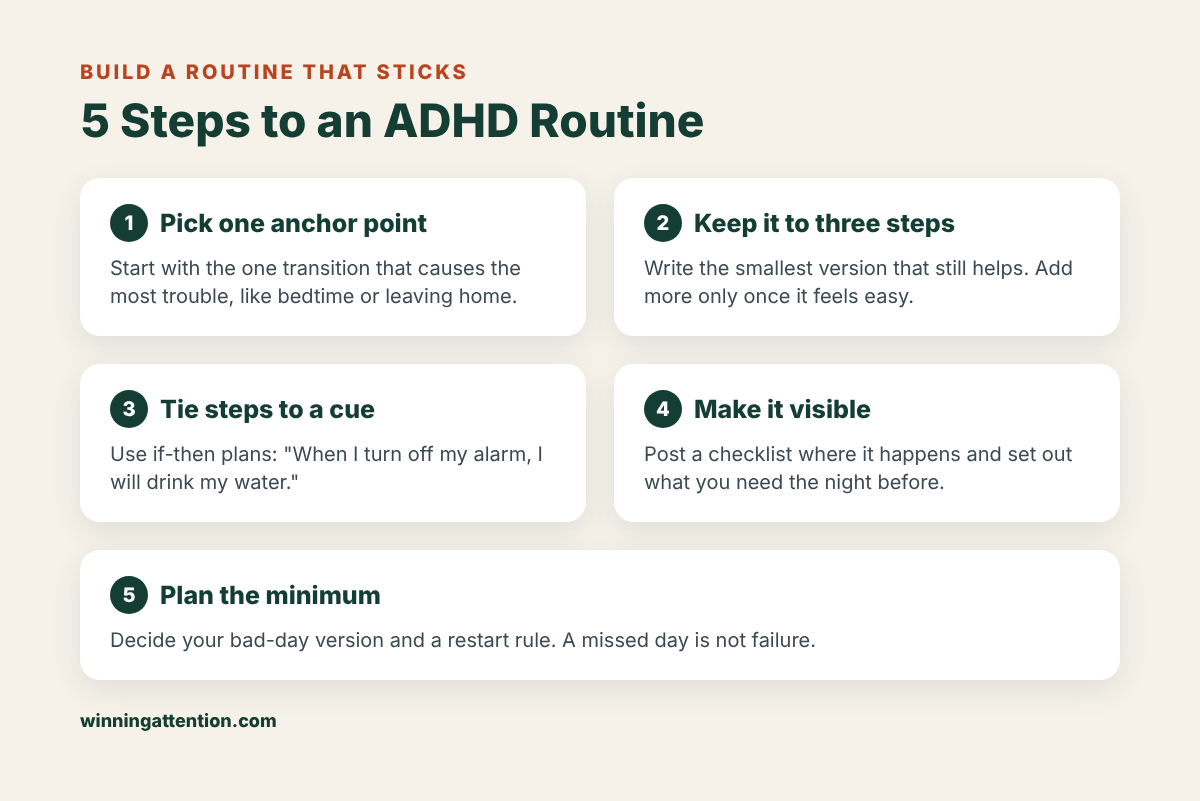
How to build an ADHD routine in 5 steps
You can use this method to build any ADHD routine: a morning routine, a start-of-work routine, an end-of-day shutdown or a bedtime routine. Build one at a time. Once the first one feels mostly automatic, add the next.
Step 1: Pick one anchor point in your day
Do not try to fix your whole day at once. Choose the one transition that causes the most trouble. For many adults with ADHD, that is getting out the door in the morning, starting work, or going to bed on time. That single transition is where your first routine goes.
Ask yourself: “If one part of my day ran smoothly, which part would make the rest easier?” Often the honest answer is bedtime, because a late night ruins the next morning, and a ruined morning drags down the whole day.
Step 2: Keep it to three steps
Write the smallest version of the routine that would still make a difference. Three steps is a good starting limit. You can always add more later, but a long routine that collapses on day four teaches you nothing except that routines do not work.
Example: a three-step morning routine
- Drink a glass of water (it is already on the nightstand).
- Get dressed in the clothes laid out the night before.
- Check the “launch pad” by the door: keys, wallet, phone, bag.
Notice what is not on the list: journaling, meditation, a 5 km run, cooking a perfect breakfast. Those can come later, if you want them. The first goal is a routine that happens.
Step 3: Tie each step to a cue you already have
Routines need a trigger. The most reliable triggers are things you already do every day without thinking: turning off your alarm, starting the coffee maker, brushing your teeth, sitting down at your desk, closing your laptop. Link the new step to one of these with an if-then plan.
Examples of ADHD-friendly if-then cues
- “When I turn off my alarm, I will drink the water on my nightstand.”
- “When the coffee maker starts, I will fill my water bottle and check today’s calendar.”
- “When I sit down at my desk, I will open my daily plan before I open email.”
- “When I close my laptop for the day, I will write tomorrow’s first task on a sticky note.”
- “When I brush my teeth at night, I will plug my phone in outside the bedroom.”
Some people call this “habit stacking.” The idea is the same: the existing habit becomes the cue, so you do not have to remember the new step on your own.
Step 4: Make the routine visible and ready
If a routine depends on memory, it will fail on your worst days, which are exactly the days you need it most. Put the routine where you will see it at the moment you need it, and set up the tools in advance.
- A checklist at the point of action. Tape the morning routine to the bathroom mirror, the shutdown routine next to your monitor, the bedtime routine by the light switch.
- A launch pad. One spot by the door for keys, wallet, bag, badge and anything you need tomorrow.
- Prepared materials. Clothes laid out, gym bag packed, lunch in the fridge, water glass filled.
- External time cues. A visible clock, an alarm labeled with the next step (“Leave in 10 minutes”), or a playlist that ends when it is time to go.
Step 5: Decide your minimum version and restart rule
This is the step most routine advice skips, and it is the one that matters most with ADHD. Before you start, decide two things:
- Your minimum version. On a bad day, what is the one step you will still do? Maybe it is just “water and launch pad” in the morning, or just “phone outside the bedroom” at night. Doing the minimum keeps the cue-and-action link alive.
- Your restart rule. When (not if) the routine breaks, how will you restart? For example: “If I miss two days in a row, I restart the next morning with the minimum version, no catching up.” Remember that in the habit research, a single missed opportunity did not materially affect habit formation.
Then give your ADHD routine time. Check in once a week: which step keeps getting skipped? Is it too big, badly timed, or missing a cue? Adjust one thing at a time.
How to create an ADHD-friendly morning routine
An ADHD morning routine has one job: get you from asleep to out the door (or to your desk) without a crisis. It is not a self-improvement program. Keep these principles in mind:
- Move decisions to the night before. Clothes, bag, lunch and tomorrow’s first task are all easier to decide at 9 p.m. than at 7 a.m.
- Remove the phone from the first 15 minutes. Checking messages in bed is one of the fastest ways to lose half an hour without noticing.
- Use a “leave by” alarm, not just a wake-up alarm. Set an alarm for ten minutes before you need to leave, labeled “Shoes, keys, go.”
- Add movement if it fits. A short walk, a few minutes of stretching or cycling to work can double as transport and, based on early research, may help with focus for a while afterward.
- Be realistic about your body clock. If you are a strong night owl, an extremely early routine may be fighting your biology. Where you have flexibility, shift important tasks later rather than forcing a 5 a.m. start.
An ADHD routine for the workday
Work routines are less about time slots and more about transitions: starting, switching and stopping. Two short routines do most of the heavy lifting.
A start-of-work routine (5 to 10 minutes)
Before you open email or messages, look at your list and choose one task that would make the day a win, then set a timer for your first focus sprint. Our guide on how to plan your day with ADHD walks through a ten-minute version of this step by step.
A shutdown routine (5 minutes)
At the end of the day, tick off what got done, move unfinished tasks to tomorrow’s list, write the first step of tomorrow’s main task on a sticky note, and close everything. This parks open tasks on paper instead of letting them follow you into the evening, and it gives tomorrow morning a ready-made starting point.
How to create an ADHD-friendly bedtime routine
If you only build one ADHD routine, an ADHD bedtime routine is often the best choice, because sleep affects attention, mood and how hard the next morning will feel. Given how common later body clocks and insomnia are in adults with ADHD, this routine may need more support than the others.
Set a “wind-down” alarm, not just a bedtime
Bedtime itself is easy to blow past when you are absorbed in something. Instead, set an alarm 45 to 60 minutes before you want to be asleep. That alarm is the cue for the routine to start, not for you to be in bed already.
Keep the routine short and calming
Three steps is enough. For example: plug the phone in outside the bedroom, set out tomorrow’s clothes, then read something low-stakes on paper. Dim the lights in your living space when the wind-down alarm goes off.
Keep wake-up time steady
A consistent wake time, including on weekends where possible, helps anchor your body clock. Sleeping in very late on Saturday and Sunday can make Monday feel like jet lag.
Watch for hyperfocus traps
Games, videos and late-night projects can pull you into hyperfocus right when you should be winding down. If you know a particular activity regularly steals your sleep, give it a firm end time earlier in the evening or move it to another part of the day.
If you have tried a steady bedtime routine for several weeks and still cannot fall asleep or stay asleep, talk to a clinician. Sleep problems in ADHD are common and treatable, and they can also be affected by medication timing, which is something only your prescriber should adjust.
Sample ADHD routine for a full workday
Here is what a full day of light routines might look like for an adult with a standard work schedule. The times are examples; shift them to fit your own sleep window and energy pattern.
| Time | Routine | Steps |
|---|---|---|
| 7:15 | Wake-up | Water from the nightstand, get dressed in the clothes laid out, open the curtains |
| 7:45 | Out the door | “Leave in 10 minutes” alarm, check the launch pad, go |
| 9:00 | Start of work | Open the daily plan before email, pick one task, start a timer |
| 12:30 | Midday reset | Lunch away from the screen, a 10-minute walk, refill water |
| 17:00 | Shutdown | Tick off done tasks, move the rest, write tomorrow’s first step, close everything |
| 21:30 | Wind-down alarm | Phone charging outside the bedroom, set out tomorrow’s clothes, dim lights |
| 22:30 | Bed | Read on paper until sleepy |
You do not need this whole ADHD routine at once. Pick the one row that would make the biggest difference and start there.
Putting it together: one routine, four weeks
Here is how building an ADHD routine might look for a fictional example: Priya, a nurse with ADHD who works day shifts and is late at least twice a week.
- Anchor point (week 1). Priya realizes her mornings fall apart because she goes to bed after 1:00 a.m. scrolling her phone. She decides her first routine will be at bedtime, not in the morning.
- Three steps. She writes: phone on the kitchen charger, uniform and badge on the chair, lights off by 11:30.
- Cues. “When my 10:45 alarm goes off, I will plug my phone in in the kitchen.” “When I brush my teeth, I will put my uniform on the chair.”
- Visible and ready. She labels the alarm “Phone to kitchen” and sticks the three steps on the bathroom mirror. She moves an old alarm clock into the bedroom so the phone is not needed there.
- Minimum version and restart. On bad nights, the minimum is “phone in the kitchen.” Her restart rule: if she misses two nights, she starts again with the minimum the next night.
In week two, Priya misses three nights after a stressful shift. In the past, that would have been the end of the routine. This time she uses the restart rule and does just the minimum for a few days. By week four, the phone goes to the kitchen most nights without much thought, and she has only been late once. Her mornings are still not perfect, but the next routine she builds, a three-step launch pad by the door, now has a better night’s sleep behind it.
Why ADHD routines fall apart, and how to restart
Even well-designed routines break. Vacations, illness, new jobs, a new baby or a stressful week can knock any routine off course. A few patterns make restarting easier:
- Restart small. Go back to the minimum version, not the full routine you had at your best.
- Look for the broken cue. Often the routine failed because the trigger changed. A new commute or a new shift pattern means the old “when X, then Y” no longer fires. Pick a new cue.
- Refresh the novelty. A new checklist design, a different playlist or a new place for the launch pad can make an old routine feel interesting again without changing its core.
- Do not catch up. There is no backlog of missed routine days to make up. Today is the only day that counts.
If a routine collapse leaves you feeling buried under everything you have not done, our guide to ADHD overwhelm has a short reset for that moment.
Common mistakes to avoid
- Copying someone else’s routine. Your ADHD routine should fit your life. A famous person’s 5 a.m. routine was not built for your body clock, your job or your brain. Start from your own trouble spots.
- Building everything at once. A morning, work and bedtime routine all launched on the same Monday is a recipe for a crash by Thursday. One at a time.
- Too many steps. Every extra step is another chance to get stuck. Start with three.
- Relying on memory. If the routine is not written down where you will see it, it will quietly disappear.
- All-or-nothing thinking. Doing one step of the routine is far better than doing none. The minimum version keeps the habit alive.
- Giving up after three weeks. Habit formation can take months. Effort at week three is normal, not a sign of failure.
If you want a simple starting point, the free ADHD Daily Planner Starter Kit includes a one-page daily planner, a weekly energy tracker you can use to spot your best and worst times of day, and a 2-minute reset card.
When to talk to a professional
Routines can make daily life smoother, but they are not a treatment for ADHD on their own. Talk to a doctor, psychologist or other qualified clinician if, despite a steady ADHD routine, disorganization or lateness is affecting your job, relationships, finances or health, if you have ongoing trouble falling or staying asleep, or if you notice low mood or anxiety. Sleep problems and ADHD often go together, and both can be assessed and treated. Evidence-based options include medication, CBT and skills programs like those described above, and many people benefit from a combination.
Frequently asked questions
Are people with ADHD routine-oriented?
Usually not by nature. Many adults with ADHD are drawn to novelty and find repetition boring, which is why routines often fade after a few days. But the areas ADHD makes hardest, such as remembering, planning and starting on time, are exactly where a simple routine can help the most.
Do routines help with ADHD?
For many adults, yes. Structured skills programs for adult ADHD, which teach organization and planning routines, have shown benefits in randomized trials and meta-analyses. Routines work best when they are short, tied to an existing habit and written down where you can see them.
How do you build a routine with ADHD?
Pick one trouble spot in your day, keep the routine to about three steps, and tie each step to something you already do with an if-then plan. Make the routine visible with a checklist and prepared materials, and decide in advance on a minimum version and a restart rule for bad days.
How do you create an ADHD-friendly morning routine?
Move decisions to the night before, keep the routine to a few steps, and keep your phone out of the first 15 minutes. Use a labeled “leave by” alarm and a launch pad by the door for keys, wallet and bag. If you are a night owl, avoid building the routine around an extremely early start.
How do you create an ADHD-friendly bedtime routine?
Set a wind-down alarm 45 to 60 minutes before you want to be asleep, then follow two or three calming steps, such as charging your phone outside the bedroom and reading on paper. Keep your wake-up time steady, including weekends where possible. If sleep problems continue, talk to a clinician.
Why do routines fall apart with ADHD?
Common reasons include routines that are too long to hold in working memory, missing cues, boredom once the novelty wears off, a later body clock, and all-or-nothing thinking after a missed day. Habits can take months to form, and one missed day does not undo your progress, so restarting small is part of the process.
Sources
- Safren SA, Sprich S, Mimiaga MJ, et al. Cognitive behavioral therapy vs relaxation with educational support for medication-treated adults with ADHD and persistent symptoms: a randomized controlled trial. JAMA. 2010;304(8):875–880. PubMed
- Knouse LE, Teller J, Brooks MA. Meta-analysis of cognitive-behavioral treatments for adult ADHD. Journal of Consulting and Clinical Psychology. 2017;85(7):737–750. PubMed
- Lally P, van Jaarsveld CHM, Potts HWW, Wardle J. How are habits formed: modelling habit formation in the real world. European Journal of Social Psychology. 2010;40(6):998–1009. DOI
- Coogan AN, McGowan NM. A systematic review of circadian function, chronotype and chronotherapy in attention deficit hyperactivity disorder. ADHD Attention Deficit and Hyperactivity Disorders. 2017;9(3):129–147. PubMed
- Bijlenga D, Vollebregt MA, Kooij JJS, Arns M. The role of the circadian system in the etiology and pathophysiology of ADHD: time to redefine ADHD? ADHD Attention Deficit and Hyperactivity Disorders. 2019;11(1):5–19. PubMed
- Wynchank D, Bijlenga D, Beekman AT, Kooij JJS, Penninx BW. Adult attention-deficit/hyperactivity disorder (ADHD) and insomnia: an update of the literature. Current Psychiatry Reports. 2017;19(12):98. PubMed
- Gollwitzer PM, Sheeran P. Implementation intentions and goal achievement: a meta-analysis of effects and processes. Advances in Experimental Social Psychology. 2006;38:69–119. DOI
- Xu S, Zhao C, Hu L. The effects of acute and chronic exercise on executive functions and core symptoms in adults with ADHD: a systematic review and meta-analysis. Psychology of Sport and Exercise. 2026;84:103088. PubMed
Turn this into a daily plan
Get the free ADHD Daily Planner Starter Kit: a one-page daily planner, a weekly energy tracker and a 2-minute reset card.