If you have ADHD, you have probably tried a dozen planners, apps and color-coded systems. Most of them work for a week. Then the planner ends up in a drawer, the app sends notifications you swipe away, and the day runs you instead of the other way around.
That pattern is not a lack of willpower. Research on adult ADHD points to specific reasons why ordinary planning advice breaks down, and to specific methods that hold up better. This guide walks through both: why daily planning is harder with ADHD, what clinical studies say actually helps, and a simple five-step method you can use tomorrow morning.
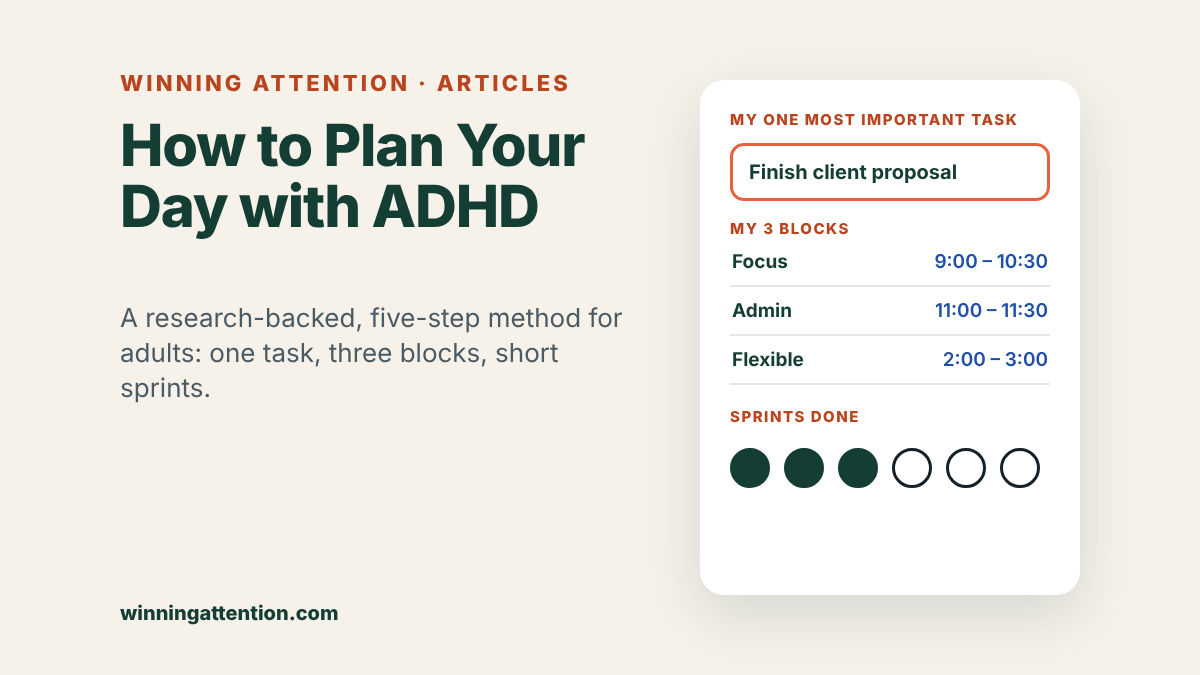
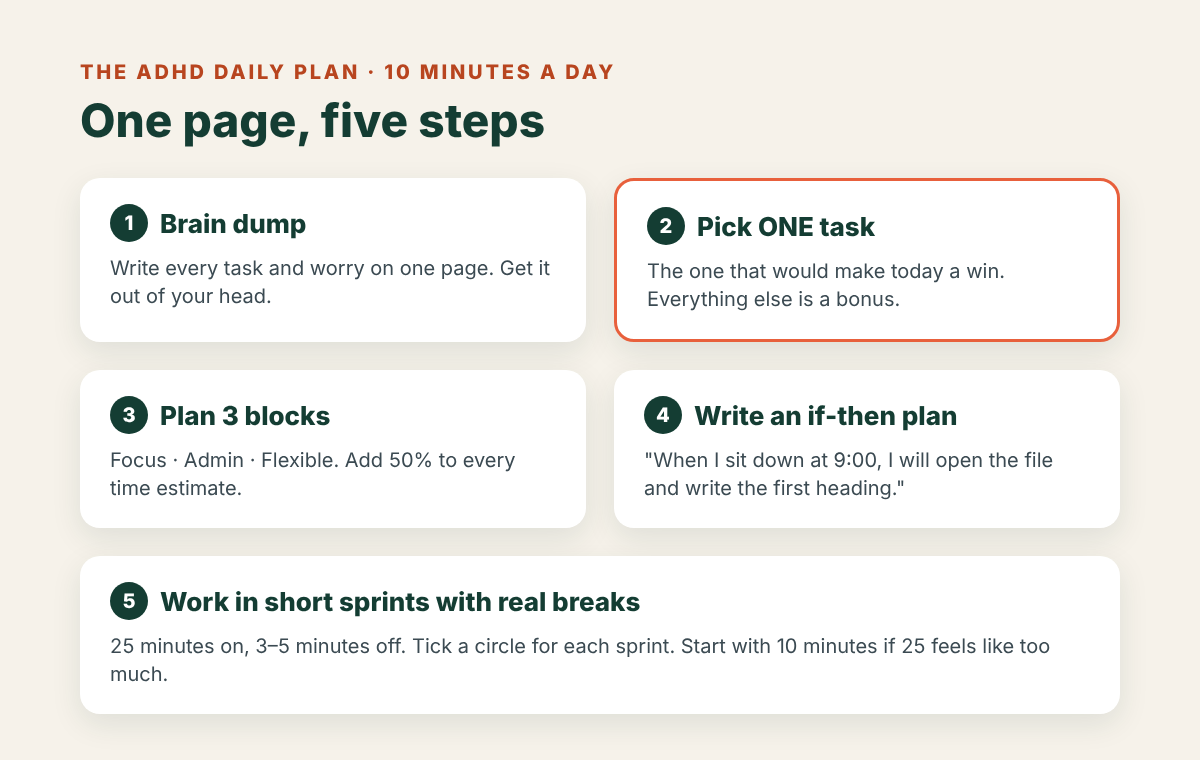
The short version: plan less, but plan visibly. Write everything down once, choose one task that would make the day a win, group the rest into three blocks, turn the hardest step into an if-then plan, and work in short sprints with real breaks.
Why planning your day is harder with ADHD
ADHD is common in adults. A 2021 global meta-analysis estimated that about 2.6% of adults have persistent ADHD that began in childhood, and about 6.8% have significant ADHD symptoms regardless of when they started (Song et al., 2021). For many of them, the hardest part of daily life is not doing tasks. It is deciding what to do, when, and then actually starting.
Time feels different
People with ADHD tend to judge time less accurately. A 2024 meta-analysis that pooled 824 effect sizes found a moderate-to-large difference in time perception between people with and without ADHD (Hedges’ g = 0.69), and the difference was present across the lifespan (Metcalfe et al., 2024). In everyday terms, “this will take ten minutes” may really take forty, and an appointment three hours away can feel either impossibly far or suddenly urgent.
This is often called time blindness. It explains why a plan built on hopeful estimates collapses by mid-morning, and why buffers and visible timers matter more than a perfect schedule.
“Now” and “not now”
Psychologist Russell Barkley’s influential model describes ADHD as, at its core, a problem with self-regulation over time: holding a future goal in mind strongly enough to guide what you do right now (Barkley, 1997). When the deadline is far away, the task barely registers. When it is close, it takes over. Many adults with ADHD describe their week as two settings: “not now” and “panic.”
A good daily plan works with this. It brings future goals into the present as small, concrete, visible steps, so they compete with whatever is in front of you.
The invisible to-do list
Working memory, the mental notepad that holds information while you use it, is often stretched thin in ADHD. If your plan lives in your head, it competes with every email, message and passing thought. Tasks that are not written down tend to vanish or, worse, keep looping in the background and drain attention.
What the research says actually helps
The strongest evidence for non-medication strategies in adult ADHD comes from structured skills programs that teach time management, organization and planning, usually as part of cognitive-behavioral therapy (CBT).
- CBT for adults already on medication. In a randomized trial of 86 adults who still had significant symptoms despite medication, 12 sessions of CBT focused on organization, planning and managing distractibility led to better outcomes than an attention-matched relaxation program. On one clinician rating, 67% responded to CBT versus 33% in the comparison group (Safren et al., 2010).
- Meta-cognitive therapy. A 12-week group program built specifically around time management, organization and planning improved inattention symptoms more than supportive therapy in 88 adults with ADHD (Solanto et al., 2010).
- The bigger picture. A meta-analysis of 32 studies of CBT for adult ADHD found small-to-medium benefits compared with control groups for symptoms (g = 0.65) and daily functioning (g = 0.51) (Knouse et al., 2017).
These programs share a few ingredients: one central place to capture tasks, a daily planning routine, breaking big tasks into small steps, scheduling tasks rather than just listing them, and practicing the routine until it becomes automatic. The method below is built from those ingredients. It is a self-help structure, not a substitute for treatment.
A 5-step daily planning method built for ADHD brains
The whole routine takes about ten minutes. Do it at the same time every day, either the evening before or first thing in the morning before you open email.
Step 1: Brain dump everything, once
Write down every task, worry and loose end on one page or one note. Do not sort yet. The goal is to get things out of your head and into one trusted place.
There is a good reason this helps. In a series of experiments, unfinished goals kept intruding on people’s thoughts and hurt their performance on other tasks, but simply making a specific plan for the goal removed most of that interference, even before the goal was done (Masicampo & Baumeister, 2011). Writing it down and deciding when you will deal with it frees attention for what you are doing now.
Step 2: Choose ONE task that would make today a win
Look at the list and ask: if only one thing gets done today, which one would make the biggest difference? Write it at the top of the page. Everything else is a bonus.
This works because long lists invite either paralysis (“where do I even start?”) or easy-task hopping, where you tick off ten small items and avoid the one that matters. One clear priority gives your brain a single target and makes the day feel winnable.
How to choose when everything feels urgent
- Pick the task with a real consequence if it slips (a deadline, a person waiting, money).
- If two tie, pick the one you have been avoiding longest; it is probably costing you the most mental energy.
- If it is too big for one day, the “one task” becomes the next concrete chunk of it.
Step 3: Plan three blocks, not twelve tasks
Instead of scheduling every item, divide your day into three blocks:
- Focus block (60–90 minutes): your one important task, at the time of day you usually have the most energy.
- Admin block (30–45 minutes): email, calls, forms, quick replies, all batched together.
- Flexible block (60 minutes or more): whatever came up, overflow, or smaller tasks from the list.
Three blocks are easier to hold in mind than a minute-by-minute schedule, and they leave room for the fact that, with time blindness, your estimates will sometimes be off. A useful rule of thumb is to add 50% to any time estimate and leave white space between blocks.
Step 4: Turn the hardest step into an if-then plan
Vague intentions (“work on the proposal”) are easy to postpone. Specific if-then plans, called implementation intentions, are harder to ignore: “When I sit down at my desk at 9:00, I will open the proposal file and write the first heading.”
A meta-analysis of 94 studies found that forming implementation intentions had a medium-to-large effect on reaching goals (d = 0.65) compared with simply setting the goal (Gollwitzer & Sheeran, 2006). The plan links a specific cue (a time, a place, an action you already do) to a specific first step, so starting becomes less of a decision.
Examples of ADHD-friendly if-then plans
- “When I finish my coffee, I will set a 25-minute timer and open the report.”
- “If I notice I am scrolling, I will stand up, drink water and return to the one task.”
- “When the admin block starts at 13:00, I will reply to the three oldest emails first.”
Step 5: Work in short sprints with real breaks
Set a timer for a short sprint, often 25 minutes, then take a real break of 3–5 minutes away from the screen. Track sprints by ticking off circles on your page. Seeing three completed sprints is a concrete, motivating record of progress.
Breaks are not a reward for being productive; they help you stay productive. In a study of a long, boring attention task, people who briefly switched away from the task twice did not show the usual drop in performance over time, while those who worked without a break did (Ariga & Lleras, 2011). The study was not about ADHD, but it supports a simple idea: planned, short breaks protect focus better than pushing through.
Sprint length is personal. If 25 minutes feels impossible, start with 10. If you regularly hyperfocus, use the timer to make sure you also stop, eat and move.
Putting it together: one morning, step by step
Here is what the method looks like in practice for a fictional example: Dana, a freelance designer with ADHD, sitting down at 8:30 on a Monday.
- Brain dump (4 minutes). Dana writes: finish client proposal, reply to 23 emails, book dentist, fix website bug, laundry, call the bank, plan next week, update invoice spreadsheet, buy a birthday gift. Seeing it all on paper is uncomfortable, but it stops the list from circling in her head.
- One task (1 minute). The client proposal is due Wednesday and pays the rent. It goes at the top: “If only this gets done, today is a win.”
- Three blocks (2 minutes). Focus 9:00–10:30 for the proposal. Admin 11:00–11:30 for email, the bank and the dentist. Flexible 14:00–15:00 for the website bug or the spreadsheet, whichever feels doable.
- If-then plan (1 minute). “When I sit down at 9:00, I will open the proposal file and write the three section headings.” The first step is so small that it is hard to argue with.
- Sprints. Dana sets a 25-minute timer, works, takes a 4-minute break to refill water, and ticks a circle. After three sprints the proposal has a full draft.
Laundry, the gift and planning next week did not get a slot. They stay on the list for the flexible block or tomorrow. That is fine: the day was built around the one task that mattered, and it moved forward.
How to structure your work day with ADHD: a sample schedule
Here is how the method might look for an adult working a standard day. Adjust the times to your own energy pattern; many people with ADHD focus best late morning or in the evening.
| Time | Block | What happens |
|---|---|---|
| 8:30–8:40 | Planning | Brain dump, choose one task, set three blocks, write one if-then plan |
| 9:00–10:30 | Focus | The one important task, in 25-minute sprints with short breaks |
| 10:30–11:00 | Buffer | Break, movement, overflow from the focus block |
| 11:00–11:45 | Admin | Email, calls, messages, forms, batched together |
| 12:00–13:00 | Lunch | A real break away from screens |
| 13:00–15:00 | Flexible | Meetings, smaller tasks, whatever came up |
| 16:30–16:40 | Shutdown | Tick off what is done, move the rest to tomorrow’s list |
The short shutdown routine at the end matters. It closes open loops, so unfinished tasks are parked on paper instead of following you into the evening.
How to get things done with ADHD when you cannot start
Sometimes the plan is clear and you still cannot begin. This is often called task paralysis, and it is common with ADHD, especially for tasks that are boring, unclear or emotionally loaded.
- Shrink the first step until it feels almost silly. Not “write the report” but “open the file and type the title.” Starting is the hardest part; momentum usually follows.
- Make the task concrete. Vague tasks (“sort out finances”) stall. Rewrite them as a visible action (“download last month’s bank statement”).
- Lower the bar for the first sprint. Tell yourself you only need to work for ten minutes. You are allowed to stop after that, and often you will not want to.
- Change the setting. A different room, a café, or working alongside another person can make starting easier for many people with ADHD.
- Use a 2-minute reset when you get stuck. Stand up, breathe, drink water, close everything that is not your one task, then ask: “what is the smallest next step?”
How to be organized with ADHD: make time and tasks visible
Because time and future goals feel abstract with ADHD, the most reliable tools are the ones that make them visible at the moment you need them.
- One capture place. Choose one notebook or one app for all tasks. Two systems means half your tasks are always in the other one.
- A visible clock or timer. An analog clock or a visual countdown timer on the desk makes the passing of time easier to feel.
- Calendar for appointments, plan for tasks. Put fixed commitments with alarms in a calendar. Keep your daily plan for tasks. Mixing both in one long list hides what is truly time-bound.
- External reminders at the point of action. A sticky note on the laptop, a phone alarm labeled with the first step, keys by the door. Reminders work best where the action happens.
- A weekly reset. Once a week, empty bags, inboxes and notes into your capture place and look at the week ahead. Fifteen minutes prevents a lot of Monday chaos.
How to use a planner with ADHD (and actually keep using it)
Most planners fail people with ADHD for predictable reasons: they ask for too much, they look like homework, and missing a few days makes the whole thing feel ruined. A few adjustments help:
- Use one page per day, with very few fields. One task, three blocks, a sprint tracker, and space for a brain dump is enough.
- Keep it where you will see it. Open on the desk, not in a bag. Out of sight really is out of mind.
- Attach planning to something you already do. “When I make my first coffee, I fill in the page.” Linking a new habit to an existing routine is easier than relying on memory.
- Expect gaps and restart without guilt. Missing three days does not mean the system failed. Start again with today’s page; do not try to catch up on the old ones.
- Review weekly, not perfectly. Notice which blocks worked and which estimates were off, then adjust next week’s plan.
If you want a ready-made version of this page, the free ADHD Daily Planner Starter Kit includes a one-page daily planner, a weekly energy tracker and a 2-minute reset card.
Common mistakes to avoid
- Planning every minute. A packed schedule breaks at the first delay. Plan blocks and leave buffers.
- Treating the to-do list as the plan. A list says what; a plan says when and in what order. You need both.
- Starting the day in your inbox. Email sets other people’s priorities. Plan first, then open messages in the admin block.
- Changing systems every week. New apps feel exciting, which is part of the trap. Give one simple system at least three weeks.
- Judging the day by the list. If the one important task moved forward, the day was a win, even if the rest of the list did not.
When to talk to a professional
Planning strategies help many adults, but they are not a treatment for ADHD on their own. If disorganization is affecting your job, relationships, finances or health, or if you are struggling with low mood or anxiety, talk to a doctor, psychologist or other qualified clinician. Evidence-based options include medication, CBT and skills programs like those described above, and many people benefit from a combination.
Frequently asked questions
How do you plan your day when you have ADHD?
Keep the plan short and visible. Brain dump everything onto one page, choose one task that would make the day a win, group the rest into three blocks (focus, admin, flexible), write one if-then plan for the hardest step, and work in short timed sprints with breaks. Do it at the same time every day.
Why is time management so hard with ADHD?
Research shows that people with ADHD tend to perceive time less accurately, and influential theories describe ADHD as a difficulty holding future goals in mind strongly enough to guide behavior now. Working memory limits also make it easy to lose track of tasks that are not written down.
Do routines help with ADHD?
Many adults find that consistent routines reduce the number of decisions they have to make each day, which saves energy for important work. Routines tend to stick better when they are simple, tied to an existing habit and written down where you can see them.
What is the best planner for adults with ADHD?
The best planner is the simplest one you will actually use. Look for one page per day, room for a single priority, a few time blocks and a way to track short work sessions. Paper works well for many people because it stays visible; apps work if you keep notifications focused.
How long should a work sprint be with ADHD?
There is no single right length. Many people start with 25 minutes followed by a 3–5 minute break. If that feels too long, start with 10 minutes and build up. If you tend to hyperfocus, use a timer to make sure you also take breaks.
Can planning replace ADHD treatment?
No. Planning skills can make daily life easier, and structured skills-based therapy has research support, but they are not a substitute for professional assessment and treatment. Talk to a qualified clinician about what is right for you.
Sources
- Song P, Zha M, Yang Q, et al. The prevalence of adult attention-deficit hyperactivity disorder: a global systematic review and meta-analysis. Journal of Global Health. 2021;11:04009. PubMed
- Metcalfe KB, McFeaters CD, Voyer D. Time-perception deficits in attention-deficit/hyperactivity disorder: a systematic review and meta-analysis. Developmental Neuropsychology. 2024;49(1):1–24. PubMed
- Barkley RA. Behavioral inhibition, sustained attention, and executive functions: constructing a unifying theory of ADHD. Psychological Bulletin. 1997;121(1):65–94. PubMed
- Safren SA, Sprich S, Mimiaga MJ, et al. Cognitive behavioral therapy vs relaxation with educational support for medication-treated adults with ADHD and persistent symptoms: a randomized controlled trial. JAMA. 2010;304(8):875–880. PubMed
- Solanto MV, Marks DJ, Wasserstein J, et al. Efficacy of meta-cognitive therapy for adult ADHD. American Journal of Psychiatry. 2010;167(8):958–968. PubMed
- Knouse LE, Teller J, Brooks MA. Meta-analysis of cognitive-behavioral treatments for adult ADHD. Journal of Consulting and Clinical Psychology. 2017;85(7):737–750. PubMed
- Masicampo EJ, Baumeister RF. Consider it done! Plan making can eliminate the cognitive effects of unfulfilled goals. Journal of Personality and Social Psychology. 2011;101(4):667–683. PubMed
- Gollwitzer PM, Sheeran P. Implementation intentions and goal achievement: a meta-analysis of effects and processes. Advances in Experimental Social Psychology. 2006;38:69–119. DOI
- Ariga A, Lleras A. Brief and rare mental “breaks” keep you focused: deactivation and reactivation of task goals preempt vigilance decrements. Cognition. 2011;118(3):439–443. PubMed
Turn this into a daily plan
Get the free ADHD Daily Planner Starter Kit: a one-page daily planner, a weekly energy tracker and a 2-minute reset card.