Winning Attention ADHD

Category: ADHD Planning & Productivity

Research-based guides for adults with ADHD on planning, time management and focus.

  • ADHD Productivity at Work: Research-Backed Tips for Adults

    ADHD Productivity at Work: Research-Backed Tips for Adults

    You know you are capable. You have had days where you solved in two hours a problem that had stalled your whole team for a week. And then there are the other days: forty browser tabs, a half-written email, a meeting you forgot, and a sinking feeling at 4 p.m. that nothing important got done. If that swing sounds familiar, ADHD productivity at work is probably less about effort and more about how your workday is built.

    This guide looks at what research says about ADHD at work, why ordinary productivity advice often misses the mark, and what tends to help instead. You will find a five-step daily system, a sample schedule, practical ADHD tips for the workplace, and a plain-language look at disclosure and accommodations.

    The short version: stop relying on memory and willpower. Start each workday with a 10-minute launch routine before you open email, protect one focus block for your most important task, catch interruptions on a single note instead of acting on them, work in short sprints with deliberate breaks, and close the day with a five-minute shutdown that parks tomorrow’s first step on paper.

    Why ADHD productivity at work is so hard

    ADHD is not a problem of laziness or intelligence. It affects the self-management skills that most office jobs, and ADHD productivity in general, quietly depend on: starting tasks, holding priorities in mind, estimating time, and steering attention back after a distraction. Work is full of exactly those demands, which is why so many adults first notice their symptoms most clearly on the job.

    What large studies say about ADHD and work

    The scale of the issue is bigger than many people realize. A World Health Organization survey of 7,075 workers aged 18 to 44 in 10 countries estimated that an average of 3.5% of workers met criteria for adult ADHD. Compared with otherwise similar coworkers, workers with ADHD lost about 22 extra days of role performance per year, and the effect did not differ by occupation, education, age or gender. Only a small minority of those workers had ever been treated for ADHD (de Graaf et al., 2008).

    A review of research on occupational health came to a similar conclusion. Adults with ADHD had higher rates of unemployment, and those who were employed reported more workplace impairment and reduced productivity, along with issues such as irritability and low frustration tolerance. The review also noted a higher risk of accidents and injuries, and a substantial economic cost from absenteeism and lost productivity (Küpper et al., 2012).

    Those numbers describe averages, not destinies, and they say nothing about your individual ADHD productivity ceiling. They are useful mainly because they make one thing clear: if work feels harder for you than it seems to be for others, you are not imagining it, and it is worth building a system around the problem instead of blaming yourself for it.

    The gap between what you can do and what gets done

    One of the most telling findings comes from a study that compared 1,231 adults from the community with 134 adults diagnosed with ADHD at an outpatient clinic. People with ADHD reported work problems especially in not meeting their own standards and perceived potential. Those problems showed up less often as poor performance reviews or job loss. Symptoms of inattention were strongly linked to work problems, while scores on lab tests of attention and executive function did not meaningfully predict how people functioned at work (Fuermaier et al., 2021).

    In other words, many adults with ADHD keep their jobs and even do well on paper, but at a high personal cost: late nights catching up, constant self-criticism, and the sense of always running behind their own ability. Improving ADHD productivity is often less about pleasing a manager and more about closing that painful gap.

    Interruptions cost more than they seem

    Modern workplaces are built on interruptions: chat pings, email alerts, quick questions, and meetings scattered across the day. A well-known experiment on office work found that when people were interrupted, they compensated by working faster, but they paid for it with more stress, frustration, time pressure and effort (Mark et al., 2008). That study was not about ADHD, but the pattern matters even more if returning to a task after a distraction is already hard for you.

    With ADHD, an interruption does not just pause the task. It can erase the mental thread entirely. You come back to the document and have to rebuild where you were, what you were about to write, and why it mattered. Ten small interruptions can quietly eat a whole morning.

    Support at work is still patchy

    Research on how to support adults with ADHD in the workplace is surprisingly thin. A systematic review that synthesized 143 studies found that most of them tested medication, and very few examined interventions designed for the work context itself. The psychosocial approaches that did show promise shared a few ingredients: group-based support, involving people from the person’s own network, and a good working relationship with the professional. The authors also flagged disclosure and self-awareness as barriers to getting support at all (Lauder et al., 2022).

    An international consensus statement by clinicians, occupational health specialists and disability advisors reached a similar view: occupational health services were often treated as a last resort rather than a way to make positive workplace changes, and professionals rarely worked together on employment issues for adults with ADHD (Adamou et al., 2013). Until that changes, much of the practical work of building an ADHD-friendly workday falls to you.

    What the research says improves ADHD productivity

    The strongest non-medication evidence for adults comes from structured skills programs, usually delivered as cognitive-behavioral therapy (CBT). These programs do not try to make you “try harder” or treat ADHD productivity as a character issue. They teach concrete systems for organization, planning and handling distraction, then help you practice them until they become routine.

    • CBT alongside medication. In a randomized trial of 86 adults who still had significant ADHD symptoms despite medication, 12 sessions of CBT led to greater improvement than an attention-matched program of relaxation with educational support. On the ADHD rating scale, 67% responded to CBT versus 33% in the comparison group, and responders kept their gains at 6 and 12 months (Safren et al., 2010).
    • The broader evidence. A meta-analysis of 32 studies found that CBT for adult ADHD had small-to-medium effects compared with control groups on both symptoms (g = 0.65) and everyday functioning (g = 0.51). Studies with active control groups showed smaller effects, which is a useful reminder that these are real but modest gains, not miracles (Knouse et al., 2017).
    • Parking unfinished tasks. In a series of experiments, unfinished goals kept intruding on people’s thoughts and hurt their performance on unrelated tasks. Simply making a specific plan for when and how to deal with the goal removed those effects (Masicampo & Baumeister, 2011). The participants did not have ADHD, but the finding supports writing tasks down with a clear next step instead of carrying them in your head.
    • Short breaks protect focus. In a study of a long, monotonous attention task, people who briefly switched their attention to a different goal a couple of times did not show the usual decline in performance over time, while those who stayed on the task without a break did (Ariga & Lleras, 2011). Again, this was not an ADHD sample, but it supports planned breaks over “pushing through.”

    The method below borrows from these ingredients: one capture place, a daily planning routine, protected time for important work, deliberate breaks and an end-of-day shutdown. It is a self-help structure that can sit alongside professional care. It is not a replacement for assessment or treatment.
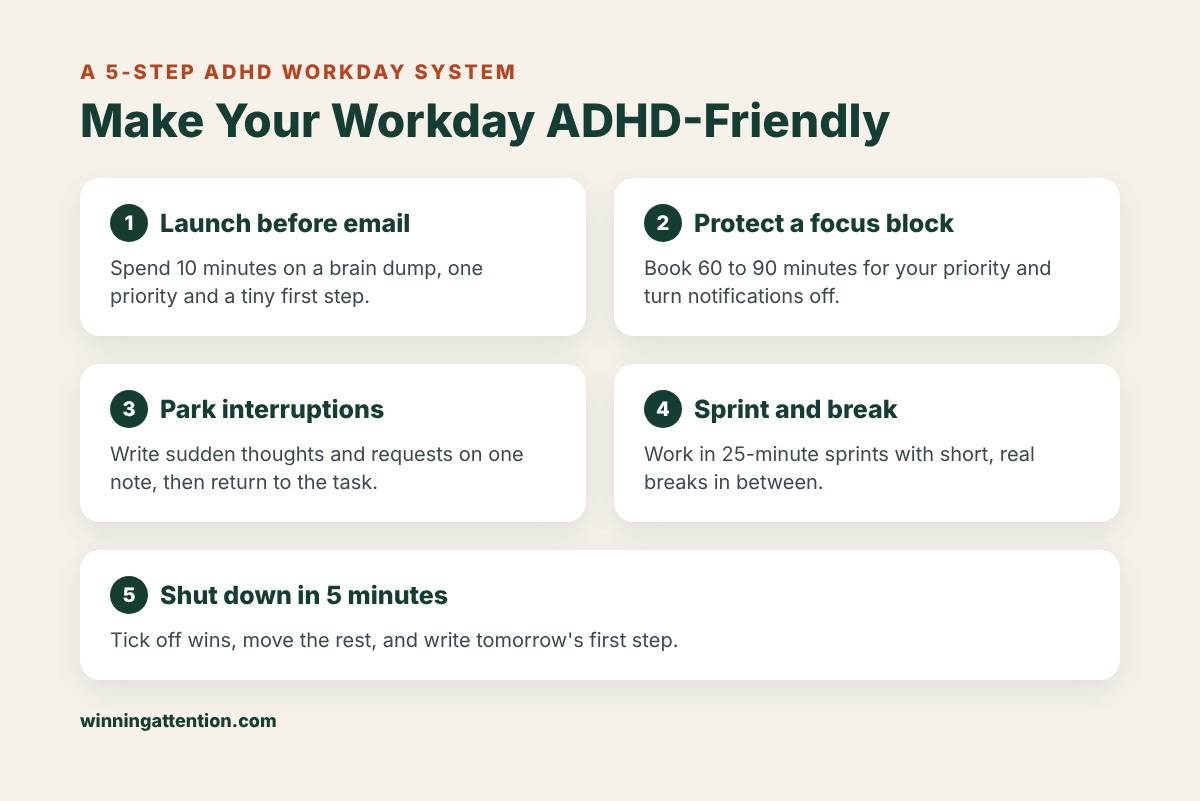
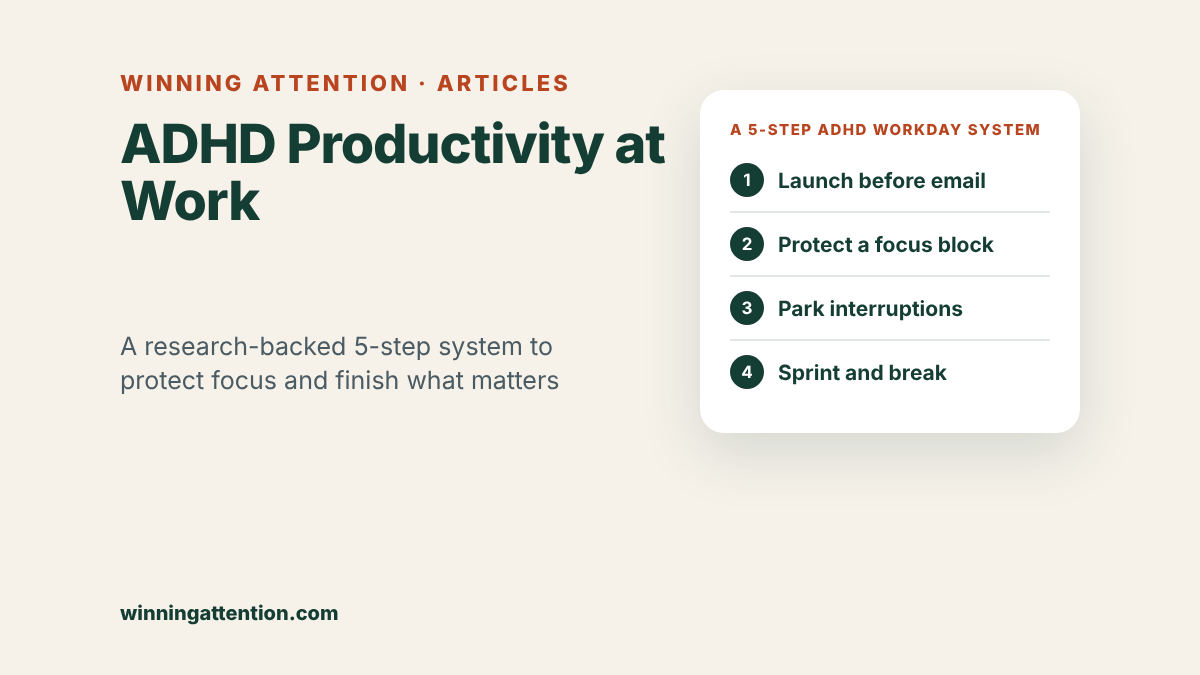
    Infographic showing a five-step ADHD productivity system for work: launch before email, protect a focus block, park interruptions, sprint and break, shut down in five minutes
    A simple workday system: plan before email, protect one focus block, park interruptions, work in sprints and close the day with a short shutdown.

    A 5-step ADHD productivity system for your workday

    The system takes about 15 minutes a day in total: 10 at the start, 5 at the end. The rest of the day runs on a few simple rules. Try it for three weeks before you judge whether it improves your ADHD productivity; most new routines feel clunky for the first several days.

    Step 1: Launch your day before you open email

    Email and chat are other people’s priorities arriving in a stream, and they are one of the biggest drains on ADHD productivity. If you open them first, your day gets planned by whoever wrote to you last. Instead, spend the first 10 minutes of your workday on a short launch routine:

    1. Brain dump. Write every task, worry and loose end onto one page or one note. Do not sort yet.
    2. Pick one priority. Ask: “If only one thing moves forward today, which one would matter most?” Write it at the top.
    3. Check the calendar. Look at meetings and fixed commitments so nothing surprises you at 2 p.m.
    4. Write the first step. Turn your priority into a tiny, visible action, such as “open the budget file and fill in the March column.”

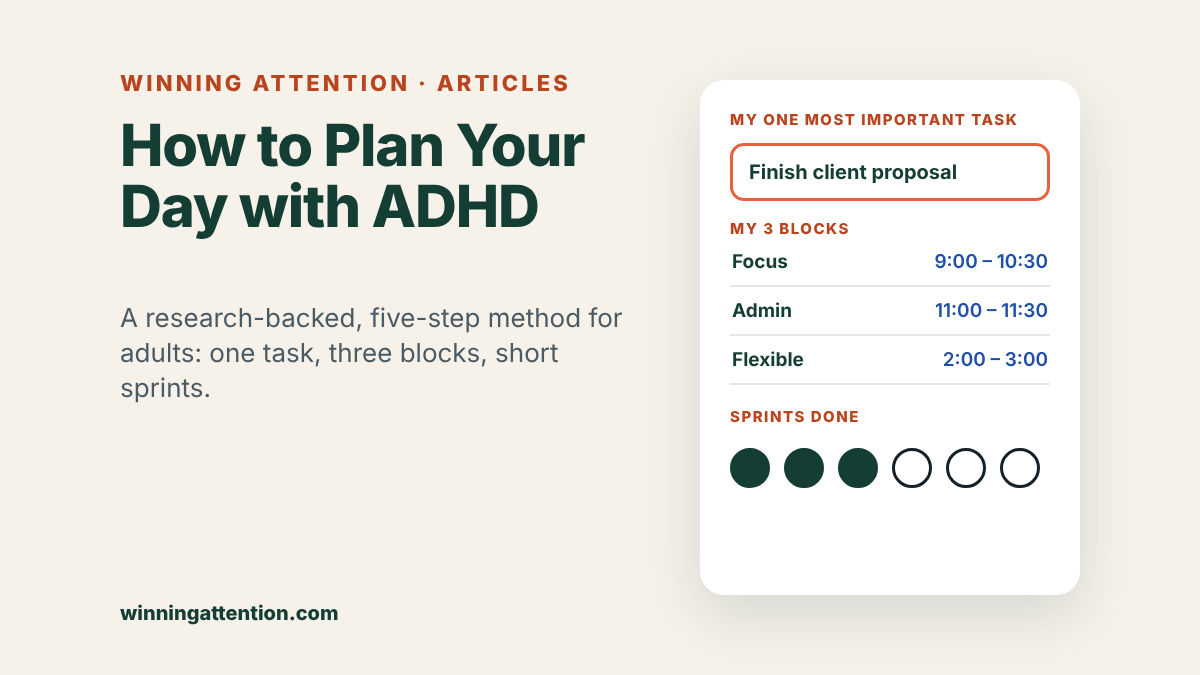
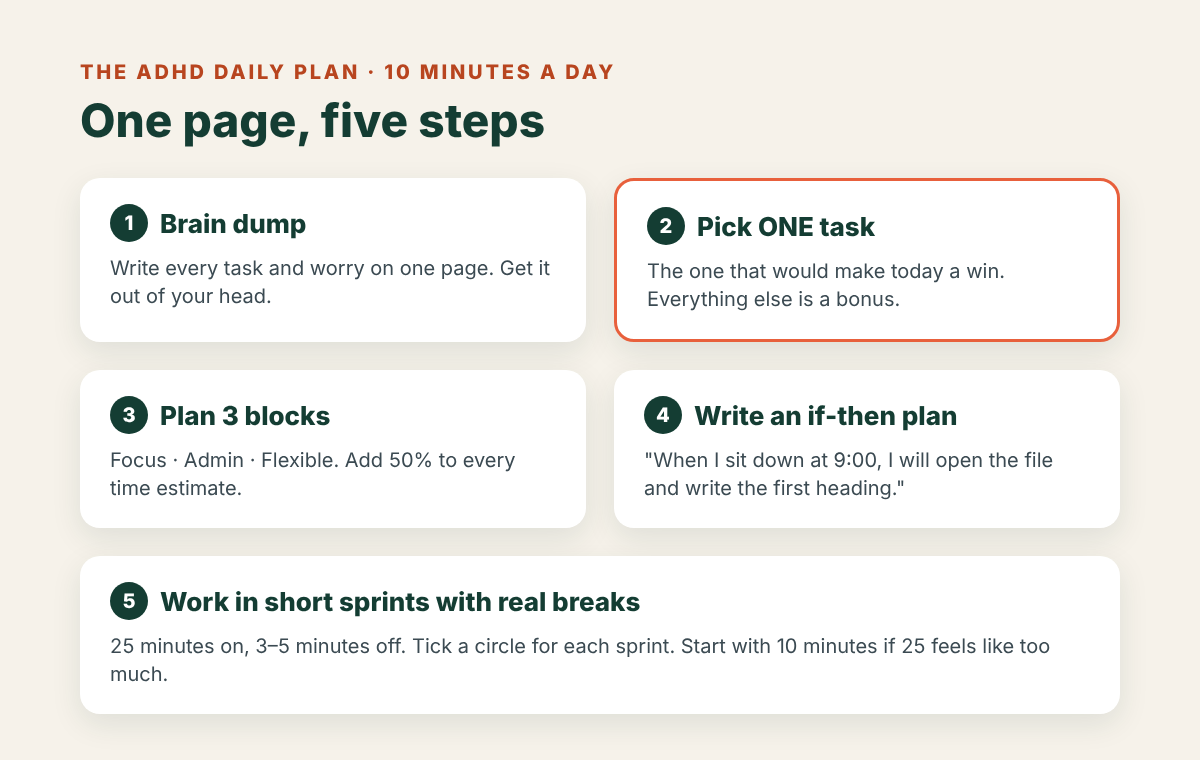
    If you already use a daily plan, this is the same idea applied to a work context. The guide on how to plan your day with ADHD goes deeper into the planning page itself.

    Example of a launch note

    • Priority: client report draft (due Thursday).
    • First step: open last quarter’s report and copy the section headings into a new file.
    • Fixed: 11:00 team stand-up, 15:00 call with vendor.
    • Parked for the admin block: expense claim, reply to HR, book training.

    Step 2: Protect one focus block

    Your most important task needs a protected window, ideally 60 to 90 minutes at the time of day when your attention is usually best. For many adults with ADHD that is late morning, but notice your own pattern rather than following a rule.

    Protecting the block means making it visible to others and to yourself. Put it in your calendar as a real appointment. Set your chat status to “focusing, back at 11:00.” Close email entirely, not just minimized. If your job allows it, move to a quieter spot or use noise-reducing headphones.

    Scripts for protecting your time

    • “I am in a focus block until 11. Can I get back to you right after?”
    • “Could we move this to the afternoon? Mornings are when I do my deepest work.”
    • “Is this urgent, or can it go on my list for today’s admin time?”

    Most colleagues respect a clear, friendly boundary, especially when you reliably follow up when you said you would.

    Step 3: Catch interruptions instead of acting on them

    Keep one “parking lot” note open next to your work: a sticky note, a text file, or a page in your notebook. When a thought, request or idea pops up during a focus block, write it there in a few words and return to your task. Do not research it, reply to it, or “just quickly” do it.

    This works with your ADHD instead of against it. The idea is captured, so your brain can stop holding it, and the task in front of you keeps its momentum. At the next break or during the admin block, empty the parking lot: do, schedule, delegate or delete each item.

    Reducing interruptions at the source

    • Turn off email and chat notifications during focus blocks; check them at set times instead.
    • Keep your phone in a drawer or another room while you focus.
    • Batch quick requests: tell your team you will answer non-urgent messages at, say, 11:30 and 16:00.
    • Close unrelated browser tabs before each sprint. Bookmark them in one folder if closing them feels risky.

    Step 4: Work in sprints and take breaks on purpose

    Long stretches of unstructured time are hard with ADHD, and they are where ADHD productivity tends to leak away. A timer gives the work a clear edge. Set it for a sprint, often 25 minutes, work on one thing only, then take a 3 to 5 minute break that is genuinely different: stand up, refill water, look out the window, stretch. Then start the next sprint.

    If 25 minutes feels impossible on a hard day, start with 10. If you tend to hyperfocus, the timer protects you in the other direction, reminding you to eat, move and check whether you are still working on the right thing. Hyperfocus feels productive, but it can swallow a whole afternoon on a task that was not the priority.

    When you cannot start at all

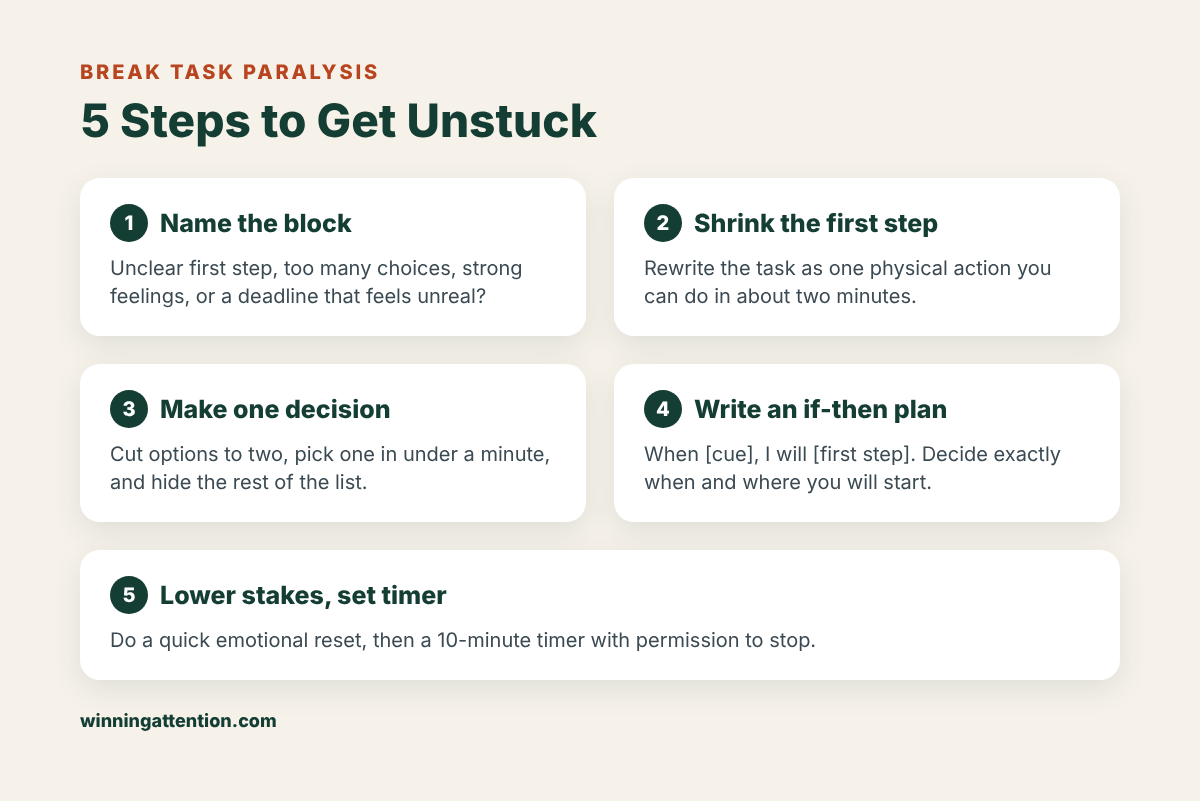
    Sometimes the plan is clear and you still freeze. That is common, especially for tasks that are boring, vague or emotionally loaded. Shrink the first step until it feels almost silly (“open the file and type the title”), commit to just one 10-minute sprint, or work alongside a colleague. The article on ADHD task paralysis covers more ways to get unstuck.

    Step 5: Shut down the day in five minutes

    Many adults with ADHD either stop abruptly when the energy runs out or keep working late because nothing feels finished. A short shutdown ritual gives the day a clear ending:

    1. Tick off what you finished. Seeing progress matters.
    2. Move unfinished items to tomorrow’s list.
    3. Write tomorrow’s first step for your priority, as specifically as you can.
    4. Glance at tomorrow’s calendar.
    5. Close every tab and app. Say or write “done for today.”

    This is where the research on plan making is most useful. Writing down a specific plan for an unfinished task helps stop it from looping in your head, so it is less likely to follow you into the evening (Masicampo & Baumeister, 2011). It also makes tomorrow’s launch much faster.

    A worked example: one Tuesday at the office

    Here is how the system might look in practice for a fictional example: Marcus, a 34-year-old marketing coordinator with ADHD who works a hybrid schedule. On Tuesday he is in the office.

    1. Launch, 8:50 to 9:00. Before opening email, Marcus writes a brain dump: campaign brief for Friday, 40 unread emails, update the social calendar, approve two invoices, prepare slides for Thursday, reply to his manager about vacation dates. He picks the campaign brief as his priority. His first step: “Open the template and write three bullet points for the target audience.”
    2. Focus block, 9:00 to 10:30. He books the time in his calendar, sets his chat status to “focusing until 10:30,” puts on headphones and starts a 25-minute timer. When a colleague asks about lunch plans, he smiles and says, “Can I catch you at 10:30?”
    3. Parking lot. During the first sprint, Marcus remembers he never sent the vendor contract. Instead of opening email, he writes “vendor contract” on his parking-lot note and goes back to the brief.
    4. Breaks. After each sprint he stands, refills his water bottle and comes back. By 10:30 he has three sprints done and a rough draft of the brief.
    5. Admin block, 11:00 to 11:45. He opens email, sends the vendor contract first, approves the invoices and replies to his manager. He leaves 30 emails unread on purpose; none are urgent.
    6. Afternoon. Meetings, the social calendar, and a second short sprint on the brief.
    7. Shutdown, 17:00. He ticks off the brief draft, moves the slides to Wednesday’s list, and writes Wednesday’s first step: “Paste brief feedback into the draft and fix the headline.”

    Marcus did not clear his inbox, and the slides did not move. But the most important task made real progress, nothing urgent was missed, and he left on time without a list of open loops spinning in his head. That is what good ADHD productivity looks like on an ordinary day.

    A sample ADHD-friendly workday

    Adjust the times to your own job and energy. The structure matters more than the exact clock.

    Time Block What happens
    8:50–9:00 Launch Brain dump, one priority, calendar check, first step written down
    9:00–10:30 Focus The priority task in 25-minute sprints, notifications off
    10:30–11:00 Buffer Break, movement, empty the parking lot
    11:00–11:45 Admin Email, chat, calls, forms and quick approvals, batched
    12:00–13:00 Lunch A real break away from the desk
    13:00–16:00 Meetings and flexible work Collaboration, smaller tasks, a second sprint if possible
    16:00–16:30 Admin Second check of messages, follow-ups
    16:55–17:00 Shutdown Tick off, move the rest, write tomorrow’s first step

    If you want a ready-made page for the launch and shutdown routines, the free ADHD Daily Planner Starter Kit includes a one-page daily planner, a weekly energy tracker and a 2-minute reset card you can keep on your desk.

    ADHD at work: finding a setup that fits

    There is no list of “ADHD jobs,” and research has not identified one ideal career. But how well a job fits your attention style can make a big difference to your ADHD productivity and to how capable you feel. Instead of asking “which job is right for ADHD,” it is usually more useful to ask which features of a role help or hurt you.

    Features that many adults with ADHD find easier

    • Variety and clear short-term goals. Work that changes through the day and has visible finish lines can be easier to engage with than long, open-ended projects with distant deadlines.
    • Interest and meaning. Many adults with ADHD find it much easier to focus on work they care about. Interest is not a luxury here; it is part of how attention works for them.
    • External structure. Regular check-ins, shared deadlines and clear expectations can act like scaffolding.
    • Some movement. Roles that involve moving around, talking with people or hands-on work suit some people better than long hours at a desk.

    Features that often make things harder

    • Constant interruptions with no protected time.
    • Large amounts of detailed, repetitive paperwork with little support.
    • Vague goals and infrequent feedback.
    • Open-plan offices with lots of noise and visual distraction.

    You may not be able to change jobs, but you can often change parts of the job: which tasks you take on, when you do them, and where you sit while doing them.

    Does working from home help or hurt with ADHD?

    Both, depending on the person and the setup. Home can mean fewer interruptions, more control over noise and lighting, and the freedom to move, pace or take short breaks without anyone noticing. It can also mean no external structure, no colleagues to work alongside, and a laundry basket, fridge and phone competing with the work.

    If you work remotely, add the structure an office would have provided:

    • Keep a consistent start time and a short “commute” ritual, such as a walk around the block, to mark the beginning and end of the day.
    • Work in one dedicated spot, even if it is just one end of the kitchen table.
    • Use virtual coworking or a video call with a colleague to work alongside someone.
    • Schedule your focus block and shutdown in your calendar exactly as you would in the office.

    Hybrid arrangements let some people put deep-focus work on home days and collaboration on office days. Notice which environment suits which kind of task for you, and plan your week around that.

    ADHD tips for the workplace: disclosure and accommodations

    Whether to tell your employer about ADHD is a personal decision, and there is no single right answer. Research has highlighted disclosure as one of the barriers that stops adults with ADHD from getting support at work (Lauder et al., 2022), but disclosure also carries real considerations about privacy, workplace culture and how a manager might respond.

    Questions to think through before you disclose

    • What do you need? Be clear about the specific changes that would help. “I need fewer interruptions in the morning” is easier to act on than “I have ADHD.”
    • Can you ask without disclosing? Many adjustments, such as written instructions or a quieter desk, can be requested as a work preference without naming a diagnosis.
    • Who should you tell? Some people tell HR only, some tell their direct manager, some tell trusted colleagues and no one else.
    • What is the culture like? Consider how the organization has handled other health or disability requests.

    Workplace accommodations people commonly discuss

    Research on which specific workplace accommodations work best for ADHD is still limited, so treat the list below as ideas to explore rather than proven treatments. Examples that are commonly discussed include:

    • A quieter workspace, noise-cancelling headphones, or permission to work from home for focus tasks.
    • Written instructions and meeting notes in addition to verbal ones.
    • Breaking larger projects into smaller milestones with regular check-ins.
    • Flexible start times or scheduling demanding work at your best time of day.
    • Permission to use timers, reminders, task-management tools or speech-to-text software.
    • Protected calendar time with no meetings.

    Where to find reliable information in the US and Canada

    In the United States, the Americans with Disabilities Act (ADA) generally requires many employers to provide reasonable accommodations for qualified employees with disabilities, and ADHD can be covered in some situations. How the law applies depends on your circumstances, so this article cannot give legal advice. A good starting point is the Job Accommodation Network (JAN), a free service that offers guidance on accommodations and the ADA. In Canada, rules vary by province and sector; your provincial human rights commission or the Canadian Human Rights Commission are useful places to start. For advice about your specific situation, speak with HR, a union representative or an employment lawyer.

    How to stop getting distracted at work with ADHD

    Distraction is the most common complaint people raise about ADHD productivity at work, but it is not a single problem. It helps to notice what kind of distraction is pulling you away, because each kind needs a different fix.

    • External distractions (noise, people, notifications): change the environment. Headphones, a different seat, notifications off, phone out of reach.
    • Digital rabbit holes (news, social media, “quick” searches): use website blockers during focus blocks, and keep your phone physically away from your desk.
    • Internal distractions (sudden ideas, worries, remembering other tasks): write them on the parking-lot note and return to the work.
    • Boredom (the task is dull): add novelty or urgency. Set a short timer and race it, switch locations, pair the task with music, or work alongside someone.
    • Unclear next step (you do not know what to do next): stop and write the next physical action before you continue.
    • Tiredness: take a real break, move, drink water, and eat. Long-term, look at sleep; it has a big effect on attention.

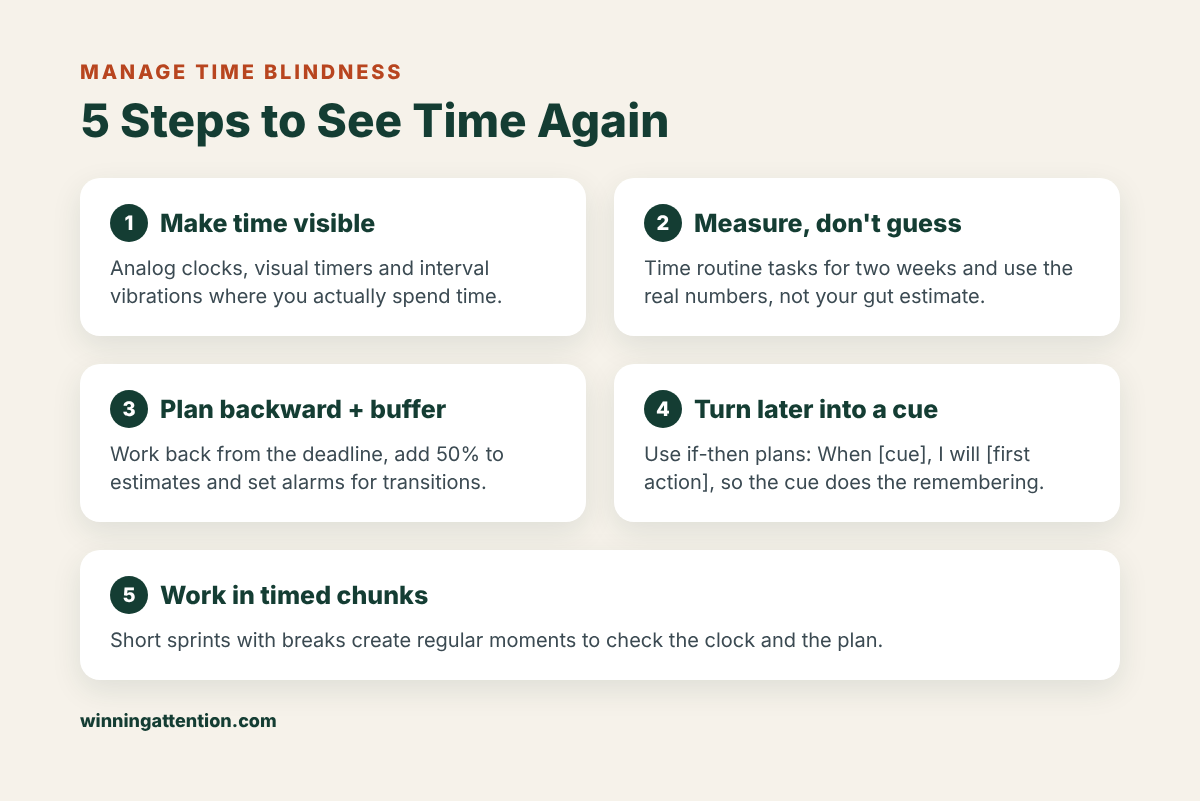
    Time blindness also plays a role. If an hour disappears without you noticing, a visible timer or analog clock on your desk can help. The article on ADHD time blindness explains why time can feel so slippery and how to make it more visible.

    Common mistakes that undermine ADHD productivity

    • Starting the day in your inbox. It feels productive, but it hands your priorities to other people. Launch first, then open email.
    • Saying yes to every meeting. Scattered meetings break the day into pieces too small for real work. Ask for agendas and protect one focus block.
    • Building a complicated system. Elaborate apps and color codes are fun to set up and hard to maintain. Start simple: one list, one calendar, one parking-lot note.
    • Relying on memory for “small” things. Small tasks are the easiest to forget. Write them down anyway.
    • Working late to make up for a scattered day. It can become a cycle: late nights lead to tired mornings and more scattered days. Use the shutdown instead.
    • Comparing yourself with neurotypical coworkers. Your process may look different. Judge your system by whether the important work moves forward.
    • Giving up after a bad week. Every system breaks sometimes. Restart with tomorrow’s launch rather than trying to catch up on everything you missed.

    When to talk to a professional

    ADHD productivity strategies help many adults, but they are not a treatment for ADHD on their own. Talk to a doctor, psychologist or other qualified clinician if work problems are putting your job at risk, if you are regularly working late to keep up, if you have never been assessed but recognize yourself in this article, or if you are dealing with low mood, anxiety, burnout or poor sleep. Evidence-based options include medication, CBT and structured skills programs, and many people do best with a combination. An occupational health service or employee assistance program, if your employer has one, may also be able to help.

    Frequently asked questions

    How can I be more productive at work with ADHD?

    Build your day around a few simple routines instead of willpower. Plan for 10 minutes before opening email, protect one focus block for your most important task, write interruptions on a single note, work in short timed sprints with breaks, and end with a five-minute shutdown. Structured CBT programs that teach these kinds of skills have research support for adults with ADHD.

    What jobs or work setups suit people with ADHD?

    Research has not identified one ideal job for ADHD. Many adults find it easier to focus in roles with variety, clear short-term goals, genuine interest and some external structure. Protected focus time and fewer interruptions often matter as much as the job title.

    Should I tell my employer I have ADHD?

    It is a personal choice with no single right answer. Think about what specific changes you need, whether you can ask for them without naming a diagnosis, and how your workplace has handled similar requests. For guidance in the US, the Job Accommodation Network (askjan.org) is a good starting point, and HR, a union representative or an employment lawyer can advise on your situation.

    What workplace accommodations help with ADHD?

    Commonly discussed examples include a quieter workspace or headphones, written instructions, regular check-ins on larger projects, flexible scheduling, protected meeting-free time, and permission to use reminder or task-management tools. Research on which accommodations work best is still limited, so focus on the specific problems you face.

    How do I stop getting distracted at work with ADHD?

    First notice what kind of distraction is pulling you away. Change the environment for noise and notifications, use blockers for digital rabbit holes, and write sudden thoughts on a parking-lot note instead of acting on them. For boring tasks, add a timer or work alongside someone.

    Does working from home help or hurt with ADHD?

    It can do both. Home often means fewer interruptions and more control over your environment, but also less structure and more temptations. If you work remotely, keep a fixed start time, a dedicated workspace, scheduled focus blocks and a clear end-of-day ritual.

    Sources

  • ADHD To-Do List: How to Make One That Actually Works (+ Template)

    ADHD To-Do List: How to Make One That Actually Works (+ Template)

    If you have ever tried to keep an ADHD to-do list, you probably know this one: a list that looked great at 9 a.m. and felt like an accusation by 3 p.m. Thirty items, three of them done, and none of the three were the ones that mattered. The next day there is a new list, or a new app, and the cycle starts again. A to-do list is supposed to calm you down. Too often it does the opposite.

    The problem is usually not you. Standard to-do lists assume a brain that can hold priorities in mind, estimate time accurately and pick the next task without much friction. ADHD makes each of those harder. This guide explains why normal lists break down with ADHD, what research says about writing tasks down and planning them, and a five-step way to build an ADHD to-do list that is short enough to use and clear enough to act on.

    The short version: separate capturing from choosing. Brain dump everything into one place, sort it into Today, This week and Parked, pick no more than three tasks for today, rewrite each one as a small visible first action with a time attached, and review the list for five minutes at the end of every day. Your master list can be long. Your daily list should not be.

    Why normal to-do lists don’t work with ADHD

    A classic to-do list is one long column: everything you need to do, in the order it occurred to you. For many adults with ADHD, that format creates as many problems as it solves.

    Your mental notepad is already full

    Working memory is the short-term mental workspace you use to hold information while you work with it, such as remembering what you were about to do next. A meta-analysis of 38 studies found moderate differences in working memory between adults with ADHD and adults without ADHD, for both verbal and visual-spatial information, and concluded that these difficulties persist into adulthood (Alderson et al., 2013).

    In daily life, this means that tasks you do not write down are easily lost, and tasks you do write down still need to be re-read, re-sorted and re-decided every time you look at the list. A long, unsorted list asks your working memory to do the very job it struggles with.

    Unfinished tasks keep tugging at your attention

    Psychologists have long suggested that unfinished goals stay active in the mind. In a series of experiments, unfulfilled goals caused intrusive thoughts during an unrelated reading task and poorer performance on an unrelated word puzzle. But when participants were allowed to make a specific plan for the goal, those interference effects disappeared, even though the goal itself was still unfinished (Masicampo & Baumeister, 2011). These studies were not done with ADHD samples, but the idea is useful: it is not only the unfinished task that drains attention, it is the unfinished task with no plan.

    You may have heard this called the Zeigarnik effect, the claim that people remember unfinished tasks better than finished ones. That specific memory claim has been hard to replicate. A 2025 meta-analysis found no memory advantage for unfinished tasks, but did find a general tendency for people to go back and resume tasks that were interrupted (Ghibellini & Meier, 2025). So be cautious with popular explanations. The more solid point is the one from the planning experiments: writing a task down and deciding when you will do it helps your mind let go of it for now.

    Long lists create too many choices

    Looking at forty tasks and asking “what should I do now?” is a hard decision. Research on choice overload outside ADHD suggests that more options are not always better. A meta-analysis of 99 observations from earlier studies (N = 7,202) found that choice overload was more likely when the choices were complex, the decision was difficult, people were unsure what they preferred, and they wanted to minimize effort (Chernev et al., 2015). This research is about consumer choices, not task lists or ADHD, but the pattern is familiar: a long, mixed list of hard-to-compare tasks, viewed when you are tired, is a recipe for doing nothing or picking the easiest item.

    Time estimates run optimistic

    A list without time attached quietly assumes everything fits into the day. With ADHD, that assumption is especially risky. A 2024 meta-analysis that pooled 824 effect sizes found a moderate-to-large difference in time perception between people with and without ADHD (g = 0.688) across the lifespan (Metcalfe et al., 2024). If tasks routinely take longer than you expect, a list of twelve “quick” items is not a plan, it is a wish. The article on ADHD time blindness goes deeper into this.

    What the research says makes a to-do list work with ADHD

    No study has tested “the perfect ADHD to-do list.” But several lines of research point in the same direction, and they shape the method below.

    • Getting tasks out of your head is a real strategy, not a crutch. Psychologists call this cognitive offloading: using physical actions, such as writing a note or setting a reminder, to reduce the mental demand of a task. A major review describes it as a common, everyday strategy and examines both when people choose to do it and what it does to thinking (Risko & Gilbert, 2016). For a brain with less working memory to spare, offloading is especially valuable.
    • Specific plans beat general intentions. A large meta-analysis of studies on implementation intentions, if-then plans that link a specific situation to a specific action (“When I sit down after lunch, I will open the tax form”), found a medium-to-large positive effect on reaching goals compared with goal-setting alone (Gollwitzer & Sheeran, 2006).
    • Structured planning skills help adults with ADHD. In a randomized trial of 86 adults with ADHD who still had significant symptoms despite medication, 12 sessions of cognitive-behavioral therapy (CBT) that included organization and planning skills outperformed an attention-matched relaxation program. On the ADHD rating scale, 67% responded to CBT compared with 33% in the comparison group (Safren et al., 2010).
    • Time management and organization can be taught. A 12-week group program focused on time management, organization and planning improved inattention symptoms more than supportive therapy in 88 adults with ADHD (Solanto et al., 2010).
    • The broader picture. A meta-analysis of 32 studies of CBT for adult ADHD found small-to-medium benefits compared with control groups, both for symptoms (g = 0.65) and for daily functioning (g = 0.51) (Knouse et al., 2017).

    Skills programs like these usually include a single place to capture tasks, a daily routine for choosing what to work on, breaking large tasks into small steps, and assigning tasks to specific times. The method below borrows those ingredients. It is a self-help structure, not a replacement for treatment.

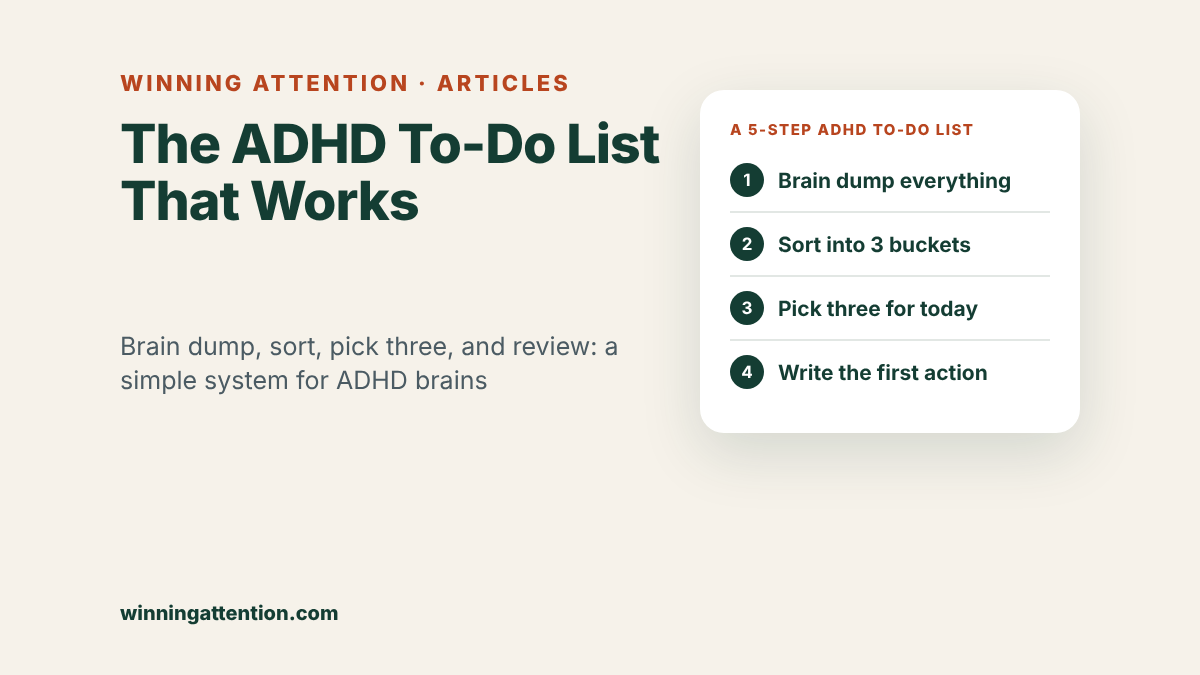
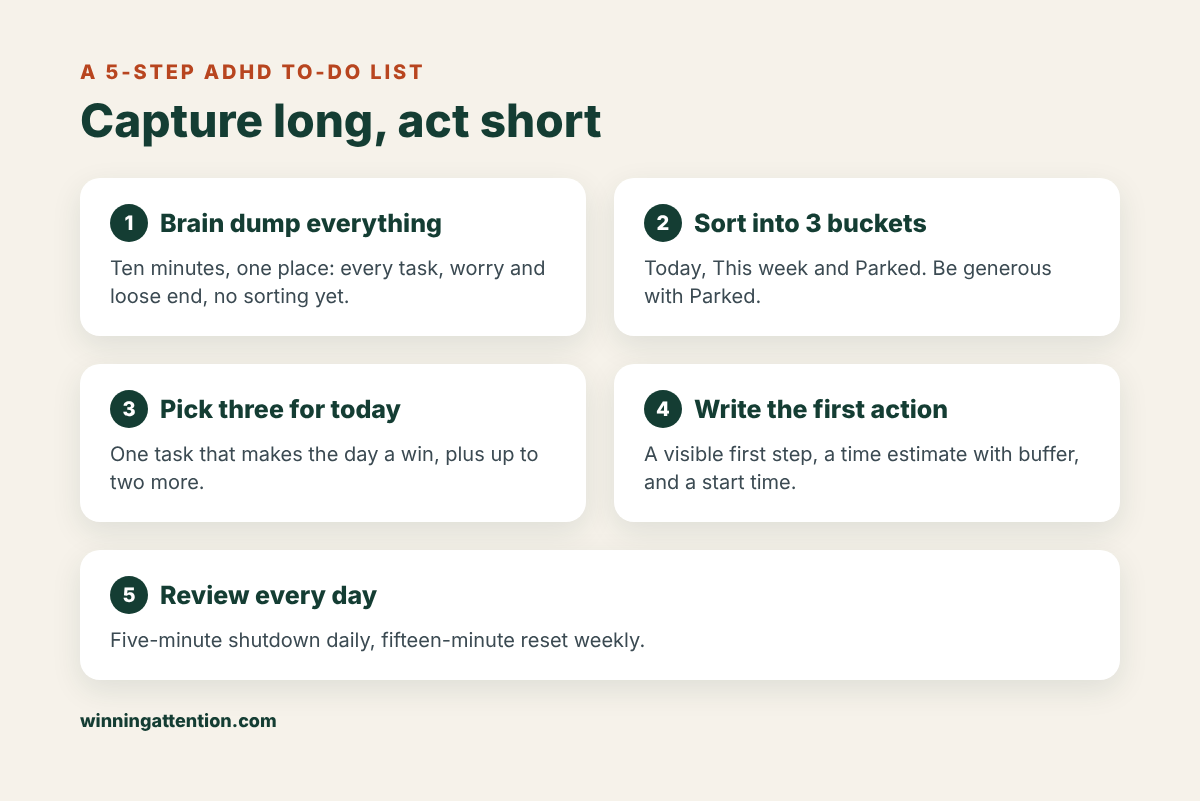
    Infographic of a five-step ADHD to-do list method: brain dump everything, sort into three buckets, pick three tasks for today, write the first action, and review every day
    Use a long master list to capture and a short daily list to act: brain dump, sort, pick three, write the first action and review daily.

    How to make an ADHD to-do list: a 5-step method

    The key idea is to stop asking one list to do every job. Use a long master list to capture, and a very short daily list to act. The first setup takes about 20 minutes. After that, the daily version takes five to ten.

    Step 1: Brain dump everything into one place

    Set a timer for ten minutes and write down every task, errand, worry and loose end you can think of. Do not sort, rank or judge. Big projects and tiny chores can sit side by side. The goal is to empty your head into one trusted place.

    That one place matters. If tasks live in three apps, two notebooks, your email inbox and a pile of sticky notes, you will always wonder what you have forgotten. Choose one notebook or one app as your master list and treat everything else as a temporary inbox that gets emptied into it.

    Brain dump prompts when your mind goes blank

    • Work: deadlines, emails waiting for a reply, meetings to prepare for, things you promised someone.
    • Home: bills, repairs, cleaning, groceries, things to return or sell.
    • Health: appointments to book, prescriptions to refill, forms to send.
    • People: birthdays, calls to return, plans to confirm.
    • Money and admin: taxes, subscriptions to cancel, documents to file.
    • The nagging stuff: anything that has been “on my mind” for more than a week.

    Step 2: Sort into three buckets

    Now go through the brain dump once and put each item into one of three groups:

    1. Today: things with a real deadline today or tomorrow, or that someone is waiting on.
    2. This week: things that need to happen soon but not today.
    3. Parked: ideas, maybes and someday projects. They are written down and safe, but you are not committing to them now.

    Be generous with the Parked bucket. Many items on a long list are not really tasks; they are hopes, ideas or vague guilt. Parking them is not giving up on them. It is choosing not to carry them around every day.

    Quick sorting questions

    • Is there a real consequence if this slips past this week? If not, it is probably Parked.
    • Is someone else waiting on this? That usually moves it up.
    • Is this actually a project with many steps? Write the project name in This week or Parked, and only its next step goes on a daily list.

    Step 3: Choose no more than three tasks for today

    Your daily list should be short enough to see at a glance. Pick one task that would make the day a win if it were the only thing you did. Then add up to two more. Anything beyond that goes in a small “if time” line underneath, with no expectation attached.

    Three is not a magic number from research. It is a practical limit that keeps the list small enough to hold in mind, leaves room for the fact that tasks often take longer than planned, and reduces the “where do I even start” problem that long lists create.

    How to choose your one task

    • Pick the task with the biggest real-world consequence: money, a deadline, a person waiting.
    • If two tie, choose the one you have avoided longest. It is likely using the most background mental energy.
    • If it is too big to finish today, the task for today is its next concrete chunk.

    Step 4: Rewrite each task as a first visible action, with a time

    Most tasks on a typical list are labels, not actions. “Taxes” or “Mom’s birthday” tells you what the topic is, but not what to do when you sit down. For each of your daily tasks, write the very first physical step, a rough time estimate (then add half again as a buffer), and when you will start.

    For the most important or most-avoided task, turn it into an if-then plan. Linking a specific cue to a specific first step makes starting less of a decision.

    Examples of rewritten tasks

    • “Taxes” becomes: “Find last year’s tax return and put it on the desk. 15 min. After breakfast.”
    • “Mom’s birthday” becomes: “Order the book she mentioned from the bookstore website. 10 min. In the admin block at 1 p.m.”
    • “Project report” becomes: “When I sit down at 9:00, I will open the report file and write the three section headings. 30 min.”
    • “Dentist” becomes: “Call the dentist’s office and book a cleaning. 5 min. When I take my lunch break.”

    Once a task has a clear first action and a start time, you may find it easier to focus on it. For more on getting through the task once you begin, see the guide on how to focus with ADHD.

    Step 5: Review for five minutes a day and fifteen a week

    A to-do list only works if it stays current. A list that is a week out of date quickly becomes one more thing to avoid. Build two short reviews into your routine.

    The daily shutdown (5 minutes)

    • Tick off what is done. Seeing it crossed out is a real record of progress.
    • Move anything unfinished to tomorrow, This week or Parked. Do not let it silently pile up.
    • Choose tomorrow’s one task, so the morning starts with a decision already made.

    The weekly reset (15 minutes)

    • Empty all temporary inboxes (sticky notes, email flags, phone notes) into the master list.
    • Look at the week ahead and move items from This week into specific days.
    • Skim the Parked list. Delete anything you no longer care about. Promote anything that has become urgent.

    This is also where the planning experiments matter. Each time you give an open task a specific place and time, you are telling your mind it does not need to keep reminding you about it.

    An ADHD to-do list template you can copy

    Here is a simple daily layout that puts the five steps on one page. You can draw it in a notebook, print it or set it up as a note on your phone.

    Section What goes here Example
    Today’s one task The task that would make the day a win, written as a first action Write three section headings for the report (30 min, 9:00)
    Two more tasks Up to two other tasks, each with a first action and start time Book the dentist (5 min, lunch); pay the electric bill (10 min, 1 p.m.)
    If there is time Optional extras, no pressure attached Return the library books; reply to the neighbor
    If-then plan One cue linked to the first step of the hardest task When I finish my coffee, I will open the report file
    Brain dump space New thoughts and tasks that show up during the day Ask about invoice; buy batteries
    Done What you finished, including things that were not on the list Report headings, dentist booked, fixed printer

    If you would rather start from a ready-made page, the free ADHD Daily Planner Starter Kit includes a one-page daily planner with space for one main task, a brain dump and short work sprints, plus a weekly energy tracker and a 2-minute reset card.

    Putting it together: a worked example

    Here is how the method might look for a fictional person, Priya, a teacher with ADHD, on a Sunday evening. Her current list is a notes app with 63 items, many of them duplicates, and she has stopped opening it.

    1. Brain dump (10 minutes). Priya copies the 63 items onto paper, adds eleven more that were only in her head, and crosses out nine duplicates. Seeing everything in one place is uncomfortable, but for the first time she knows what is actually there.
    2. Sort (10 minutes). Eight items go into Today and tomorrow, fourteen into This week, and the rest into Parked, including “learn Spanish,” “reorganize the garage” and “start a podcast.” She feels a small sense of relief as the active list shrinks.
    3. Choose three (2 minutes). For Monday, her one task is grading the science quizzes, because the grades are due Tuesday. Her other two are emailing a parent back and renewing her car registration, which expires Friday.
    4. Rewrite as actions (5 minutes). “Grading” becomes “When I sit down in my classroom at 3:15, I will grade the first ten quizzes. 40 min.” The registration becomes “Open the state DMV renewal page and fill in the form. 15 min. Lunch break.”
    5. Review. On Monday afternoon she grades twenty quizzes, emails the parent, and runs out of time for the registration. During her five-minute shutdown she moves it to Tuesday’s one task, because the deadline is getting close, and picks the remaining quizzes as the second task.

    Priya did not finish everything on Monday. But the most important task moved forward, nothing was forgotten, and the unfinished item was given a new home instead of becoming a vague source of guilt. That is what a working list looks like in real life.

    Paper or app: which works better with ADHD?

    There is no research showing that one format is better for ADHD in general. The best choice is the one you will open every day. A few considerations can help you decide.

    • Paper stays visible on your desk, has no notifications or rabbit holes, and makes crossing things off satisfying. It is easy to lose, though, and hard to search.
    • Apps are always with you, can set reminders at specific times and places, and handle recurring tasks well. They are also easy to ignore, and the phone they live on is full of distractions.
    • A hybrid works well for many people: a master list in an app (so it is searchable and always with you) and a short daily list on paper (so it is visible while you work).

    Whichever you choose, give it at least two or three weeks before switching. Changing systems feels like progress, but it often resets you to the beginning.

    What to do with a never-ending ADHD to-do list

    If your list keeps growing faster than you can finish it, that is not a personal failure. It usually means the list is doing too many jobs at once. These steps help:

    • Declare list bankruptcy, safely. Move everything older than a month into a new Parked list, dated today. You can still find it, but it stops shouting at you. Anything truly important will resurface.
    • Separate projects from tasks. “Plan the wedding” is a project with dozens of steps. Keep the project name on the master list and put only the next step on a daily list.
    • Delete without guilt. Some items have quietly stopped mattering. Crossing them off on purpose is a decision, not a failure.
    • Delegate or drop. For each lingering item, ask whether someone else could do it, whether a simpler version would be good enough, or whether it can simply be let go.
    • Batch small tasks. Group calls, emails and online forms into one admin block so they do not scatter across the day.
    • Measure the day by the one task. If it moved forward, the day counts, even if the master list is still long.

    To see how a short daily list fits into a whole day with focus and admin blocks, the guide on how to plan your day with ADHD walks through a full schedule.

    Common mistakes to avoid

    • Using the master list as the daily list. A long list is for capturing, not for deciding what to do next. Keep the daily list to three tasks.
    • Writing labels instead of actions. “Taxes” is a topic. “Find last year’s return” is something you can start.
    • Leaving out time. A list without estimates hides how overloaded the day is. Add rough times and a buffer.
    • Keeping several lists in several places. Half your tasks will always be in the other one. Choose one master list.
    • Skipping the review. An outdated list quickly becomes one more thing to avoid. Five minutes at the end of the day keeps it trustworthy.
    • Making the list beautiful instead of usable. Color-coding and stickers can be fun, but if setting it up takes longer than doing the tasks, simplify.
    • Restarting from scratch after a bad week. Missing a few days does not mean the system failed. Do a weekly reset and pick up from today.

    When to talk to a professional

    A good to-do list can make daily life noticeably easier, but it is not a treatment for ADHD. If disorganization is affecting your job, studies, finances, relationships or health, or if you are feeling persistently overwhelmed, anxious or low, talk to a doctor, psychologist or other qualified clinician. The same applies if you have never been assessed and suspect you may have ADHD. Evidence-based options include medication, CBT and structured skills programs focused on organization and planning, and many people benefit from a combination.

    Frequently asked questions

    Why don’t normal to-do lists work with ADHD?

    Typical lists are long, unsorted and have no times attached, so they lean heavily on working memory, prioritizing and time estimates, which are all areas where research shows people with ADHD tend to struggle. A long list can also make it harder to choose where to start. Splitting the list into a long master list and a short daily list helps.

    How do you make an ADHD to-do list?

    Brain dump everything into one place, then sort it into Today, This week and Parked. Choose no more than three tasks for today, rewrite each as a small first action with a time estimate and start time, and turn the hardest one into an if-then plan. Review the list for five minutes at the end of each day.

    What is an ADHD brain dump?

    A brain dump is a short, timed session where you write down every task, worry and idea in your head without sorting or judging them. It moves information out of your working memory and into one trusted place. Research on plan making suggests that writing tasks down and deciding when to handle them can reduce how much they intrude on your thoughts.

    How many tasks should be on an ADHD to-do list?

    Your master list can be as long as it needs to be, but your daily list works best when it is short. A practical limit is one main task plus up to two others, with any extras in an optional “if time” line. That keeps the list easy to see at a glance and leaves room for tasks that take longer than expected.

    Is paper or an app better for an ADHD to-do list?

    Neither is better for everyone; the best one is the one you will actually check every day. Paper stays visible and has no distractions, while apps are portable and good for reminders. Many people use an app for the master list and a paper page for the short daily list.

    What do you do with a never-ending to-do list?

    Move anything older than a month into a dated Parked list, separate projects from their next steps, and delete items that no longer matter. Batch small tasks into one admin block. Judge each day by whether your one main task moved forward, not by how long the master list still is.

    Sources

  • ADHD Focus: How to Concentrate with ADHD (Evidence-Based Tips)

    ADHD Focus: How to Concentrate with ADHD (Evidence-Based Tips)

    You sit down to work, open the file, and ten minutes later you are reading about the history of a font, answering a message you did not need to answer, or staring at the same sentence for the fourth time. Then, later that night, you lose three hours to a project you actually care about. If ADHD focus feels unpredictable, that is because it often is.

    This is not laziness, and it is not a sign that you simply need to try harder. Research on ADHD describes specific patterns behind the problem: a mind that wanders more, attention that locks on to what is interesting, and timing that does not match a typical nine-to-five day. This guide explains why you can’t focus with ADHD on some tasks, what studies say about non-medication strategies, and a six-step method for setting up a focus session that works with your brain instead of against it.

    The short version: do not rely on willpower. Pick one small, visible target, put your phone out of sight, try steady background noise, move your body before hard work, and work in short timed sprints with planned breaks. Keep a pad nearby to park stray thoughts. Small, repeatable changes to your setup tend to beat big promises to concentrate harder.

    Why ADHD focus works differently

    The name “attention deficit” is a little misleading. Many adults with ADHD can pay intense attention, sometimes for hours. The harder part is steering attention: aiming it at a task that is important but not interesting, keeping it there, and bringing it back after a distraction. That is why ADHD concentration can look excellent in one setting and almost absent in another.

    The mind wanders more, and more freely

    Everyone’s mind wanders. With ADHD, it tends to wander more often and in a less settled way. A 2018 review of brain-imaging and behavioral research described excessive spontaneous mind wandering as a characteristic experience of people with ADHD, marked by constant mental activity that jumps between topics. The authors proposed that the brain network active during rest does not switch off as smoothly when a task begins, and competes with the networks that should be running the task (Bozhilova et al., 2018). This is a theory, not a settled fact, but it matches what many adults describe: it is not that nothing is happening in your head, it is that too much is.

    In practice, this means that the moment a task gets slow, repetitive or unclear, your attention has somewhere more interesting to go. Strategies that make the task clearer and more stimulating, or that give stray thoughts somewhere to land, tend to help more than telling yourself to “just focus.”

    Hyperfocus: the other side of the same coin

    Many people with ADHD also report periods of intense, absorbed attention, often called hyperfocus. In two samples of adults (251 in a pilot and 372 in a replication), people with higher levels of ADHD symptoms reported more hyperfocus overall, including during school or work, hobbies and screen time (Hupfeld et al., 2019).

    Hyperfocus shows that the ability to concentrate is there. The challenge is that it tends to switch on for what is interesting, new or urgent, and not necessarily for what is important. It can also make it hard to stop, eat, sleep or switch to the next commitment. A good focus routine has to do two jobs: help you start on dull tasks and help you stop when absorbing ones run too long.

    Timing matters more than most advice admits

    Many adults with ADHD are night owls. A review of circadian research noted that adults with ADHD often have sleep problems linked to a delayed internal body clock, and are often described as “evening” or “night” types (Kooij & Bijlenga, 2013). If your best ADHD focus arrives at 4 p.m. or 10 p.m., you are not imagining it. Forcing your most demanding work into your lowest-energy hours makes concentration harder than it needs to be.

    Time itself can also feel slippery. If you often underestimate how long tasks take, the article on ADHD time blindness explains why and how to plan around it.

    What research says about improving ADHD focus without medication

    Medication and cognitive-behavioral therapy have the strongest evidence for treating ADHD overall. Alongside treatment, or while you are waiting for an assessment, several everyday strategies have research behind them. None of them is a replacement for care, and most of the effects are modest. But modest effects add up when you stack them.

    Steady background noise can help some people

    White noise sounds like static; pink noise has more low-frequency sound and resembles steady rain. A 2024 meta-analysis pooled 13 studies with 335 children and college-age young adults who had ADHD or high ADHD symptoms. White and pink noise produced a small but statistically significant improvement on laboratory attention tasks (g = 0.249). In people without ADHD, the same noise had a small negative effect (g = -0.212). No studies of brown noise were found (Nigg et al., 2024).

    Two cautions. The studies used lab tasks, not real jobs, and they did not include older adults. And the authors stressed that safe volume levels still need study. If you try noise, keep the volume comfortable and low, and notice honestly whether it helps you, since effects vary from person to person.

    Moving before hard work

    Exercise has been studied for ADHD for years, mostly in children. A 2026 meta-analysis focused specifically on adults with ADHD. Across eight studies, a single bout of exercise had a moderate positive effect on inhibitory control, the ability to hold back an automatic response (g = 0.55), and a small benefit for core ADHD symptoms (g = 0.23). Results for longer-term exercise programs were mixed (Xu et al., 2026).

    The practical takeaway is not “become an athlete.” It is closer to: a short walk, some stairs or a few minutes of movement before a demanding task may give you a small, short-lived boost. Check with a doctor before starting anything strenuous if you have health concerns.

    Planned breaks protect attention

    Pushing through for hours feels virtuous, but attention tends to slide on long, boring tasks. In a laboratory study of a long, monotonous attention task, people who briefly switched away from the task twice did not show the usual drop in performance over time, while those who kept going without a break did (Ariga & Lleras, 2011). The participants were not selected for ADHD, so treat this as a general principle: short, planned breaks help you stay on task, they are not a reward for having stayed on it.

    Your phone: out of sight is safer than “just don’t check it”

    In two experiments, researchers reported that the mere presence of people’s own smartphones reduced available cognitive capacity, even when participants did not check them, and that the cost was highest in people most dependent on their phones (Ward et al., 2017). This “brain drain” finding has been debated. A pre-registered direct replication of one of the original experiments found no difference in performance between phone locations (Ruiz Pardo & Minda, 2022).

    So the honest summary is: the evidence that a silent phone on the desk drains attention is mixed. But a phone that buzzes, lights up or invites “just one quick check” is a reliable distraction for almost anyone, and especially for a brain that already wanders easily. Putting it in another room costs nothing and removes the decision.

    Mindfulness training

    Mindfulness is not about emptying your mind. In ADHD programs it usually means practicing noticing where your attention has gone, then bringing it back without judgment. A 2025 meta-analysis of 10 controlled studies in adults with ADHD found improvements in self-reported ADHD symptoms (SMD = 0.48), observer-rated symptoms (SMD = 0.32) and daily functioning (SMD = 0.56). It found no clear effect on measured mindfulness skills or mood, and the authors called for more high-quality trials (Kim & Jung, 2025).

    These were structured programs, often run by trained facilitators over several weeks, not a single app session. Short practice at home may still help, but it is not the same thing as the programs that were studied.

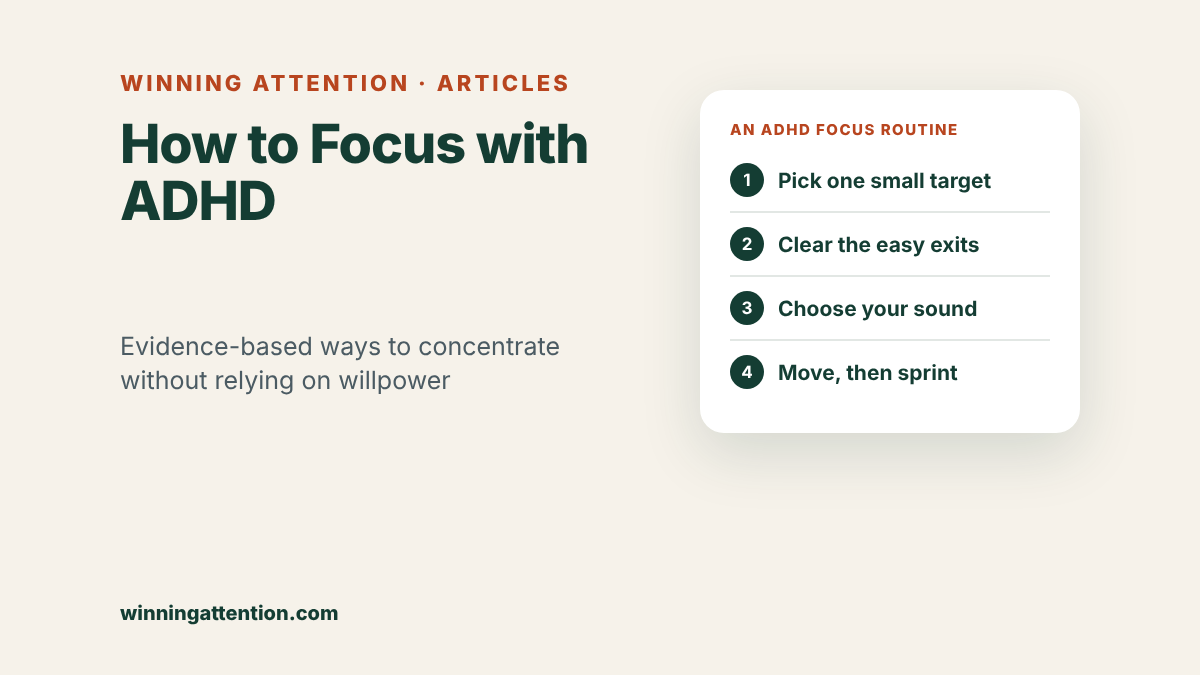
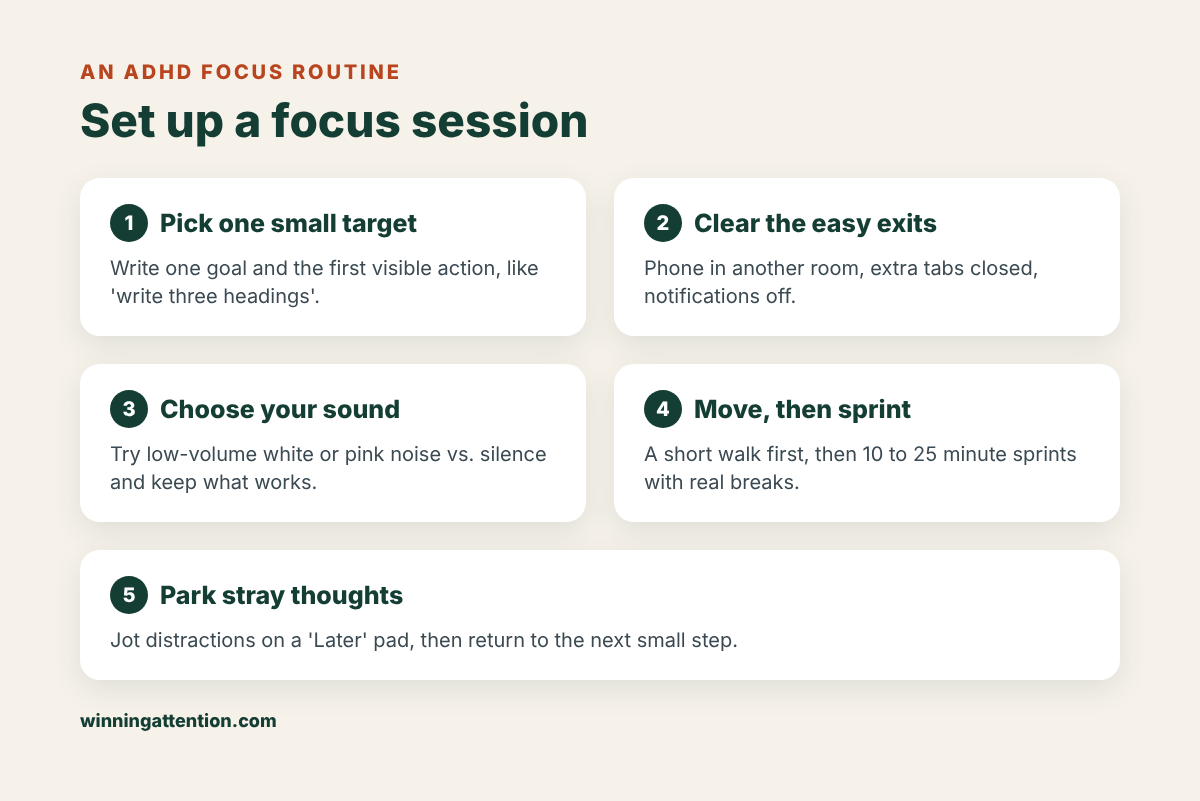
    Infographic of a five-part ADHD focus routine: pick one small target, clear easy exits, choose your sound, move then sprint, and park stray thoughts on a pad
    A simple focus session: one clear target, fewer distractions, steady sound, short sprints and a place to park wandering thoughts.

    How to focus with ADHD: a 6-step method

    The method below turns those findings into a routine you can repeat. The whole setup takes about five minutes. The aim is not perfect concentration. The aim is to make starting easier, make drifting less costly, and make coming back automatic.

    Step 1: Choose one target and write the first visible step

    Vague tasks invite wandering. “Work on the report” gives your attention nothing to hold. Before you start, write one target for this session and the first physical action you will take: “Write the three section headings in the report,” or “Open the invoice spreadsheet and enter the first five receipts.”

    A clear, small first step reduces the gap between sitting down and starting. If even that feels heavy, the guide to ADHD task paralysis covers how to shrink a step until it feels doable.

    Examples of focus targets that work

    • Too vague: “Study.” Better: “Read pages 40 to 46 and write three bullet points.”
    • Too vague: “Emails.” Better: “Reply to the four oldest emails flagged as urgent.”
    • Too vague: “Clean the kitchen.” Better: “Empty the dishwasher and wipe one counter.”

    Step 2: Clear the space of easy exits

    Your environment makes dozens of small decisions for you. Make the default choice the focused one.

    • Put your phone in another room or a closed drawer, not face down beside you.
    • Close every browser tab and app you do not need for the target.
    • Turn off notifications on your computer for the length of the session.
    • Keep only the materials for this one task on the desk.

    This works because it removes the need to resist temptation over and over. Each time you have to say “no” to a distraction, you are spending attention you need for the task.

    Step 3: Pick your sound on purpose

    Decide what you will hear before you start, so you are not hunting for a playlist halfway through. Based on the research above, some people with ADHD find steady white or pink noise helpful. Others prefer instrumental music, a recording of a coffee shop, or silence with earplugs.

    A simple sound experiment

    • Try three sessions with low-volume pink or white noise and three sessions in silence.
    • After each one, rate your focus from 1 to 5 and note how much of the target you finished.
    • Keep whichever setting scored better for you. Skip music with lyrics if you are reading or writing; words tend to compete with words.

    Step 4: Move for a few minutes first

    Before a demanding block, take a brisk five- to ten-minute walk, climb a few flights of stairs, or do a short set of simple movements. Research in adults with ADHD suggests a single bout of exercise can give a modest, short-term lift to inhibitory control. It also works as a clear “start ritual” that tells your brain the focus block is about to begin.

    Step 5: Work in short sprints with planned breaks

    Set a visible timer for a short sprint. Twenty-five minutes is a common starting point, but 10 or 15 minutes is fine if that feels more realistic. When the timer ends, take a real break of three to five minutes: stand up, drink water, look out a window. Then start the next sprint.

    The timer does two things for ADHD focus. It turns an open-ended task into a short, finite one, which makes starting less daunting. And it creates a stopping point, which protects you from hyperfocus swallowing the afternoon.

    Sprint lengths to try

    • Hard to start: 10 minutes on, 3 minutes off. Increase by five minutes once it feels easy.
    • Typical day: 25 minutes on, 5 minutes off, with a longer break after three or four sprints.
    • Prone to hyperfocus: 45 minutes on, 10 minutes off, with an alarm you must physically stand up to turn off.

    Step 6: Catch the drift with a parking pad

    Your mind will wander. Plan for it. Keep a sticky note or a small notepad next to you labeled “Later.” When a thought pops up (“I need to email Sam,” “what was that song?”), write three or four words on the pad and go back to the target. You do not need to act on it now, and you do not need to hold it in your head.

    When you notice you have drifted completely, use a quick reset rather than self-criticism: look at your written target, read the last line you wrote, and do the very next small action. Noticing and returning is the skill. Every time you do it, you are practicing the same thing mindfulness programs train.

    A focus session in practice: a worked example

    Here is how the method might look for a fictional person, Marcus, an office administrator with ADHD who needs to finish a quarterly expense summary. He has been “about to start” for two days.

    1. Target (2 minutes). Marcus writes on a sticky note: “Expense summary: enter January receipts into the spreadsheet.” It is only one month of three, but it is clear and finishable.
    2. Clear the space (1 minute). His phone goes into his bag in the coat closet. He closes email and chat and leaves only the spreadsheet and the folder of receipts open.
    3. Sound (30 seconds). He has already learned that pink noise at low volume works better for him than music, so he starts the same track he always uses.
    4. Move (5 minutes). He walks down and up two flights of stairs and refills his water bottle. Coming back to the desk is the signal that the block has begun.
    5. Sprints. Marcus sets a 25-minute timer. Twelve minutes in, he remembers he forgot to book a car service. He writes “car service” on the “Later” pad and keeps going. At the timer, he takes a four-minute break to stretch, then starts a second sprint.
    6. Result. After two sprints, January is done and February is half-entered. The car service, a reply to a colleague and an idea for the weekend are all waiting on the pad for his admin time.

    Notice what Marcus did not do. He did not try to finish the whole summary in one heroic session, and he did not rely on remembering to ignore his phone. He shaped the situation so that focusing was the easiest option. If you want to fit sessions like this into a full day, the guide on how to plan your day with ADHD shows how to build a day around one or two focus blocks.

    ADHD focus techniques for different situations

    The core method stays the same, but the details shift with the task. Use this as a starting point and adjust based on what you notice.

    Situation What usually gets in the way Try this
    Boring admin (forms, invoices) Low interest, easy to drift Short sprints, steady noise, a small reward after each sprint
    Reading or studying Rereading the same line, mind wandering Read with a pen, write one bullet per page, no lyrics
    Writing Blank-page freeze, perfectionism Start with headings or a messy first paragraph, edit later
    Meetings and calls Zoning out, interrupting Take brief notes, keep a “Later” pad for your own ideas
    Open-plan office Noise, people, visual movement Headphones with steady noise, face a wall, book a quiet room for focus blocks
    Working from home Chores, snacks, the couch Same desk and start ritual every day, phone in another room

    Whatever the situation, keep a note of what you tried and how it went. Patterns usually show up within a couple of weeks, and they are more useful than any general rule, including the ones in this table.

    Caffeine and ADHD focus: what the evidence says

    Many adults with ADHD say coffee helps them concentrate, and the question comes up often. The research is thinner than the popularity suggests. A 2023 meta-analysis of randomized trials in children with ADHD (seven trials with 104 children aged 5 to 15) found that, in the four trials that could be pooled, caffeine did not show a significant benefit over placebo for overall ADHD symptoms (Perrotte et al., 2023). The individual studies were small and the results were mixed, and these were children, so the findings may not apply directly to adults.

    In short, there is no good evidence that caffeine is a treatment for ADHD. If you drink coffee or tea and wonder whether it helps or hurts your focus, sleep or anxiety, or whether it fits with any medication you take, talk to your doctor or pharmacist. Do not use caffeine as a substitute for assessment or treatment.

    Common mistakes that make focus harder

    • Waiting to feel ready. With ADHD, the feeling of focus often shows up after you start, not before. Begin with the smallest step and let momentum do some of the work.
    • Trusting willpower over setup. Resisting a phone on the desk all afternoon is exhausting. Move the phone and the problem shrinks.
    • Scheduling deep work at your worst time. If your best concentration is in the late afternoon, protect that window when you can, and use low-energy hours for routine tasks.
    • Skipping breaks. Long, unbroken sessions tend to end in drifting or burnout. Planned short breaks keep you going longer.
    • Treating every wandering thought as urgent. Write it down and keep going. The pad will hold it.
    • Changing your system every week. New tools feel exciting, which is part of the trap. Give one simple routine two or three weeks before judging it.
    • Using hyperfocus as a plan. Waiting for a deadline panic to produce concentration works sometimes, but it is costly. A timer and a clear target are more reliable.

    A focus routine is easier to keep when it lives on paper rather than in your head. The free ADHD Daily Planner Starter Kit includes a one-page daily planner with a sprint tracker, a weekly energy tracker to spot your best focus hours, and a 2-minute reset card for when you drift.

    When to talk to a professional

    Focus strategies can make a real difference, but they are not a treatment for ADHD on their own. Talk to a doctor, psychologist or other qualified clinician if trouble concentrating is affecting your work, studies, relationships, money or safety, for example while driving. It is also worth seeking help if you have never been assessed and suspect ADHD, if your symptoms have changed, or if you are dealing with low mood, anxiety or sleep problems, which can also affect attention. Evidence-based options include medication, cognitive-behavioral therapy and skills-based programs, and many people benefit from a combination.

    Frequently asked questions

    Why can’t I focus with ADHD?

    ADHD affects how attention is regulated, not just how much attention you have. Research describes more frequent, less settled mind wandering in ADHD, which makes slow or unclear tasks especially hard to stick with. Interest, urgency, timing of day and your environment all have a big influence on how well you can focus.

    Can people with ADHD focus on things they like?

    Yes. Many adults with ADHD experience hyperfocus, a state of intense, absorbed attention, and a study of adults found it was more common in people with higher ADHD symptoms. The difficulty is that it tends to switch on for interesting tasks rather than important ones, and it can be hard to stop.

    How can I improve ADHD focus without medication?

    Studies support a few practical habits: steady background noise for some people, a short bout of exercise before demanding work, planned breaks, removing your phone from sight, and structured mindfulness training. Effects are usually modest, so combine them in a simple routine. These strategies work alongside professional care, not instead of it.

    Does music or background noise help ADHD focus?

    A 2024 meta-analysis found that white and pink noise gave a small benefit on lab attention tasks for young people with ADHD or high ADHD symptoms, but a small negative effect for people without ADHD. Keep the volume low, compare a few sessions with and without noise, and avoid lyrics while reading or writing.

    Does caffeine help ADHD focus?

    The evidence is limited. A meta-analysis of trials in children with ADHD found no significant benefit of caffeine over placebo for overall symptoms, and good research in adults is scarce. Caffeine is not a treatment for ADHD, so ask your doctor or pharmacist if you have questions, especially if you take medication.

    When can people with ADHD focus best?

    It varies, but many adults with ADHD are evening types with a delayed body clock, so their best focus often comes later in the day. Track your energy for a week or two, then protect your strongest hours for the work that needs the most concentration.

    Sources

  • ADHD Routine: How to Build One for Morning, Workday and Bedtime

    ADHD Routine: How to Build One for Morning, Workday and Bedtime

    You have probably built the perfect routine more than once. Wake at 6:00, stretch, journal, healthy breakfast, inbox zero by 9:00. It lasts four days. Then one late night or one busy Monday knocks it over, and you are back to rushing out the door with one shoe on and no idea where your keys are.

    That cycle is common, and it is not a character flaw. An ADHD routine has to work with a brain that gets bored quickly, often runs on a later body clock and holds fewer steps in mind at once. Research on habits, sleep and adult ADHD treatment explains why standard routines fall apart and what makes some routines stick. This guide covers whether routines really help with ADHD, why they break, what studies say, and a five-step method for building an ADHD-friendly morning, workday and bedtime routine.

    The short version: build small, not perfect. Start with one anchor time of day, limit the routine to three steps, tie each step to something you already do, make it visible, and decide in advance what the “minimum version” looks like on bad days. Expect a new ADHD routine to take weeks or months to feel automatic, and expect to restart. Restarting is part of the routine.

    Do routines help with ADHD?

    Yes, for many adults an ADHD routine does help, but not in the way most productivity advice suggests. A good one is not a strict schedule you follow perfectly. It is a short set of default actions that removes decisions from the parts of the day where you tend to get stuck, such as getting out the door, starting work or going to bed.

    The strongest evidence for non-medication help in adult ADHD comes from structured skills programs that teach organization and planning, and building routines is a core part of them. In a randomized trial of 86 adults who still had significant symptoms despite medication, 12 sessions of cognitive-behavioral therapy (CBT) focused on organization, planning and handling distractibility worked better than an attention-matched relaxation program. On one rating scale, 67% responded to CBT compared with 33% in the comparison group, and responders kept their gains at 6 and 12 months (Safren et al., 2010). Across 32 studies, a meta-analysis found CBT for adult ADHD had small-to-medium benefits over control groups for symptoms (g = 0.65) and daily functioning (g = 0.51) (Knouse et al., 2017).

    Are people with ADHD routine-oriented?

    Often not naturally, and that is part of the point. Many adults with ADHD are drawn to novelty and find repetition dull, so routines feel boring or even trapping. At the same time, the parts of life that depend on remembering, planning and starting on time tend to be exactly where ADHD makes things hardest. A simple ADHD routine fills that gap. The trick is to design one that is light enough to survive boredom and flexible enough to survive real life.

    Why an ADHD routine falls apart: what the research says

    If your ADHD routine keeps collapsing, it is usually not because you lack discipline. Several predictable forces work against them.

    Habits take longer than you were told

    You may have heard that a habit forms in 21 days. Research does not support a neat number like that. In a well-known study, 96 volunteers chose a simple daily behavior, like drinking water after breakfast or going for a walk, and repeated it in the same situation for 12 weeks. The time it took people to reach most of their maximum automaticity ranged from 18 to 254 days. People who performed the behavior more consistently had more predictable habit curves. Importantly, missing one opportunity did not materially affect the habit-forming process (Lally et al., 2010).

    That study was not about ADHD, but two lessons carry over. First, if your routine still feels effortful after three weeks, nothing is wrong; you are in the normal range. Second, one missed day does not reset you to zero. The real danger is not the missed day but the story that “I’ve ruined it” that often follows.

    Your body clock may run later

    Many routines are built around early mornings that a lot of ADHD bodies simply do not cooperate with. A systematic review of 62 studies involving 4,462 people with ADHD found consistent evidence that ADHD is associated with a later chronotype (“night owl” tendency) and with delays in body clock markers such as the evening rise in melatonin and the time people fall asleep (Coogan & McGowan, 2017). A later review reported that delayed sleep phase disorder, where the whole sleep window is shifted later, occurs in an estimated 73 to 78% of children and adults with ADHD (Bijlenga et al., 2019).

    Insomnia is common too. A literature review reported insomnia rates of 43 to 80% in adults with ADHD across three studies, and noted that insomnia can also be a side effect of some ADHD medications (Wynchank et al., 2017). When sleep starts late and ends early, mornings feel brutal, and an ADHD routine built for a “lark” will keep failing.

    Routines live in working memory

    A routine with ten steps only works if you can remember all ten steps, in order, while half asleep or rushing. Working memory is often stretched thin with ADHD, so long routines that live only in your head tend to lose steps. You skip one, then two, and soon the routine has quietly disappeared. Routines hold up much better when the steps are written down, visible and few.

    Time slips past unnoticed

    With ADHD, ten minutes can feel like two, or like twenty. Our guide to ADHD time blindness explains this in more detail. A routine that assumes you will notice when it is time to move on, without any external cue, is fragile. Timers, alarms and visible clocks are not crutches; they are part of the design.

    Boredom wins over time

    The novelty of a new routine carries you for a few days. Then the routine becomes boring, which, for an ADHD brain, can feel almost physically uncomfortable. This is why routines often fail right around the point where they should be getting easier. Building in a bit of interest, such as music, a podcast you only listen to during the routine, or a small reward, helps you through that dip.

    What helps an ADHD routine stick

    The research above points to a few ingredients that make an ADHD routine more likely to last.

    • Same cue, same action. In the habit study, people repeated the behavior in a consistent context, such as “after breakfast,” and consistency was linked to more predictable habit formation (Lally et al., 2010). Anchoring each step to something you already do gives the routine a reliable trigger.
    • If-then plans. Specific plans of the form “when X happens, I will do Y,” known as implementation intentions, reliably improved goal achievement compared with simply setting a goal in a large meta-analysis (Gollwitzer & Sheeran, 2006). They turn “I should exercise more” into “when I put my coffee cup in the sink, I will put on my walking shoes.”
    • Movement as a routine anchor. A 2026 meta-analysis of studies in adults with ADHD found that a single bout of exercise had a moderate positive effect on inhibitory control (g = 0.55) and a small benefit for core symptoms; results for longer-term exercise programs were mixed (Xu et al., 2026). The evidence is still preliminary, but it is a reasonable reason to put a short walk or other movement early in your day.
    • Protecting sleep timing. The circadian reviews describe sleep hygiene and adjusting sleep timing among the approaches used to help with ADHD-related sleep problems (Bijlenga et al., 2019). That makes the bedtime routine one of the most important routines of all.

    The five-step method below turns these ingredients into a routine you can build this week. It is a self-help structure, not a replacement for treatment.

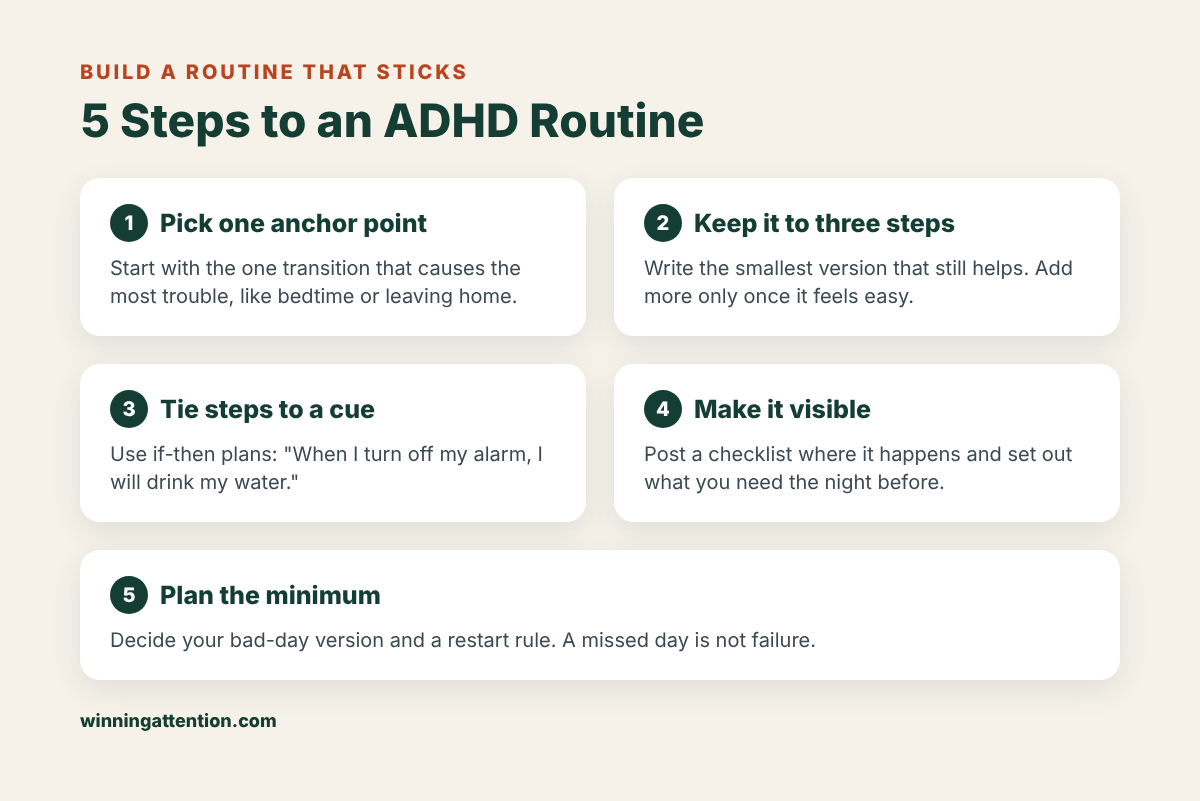
    Five steps to build an ADHD routine: pick one anchor point, keep it to three steps, tie each step to a cue, make it visible, and plan a minimum version
    Five steps to an ADHD routine that survives real life: start small, use cues, and plan for restarts.

    How to build an ADHD routine in 5 steps

    You can use this method to build any ADHD routine: a morning routine, a start-of-work routine, an end-of-day shutdown or a bedtime routine. Build one at a time. Once the first one feels mostly automatic, add the next.

    Step 1: Pick one anchor point in your day

    Do not try to fix your whole day at once. Choose the one transition that causes the most trouble. For many adults with ADHD, that is getting out the door in the morning, starting work, or going to bed on time. That single transition is where your first routine goes.

    Ask yourself: “If one part of my day ran smoothly, which part would make the rest easier?” Often the honest answer is bedtime, because a late night ruins the next morning, and a ruined morning drags down the whole day.

    Step 2: Keep it to three steps

    Write the smallest version of the routine that would still make a difference. Three steps is a good starting limit. You can always add more later, but a long routine that collapses on day four teaches you nothing except that routines do not work.

    Example: a three-step morning routine

    1. Drink a glass of water (it is already on the nightstand).
    2. Get dressed in the clothes laid out the night before.
    3. Check the “launch pad” by the door: keys, wallet, phone, bag.

    Notice what is not on the list: journaling, meditation, a 5 km run, cooking a perfect breakfast. Those can come later, if you want them. The first goal is a routine that happens.

    Step 3: Tie each step to a cue you already have

    Routines need a trigger. The most reliable triggers are things you already do every day without thinking: turning off your alarm, starting the coffee maker, brushing your teeth, sitting down at your desk, closing your laptop. Link the new step to one of these with an if-then plan.

    Examples of ADHD-friendly if-then cues

    • “When I turn off my alarm, I will drink the water on my nightstand.”
    • “When the coffee maker starts, I will fill my water bottle and check today’s calendar.”
    • “When I sit down at my desk, I will open my daily plan before I open email.”
    • “When I close my laptop for the day, I will write tomorrow’s first task on a sticky note.”
    • “When I brush my teeth at night, I will plug my phone in outside the bedroom.”

    Some people call this “habit stacking.” The idea is the same: the existing habit becomes the cue, so you do not have to remember the new step on your own.

    Step 4: Make the routine visible and ready

    If a routine depends on memory, it will fail on your worst days, which are exactly the days you need it most. Put the routine where you will see it at the moment you need it, and set up the tools in advance.

    • A checklist at the point of action. Tape the morning routine to the bathroom mirror, the shutdown routine next to your monitor, the bedtime routine by the light switch.
    • A launch pad. One spot by the door for keys, wallet, bag, badge and anything you need tomorrow.
    • Prepared materials. Clothes laid out, gym bag packed, lunch in the fridge, water glass filled.
    • External time cues. A visible clock, an alarm labeled with the next step (“Leave in 10 minutes”), or a playlist that ends when it is time to go.

    Step 5: Decide your minimum version and restart rule

    This is the step most routine advice skips, and it is the one that matters most with ADHD. Before you start, decide two things:

    1. Your minimum version. On a bad day, what is the one step you will still do? Maybe it is just “water and launch pad” in the morning, or just “phone outside the bedroom” at night. Doing the minimum keeps the cue-and-action link alive.
    2. Your restart rule. When (not if) the routine breaks, how will you restart? For example: “If I miss two days in a row, I restart the next morning with the minimum version, no catching up.” Remember that in the habit research, a single missed opportunity did not materially affect habit formation.

    Then give your ADHD routine time. Check in once a week: which step keeps getting skipped? Is it too big, badly timed, or missing a cue? Adjust one thing at a time.

    How to create an ADHD-friendly morning routine

    An ADHD morning routine has one job: get you from asleep to out the door (or to your desk) without a crisis. It is not a self-improvement program. Keep these principles in mind:

    • Move decisions to the night before. Clothes, bag, lunch and tomorrow’s first task are all easier to decide at 9 p.m. than at 7 a.m.
    • Remove the phone from the first 15 minutes. Checking messages in bed is one of the fastest ways to lose half an hour without noticing.
    • Use a “leave by” alarm, not just a wake-up alarm. Set an alarm for ten minutes before you need to leave, labeled “Shoes, keys, go.”
    • Add movement if it fits. A short walk, a few minutes of stretching or cycling to work can double as transport and, based on early research, may help with focus for a while afterward.
    • Be realistic about your body clock. If you are a strong night owl, an extremely early routine may be fighting your biology. Where you have flexibility, shift important tasks later rather than forcing a 5 a.m. start.

    An ADHD routine for the workday

    Work routines are less about time slots and more about transitions: starting, switching and stopping. Two short routines do most of the heavy lifting.

    A start-of-work routine (5 to 10 minutes)

    Before you open email or messages, look at your list and choose one task that would make the day a win, then set a timer for your first focus sprint. Our guide on how to plan your day with ADHD walks through a ten-minute version of this step by step.

    A shutdown routine (5 minutes)

    At the end of the day, tick off what got done, move unfinished tasks to tomorrow’s list, write the first step of tomorrow’s main task on a sticky note, and close everything. This parks open tasks on paper instead of letting them follow you into the evening, and it gives tomorrow morning a ready-made starting point.

    How to create an ADHD-friendly bedtime routine

    If you only build one ADHD routine, an ADHD bedtime routine is often the best choice, because sleep affects attention, mood and how hard the next morning will feel. Given how common later body clocks and insomnia are in adults with ADHD, this routine may need more support than the others.

    Set a “wind-down” alarm, not just a bedtime

    Bedtime itself is easy to blow past when you are absorbed in something. Instead, set an alarm 45 to 60 minutes before you want to be asleep. That alarm is the cue for the routine to start, not for you to be in bed already.

    Keep the routine short and calming

    Three steps is enough. For example: plug the phone in outside the bedroom, set out tomorrow’s clothes, then read something low-stakes on paper. Dim the lights in your living space when the wind-down alarm goes off.

    Keep wake-up time steady

    A consistent wake time, including on weekends where possible, helps anchor your body clock. Sleeping in very late on Saturday and Sunday can make Monday feel like jet lag.

    Watch for hyperfocus traps

    Games, videos and late-night projects can pull you into hyperfocus right when you should be winding down. If you know a particular activity regularly steals your sleep, give it a firm end time earlier in the evening or move it to another part of the day.

    If you have tried a steady bedtime routine for several weeks and still cannot fall asleep or stay asleep, talk to a clinician. Sleep problems in ADHD are common and treatable, and they can also be affected by medication timing, which is something only your prescriber should adjust.

    Sample ADHD routine for a full workday

    Here is what a full day of light routines might look like for an adult with a standard work schedule. The times are examples; shift them to fit your own sleep window and energy pattern.

    Time Routine Steps
    7:15 Wake-up Water from the nightstand, get dressed in the clothes laid out, open the curtains
    7:45 Out the door “Leave in 10 minutes” alarm, check the launch pad, go
    9:00 Start of work Open the daily plan before email, pick one task, start a timer
    12:30 Midday reset Lunch away from the screen, a 10-minute walk, refill water
    17:00 Shutdown Tick off done tasks, move the rest, write tomorrow’s first step, close everything
    21:30 Wind-down alarm Phone charging outside the bedroom, set out tomorrow’s clothes, dim lights
    22:30 Bed Read on paper until sleepy

    You do not need this whole ADHD routine at once. Pick the one row that would make the biggest difference and start there.

    Putting it together: one routine, four weeks

    Here is how building an ADHD routine might look for a fictional example: Priya, a nurse with ADHD who works day shifts and is late at least twice a week.

    1. Anchor point (week 1). Priya realizes her mornings fall apart because she goes to bed after 1:00 a.m. scrolling her phone. She decides her first routine will be at bedtime, not in the morning.
    2. Three steps. She writes: phone on the kitchen charger, uniform and badge on the chair, lights off by 11:30.
    3. Cues. “When my 10:45 alarm goes off, I will plug my phone in in the kitchen.” “When I brush my teeth, I will put my uniform on the chair.”
    4. Visible and ready. She labels the alarm “Phone to kitchen” and sticks the three steps on the bathroom mirror. She moves an old alarm clock into the bedroom so the phone is not needed there.
    5. Minimum version and restart. On bad nights, the minimum is “phone in the kitchen.” Her restart rule: if she misses two nights, she starts again with the minimum the next night.

    In week two, Priya misses three nights after a stressful shift. In the past, that would have been the end of the routine. This time she uses the restart rule and does just the minimum for a few days. By week four, the phone goes to the kitchen most nights without much thought, and she has only been late once. Her mornings are still not perfect, but the next routine she builds, a three-step launch pad by the door, now has a better night’s sleep behind it.

    Why ADHD routines fall apart, and how to restart

    Even well-designed routines break. Vacations, illness, new jobs, a new baby or a stressful week can knock any routine off course. A few patterns make restarting easier:

    • Restart small. Go back to the minimum version, not the full routine you had at your best.
    • Look for the broken cue. Often the routine failed because the trigger changed. A new commute or a new shift pattern means the old “when X, then Y” no longer fires. Pick a new cue.
    • Refresh the novelty. A new checklist design, a different playlist or a new place for the launch pad can make an old routine feel interesting again without changing its core.
    • Do not catch up. There is no backlog of missed routine days to make up. Today is the only day that counts.

    If a routine collapse leaves you feeling buried under everything you have not done, our guide to ADHD overwhelm has a short reset for that moment.

    Common mistakes to avoid

    • Copying someone else’s routine. Your ADHD routine should fit your life. A famous person’s 5 a.m. routine was not built for your body clock, your job or your brain. Start from your own trouble spots.
    • Building everything at once. A morning, work and bedtime routine all launched on the same Monday is a recipe for a crash by Thursday. One at a time.
    • Too many steps. Every extra step is another chance to get stuck. Start with three.
    • Relying on memory. If the routine is not written down where you will see it, it will quietly disappear.
    • All-or-nothing thinking. Doing one step of the routine is far better than doing none. The minimum version keeps the habit alive.
    • Giving up after three weeks. Habit formation can take months. Effort at week three is normal, not a sign of failure.

    If you want a simple starting point, the free ADHD Daily Planner Starter Kit includes a one-page daily planner, a weekly energy tracker you can use to spot your best and worst times of day, and a 2-minute reset card.

    When to talk to a professional

    Routines can make daily life smoother, but they are not a treatment for ADHD on their own. Talk to a doctor, psychologist or other qualified clinician if, despite a steady ADHD routine, disorganization or lateness is affecting your job, relationships, finances or health, if you have ongoing trouble falling or staying asleep, or if you notice low mood or anxiety. Sleep problems and ADHD often go together, and both can be assessed and treated. Evidence-based options include medication, CBT and skills programs like those described above, and many people benefit from a combination.

    Frequently asked questions

    Are people with ADHD routine-oriented?

    Usually not by nature. Many adults with ADHD are drawn to novelty and find repetition boring, which is why routines often fade after a few days. But the areas ADHD makes hardest, such as remembering, planning and starting on time, are exactly where a simple routine can help the most.

    Do routines help with ADHD?

    For many adults, yes. Structured skills programs for adult ADHD, which teach organization and planning routines, have shown benefits in randomized trials and meta-analyses. Routines work best when they are short, tied to an existing habit and written down where you can see them.

    How do you build a routine with ADHD?

    Pick one trouble spot in your day, keep the routine to about three steps, and tie each step to something you already do with an if-then plan. Make the routine visible with a checklist and prepared materials, and decide in advance on a minimum version and a restart rule for bad days.

    How do you create an ADHD-friendly morning routine?

    Move decisions to the night before, keep the routine to a few steps, and keep your phone out of the first 15 minutes. Use a labeled “leave by” alarm and a launch pad by the door for keys, wallet and bag. If you are a night owl, avoid building the routine around an extremely early start.

    How do you create an ADHD-friendly bedtime routine?

    Set a wind-down alarm 45 to 60 minutes before you want to be asleep, then follow two or three calming steps, such as charging your phone outside the bedroom and reading on paper. Keep your wake-up time steady, including weekends where possible. If sleep problems continue, talk to a clinician.

    Why do routines fall apart with ADHD?

    Common reasons include routines that are too long to hold in working memory, missing cues, boredom once the novelty wears off, a later body clock, and all-or-nothing thinking after a missed day. Habits can take months to form, and one missed day does not undo your progress, so restarting small is part of the process.

    Sources

  • ADHD Overwhelm: Why Everything Feels Like Too Much and How to Reset

    ADHD Overwhelm: Why Everything Feels Like Too Much and How to Reset

    It can start with something tiny: one more email, a sink full of dishes, a text you forgot to answer. Suddenly everything feels like too much at once. Your thoughts race, your chest tightens, and the only options that seem possible are shutting down or running away. If you live with ADHD, you probably know this feeling well. Many adults call it ADHD overwhelm.

    ADHD overwhelm is not a sign that you are lazy, weak or bad at life. Research on adult ADHD points to clear reasons why emotions, tasks and noise pile up faster for some brains, and it also points to practical ways to come back down. This guide covers what ADHD overwhelm is, why it happens, what studies say actually helps, and a five-step reset you can use in the moment.

    The short version: when overwhelm hits, do not try to solve everything. Pause and name the feeling, calm your body with a few long exhales, empty your head onto one page, shrink the next action until it is almost too small to fail, and cut the input around you. Then, on calmer days, build habits that keep the pile from getting so high.

    What is ADHD overwhelm?

    ADHD overwhelm is not an official diagnosis. It is a plain-language name for a state many adults with ADHD describe: the sense that demands, feelings and information have gone past what you can handle right now, so your ability to think, plan and act seems to switch off. It often looks like freezing, procrastinating, crying, snapping at people or scrolling your phone for an hour without meaning to.

    Everyone feels overwhelmed sometimes. What tends to be different with ADHD is how quickly it arrives, how intense it feels and how often it happens. A small trigger can tip a whole day. That pattern lines up with what researchers have found about emotion, attention and working memory in ADHD, which we will look at below.

    What ADHD overwhelm feels like

    People describe it in many ways, but a few experiences come up again and again:

    • Mental static. Your mind feels full and noisy, yet you cannot hold a single clear thought long enough to act on it.
    • Everything is urgent. Every task on the list seems equally important, so choosing one feels impossible.
    • Body alarm. A racing heart, shallow breathing, tight shoulders, a hot face or a knot in the stomach.
    • Shutdown or flight. You stare at the screen, go to bed in the middle of the day, or leave the room.
    • A harsh inner voice. “Why can’t I just do this like everyone else?” often follows close behind.

    Recognizing these signs early matters. The sooner you notice the wave, the smaller the reset you will need.

    Why ADHD overwhelm happens: what the research says

    There is no single cause of ADHD overwhelm. It usually comes from several pressures stacking up at once: strong emotions, too many open tasks, too much sensory input and too many decisions. Here is what research says about each one.

    Emotions rise faster and hit harder

    For a long time, ADHD was described only in terms of attention and hyperactivity. That view has changed. A major review in the American Journal of Psychiatry concluded that emotion dysregulation is common in ADHD across the lifespan and is a major contributor to the problems people experience in daily life (Shaw et al., 2014).

    A 2020 meta-analysis put numbers on it. Pooling 13 studies with 2,535 participants, researchers found that adults with ADHD had much higher levels of emotion dysregulation than healthy controls (Hedges’ g = 1.17, a large difference). Emotional lability, meaning quick and intense shifts in mood, showed the strongest effect (g = 1.20). The more severe someone’s ADHD symptoms, the more emotion dysregulation they tended to report (r = 0.54) (Beheshti et al., 2020).

    In everyday terms: if frustration, worry or disappointment arrives faster and louder, there is less room between “this is a lot” and “this is too much.” That is one of the main engines behind feeling overwhelmed with ADHD.

    Too many open loops

    Working memory is the brain’s short-term notepad. In ADHD it often has less room, which is one piece of the wider picture of ADHD executive function challenges. When dozens of tasks, reminders and worries live only in your head, they keep competing for that limited space.

    Research outside ADHD shows how costly those open loops can be. In a series of experiments, unfinished goals caused intrusive thoughts during an unrelated reading task. When participants were allowed to make a specific plan for the unfinished goal, those interference effects disappeared, even though the goal itself was not yet done (Masicampo & Baumeister, 2011). The study did not look at ADHD, but it suggests something useful: getting a task out of your head and onto a plan can quiet the background noise.

    The world can feel louder

    Many adults with ADHD say that noise, bright light, clutter, scratchy clothes or busy rooms wear them down faster than other people. Research here is still young, but it supports the experience. In a study of 234 adults from the general population (not a clinical ADHD sample), people with more ADHD traits reported more sensory processing problems across all senses, and ADHD traits predicted those sensory difficulties (Panagiotidi et al., 2018). The authors suggested sensory difficulties could be part of the ADHD picture.

    When your environment is already taking a large share of your attention, it takes much less for a task or a feeling to push you over the edge.

    Too many decisions (and a note on “willpower”)

    You may have heard that willpower is like a battery that runs down with every decision, an idea known as ego depletion. It is worth being honest about this one. When 23 laboratories ran a careful, preregistered replication with 2,141 participants, the effect was close to zero (d = 0.04, with a confidence interval that included zero) (Hagger et al., 2016). So it is not accurate to say that every choice drains a fixed tank.

    What is still true, and does not depend on that theory, is that a long list of unmade choices keeps many open loops running at once. Each “should I do this or that first?” competes for the same limited working memory. Reducing choices helps not because willpower is a battery, but because fewer open questions leave more room to think.

    The snowball effect

    These pressures feed each other. A noisy office makes it harder to focus, so tasks slip. Slipped tasks become a longer list. A longer list triggers worry and self-criticism, and strong emotions make it even harder to start. Before long, you are not reacting to one task but to the whole pile, plus the shame about the pile. Breaking that loop at any point, whether the emotion, the list or the noise, makes the rest easier to handle.

    What helps with ADHD overwhelm, according to studies

    No study has tested a single “overwhelm protocol” for adult ADHD. But several lines of research point in the same direction: build skills for managing tasks, learn to notice and label emotions, and calm the body directly.

    • Cognitive-behavioral therapy (CBT). A meta-analysis of 32 studies of CBT for adult ADHD found small-to-medium benefits compared with control groups for ADHD symptoms (g = 0.65) and for daily functioning (g = 0.51) (Knouse et al., 2017). These programs usually teach organization, planning and ways of handling unhelpful thoughts, all of which reduce the raw material of overwhelm.
    • Mindfulness-based approaches. A meta-analysis of mindfulness-based therapies for ADHD found reductions in inattention (d = -0.66 across 10 studies) and in hyperactivity/impulsivity (d = -0.53 across 9 studies) (Cairncross & Miller, 2020). In a randomized trial of 81 medication-free adults with ADHD, an 8-week mindfulness program and structured psychoeducation both reduced symptoms, and mindfulness was not superior to psychoeducation (Hoxhaj et al., 2018). The takeaway: mindfulness can help, but learning about ADHD and how it works for you is also valuable.
    • Putting feelings into words. In four experiments with adults (not an ADHD sample), people reported less distress when they labeled the emotion in a negative picture compared with just looking at it. Interestingly, participants did not expect labeling to help, even after it had (Lieberman et al., 2011).
    • Breathing with long exhales. In a remote randomized study, five minutes a day of “cyclic sighing,” a breathing pattern that emphasizes long exhales, improved mood and lowered breathing rate more than the same amount of mindfulness meditation over one month (Balban et al., 2023). This study was not done in people with ADHD, so treat it as a promising tool rather than an ADHD-specific treatment.

    The reset below combines these ingredients into a short routine you can use when overwhelm hits. It is a self-help structure, not a substitute for professional care.

    Five-step ADHD overwhelm reset: pause and name it, calm your body, empty your head onto one page, shrink to one small step, and cut the input
    A five-step reset for ADHD overwhelm: calm the body first, then shrink the pile to one small step.

    How to manage ADHD overwhelm: a 5-step reset

    The full reset takes about ten minutes. The first two steps alone take two minutes and are often enough to take the edge off. You do not need to feel calm to begin; you only need to start Step 1.

    Step 1: Pause and name it

    Stop what you are doing, even for thirty seconds. Then say, out loud or in writing, what is happening: “I am overwhelmed.” If you can, add the main feeling underneath it.

    This sounds almost too simple, but the labeling research above suggests that putting a feeling into words can turn down its intensity, even when it does not feel like it will help. Naming it also shifts you from being inside the wave to watching it, which is where choices become possible again.

    Examples of quick labels

    • “This is overwhelm. It will pass.”
    • “I feel panicked about the deadline and guilty about the emails.”
    • “Too much noise, too many tabs, not enough sleep.”
    • “I’m frustrated, and I’m also tired.”

    Step 2: Calm your body first

    When your body is in alarm mode, planning is very hard. So deal with the body before the to-do list. The simplest tool is a slow breath with a long exhale.

    How to do a cyclic sigh

    1. Breathe in through your nose.
    2. At the top, take a second, shorter sip of air to fully fill your lungs.
    3. Breathe out slowly through your mouth, making the exhale longer than the inhale.
    4. Repeat for one to five minutes, at a comfortable pace.

    If breathing exercises make you feel more anxious, skip them. Other body-first resets include splashing cold water on your face, stepping outside for two minutes, stretching, or walking around the block. The goal is not perfect calm; it is to come down one notch so your thinking brain can come back online.

    Step 3: Empty your head onto one page

    Take a sheet of paper or open one note and write down everything that is pressing on you: tasks, worries, messages you owe, things you are afraid you will forget. Do not sort or judge. Just get it out.

    This is the “open loops” idea in action. Once a task is on paper, your brain no longer has to keep reminding you about it. Many people are surprised to find that the list is shorter than it felt: twelve items, not a hundred. Seeing the real size of the pile is calming in itself.

    Step 4: Shrink to one next step

    Now look at the list and pick one item. Not the most important thing in your life, just one thing that would make the next hour better. Then shrink it down to a first step so small it feels almost silly.

    Overwhelm feeds on size. “Do my taxes” is a mountain. “Find last year’s tax return and put it on the desk” is a pebble. If you notice you still cannot start, the step is not small enough yet. Our guide to ADHD task paralysis has more ways to get moving when you are stuck.

    Examples of shrinking a task

    • “Clean the kitchen” becomes “put the plates in the dishwasher.”
    • “Answer all my email” becomes “reply to the one from my manager.”
    • “Fix my finances” becomes “log into the bank and look at this week’s balance.”
    • “Prepare the presentation” becomes “open the file and write three slide titles.”

    Step 5: Cut the input

    Before you start that tiny step, lower the noise around you for the next 20 to 30 minutes. Close tabs you do not need. Put your phone in another room or on do-not-disturb. Use headphones or earplugs if sound is bothering you. Clear just the area in front of you, not the whole room.

    Then set a short timer, maybe 10 or 15 minutes, and do only the one step. When the timer goes off, check in: do you want to keep going, take a break, or pick the next step from your list? Any of those is a win.

    Putting it together: one overwhelming afternoon

    Here is how the reset might look in practice for a fictional example: Marcus, a project coordinator with ADHD, at 2:15 on a Thursday afternoon, in the middle of a classic bout of ADHD overwhelm.

    1. The trigger. Marcus gets a message from his manager asking for the budget update “by end of day.” He already has 40 unread emails, a meeting at 3:30, and he has not eaten lunch. He opens the spreadsheet, closes it, opens his inbox, closes it, and finds himself reading the news. His heart is pounding.
    2. Pause and name it (30 seconds). He notices he has opened the same three tabs four times. He writes on a sticky note: “Overwhelmed. Hungry. Scared about the budget.”
    3. Calm the body (2 minutes). He does six slow cyclic sighs at his desk, then gets a granola bar and a glass of water from the kitchen.
    4. Empty the head (3 minutes). On one page he writes: budget update, 40 emails, prepare for 3:30 meeting, call the dentist back, pay the electric bill, reply to his sister about the weekend. Six items, not sixty.
    5. One small step (1 minute). The budget update has a real deadline. He shrinks it to: “Copy last month’s numbers into this month’s tab.” Everything else can wait until after the meeting or tomorrow.
    6. Cut the input (1 minute). He closes his email, puts his phone face down, and sets a 15-minute timer.

    By the end of the timer, the numbers are in and Marcus can see what is missing. The budget is not finished, but it is no longer a fog. He sends his manager a short note saying he will have it by 5:00 and goes into the meeting with a clearer head. The dentist and the electric bill go on tomorrow’s list. Nothing about the situation changed except how much of it he tried to hold at once.

    Preventing ADHD overwhelm before it starts

    The reset is for the moment overwhelm arrives. These habits help lower how often it shows up in the first place.

    Early warning sign What it often means A small response
    Opening and closing the same apps or tabs Too many open choices Write the list down and pick one item
    Snapping at people over small things Emotional load is high Name the feeling, take a short break
    Rereading the same sentence again and again Working memory is full Brain dump, then return
    Noise or light suddenly irritating Sensory load is high Headphones, a quieter room, dim the screen
    Skipping meals or water Body running on empty Eat something simple before deciding anything
    Saying “yes” to every request Load is growing faster than capacity Pause before agreeing: “Let me check and get back to you”

    Keep one trusted list

    Use one notebook or one app for everything you need to do. When tasks are scattered across sticky notes, inboxes and your memory, you can never be sure what is on your plate, and that uncertainty itself feels heavy. A short daily plan built from that single list, like the method in our guide on how to plan your day with ADHD, keeps the pile visible and manageable.

    Plan fewer things than you think you can do

    With ADHD, time estimates are often optimistic. A day planned to the minute leaves no room for the inevitable delay, and the first delay can tip you into overwhelm. Choose one task that would make the day a win, and treat the rest as a bonus.

    Protect the basics

    Sleep, food, water and movement are not extras. When you are tired or hungry, your emotional fuse gets shorter. You do not need a perfect routine; small, steady anchors such as a regular bedtime or a walk at lunch make overwhelm less likely.

    Practice the reset when you are calm

    Skills are easier to use under stress if you have practiced them without stress. Try the cyclic sigh for a minute while waiting for the kettle. Do a two-minute brain dump on a quiet evening. That way the steps are familiar when you really need them. The free ADHD Daily Planner Starter Kit includes a printable 2-minute reset card you can keep on your desk as a reminder.

    Is ADHD overwhelm a sign of burnout?

    Not always, but it can be. Overwhelm is usually a short-term state: it comes on in a moment, peaks and then eases, especially once you reset. Burnout is a longer pattern of exhaustion that builds over weeks or months, where rest no longer seems to restore your energy and you feel detached or hopeless about work or daily life.

    If you notice that overwhelm is happening most days, that you dread every morning, or that weekends and holidays do not help you recover, take it seriously. That is often a sign that the overall load is too high for too long, not that you need to try harder. It is a good moment to look at what can be dropped, delegated or postponed, and to talk to a professional.

    Common mistakes to avoid

    Most of these mistakes come from trying to think your way out of ADHD overwhelm while still flooded. Watch for them.

    • Trying to fix everything at once. When you are overwhelmed, a big cleanup or full reorganization only adds to the load. Aim for one small step.
    • Planning while flooded. Making decisions in alarm mode tends to produce panic plans. Calm the body first, then plan.
    • Pushing through without breaks. Forcing yourself to keep going while overwhelmed often leads to a bigger crash later. A five-minute reset is usually faster in the long run.
    • Treating escape as rest. Scrolling or bingeing a show can feel like a break, but it often leaves the pile untouched and adds guilt. Real rest is something that actually leaves you a bit restored.
    • Talking to yourself like a harsh critic. Shame makes emotions louder, not quieter. Try speaking to yourself the way you would speak to a stressed friend.
    • Waiting until you feel ready. With ADHD, motivation often follows action rather than coming first. Start tiny and let momentum do some of the work.

    When to talk to a professional

    Self-help strategies can make overwhelm more manageable, but they are not a treatment for ADHD on their own. Talk to a doctor, psychologist or other qualified clinician if overwhelm is affecting your work, relationships, finances or health, if it happens most days, or if you also have ongoing low mood, anxiety, sleep problems or panic attacks. Emotion dysregulation is common with ADHD, and evidence-based options such as medication, CBT and skills programs can help with it. If you ever have thoughts of harming yourself, contact a crisis line or emergency services right away; in the US and Canada you can call or text 988.

    Frequently asked questions

    What is ADHD overwhelm and is it real?

    ADHD overwhelm is an informal name for the state where tasks, emotions and information feel like more than you can handle, so thinking and acting seem to shut down. It is not a separate diagnosis, but it is real: research shows that adults with ADHD experience much more emotion dysregulation than adults without ADHD, which makes this kind of overload more likely.

    Why is everything so overwhelming with ADHD?

    Several things stack up at once. Emotions tend to rise faster and more intensely, working memory has less room for open tasks, many people are more sensitive to noise and clutter, and unmade decisions keep competing for attention. Each of these lowers the threshold for feeling that everything is too much.

    What does ADHD overwhelm feel like?

    Many people describe a full, noisy mind that cannot settle on one thought, a sense that every task is urgent, and physical signs like a racing heart or tight chest. It often ends in freezing, avoiding, crying, snapping at people or escaping into a phone.

    How do you calm ADHD overwhelm in the moment?

    Start with the body and work up to the task. Pause and name the feeling, take a few slow breaths with long exhales, write everything on one page, pick one tiny next step, and cut the noise around you for 15 minutes. You do not need to feel calm before you begin.

    How can I stop ADHD overwhelm from happening so often?

    Keep one trusted list, plan fewer tasks than you think you can do, and protect sleep, food and movement. Practice reset skills when you are calm so they are easier to use under stress. If overwhelm is frequent, structured help such as CBT for adult ADHD has research support.

    Is ADHD overwhelm a sign of burnout?

    Not always. Overwhelm is usually a short-term state that eases after a reset, while burnout is a longer pattern of exhaustion that rest does not seem to fix. If you feel overwhelmed most days for weeks, it may be a sign of burnout, and it is a good idea to talk to a professional.

    Sources

  • ADHD and Executive Function: A Plain-Language Guide for Adults

    ADHD and Executive Function: A Plain-Language Guide for Adults

    You can explain a complicated idea in a meeting, solve a problem nobody else saw, and still forget to pay the electric bill for the third month in a row. You know what to do. The trouble is getting yourself to do it, in the right order, at the right time. For many adults, that gap between knowing and doing is the heart of ADHD executive function problems.

    “Executive function” is one of those terms that gets used everywhere and explained almost nowhere. This guide translates it into plain language: what executive functions are, how ADHD affects them, what the research says helps (and what does not), and a practical five-step approach for building ADHD executive function strategies into everyday life.

    The short version: executive functions are the mental skills you use to manage yourself toward a goal. ADHD often makes them less reliable, but not in everyone and not in every situation. Brain-training games show little real-world benefit. What tends to help more is moving the work outside your head: written plans, visible time, small next steps, a friendlier environment and routines practiced until they run on their own.

    What is executive function? A plain-language definition

    Executive functions are a family of mental skills that let you stop and think before acting, hold information in mind while you use it, and switch approaches when something is not working. A widely cited review describes three core executive functions (Diamond, 2013):

    • Inhibition. Resisting impulses and temptations, and filtering out distractions so you can stay focused. This is what lets you not check your phone mid-sentence.
    • Working memory. Holding information in mind and working with it, like remembering the three things you came into the kitchen for, or keeping track of a conversation while planning your reply.
    • Cognitive flexibility. Shifting perspectives, adapting when plans change, and finding a new way around a problem.

    Higher-level skills such as planning, organizing, problem-solving and managing time are built on top of these three. A helpful way to picture it: executive functions are less like a single “boss” in the brain and more like a management team. When the team is working well, you barely notice it. When it is stretched, everyday tasks start slipping through the cracks.

    The same review also points out something important for adults: stress, lack of sleep, loneliness and lack of exercise each impair executive functions (Diamond, 2013). Everyone’s executive skills dip on a bad night’s sleep or a high-stress week. With ADHD, that dip often starts from a lower baseline.

    Is ADHD an executive function disorder?

    This is one of the most common questions about ADHD executive function, and the honest answer is: partly. Executive function problems are a central part of ADHD for many people, but they do not fully explain it.

    The theory: ADHD as a self-regulation problem

    One influential model proposed that ADHD is rooted in difficulty with behavioral inhibition, the ability to pause before responding. That pause, the model argues, is what gives other executive functions room to work: working memory, regulating motivation and emotion, self-directed speech (“OK, first I need to…”), and planning. Reviewing the evidence available at the time, the author found the strongest support for deficits in behavioral inhibition, working memory, regulation of motivation and motor control (Barkley, 1997). The model also stressed that much more research was needed.

    The evidence: real, but not universal

    A major meta-analysis tested the ADHD executive function theory across 83 studies, comparing 3,734 people with ADHD to 2,969 without it; most of the studies involved children and adolescents. People with ADHD showed significant weaknesses on every executive function task, with medium effect sizes (0.46 to 0.69). The strongest and most consistent differences were in response inhibition, vigilance, working memory and planning. These weaknesses were not explained by differences in intelligence or other conditions (Willcutt et al., 2005).

    But the same researchers also concluded that, because the effects were moderate and executive function weaknesses were not found in everyone with ADHD, those weaknesses are “neither necessary nor sufficient” to cause all cases of ADHD. Executive function difficulties are one important piece of the picture, not the whole picture.

    Studies of adult ADHD executive function point the same way. A meta-analysis of 13 studies comparing adults with ADHD to adults without it found medium-sized differences on executive measures such as inhibition, verbal fluency and set shifting, but also similar-sized differences on non-executive measures such as response consistency and reading speed (Boonstra et al., 2005). The authors concluded that neuropsychological difficulties in adult ADHD may not be confined to executive functioning.

    Why lab tests and daily life often disagree

    Here is something that surprises many people: you can do fine on formal executive function tests and still struggle badly with executive function in daily life. A review of 20 studies (13 with children and 7 with adults) compared performance-based tests of executive function with rating scales that ask how people actually manage in everyday life. Only 24% of the 286 correlations were statistically significant, and the median correlation was just 0.19 (Toplak et al., 2013).

    The authors concluded that the two kinds of measures capture different things: tests reflect how efficiently your mind works in a quiet, structured room with clear instructions, while ratings reflect how well you actually pursue your goals in the messy real world. For anyone frustrated by ADHD executive function struggles, this is validating. A “normal” test result does not mean your everyday struggles are imaginary. The quiet testing room provides exactly the external structure that daily life lacks.

    Signs of ADHD executive function problems in adults

    Executive dysfunction is not a formal diagnosis. It is a description of what happens when the management team is under-resourced. Here is how ADHD executive function difficulties often show up for adults, grouped by the skill involved.

    Inhibition and self-control

    • Interrupting people or blurting out comments, then regretting it.
    • Impulse purchases, or saying yes to commitments before checking your calendar.
    • Getting pulled into your phone, email or a side task before finishing what you started.

    Working memory

    • Walking into a room and forgetting why.
    • Losing track of instructions halfway through a task or conversation.
    • Forgetting appointments, bills and promises unless they are written down and visible.

    Planning and organization

    • Not knowing where to start on a multi-step project, even when you understand each step.
    • Underestimating how long tasks will take, again and again. Our article on ADHD time blindness explains why.
    • Piles, lost keys, missing documents and an inbox with thousands of unread emails.

    Task initiation and follow-through

    • Struggling to start tasks that are boring or unclear, then finishing in a last-minute rush.
    • Many half-finished projects.
    • Putting off important tasks for weeks, which is covered in detail in our guide to ADHD procrastination.

    Flexibility and emotional regulation

    • Feeling thrown for the whole day when a plan changes.
    • Getting stuck on one approach even when it is clearly not working.
    • Frustration that builds quickly and makes it hard to return to the task.

    None of these alone means you have ADHD. Everyone forgets things and procrastinates sometimes. What matters is how often it happens, how much it costs you, and whether the pattern has been present since childhood. Only a qualified clinician can assess that.

    Executive dysfunction: ADHD, autism or depression?

    Executive function difficulties are not unique to ADHD. They show up across many conditions, which is one reason “executive dysfunction” on its own does not point to a specific diagnosis.

    • Depression. A meta-analysis of 113 studies found that major depressive disorder is reliably associated with weaker performance on executive function tests, with effect sizes ranging from 0.32 to 0.97. Some evidence suggested bigger deficits in people with more severe current depression (Snyder, 2013).
    • Autism. A meta-analysis of 235 studies with 14,081 participants found a moderate overall reduction in executive function in autism spectrum disorder (Hedges’ g = 0.48), relatively stable across development. Notably, executive function tests were not good at telling autism apart from other conditions (Demetriou et al., 2018).
    • ADHD. As described above, ADHD executive function research shows medium-sized differences across several executive domains, strongest for inhibition, working memory, vigilance and planning, but not present in everyone with the diagnosis (Willcutt et al., 2005).

    These conditions also frequently occur together. An adult can have ADHD and depression, or ADHD and autism, and each can make executive functioning harder in different ways. Some practical differences people often notice: ADHD-related executive problems usually go back to childhood and are fairly constant over time, while depression-related problems often come and go with mood episodes and are accompanied by low mood or loss of interest. Because the patterns overlap so much, the question “is this ADHD, autism or depression?” is one to take to a professional rather than answer with a checklist.

    Can you improve ADHD executive function? What the research says

    The good news: adults can get better at managing their executive function challenges. The more nuanced news: the methods with the best evidence focus on strategies and habits, not on “training the brain” directly.

    Brain-training games: weak real-world transfer

    Computerized working memory training was once promoted as a way to boost attention and intelligence, including for ADHD. A meta-analysis of 87 publications with 145 comparisons found that these programs do produce short-term improvements on tasks similar to the ones practiced. But when compared with active control groups, there was no convincing evidence of improvement on “far transfer” measures such as reasoning, reading comprehension or arithmetic, and how much people improved on the training did not predict any wider benefit (Melby-Lervåg et al., 2016). The authors concluded that the effects are short-term and specific and do not generalize to real-world cognitive skills.

    In plain terms: you will probably get better at the game. That improvement is unlikely to carry over to everyday ADHD executive function tasks like remembering to pay the bill. Your time and money are usually better spent elsewhere.

    Skills-based therapy: the strongest evidence

    Approaches that teach practical strategies for time management, organization and planning have more encouraging results.

    • Meta-cognitive therapy. In a randomized trial of 88 adults with ADHD, a 12-week group program teaching time management, organization and planning skills, and addressing the discouraging thoughts that undermine self-management, improved inattention symptoms more than supportive therapy. After adjusting for baseline severity, participants in the skills group had more than five times the odds of responding to treatment (odds ratio 5.41) (Solanto et al., 2010).
    • CBT for adult ADHD overall. A meta-analysis of 32 studies found small-to-medium benefits of cognitive-behavioral treatments compared with control groups for ADHD symptoms (g = 0.65) and daily functioning (g = 0.51), with smaller effects in studies using active control groups (Knouse et al., 2017).

    These programs do not try to make your working memory bigger. They teach you to rely on it less: one central capture system, a daily planning routine, breaking tasks into small steps, scheduling tasks rather than just listing them, and practicing until the routine becomes automatic. The method below borrows those ingredients.

    Five external supports for ADHD executive function: externalize memory, make time visible, shrink and sequence tasks, design your space, build routines
    If a skill is unreliable inside your head, move it outside: five ways to support ADHD executive function.

    ADHD executive function strategies: a 5-step “outsource it” method

    The core idea is simple: if a skill is unreliable inside your head, move it outside your head. Each step below takes one executive function that ADHD tends to strain and gives it an external support. Start with one step, practice it for a couple of weeks, then add the next. These are simplified versions of the ADHD executive function strategies taught, in various forms, in the skills programs described above.

    Step 1: Externalize your working memory

    Stop trusting your memory with anything that matters. Choose one capture place for all tasks, ideas and commitments: one notebook, or one app. Two systems means half your tasks are always in the other one. Capture things the moment they come up, and check the capture place at set times each day.

    Examples

    • Keep a small notebook or a single notes app on your phone’s home screen, and use nothing else for tasks.
    • Put fixed appointments in a calendar with two alarms: one the day before and one with enough travel time.
    • When someone asks you to do something, write it down before you say yes.

    Step 2: Make time visible

    Planning and time management depend on sensing how much time is passing and how much is left. When that sense is unreliable, use tools that show time instead of relying on feel.

    Examples

    • An analog clock or a visual countdown timer on your desk.
    • Timers for any task where you tend to lose track, such as showering, social media or “just one more email.”
    • Adding 50% to every time estimate, and writing the end time next to the task (“10:00 to 10:45”), not just the start.

    Step 3: Shrink and sequence every task

    Planning a multi-step task in your head taxes working memory and planning at the same time. Do it on paper instead. For any task bigger than about 30 minutes, write the steps down and circle the very first physical action. Then put that first action on a specific day and time, not just on a list. A short daily routine helps here; our guide on how to plan your day with ADHD shows a ten-minute version.

    Example: breaking down “renew my passport”

    1. Find the old passport and put it on the desk (Monday, 7 p.m.).
    2. Look up the renewal form and print it (Monday, 7:10 p.m.).
    3. Get a photo taken (Wednesday, lunch break).
    4. Fill in the form and put everything in an envelope (Thursday, 7 p.m.).
    5. Mail it (Friday, on the way to work).

    Step 4: Design your environment so inhibition has less to do

    Every time you resist a distraction, you spend a bit of self-control. With ADHD, that supply runs low quickly. Instead of resisting harder, reduce how often you have to resist at all.

    Examples

    • Phone in another room, or in a drawer, during focus work.
    • Website blockers scheduled for your most important work hours.
    • A “launch pad” by the door for keys, wallet, badge and anything you need tomorrow.
    • Only the current task’s materials on your desk; everything else in a box or another room.

    Step 5: Turn repeated decisions into routines and checklists

    Every decision draws on executive resources. Routines and checklists make decisions once, in advance, so you do not have to make them again every day. Attach each new routine to something you already do, and write it down where you will see it at that moment.

    Examples

    • A morning checklist taped inside the front door: keys, phone, lunch, meds if prescribed, bag.
    • A five-minute shutdown at the end of the workday: tick off what is done, move the rest to tomorrow, clear the desk.
    • A 15-minute weekly reset: empty bags and inboxes into your capture place and look at the week ahead.

    If you would like printable tools for Steps 1, 3 and 5, the free ADHD Daily Planner Starter Kit includes a one-page daily planner, a weekly energy tracker and a 2-minute reset card.

    Supporting all five steps: protect the basics

    Because stress, poor sleep, loneliness and lack of exercise all impair executive functions (Diamond, 2013), looking after these is not a luxury. It is part of the strategy. If your systems keep collapsing during busy or sleep-deprived weeks, that is not a personal failure. It is a sign to simplify the plan and protect recovery time.

    Quick reference: ADHD executive function supports

    Use this table to match the skill that is giving you trouble with a tool that takes some of the load.

    Executive function How it can look with ADHD External support to try
    Working memory Forgetting tasks, losing track mid-conversation One capture notebook or app, written instructions, alarms labeled with the action
    Inhibition Impulsive replies, purchases, phone checking Phone out of reach, site blockers, a 24-hour rule for non-essential purchases
    Planning Not knowing where to start on big projects Break tasks into steps on paper, circle the first action, schedule it
    Time management Chronic lateness, underestimating tasks Visual timers, end times on tasks, add 50% to estimates
    Task initiation Putting off boring or unclear tasks Five-minute first steps, if-then plans, working alongside someone
    Cognitive flexibility Derailed by changes in plans A flexible block in the day, a written “plan B” for important tasks
    Organization Piles, lost items, missed paperwork A launch pad by the door, one inbox tray, a weekly reset

    Putting it together: a worked example

    Here is how the approach might look for a fictional example: Priya, a 41-year-old nurse and parent of two, who was diagnosed with ADHD last year. She is good at her job, where shifts are structured and checklists are everywhere. At home, it is a different story: permission slips go unsigned, bills are paid late, and she regularly loses her car keys.

    1. One capture place (week 1). Priya replaces three notebooks, a whiteboard and her phone’s reminders with one small notebook she keeps in her bag. Every request from her kids’ school goes in it the moment she reads it. She checks it each morning with coffee.
    2. Visible time (week 2). She puts a visual timer on the kitchen counter for the evening routine: 20 minutes for dinner cleanup, 10 minutes for school bags. The kids can see it too, and it ends the nightly negotiation over “five more minutes.”
    3. Shrink and sequence (week 3). The overdue task of switching the family to a new health insurance plan has sat for two months. Priya writes five tiny steps, circles “find the email from HR,” and schedules it for Tuesday at 8 p.m.
    4. Environment (week 4). She installs a hook and a small tray by the front door. Keys, wallet and badge go there every time she walks in. Lost-keys mornings drop from several a week to rare.
    5. Routines (week 5). A Sunday 15-minute reset: she empties her bag, copies the week’s school events into the family calendar, and pays any bills due that week. She tapes a short checklist for it to the inside of a cupboard door.

    Priya’s working memory has not changed. What changed is how much she asks of it. By the end of five weeks, many of the tasks that used to depend on her remembering at the right moment are now handled by systems she can see. That is what good ADHD executive function support looks like in practice.

    Can adults improve executive functioning skills?

    Yes, in the sense that matters most: adults can get much better at managing ADHD executive function challenges and at reaching their goals despite them. The research summarized above suggests that structured, skills-based programs help many adults with ADHD, while generic brain training does little for everyday life.

    A few principles make progress more likely:

    • Practice in real life, not on an app. Skills seem to stick when you practice them in the situations where you need them, such as at your desk, in your kitchen or at the front door.
    • Change one thing at a time. Adding five new systems at once is itself a heavy executive load. One habit, practiced for two or three weeks, beats five abandoned ones.
    • Expect lapses and plan restarts. Systems will break during busy weeks. The skill is noticing and restarting, not never slipping.
    • Use other people. Shared calendars, a friend you check in with, or working alongside someone are all legitimate external supports.
    • Treat it as support, not a test. Using alarms, lists and checklists is not cheating. It is how executive function works best for many brains, with or without ADHD.

    Common mistakes to avoid

    • Trying to fix it with willpower. ADHD executive function difficulties are not a motivation problem. Trying harder with the same unreliable tools usually leads to the same result, plus more guilt.
    • Building a complicated system. A color-coded, multi-app setup is itself an executive function challenge. The best system is the simplest one you will actually use.
    • Relying on brain-training apps. Short-term gains on the game rarely transfer to real tasks. Spend the time on practical strategies instead.
    • Keeping the plan in your head. If it is not written down and visible, assume it will be forgotten.
    • Assuming a normal test score settles it. Formal tests and daily functioning often disagree. Your real-world difficulties are worth taking seriously.
    • Ignoring sleep, stress and mood. When these are off, every executive skill suffers. Sometimes the most useful strategy is to rest, simplify or get support for mood.

    When to talk to a professional

    The strategies in this guide can make daily life easier, but they are not a treatment for ADHD on their own and they cannot tell you what is causing your difficulties. Talk to a doctor, psychologist or other qualified clinician if executive function problems are affecting your work, studies, finances, relationships or safety; if you have never been assessed and recognize yourself here; or if your difficulties came on recently, are getting worse, or come with low mood, anxiety, memory changes or sleep problems. Executive dysfunction can be linked to ADHD, depression, autism, anxiety, sleep disorders and other medical conditions, and sorting these out is a job for a professional. Evidence-based options for adult ADHD include medication, CBT and skills-based programs like those described above, and many people benefit from a combination.

    Frequently asked questions

    What is ADHD executive function?

    Executive functions are the mental skills you use to manage yourself toward a goal, including inhibition, working memory and cognitive flexibility, plus planning and organization built on top of them. “ADHD executive function” usually refers to the way ADHD makes these skills less reliable, so that knowing what to do does not always translate into doing it. The effects vary a lot from person to person.

    Is ADHD an executive function disorder?

    Partly. Research shows that groups of people with ADHD have medium-sized weaknesses in executive functions, especially inhibition, working memory, vigilance and planning. But these weaknesses are not found in everyone with ADHD, so researchers describe executive difficulties as one important part of ADHD rather than its single cause.

    What are examples of executive dysfunction in ADHD?

    Common examples include forgetting appointments unless they are written down, struggling to start boring or unclear tasks, underestimating how long things take, losing items, getting derailed when plans change and acting on impulses before thinking. Many adults also describe many half-finished projects and last-minute rushes.

    Is executive dysfunction ADHD, autism or depression?

    It can be any of these, and more. Meta-analyses show executive function weaknesses in ADHD, autism and depression, and the conditions often occur together. Executive function tests alone cannot tell them apart, so a qualified clinician should assess the full picture, including history, mood and other symptoms.

    How do you manage executive dysfunction with ADHD?

    The most practical approach to ADHD executive function problems is to move the work outside your head: one place to capture tasks, visible timers, tasks broken into small scheduled steps, an environment with fewer distractions and routines with checklists. Structured skills-based therapy for adult ADHD has research support, and many people combine strategies with medication under a clinician’s care.

    Can adults improve executive functioning skills?

    Adults can get much better at managing executive function challenges, especially by practicing practical strategies in real-life situations. Studies of computerized working memory training show little benefit beyond the trained tasks, while skills-based programs for adult ADHD show more meaningful improvements in symptoms and daily functioning.

    Sources

  • ADHD Procrastination: Why It Isn’t Laziness and What Works Instead

    ADHD Procrastination: Why It Isn’t Laziness and What Works Instead

    You know the task matters. You know the deadline is real. You may even have cleared your afternoon for it. And still, hours later, the document is unopened, the dishes are done, your inbox is tidy, and you feel worse than when you started. If that loop sounds familiar, you are probably dealing with ADHD procrastination, and it has very little to do with being lazy.

    Research on procrastination and on adult ADHD points to the same handful of drivers: tasks that feel unpleasant, rewards that feel far away, attention that drifts, and strong emotions that push you toward quick relief. This guide explains why ADHD procrastination happens, what the research says actually helps, and a five-step method you can use the next time you are stuck staring at a task you cannot make yourself begin.

    The short version: ADHD procrastination is a problem of starting and of managing feelings, not a problem of caring. Name what makes the task feel bad, shrink the first step until it takes five minutes, bring the reward and the deadline closer to now, tie the start to a specific cue, and restart without punishing yourself when you slip.

    Why ADHD procrastination happens: what the research says

    Everyone procrastinates sometimes. Procrastination becomes a bigger problem when it is chronic, when it costs you money, jobs, grades or relationships, and when it happens even for tasks you genuinely want to get done. That is the pattern many adults with ADHD describe, and research is starting to explain why.

    Procrastination is a self-regulation problem, not a character flaw

    The best-known review of procrastination research is a meta-analysis that pooled 691 correlations from studies of general (non-ADHD) samples. It found that the strongest and most consistent predictors of putting things off were how unpleasant the task felt (task aversiveness), how far away the deadline or reward was, low confidence in one’s ability to do the task (self-efficacy), and impulsiveness, along with facets of conscientiousness such as self-control, distractibility and organization (Steel, 2007). Traits that people often blame, such as rebelliousness, showed only a weak connection.

    Look at that list again with ADHD in mind. Distractibility, impulsiveness and disorganization are close cousins of core ADHD symptoms. In other words, the ingredients that make anyone more likely to procrastinate are the same areas where ADHD makes life harder. The review described procrastination as a “quintessential” failure of self-regulation, and that framing matters: it points to skills and supports, not to blame.

    Inattention is the symptom most linked to procrastination

    Procrastination is not listed as an official ADHD symptom, but studies keep finding a connection. In a small study of 54 university students with varying levels of ADHD-type behaviors, the researchers expected impulsivity to drive procrastination. Instead, once the overlap between symptom types was accounted for, only inattention was linked to general procrastination (Niermann & Scheres, 2014). The authors called the finding preliminary, since the students were not formally diagnosed.

    A larger preregistered survey of 640 adults found the same pattern: ADHD inattention symptoms were positively associated with procrastination. Three factors helped explain the link: sensitivity to delay, seeing the task as low in value, and difficulty with flexible goal adjustment (Netzer Turgeman & Pollak, 2026). That is useful, because each of those three things is something you can work on directly, as you will see in the method below.

    “Later” feels much smaller than “now”

    Most people prefer a reward today over a bigger reward next month. Researchers call this delay discounting, and people with ADHD tend to show more of it. A meta-analysis of 21 investigations with 3,913 participants found a medium-sized difference between people with and without ADHD (d = 0.43), with no significant difference between children and adults (Jackson & MacKillop, 2016).

    For procrastination, this means the payoff of finishing a report next week barely registers against the instant relief of checking your phone right now. It also explains why a looming deadline suddenly works: when the consequence is close enough to feel, your brain finally treats it as real. Many adults with ADHD notice that their sense of time itself is slippery, which makes distant deadlines feel even more abstract. If that sounds like you, our guide to ADHD time blindness goes deeper.

    Procrastination is often about feelings, not tasks

    One of the most helpful ideas in procrastination research is that putting things off is often a way of managing mood. Researchers have argued that procrastination has “a great deal to do with short-term mood repair and emotion regulation”: when a task feels aversive, avoiding it brings quick relief, and the cost is handed to your future self (Sirois & Pychyl, 2013).

    This matters for ADHD because emotional regulation is often harder. A meta-analysis of 13 studies with 2,535 participants found that adults with ADHD showed substantially higher levels of emotion dysregulation than healthy controls (Hedges’ g = 1.17), and that more severe ADHD symptoms went along with more emotion dysregulation (r = 0.54) (Beheshti et al., 2020). When boredom, frustration, shame or fear of failure hit harder, the pull toward instant relief is stronger too.

    The cost adds up

    ADHD procrastination is not a harmless quirk. In an online survey of 132 adults, higher ADHD symptoms were linked to more procrastination and to lower quality of life, and procrastination helped account for the link between ADHD symptoms and poorer quality of life (Netzer Turgeman & Pollak, 2025). The study was cross-sectional, so it cannot prove cause and effect, but it fits what many people live with: missed deadlines, late fees, stalled projects and a constant background hum of guilt.

    ADHD procrastination vs. laziness: what is the difference?

    From the outside, ADHD procrastination and laziness can look the same: the task is not getting done. From the inside, they feel very different.

    • Laziness usually means you do not much care about the task and are comfortable not doing it. You are not suffering over it.
    • ADHD procrastination usually means you do care, often a lot. You think about the task constantly, feel guilty and anxious, and may spend more energy avoiding it than the task itself would take. You are stuck, not relaxed.

    Another clue is that ADHD procrastination is uneven. You may struggle for weeks to send a two-line email, then work for six hours straight on something that interests you, or finish a huge project overnight once panic kicks in. That pattern fits what the research describes: interest, urgency and emotional relief move the needle, while abstract importance often does not.

    The “lazy” label does real harm. It turns a skills problem into a moral one, which adds shame, which makes the task feel even more aversive, which leads to more avoidance. Dropping the label is not about excusing yourself. It is about choosing strategies that actually work.

    What helps with ADHD procrastination: the treatment evidence

    There are no large trials of “procrastination treatment” specifically for adults with ADHD. The strongest evidence comes from cognitive-behavioral therapy (CBT) programs for adult ADHD, which almost always include procrastination as a core target alongside planning, organization and unhelpful thinking patterns.

    • CBT for adults already on medication. In a randomized trial of 86 adults with ADHD who still had significant symptoms despite medication, 12 individual sessions of CBT led to better symptom outcomes than an attention-matched relaxation and education program. On the ADHD rating scale, 67% responded to CBT versus 33% in the comparison group, and responders maintained their gains over 6 and 12 months (Safren et al., 2010).
    • The bigger picture. A meta-analysis of 32 studies of CBT for adult ADHD found small-to-medium benefits compared with control groups for symptoms (g = 0.65) and for daily functioning (g = 0.51) (Knouse et al., 2017). Effects were smaller in studies that used active control groups, which is a reminder that results vary.
    • If-then plans. Outside ADHD research, a large meta-analysis of implementation intentions, plans in the form “when X happens, I will do Y”, found that they improve goal attainment compared with setting a goal alone (Gollwitzer & Sheeran, 2006). This is one of the simplest tools for the “starting” problem.

    Put together, the research suggests a practical recipe: make tasks less aversive, make rewards and consequences feel closer, make the start automatic, and handle the emotions that drive avoidance. The method below is built from those ingredients. It is a self-help structure, not a replacement for professional care.

    Five-step ADHD procrastination method: name the feeling, shrink the first step, bring the reward closer, tie the start to a cue, restart kindly
    Five steps for ADHD procrastination: work on the feeling and the first step, not on willpower.

    How to stop procrastinating with ADHD: a 5-step method

    Use these steps whenever you notice you have been circling a task. The first time, it may take 10 minutes. With practice, you can run through it in two or three.

    Step 1: Name what makes the task feel bad

    Before trying to force yourself to start, ask one honest question: what exactly feels bad about this task? Write the answer down in a few words. Most stuck tasks fall into one of a few categories.

    • Boring: repetitive, low-stimulation work like expense reports or filing.
    • Unclear: you do not know what the first step is, or what “done” looks like.
    • Too big: the whole task is in your head at once, and it is overwhelming.
    • Emotionally loaded: it involves possible criticism, conflict, money worries or a past failure.
    • Low value: you cannot see why it matters, or it matters to someone else more than to you.

    Naming the feeling does two things. It reminds you that the problem is the mood, not your character. And it tells you which of the next steps to lean on hardest, because a boring task needs a different fix than a scary one.

    Example: naming the stuck point

    “Call the insurance company” might be stuck because it is emotionally loaded (you are worried they will say no) and unclear (you are not sure which number to call or what documents you need). Now you know the problem is not the phone call itself.

    Step 2: Shrink the first step to five minutes

    Vague, large tasks are the natural habitat of ADHD procrastination. Rewrite the task as the smallest visible physical action you could do in five minutes or less. Not “do taxes” but “find last year’s tax return and put it on the desk.” Not “write the essay” but “open a document and write three bad sentences.”

    The goal of the first step is not progress. It is ignition. Once you are moving, the task usually feels less threatening and continuing is easier than starting. If you often freeze completely at this stage, our article on ADHD task paralysis has more ways to get unstuck.

    Examples of five-minute first steps

    • “Clean the kitchen” becomes “load the top rack of the dishwasher.”
    • “Update my resume” becomes “open my resume and change the date on my current job.”
    • “Reply to the difficult email” becomes “write a one-line subject and the greeting, then save as draft.”
    • “Plan the project” becomes “list the three parts of the project on a sticky note.”

    Step 3: Bring the reward and the deadline closer to now

    Because a distant payoff feels small, the fix is to create a nearer one. You are not trying to want the task more in the abstract. You are adding something that matters today.

    • Make a near deadline. Split one far deadline into small, dated checkpoints, and tell someone about the first one.
    • Add a small immediate reward. Pair the task with something you enjoy, such as a favorite drink, a playlist or a podcast reserved only for that type of task.
    • Add accountability. Work alongside a friend in person or on a video call, a practice often called body doubling. Telling someone “I will send you a screenshot of the first page by 11:00” turns a vague future consequence into a present one.
    • Connect it to a reason you care about. If the task feels low value, write one sentence about what finishing it gives you: less stress, money, freedom, keeping a promise to someone you love.

    These strategies map directly onto two of the factors that explained the link between inattention and procrastination in adults: sensitivity to delay and low perceived task value (Netzer Turgeman & Pollak, 2026).

    Step 4: Tie the start to a specific cue

    “I will do it this afternoon” is a wish. “When I come back from lunch and sit down, I will open the budget spreadsheet and fill in this month’s rent” is a plan. If-then plans link a cue you will definitely meet (a time, a place, an action you already do) to the five-minute first step from Step 2, so starting stops being a decision you have to make in the moment.

    Examples of if-then plans for ADHD procrastination

    • “When I pour my first coffee, I will open the report and read the last paragraph I wrote.”
    • “If I catch myself opening social media during my work block, I will close the app, stand up, and write the next single step on a sticky note.”
    • “When the 3:00 alarm labeled ‘insurance call’ goes off, I will dial the number written on the alarm.”
    • “When I get home and put my keys down, I will spend five minutes on the laundry pile before sitting on the couch.”

    Write the plan where you will see it at the moment of the cue: on the alarm label, a sticky note on your laptop, or the top line of today’s page in your planner.

    Step 5: Restart without punishment

    You will slip. Everyone does, and with ADHD it will happen often. What matters is how fast you restart. Harsh self-criticism feels like it should motivate you, but it mostly adds another bad feeling to the task, and avoiding bad feelings is exactly what drives procrastination in the first place (Sirois & Pychyl, 2013).

    Try a short reset instead:

    1. Notice: “I have been avoiding this for the last hour.”
    2. Normalize: “That makes sense. This task feels unclear and a bit scary.”
    3. Next step: “What is the five-minute version I can do right now?”

    Then set a timer and do only that. Treat each restart as a skill you are practicing, not proof that you have failed.

    Match the strategy to the reason you are stuck

    Different kinds of ADHD procrastination need different first moves. Use this table as a quick reference once you have named the stuck point in Step 1.

    Why the task feels bad What it sounds like Try this first
    Boring “I just can’t make myself do this.” Pair it with music or a treat, set a 10-minute timer, work next to someone else
    Unclear “I don’t even know where to start.” Write the very first physical action, or ask someone what “done” looks like
    Too big “There’s no point starting, I’ll never finish.” Break it into three parts and schedule only the first one
    Emotionally loaded “What if it goes badly?” Name the fear, do the smallest step, plan a kind reset for afterward
    Low value “Why does this even matter?” Write one sentence on what finishing gives you, add a near deadline
    Far deadline “I have weeks, I’ll do it later.” Create dated checkpoints and tell someone about the first one

    Putting it together: a worked example

    Here is how the method might look for a fictional example: Marcus, a 34-year-old sales manager with ADHD, who has put off his tax paperwork for six weeks. The filing deadline is in three weeks. Every evening he plans to “start the taxes,” and every evening he does something else.

    1. Name the feeling (2 minutes). Marcus writes: “Unclear (I don’t know what documents I need), too big, and emotionally loaded (I’m scared I owe money).” Seeing the words on paper makes it clear that the real problem is fear and fog, not lack of effort.
    2. Shrink the first step (1 minute). The five-minute version is: “Find last year’s return in the email folder and print the first page.” That is it.
    3. Bring it closer (3 minutes). He texts a friend: “I’m sending you a photo of my tax folder by Thursday 8 p.m. Hold me to it.” He splits the job into three checkpoints: gather documents (Thursday), enter income (Sunday), review and file (next Wednesday). He also writes one sentence on why it matters to him: “Getting this done means I stop feeling sick every time I see the word ‘tax.’”
    4. Tie the start to a cue (1 minute). “When I finish dinner on Thursday, I will put the laptop on the kitchen table and open my email folder.” He sets a phone alarm for 7:30 p.m. labeled with the first step.
    5. Restart without punishment. On Thursday he gets distracted by a game after finding the old return. At 8:15 he notices, says to himself, “OK, I drifted, that happens,” and asks what the next five-minute step is: “Download two pay statements.” He sends his friend the photo at 8:40, forty minutes late, and counts it as a win.

    Marcus does not suddenly enjoy doing taxes. But a task that sat untouched for six weeks moves forward in three short sessions, because each session started with something small, specific and close.

    How to manage ADHD procrastination without medication

    Medication is one evidence-based option for ADHD, and the right choice for you is a decision to make with a clinician. Whether or not you take medication, there are many non-medication supports that target the drivers of procrastination. In the CBT meta-analysis mentioned above, the participant’s medication status did not change how much people improved from before to after treatment (Knouse et al., 2017).

    Build structure around your day

    A lot of procrastination happens in unstructured time, when there is no clear signal about what comes next. A simple daily routine that names one important task and blocks out time for it reduces the number of decisions you have to make. Our guide on how to plan your day with ADHD walks through a ten-minute daily planning method. If you want a printable version, the free ADHD Daily Planner Starter Kit includes a one-page daily planner, a weekly energy tracker and a 2-minute reset card that pairs well with Step 5 above.

    Use your environment

    • Remove the easiest escape. Put your phone in another room or use a site blocker during your work block. The fewer quick-relief options within reach, the less you have to resist.
    • Make the task the most visible thing. Leave the folder open on the desk, the guitar out of its case, the running shoes by the door.
    • Change location. Many people find that a library, a café or a different room helps them start tasks they avoid at home.

    Work in short, timed sprints

    A defined end point makes starting less daunting. Try a 10- or 25-minute timer, then a real break. Knowing you are allowed to stop when the timer ends lowers the emotional cost of beginning, and many people find they keep going once they are in motion.

    Look after the basics

    Poor sleep, skipped meals and high stress make every self-regulation task harder, including starting work you dislike. Fixing them will not solve everything, but if your procrastination is noticeably worse on bad-sleep days, that is useful information.

    Get structured help

    CBT and similar skills programs for adult ADHD are designed to address procrastination directly, including the unhelpful thoughts (“I have to do it perfectly or not at all”) that keep you stuck. Some people do this one-to-one with a therapist, others in groups or with an ADHD coach. The trial and meta-analysis evidence summarized above is strongest for structured CBT delivered by trained clinicians.

    Common mistakes to avoid

    • Waiting to feel motivated. With ADHD, motivation often shows up after you start, not before. Begin with the five-minute step and let motivation catch up.
    • Relying on panic as a system. Last-minute adrenaline can work, which is why it is tempting. But it is exhausting, it leaves no room for mistakes, and it trains your brain to wait for a crisis.
    • Making the to-do list longer. Adding more tasks or more detailed plans can feel productive while delaying the real work. One clear next step beats a perfect list.
    • Using shame as fuel. Calling yourself lazy makes tasks feel worse, and worse-feeling tasks get avoided more.
    • Trying a new system every week. Searching for the perfect app can become its own form of ADHD procrastination. Give one simple approach at least three weeks.
    • Ignoring the emotional part. If you only ever try harder or schedule more, but never address the fear or frustration attached to a task, you will keep running into the same wall.

    When to talk to a professional

    Self-help strategies can make a real difference, but they are not a treatment for ADHD on their own. Talk to a doctor, psychologist or other qualified clinician if procrastination is putting your job, studies, finances, health or relationships at risk, if you have never been assessed for ADHD but recognize yourself in this article, or if avoidance comes with persistent low mood, anxiety, hopelessness or trouble sleeping. Procrastination can also be part of depression and anxiety, and a professional can help sort out what is going on. Evidence-based options include medication, CBT and structured skills programs, and many people benefit from a combination.

    If you ever have thoughts of harming yourself, contact emergency services or a crisis line right away. In the US and Canada you can call or text 988.

    Frequently asked questions

    Is procrastination a symptom of ADHD?

    Procrastination is not listed as an official ADHD symptom, but research consistently links it to ADHD, especially to inattention. Studies suggest that sensitivity to delay, seeing tasks as low in value and difficulty regulating emotions help explain why adults with ADHD procrastinate more. That is why procrastination is a common focus of CBT for adult ADHD.

    Why do people with ADHD procrastinate?

    People with ADHD tend to discount future rewards more steeply, so a distant deadline feels less real than an immediate distraction. Many also experience stronger emotional reactions, which makes avoiding an unpleasant task feel like quick relief. Add inattention and difficulty breaking big tasks into steps, and starting becomes much harder.

    What does ADHD procrastination feel like?

    Many people describe it as being stuck while caring deeply: you want to do the task, you think about it constantly, and you still cannot begin. It often comes with guilt, anxiety and frustration, and then a sudden burst of action when the deadline gets close enough to feel urgent.

    What is the difference between ADHD procrastination and laziness?

    Laziness usually means not caring about a task and being comfortable leaving it undone. ADHD procrastination usually involves caring a lot, feeling distressed about avoiding the task and spending energy on the avoidance itself. The problem is starting and managing feelings, not a lack of values or effort.

    How do you stop procrastinating with ADHD?

    Start by naming what makes the task feel bad, then shrink the first step to something you can do in five minutes. Bring the reward and deadline closer with checkpoints, accountability or a small treat, and link the start to a specific cue with an if-then plan. When you slip, restart quickly without harsh self-criticism.

    How can you manage ADHD procrastination without medication?

    Useful non-medication strategies include a simple daily plan with one priority, short timed work sprints, body doubling, removing easy distractions and if-then plans for starting. Structured CBT for adult ADHD has the strongest research support among non-medication approaches. Talk to a clinician about which options suit you.

    What is ADHD procrastination called?

    There is no separate official term. People often use phrases like “ADHD procrastination,” “task paralysis” or “executive dysfunction” to describe it, and researchers typically study it simply as procrastination linked to ADHD symptoms. Whatever you call it, the strategies that help are similar.

    Sources

  • ADHD Task Paralysis: Why You Can’t Start and How to Get Unstuck

    ADHD Task Paralysis: Why You Can’t Start and How to Get Unstuck

    You know exactly what you need to do. The email is two lines long, the form takes ten minutes, the report has been on your list for a week. And yet you sit there, unable to start, while the clock moves and the guilt builds. Many people describe this as ADHD task paralysis: a frozen, stuck feeling that is not laziness and not a lack of caring.

    “Task paralysis” is not a formal diagnostic term, and you will not find it in a diagnostic manual. But the experience it names connects to well-studied areas of ADHD research: executive function, emotion regulation, procrastination and the challenge of turning an intention into action. This guide explains what the research says, how task paralysis differs from ordinary procrastination, and a five-step method to get unstuck when you are frozen in front of a task.

    The short version: you are rarely stuck on the whole task. You are stuck on an unclear first step, too many choices, or an uncomfortable feeling. Name what is blocking you, shrink the first step until it takes two minutes, decide in advance when and where you will do it, and start a short timer with permission to stop.

    What is ADHD task paralysis?

    ADHD task paralysis is a common name for the experience of being unable to start (or sometimes continue) a task even when you want to do it, know it matters, and have the time. It often comes with a sense of mental overload or freezing, and with a lot of inner pressure that does not turn into action.

    What is it called?

    You may hear several overlapping names: task paralysis, ADHD paralysis, task initiation problems, executive dysfunction or simply getting stuck. Clinicians and researchers more often talk about difficulties with task initiation, self-regulation and procrastination. None of these is a separate diagnosis. They describe a pattern that shows up in many adults with ADHD and, to a lesser degree, in people without ADHD.

    What ADHD task paralysis feels like

    People describe it in strikingly similar ways:

    • “I know what to do, but my body will not start doing it.”
    • “My head is full of everything I need to do, so I do none of it.”
    • “I sit down, open the laptop, and then I am on my phone 40 minutes later.”
    • “It is like a wall between me and the task, and the wall gets taller the longer I wait.”
    • “I feel guilty all day about a ten-minute job.”

    The feeling often has a physical side: restlessness, tension, heaviness or a fog. It is also tiring. Avoiding a task is not restful, because the task keeps tapping you on the shoulder.

    What it looks like from the outside

    From the outside, task paralysis can look like scrolling, tidying the wrong thing, doing easy tasks instead of the important one, or staring at a screen. That is why it is so often misread as laziness. The difference is that the person is usually distressed, wants to start, and is spending a lot of mental energy not starting.

    Is ADHD task paralysis real? What the research says

    There are no studies measuring “task paralysis” under that exact name, so any honest answer has to look at related research. That research consistently links ADHD with difficulty initiating and completing tasks, especially tasks that are unpleasant, unclear or far from a deadline.

    Procrastination and ADHD symptoms

    Several studies have looked at procrastination and ADHD symptoms together. In a study of 54 university students with varying levels of ADHD-related behaviors, inattention, rather than impulsivity or hyperactivity, was the symptom area linked to general procrastination (Niermann & Scheres, 2014). The authors also noted that procrastination is often addressed in therapy for adults with ADHD even though it is not an official ADHD symptom.

    A study of 114 college students found that executive functions helped explain the link between ADHD symptoms and procrastination. Two areas stood out as the specific pathways: self-management of time, and organization and problem-solving (Bolden & Fillauer, 2020). In plain language, people with more ADHD symptoms tended to procrastinate more partly because organizing a task and managing time around it were harder.

    Memory for intentions plays a role too. In a study of 29 adults with ADHD and 24 adults without ADHD, those with ADHD recalled and carried out fewer of their own real-life intentions, and their everyday prospective memory (remembering to do things in the future) partly explained the link between ADHD symptoms and procrastination (Altgassen, Scheres & Edel, 2019). These studies are small, and two used student samples rather than diagnosed adults, but they point in the same direction.

    Why some tasks feel impossible to start

    Procrastination research outside ADHD helps explain why certain tasks trigger paralysis. A large meta-analysis based on 691 correlations found that the strongest and most consistent predictors of procrastination included task aversiveness (how unpleasant a task feels), how far away the reward or deadline is, low self-efficacy (doubting you can do it well), and impulsiveness and distractibility (Steel, 2007). Several of those factors, especially impulsiveness and distractibility, overlap with ADHD traits.

    The emotional side of being stuck

    ADHD task paralysis is rarely just a planning problem. Emotion dysregulation, meaning difficulty managing the intensity of feelings, is increasingly seen as a core part of adult ADHD. A meta-analysis of 13 studies with 2,535 participants found that adults with ADHD had much higher levels of emotion dysregulation than healthy controls (Hedges’ g = 1.17), and that the severity of ADHD symptoms correlated with emotion dysregulation (r = 0.54) (Beheshti, Chavanon & Christiansen, 2020).

    A major review reached a similar conclusion: emotion dysregulation is common in ADHD across the lifespan and is a major contributor to impairment (Shaw et al., 2014). When a task carries dread, boredom, fear of failure or shame from past attempts, those feelings can hit harder and last longer, and avoiding the task becomes a way to avoid the feeling.

    What causes ADHD task paralysis?

    There is no single cause, and the trigger can change from one task to the next. Putting the research together, most episodes of ADHD task paralysis come from one or more of these five sources.

    1. An unclear first step

    Tasks like “do taxes,” “sort out the garage” or “work on the thesis” are not really tasks. They are projects with dozens of hidden decisions. If your brain cannot see the first physical action, it has nothing to start. Difficulties with organization and problem-solving, which were one of the pathways linking ADHD symptoms and procrastination in the college study above (Bolden & Fillauer, 2020), make this breakdown step harder.

    2. Too many choices at once

    A long to-do list can freeze you just as much as a vague task. When ten things feel equally urgent, choosing one means not choosing nine, and the cost of picking “wrong” feels high. Many adults with ADHD describe this kind of decision overload as the moment they shut down. It is a common clinical observation rather than a precisely measured effect, but it explains why reducing choices is such a useful strategy.

    3. Uncomfortable feelings attached to the task

    Boredom, anxiety, perfectionism and memories of past failures all add weight. Task aversiveness and low self-efficacy are among the strongest predictors of procrastination in general (Steel, 2007), and with the stronger emotional reactions often seen in adult ADHD, those feelings can be enough to stop you before you start.

    4. Rewards and deadlines that feel far away

    A task due next month competes poorly with anything that feels good right now. In the procrastination meta-analysis, the delay before a task’s payoff was one of the consistent predictors of putting things off (Steel, 2007). Many people with ADHD only get moving when a deadline is close enough to create urgency, which works, but at a high cost in stress.

    5. Too many open loops

    Unfinished tasks do not sit quietly. In a series of experiments, unfulfilled goals caused intrusive thoughts and worse performance on unrelated tasks, but making a specific plan for each goal removed those effects, even before the goal was done (Masicampo & Baumeister, 2011). These studies were not in ADHD samples, but they suggest one reason why a head full of unplanned tasks can feel paralyzing: each one keeps pulling at your attention.

    Task paralysis vs. procrastination: what’s the difference?

    The two overlap a lot, and researchers often study ADHD task paralysis under the label of procrastination. In everyday use, though, people tend to mean slightly different things. The table below sums up the usual distinction. It is a practical guide, not a clinical definition.

    Ordinary procrastination ADHD task paralysis
    What it feels like “I don’t feel like it right now” “I want to, but I can’t make myself start”
    What you do instead Something more enjoyable, often guilt-free in the moment Often nothing useful; stuck, scrolling or frozen
    Emotional tone Mild reluctance Overwhelm, distress, shame or fog
    Usual trigger Boring or unpleasant task Unclear first step, too many choices, strong emotions
    What tends to help A reason to start or a reward Smaller steps, fewer choices, external cues and support

    In short, procrastination is usually a choice to delay, while task paralysis feels like the choice is not available. Most people with ADHD experience both, sometimes on the same day.

    Is task paralysis the same as executive dysfunction?

    Not exactly. Executive functions are the mental skills that help you plan, organize, start, monitor and finish what you intend to do. Executive dysfunction is a broad term for difficulty with those skills. Task paralysis is one visible result of executive dysfunction, specifically the moment when planning, prioritizing and starting all break down at once.

    The research above fits this picture: executive functions such as time management and organization helped explain the link between ADHD symptoms and procrastination (Bolden & Fillauer, 2020). But emotional factors matter too, which is why the method below works on both the practical and the emotional side of getting stuck.

    Infographic with five steps to break ADHD task paralysis: name the block, shrink the first step, make one decision, write an if-then plan, and start a short timer
    Five steps for breaking ADHD task paralysis: find what is blocking you, make the first step tiny, and lower the stakes of starting.

    How to break ADHD task paralysis: a 5-step method

    The following method is designed for the moment you are stuck. It takes about five minutes. Structured skills programs for adults with ADHD use many of the same ingredients: breaking tasks down, planning when to do them, and addressing the unhelpful thoughts that get in the way. In a randomized trial of 88 adults with ADHD, a 12-week group program teaching time management, organization and planning, while also targeting anxious and discouraging thoughts, improved inattention symptoms more than supportive therapy (Solanto et al., 2010).

    Step 1: Name what is blocking you

    Before trying to push through, take 30 seconds to ask: what exactly is making this hard? Pick the closest answer:

    • “I don’t know where to start.” The first step is unclear (go to Step 2).
    • “There’s too much, I don’t know what to do first.” Too many choices (go to Step 3).
    • “I dread it.” The task carries strong feelings (go to Step 5 and use the emotional reset).
    • “It’s not due for ages.” The deadline feels unreal (go to Step 4).

    Naming the block turns a vague, global feeling of “I can’t” into a specific problem with a specific fix. It also takes some of the sting out of self-criticism, because you are solving a problem rather than judging yourself.

    Step 2: Shrink the first step until it takes two minutes

    Rewrite the task as the smallest physical action you could do in about two minutes. Not “write the report” but “open the document and type the title.” Not “clean the kitchen” but “put the dishes from the counter into the sink.”

    Examples of two-minute first steps

    • “Do my taxes” becomes “find last year’s tax return and put it on the desk.”
    • “Reply to the difficult email” becomes “open the email and write one sentence, any sentence.”
    • “Apply for the job” becomes “open the job ad and copy the requirements into a note.”
    • “Book a doctor’s appointment” becomes “find the clinic’s phone number and put it on my screen.”

    The two-minute step is not the whole job. It is the bridge from frozen to moving. Once you are moving, the next step is usually easier to see.

    Step 3: Make one decision, then stop deciding

    If you are frozen by choice, cut the options down to two and pick one in under a minute. If two options tie, choose the one with a real consequence if it slips (a deadline, a person waiting, money), or simply the one closest to hand. Then put the rest of the list out of sight.

    Ways to reduce choices fast

    • Cover your to-do list with a sticky note so only the top item is visible.
    • Ask someone you trust, “Which of these two should I do first?” and accept the answer.
    • Flip a coin between two equal tasks. If you feel disappointed by the result, do the other one.
    • Decide that “good enough” applies to the choice itself: any start beats no start.

    Step 4: Turn “soon” into an if-then plan

    If you cannot start right now, or the deadline feels too far away to matter, decide exactly when and where you will take the first step. An implementation intention links a specific cue to a specific action: “When [cue], I will [first step].”

    A meta-analysis of 94 independent tests found that implementation intentions had a positive effect of medium-to-large size on reaching goals (d = .65), and they were effective in helping people initiate goal-directed action (Gollwitzer & Sheeran, 2006). These studies were not limited to people with ADHD, but initiation is exactly where ADHD task paralysis bites. Making the plan also helps close the open loop, so the task stops nagging at you while you do other things (Masicampo & Baumeister, 2011).

    Examples of if-then plans for getting unstuck

    • “When I sit down after lunch, I will open the budget spreadsheet and fill in one row.”
    • “When the kettle boils tomorrow morning, I will call the bank while the tea steeps.”
    • “If I catch myself scrolling, I will put the phone in a drawer and do the two-minute step.”

    Step 5: Lower the stakes and start a short timer

    Set a timer for 10 minutes and give yourself permission to stop when it rings. That permission is important: it shrinks the commitment so the uncomfortable feeling does not have to be faced all at once. Many people find they keep going, but stopping is allowed.

    A two-minute emotional reset

    When dread or shame is the main block, try this before the timer:

    1. Stand up and move. Walk to another room, stretch, or drink a glass of water.
    2. Breathe slowly. Take a few breaths with longer exhales than inhales.
    3. Name the feeling. “I’m anxious this will be bad,” or “I’m bored and annoyed.” Naming it is not the same as obeying it.
    4. Lower the bar. Tell yourself that this first round is allowed to be messy, incomplete or bad.
    5. Start the timer and do the two-minute step.

    Other ways to make starting easier

    • Body doubling. Work alongside another person, in person or on a video call, even if they are doing something different.
    • Change your setting. A different room, a library or a café can break the association between your desk and feeling stuck.
    • Pair it with something pleasant. A specific playlist, a favorite drink, or a walk afterward.
    • Tell someone. “I’m going to send the email by 3:00” creates gentle accountability.

    Getting unstuck in real life: a worked example

    Here is how the method might work for a fictional example. Priya is a 29-year-old graduate student with ADHD. Her literature review is due in two weeks, and for five days she has opened her laptop every morning and ended up doing everything except the review. She feels guilty, tired and increasingly anxious.

    1. Name the block (1 minute). Priya asks what is actually stopping her. Two answers: she does not know where to start, and she is afraid the review will not be good enough for her supervisor.
    2. Shrink the step (2 minutes). “Write the literature review” becomes “open a blank document and list the five papers I already know I’ll use.” That takes her about two minutes.
    3. One decision (1 minute). She has three possible sections to start. She picks the one with the most notes already and covers the other headings so she cannot see them.
    4. If-then plan. For the next day: “When I sit down at the library at 10:00, I will write three bullet points summarizing the first paper.” She puts it on a sticky note on her laptop.
    5. Lower the stakes and start. She tells herself the first draft is a “bad draft” no one will see, sets a 10-minute timer and starts. The timer rings; she keeps going for another 20 minutes.

    The review is not finished that day. But Priya has moved from frozen to working, and the next morning starts with a clear first step instead of a wall. When she gets stuck again later in the week, she goes back to Step 1. Getting out of ADHD task paralysis is not a one-time fix; it is a skill you repeat.

    How to prevent ADHD task paralysis before it starts

    The five steps help in the moment. A few habits reduce how often you get stuck in the first place:

    • Plan the day in blocks, not long lists. Choosing one main task and grouping the rest reduces the number of decisions you face later. The guide on How to Plan Your Day with ADHD walks through a ten-minute routine built on this idea.
    • Write the first step next to every task. When you add something to your list, add its two-minute first step at the same time, while you still remember what it involves.
    • Keep one capture place. Getting tasks out of your head and onto one page reduces the background noise of open loops.
    • Schedule hard tasks for your best hours. Many adults with ADHD have a time of day when starting is easier. Protect it for the task you are most likely to avoid.
    • Use a reset card. Keep a short written routine for when you feel stuck, so you do not have to remember the steps while overwhelmed.

    If you want ready-made tools for this, the free ADHD Daily Planner Starter Kit includes a one-page daily planner, a weekly energy tracker and a 2-minute reset card designed for exactly these moments.

    Common mistakes when trying to beat task paralysis

    • Waiting to feel motivated. With ADHD task paralysis, motivation often shows up after you start, not before. Begin with the two-minute step and let momentum follow.
    • Keeping tasks vague. “Work on project” invites freezing. Every task on your list should begin with a verb you could do in the next minute.
    • Looking at the whole list when stuck. A full list adds choices. Hide everything except the next task.
    • Using shame as fuel. Harsh self-talk can push you briefly, but it adds to the dread that caused the paralysis in the first place.
    • Relying only on deadline panic. Last-minute urgency works, but it is exhausting and makes the next task feel even more threatening.
    • Treating every stuck moment as the same. An unclear step, too many choices and strong emotions need different fixes. Start by naming which one it is.
    • Trying a new system every week. New apps feel productive, but a simple routine practiced for several weeks does more.

    When to talk to a professional

    The strategies in this guide are self-help tools, not a treatment for ADHD. Consider talking to a doctor, psychologist or other qualified clinician if getting stuck is affecting your job, studies, finances, health or relationships; if you often feel overwhelmed, hopeless or anxious; or if you have never been assessed for ADHD but recognize yourself in this article.

    There is good evidence for structured help. A meta-analysis of 32 studies of cognitive-behavioral therapy (CBT) for adult ADHD found small-to-medium benefits compared with control groups, both for ADHD symptoms (g = .65) and for daily functioning (g = .51) (Knouse, Teller & Brooks, 2017). Medication, CBT and skills-based programs are all options, and many people benefit from a combination. A clinician can help you decide what fits.

    Frequently asked questions

    What is ADHD task paralysis and what is it called?

    ADHD task paralysis is a common name for being unable to start a task even when you want to and know it matters. It is not a formal diagnosis. Researchers usually study it under related terms such as task initiation difficulties, executive dysfunction and procrastination.

    Is ADHD task paralysis real?

    The experience is real, even though the term is informal. Studies link ADHD symptoms with more procrastination, weaker follow-through on everyday intentions and greater emotion dysregulation, all of which make starting tasks harder. Most of this research is still small or done in student samples, so more work is needed.

    What causes ADHD task paralysis?

    Common causes include an unclear first step, too many choices at once, strong uncomfortable feelings attached to the task, and deadlines or rewards that feel far away. Difficulties with time management, organization and emotion regulation, which are common in ADHD, make each of these harder to push through.

    What does ADHD task paralysis feel like?

    Many people describe knowing exactly what to do but being unable to make themselves start, often with a sense of overwhelm, fog or physical restlessness. It usually comes with guilt and frustration, and it can be tiring, because avoiding a task still takes mental energy.

    How do you break ADHD task paralysis?

    Name what is blocking you, shrink the first step until it takes about two minutes, cut your options down to one, and make an if-then plan for when you will start. Then set a 10-minute timer with permission to stop. Body doubling and a quick emotional reset can also help.

    Task paralysis vs. procrastination: what’s the difference?

    Procrastination usually feels like choosing to delay something you do not feel like doing. Task paralysis feels like wanting to start but being unable to, often with overwhelm or distress. The two overlap a lot, and most people with ADHD experience both.

    Is task paralysis the same as executive dysfunction?

    Not exactly. Executive dysfunction is a broad term for difficulties with planning, organizing, starting and finishing tasks. Task paralysis is one visible result of it, often combined with emotional factors such as dread or fear of failure.

    Sources

  • ADHD Time Blindness: What the Research Says and What Actually Helps

    ADHD Time Blindness: What the Research Says and What Actually Helps

    You look up from your screen and it is somehow 4:30. The “quick” email took an hour, the appointment you had plenty of time for is in ten minutes, and the drive takes twenty. If that sounds familiar, you have met ADHD time blindness: the everyday experience of losing track of time, misjudging how long things take, and feeling the future only when it is suddenly here.

    Time blindness is not an official diagnosis, and it is not a character flaw. It is a popular name for something researchers have measured for decades: people with ADHD, on average, perceive and manage time less accurately than people without it. This guide covers what the research actually says, what time blindness looks and feels like, whether there is a test, and a practical five-step method for managing it day to day.

    The short version: you cannot fix your internal clock by trying harder, but you can stop relying on it. Make time visible, measure how long tasks really take, plan backward from deadlines with built-in buffers, and use if-then cues so that “later” becomes a specific moment you will notice.

    What is ADHD time blindness?

    ADHD time blindness describes difficulty sensing the passage of time and using that sense to guide behavior. In practice it shows up in three ways: underestimating how long tasks take, losing track of time while absorbed in something, and struggling to act on future deadlines until they feel urgent.

    The term itself comes from clinicians and the ADHD community rather than from diagnostic manuals. Researchers tend to use more technical labels such as time perception, time estimation, time reproduction and temporal processing. Those terms describe specific lab tasks, but together they map closely onto what people mean when they say “I have no sense of time.”

    What ADHD time blindness looks like

    From the outside, time blindness is easy to mistake for not caring. Common patterns include:

    • Running late regularly, even for things you are looking forward to.
    • Starting to get ready at the time you should be leaving.
    • Saying “five minutes” and meaning it, then finishing forty minutes later.
    • Missing deadlines that felt far away until, suddenly, they were tomorrow.
    • Losing whole afternoons to one absorbing task while other plans quietly expire.
    • Being early for some things out of anxiety, then late for everything else.

    What ADHD time blindness feels like

    From the inside, many adults describe time as having only two zones: now and not now. Anything in the “not now” zone, whether it is next month’s tax deadline or a dentist appointment on Friday, feels vague and weightless. Then it crosses into “now” and becomes an emergency.

    Others describe time as elastic. Ten minutes of a boring task can feel like an hour, while an hour of something interesting disappears. There is often a layer of shame on top: you know you “should” be able to judge time, other people seem to manage, and repeated lateness can strain work and relationships. Understanding the research can take some of that shame out of the picture and point toward strategies that actually fit.

    Is ADHD time blindness real? What the research says

    Yes, in the sense that matters: differences in time perception between people with and without ADHD are among the more consistent findings in ADHD neuropsychology. The word “blindness” is an exaggeration, though. People with ADHD can tell time; what tends to differ is how accurately and consistently they sense it, especially when they are not looking at a clock.

    Large studies show a consistent gap

    The biggest summary so far is a 2024 meta-analysis that pooled 824 effect sizes from studies of time perception in ADHD. It found an average difference of Hedges’ g = 0.688 between people with and without ADHD, which researchers usually describe as moderate to large. The size of the difference depended partly on the age of the sample, and the gap was present across the lifespan, not only in childhood (Metcalfe et al., 2024).

    A separate 2022 meta-analysis of 55 studies looked at timing over very short intervals, from milliseconds up to several seconds. Compared with people without ADHD, those with ADHD had more trouble telling apart very brief durations, were more variable when estimating durations of several seconds, and showed patterns in time estimation and production consistent with an “accelerated internal clock” (Marx et al., 2022). Those are lab tasks measured in seconds, not hours, but they suggest the difference starts at a basic level.

    Studies in adults with ADHD

    Much of the early research focused on children, so adult studies matter here. In one well-known study, 104 young adults with ADHD and 64 adults without ADHD estimated and reproduced time intervals. The ADHD group made shorter reproductions of 15- and 60-second intervals and made larger reproduction errors, and these differences held up after the researchers accounted for IQ, depression, anxiety and oppositional symptoms. The ADHD group also gave larger verbal time estimates, though that difference disappeared once IQ was taken into account (Barkley, Murphy & Bush, 2001).

    The adult picture is not perfectly tidy. A 2023 review of a decade of adult studies concluded that research on time perception in adult ADHD is still scarce, and that while some studies found clear deficits in time estimation, time reproduction and time management, others did not find a clear link. The studies also differed a lot in design and methods (Mette, 2023). Honest summary: the overall gap is well supported, but not every adult with ADHD will show it on every type of task.

    Not everyone with ADHD has the same time problems

    ADHD is not one uniform profile. A study of 71 children and teens with ADHD (ages 6 to 17) measured three areas: inhibitory control, timing, and reactions to waiting. The three turned out to be largely independent, and substantial groups of young people with ADHD had problems in only one of them (Sonuga-Barke, Bitsakou & Thompson, 2010). The study was in children, but the takeaway is useful for adults too: time blindness is common in ADHD, not universal, and it may sit alongside other difficulties rather than explain all of them.

    What causes ADHD time blindness?

    There is no single agreed cause, but several research threads fit together well.

    Self-regulation across time

    An influential theory by Russell Barkley describes ADHD as, at its core, a difficulty with behavioral inhibition: pausing long enough to let internal information guide action. In this model, inhibition supports executive functions such as working memory and the self-regulation of motivation and arousal, and the theory predicts problems in using a sense of time and the future to direct behavior (Barkley, 1997). In everyday terms, the future is harder to hold in mind strongly enough to compete with whatever is happening now.

    Working memory

    Keeping track of time usually means holding something in mind while doing something else: “I started at 2:00, I need to leave at 3:15.” In the 2024 meta-analysis, working memory helped explain the size of the time perception gap, although that link showed up in samples under 18 rather than in adults (Metcalfe et al., 2024). For adults, it still makes practical sense to take the timekeeping job off your mental notepad and put it somewhere visible.

    The pull of “now” over “later”

    Time blindness also has a motivational side. In delay discounting tasks, people choose between a smaller reward now and a larger one later. A meta-analysis of 25 case-control comparisons with 3,913 participants found that people with ADHD discounted delayed rewards more steeply than controls, with a medium effect size (d = 0.43), and the difference did not depend on whether participants were children or adults (Jackson & MacKillop, 2016). When future payoffs feel smaller, future deadlines also tend to feel less real until they are close.

    The 2022 timing meta-analysis points in a similar direction. In time reproduction tasks, people with ADHD tended to count more slowly at short intervals, linked to distraction, and faster at long intervals, which the authors linked to delay aversion: waiting feels more unpleasant, so time seems to drag (Marx et al., 2022).

    Interest and hyperfocus

    Many adults notice that time blindness is worst at the two extremes: deeply absorbing tasks, where hours vanish, and dull tasks, where minutes crawl. Attention is pulled toward what is interesting in the moment, and the background job of checking the clock is the first thing to drop. This is a common clinical description rather than a precisely measured finding, but it explains why strategies need to work without relying on you remembering to check the time.

    Is there an ADHD time blindness test?

    There is no single validated “time blindness test” that diagnoses anything, and online quizzes cannot tell you whether you have ADHD. Researchers measure timing with structured lab tasks: time discrimination (which of two tones was longer), time estimation (saying how long something lasted), time production (pressing a button after a set time) and time reproduction (copying a duration you just experienced) (Marx et al., 2022). These tasks are used in research and sometimes in neuropsychological assessment, not as standalone diagnostic tools.

    If you are curious about your own patterns, a simple self-check can be informative, as long as you treat it as self-knowledge and not a diagnosis:

    • The one-minute check. Start a stopwatch without looking at it, and stop it when you think 60 seconds have passed. Repeat a few times, on different days.
    • The task log. For one week, write down how long you expect five routine tasks to take, then time them. Note the gap.
    • The departure audit. Track when you intended to leave for appointments and when you actually left.

    If you are consistently far off, that is useful data for planning. If time problems are affecting your work, money or relationships, an evaluation by a qualified clinician is the right next step, because ADHD diagnosis involves much more than any single test.

    Infographic with five steps to manage ADHD time blindness: make time visible, measure task times, plan backward with buffers, use if-then cues, and work in timed chunks
    Five steps for managing ADHD time blindness: rely less on your internal clock and more on visible, external structure.

    How to manage ADHD time blindness: a 5-step method

    People often ask how to get rid of time blindness for good. Honestly, the realistic goal is to manage it, because nothing here will rewire your internal clock. What does help is changing your environment so that you need your internal clock less. Structured skills programs for adults with ADHD focus heavily on exactly this. In a randomized trial of 88 adults with ADHD, a 12-week group program built around time management, organization and planning led to greater improvement in inattention symptoms than supportive therapy (Solanto et al., 2010). The five steps below borrow those principles for self-help use.

    Step 1: Make time visible

    If your sense of time is unreliable, put time where your eyes already are. The goal is to see time passing without having to remember to check it.

    There is some direct evidence for this idea, though it comes from children. In a randomized controlled study of 38 children with ADHD aged 9 to 15 who were already on stable medication, combining time-skill training with time-assistive devices improved their time-processing ability and parent-rated daily time management at 24 weeks, compared with education alone. The children’s own ratings of their daily time management did not change significantly (Wennberg et al., 2018). Adult trials of specific time aids are limited, so treat this as encouraging rather than conclusive.

    Examples of visible time

    • An analog clock in every room you work in, including the bathroom where you get ready.
    • A visual countdown timer that shows a shrinking colored disc, so you can see time running out at a glance.
    • A smartwatch or phone setting that vibrates every 15 or 30 minutes as a gentle “time check.”
    • Calendar blocks with color, so the shape of your day is visible rather than a list of words.

    Step 2: Measure, don’t guess

    Your gut estimate of “how long this takes” is the weakest link. Replace it with data. For two weeks, time the tasks you do often: showering and dressing, the commute, weekly reports, grocery shopping, answering email. Write the real numbers on a list you keep with your planner.

    After a few days you will probably notice a pattern, such as consistently underestimating admin tasks by half or forgetting that “leaving the house” includes finding keys, shoes and a charger. That pattern becomes your personal correction factor.

    Example: building a time reference list

    • “Getting ready for work: I think 20 minutes. Actually 38 minutes on average.”
    • “Weekly expense report: I think 15 minutes. Actually 45 minutes.”
    • “Drive to the office: maps says 22 minutes. Door to desk is 35.”

    Step 3: Plan backward with buffers

    Instead of asking “when should I start?”, start from the moment something must be done and work backward, adding your real task times and a buffer. A rule of thumb many people use is to add 50% to any estimate, plus a fixed transition buffer of 10 to 15 minutes between activities.

    Example: backward planning for a 10:00 appointment

    1. Appointment starts: 10:00.
    2. Arrive and park: 9:50 (10-minute buffer).
    3. Leave the house: 9:15 (real door-to-door time is 35 minutes).
    4. Start getting ready: 8:35 (real getting-ready time is about 40 minutes).
    5. Stop whatever you are doing: 8:30, with an alarm labeled “STOP and start getting ready.”

    Notice that the critical alarm is not the appointment time. It is the moment you need to stop the previous activity. That transition point is where time blindness does the most damage.

    Step 4: Turn “later” into a specific cue

    “I’ll do it later” is a promise to a part of the day that, with time blindness, may never feel real. Replace it with an if-then plan, also called an implementation intention: “When [specific cue], I will [specific first action].”

    A meta-analysis of 94 independent tests found that forming implementation intentions had a positive effect of medium-to-large size on goal attainment (d = .65), and that these plans helped people initiate goal-directed action (Gollwitzer & Sheeran, 2006). These studies were not specific to ADHD, but the logic fits time blindness well: the cue does the remembering, so you do not have to feel the right moment arrive.

    Examples of time-anchored if-then plans

    • “When my 8:30 alarm rings, I will close the laptop and walk to the bathroom.”
    • “When I sit in the car after work, I will check tomorrow’s calendar before I start the engine.”
    • “If the timer goes off and I am mid-task, I will write the next step on a sticky note and stand up.”

    Step 5: Break the day into short, timed chunks

    Long stretches of unstructured time are where hours disappear. Short, timed work periods create regular “surface for air” moments when you can check the clock and your plan. Many people use 25-minute sprints with a 5-minute break; if that feels too long, start with 10 or 15 minutes.

    Chunking also helps with the “not now” problem. A project due in three weeks feels abstract; a 25-minute block today to outline section one is concrete. For a full version of this approach, see How to Plan Your Day with ADHD, which walks through a ten-minute daily planning routine built around blocks and sprints.

    Example: protecting yourself from hyperfocus

    • Set a timer before you start anything you find absorbing, such as gaming, scrolling, coding or a hobby project.
    • Put the device that rings across the room, so you have to stand up to turn it off.
    • Decide in advance what you will do when it rings: “save, stand up, check the calendar.”

    ADHD time blindness in real life: a worked example

    Here is how the method could look for a fictional example. Marcus is a 34-year-old project coordinator with ADHD. He is often 15 to 20 minutes late to morning meetings, misses expense deadlines, and loses evenings to video games he meant to play “for half an hour.”

    1. Visible time. Marcus puts an analog clock in the bathroom and the kitchen, and sets his watch to vibrate every 30 minutes during work hours. At first the vibrations are annoying; after a week he notices them as a cue to glance at his calendar.
    2. Measurement. For two weeks he times his morning routine and his commute. He thought getting ready took 20 minutes. It averages 41. His “15-minute” commute is 27 minutes door to desk.
    3. Backward planning. For his 9:00 meeting, Marcus now works backward: arrive 8:50, leave 8:20, start getting ready 7:40, stop scrolling at 7:35. He sets a single alarm at 7:35 labeled “Phone down, shower now.”
    4. If-then plans. For expense reports he writes: “When I get back from lunch on Friday, I will open the expense app and photograph every receipt in my wallet.” The plan is tied to a cue he already experiences every week.
    5. Timed chunks. In the evening, he sets a 45-minute timer on the other side of the room before starting a game. When it rings, he saves and checks whether anything needs doing before bed.

    After a month, Marcus is not always on time, and some weeks the system slips. But he is late far less often, his expense reports go in on Fridays, and when things go wrong he can see where: usually a skipped alarm or a missing buffer. That is the realistic goal for managing ADHD time blindness: fewer surprises, faster recovery, and less self-blame.

    Tools that support people with time blindness

    No tool fixes ADHD time blindness on its own, but the right tools make the five steps easier to keep up. Here is a quick comparison of common options.

    Tool What it helps with Watch out for
    Analog wall clock Seeing time pass at a glance; sensing “how much is left” Only works where you can see it, so place several
    Visual countdown timer Making a block of time feel concrete and finite Easy to ignore if it never makes a sound
    Labeled phone alarms Transitions: stopping one thing to start the next Too many alarms become background noise
    Interval vibrations (watch) Breaking hyperfocus with regular time checks Can feel intrusive; adjust the interval
    Color-blocked calendar Seeing the shape of the day and week Needs a daily look to be useful
    Paper daily plan Keeping priorities and time blocks in view all day Must stay open on the desk, not in a bag

    If you like working on paper, the free ADHD Daily Planner Starter Kit includes a one-page daily planner with time blocks, a weekly energy tracker and a 2-minute reset card for when the day gets away from you.

    Is ADHD time blindness a disability?

    Time blindness on its own is not a separate diagnosis or a recognized disability category. It is a description of one way ADHD can affect daily life. ADHD itself, however, can significantly limit functioning at work, school and home, and in some situations it may qualify someone for accommodations. Whether that applies to you depends on how much your symptoms affect you and on the rules where you live, study or work.

    If time problems are causing real impairment, it is reasonable to ask about accommodations such as written deadlines, reminders before key dates, flexible start times or extra time on timed tasks. A clinician who knows your history, or a school or workplace disability office, can explain the process where you are.

    Common mistakes when managing time blindness

    • Trying to “just be more aware.” Willpower does not change how you perceive time. External cues do the job your internal clock struggles with.
    • Setting alarms for the event instead of the transition. An alarm at 10:00 for a 10:00 meeting is too late. Set it for when you need to stop what you are doing.
    • Trusting your first estimate. Use your measured times, then add a buffer. If you have not measured yet, add 50%.
    • Using a single clock in one room. Time awareness has to be where you are, including the places where you tend to lose track.
    • Stacking appointments back to back. With time blindness, one delay cascades. Leave white space between commitments.
    • Treating every slip as failure. Look at what broke (a missing alarm, an unrealistic estimate) and adjust the system rather than blaming yourself.
    • Collecting apps instead of using one. A new timer app feels productive, but a simple setup used daily beats a complex one used for a week.

    When to talk to a professional

    The strategies in this guide are self-help tools, not a treatment for ADHD. Consider talking to a doctor, psychologist or other qualified clinician if time problems are affecting your job, studies, finances, health or relationships; if you have never been assessed but recognize many ADHD traits; or if you are dealing with low mood, anxiety or burnout alongside these difficulties.

    Evidence-based options for adults with ADHD include medication, cognitive-behavioral therapy and structured skills programs focused on time management, organization and planning, and many people benefit from a combination. A clinician can help you work out what fits your situation.

    Frequently asked questions

    What is ADHD time blindness?

    ADHD time blindness is a popular term for difficulty sensing and managing time, such as underestimating how long tasks take, losing track of time, and struggling to act on future deadlines until they feel urgent. It is not an official diagnosis, but it reflects measurable differences in time perception that research has found in people with ADHD.

    Is ADHD time blindness real?

    Yes. A 2024 meta-analysis of 824 effect sizes found a moderate-to-large average difference in time perception between people with and without ADHD, across the lifespan. Not every person with ADHD shows the same timing difficulties, and adult research is still more limited than research in children.

    What causes ADHD time blindness?

    There is no single agreed cause. Leading explanations include difficulties with self-regulation and working memory, which make it harder to keep the future in mind, and a stronger pull toward immediate rewards, shown by steeper delay discounting in people with ADHD. Interest and boredom also seem to change how fast time feels.

    What does ADHD time blindness feel like?

    Many adults describe time as having only two settings, “now” and “not now,” so future tasks feel unreal until they become urgent. Others notice that time flies during absorbing activities and drags during dull ones. Repeated lateness and missed deadlines often bring frustration and shame as well.

    How do you manage ADHD time blindness?

    Rely less on your internal sense of time and more on external structure. Make time visible with clocks and timers, measure how long tasks really take, plan backward from deadlines with buffers, use if-then plans tied to clear cues, and break the day into short timed chunks.

    Is there a test for time blindness?

    There is no single validated test that diagnoses time blindness. Researchers use lab tasks such as time estimation, production and reproduction, and clinicians may include timing in a broader assessment. Self-checks like timing your routine tasks can be useful for planning, but only a qualified clinician can assess ADHD.

    Is ADHD time blindness a disability?

    Time blindness itself is not a separate diagnosis or disability category. ADHD can significantly affect daily functioning, and depending on its impact and local rules, it may qualify someone for accommodations at school or work. A clinician or disability office can explain the options where you live.

    Sources

  • How to Plan Your Day with ADHD: A Research-Backed Guide for Adults

    How to Plan Your Day with ADHD: A Research-Backed Guide for Adults

    If you have ADHD, you have probably tried a dozen planners, apps and color-coded systems. Most of them work for a week. Then the planner ends up in a drawer, the app sends notifications you swipe away, and the day runs you instead of the other way around.

    That pattern is not a lack of willpower. Research on adult ADHD points to specific reasons why ordinary planning advice breaks down, and to specific methods that hold up better. This guide walks through both: why daily planning is harder with ADHD, what clinical studies say actually helps, and a simple five-step method you can use tomorrow morning.

    The short version: plan less, but plan visibly. Write everything down once, choose one task that would make the day a win, group the rest into three blocks, turn the hardest step into an if-then plan, and work in short sprints with real breaks.

    Why planning your day is harder with ADHD

    ADHD is common in adults. A 2021 global meta-analysis estimated that about 2.6% of adults have persistent ADHD that began in childhood, and about 6.8% have significant ADHD symptoms regardless of when they started (Song et al., 2021). For many of them, the hardest part of daily life is not doing tasks. It is deciding what to do, when, and then actually starting.

    Time feels different

    People with ADHD tend to judge time less accurately. A 2024 meta-analysis that pooled 824 effect sizes found a moderate-to-large difference in time perception between people with and without ADHD (Hedges’ g = 0.69), and the difference was present across the lifespan (Metcalfe et al., 2024). In everyday terms, “this will take ten minutes” may really take forty, and an appointment three hours away can feel either impossibly far or suddenly urgent.

    This is often called time blindness. It explains why a plan built on hopeful estimates collapses by mid-morning, and why buffers and visible timers matter more than a perfect schedule.

    “Now” and “not now”

    Psychologist Russell Barkley’s influential model describes ADHD as, at its core, a problem with self-regulation over time: holding a future goal in mind strongly enough to guide what you do right now (Barkley, 1997). When the deadline is far away, the task barely registers. When it is close, it takes over. Many adults with ADHD describe their week as two settings: “not now” and “panic.”

    A good daily plan works with this. It brings future goals into the present as small, concrete, visible steps, so they compete with whatever is in front of you.

    The invisible to-do list

    Working memory, the mental notepad that holds information while you use it, is often stretched thin in ADHD. If your plan lives in your head, it competes with every email, message and passing thought. Tasks that are not written down tend to vanish or, worse, keep looping in the background and drain attention.

    What the research says actually helps

    The strongest evidence for non-medication strategies in adult ADHD comes from structured skills programs that teach time management, organization and planning, usually as part of cognitive-behavioral therapy (CBT).

    • CBT for adults already on medication. In a randomized trial of 86 adults who still had significant symptoms despite medication, 12 sessions of CBT focused on organization, planning and managing distractibility led to better outcomes than an attention-matched relaxation program. On one clinician rating, 67% responded to CBT versus 33% in the comparison group (Safren et al., 2010).
    • Meta-cognitive therapy. A 12-week group program built specifically around time management, organization and planning improved inattention symptoms more than supportive therapy in 88 adults with ADHD (Solanto et al., 2010).
    • The bigger picture. A meta-analysis of 32 studies of CBT for adult ADHD found small-to-medium benefits compared with control groups for symptoms (g = 0.65) and daily functioning (g = 0.51) (Knouse et al., 2017).

    These programs share a few ingredients: one central place to capture tasks, a daily planning routine, breaking big tasks into small steps, scheduling tasks rather than just listing them, and practicing the routine until it becomes automatic. The method below is built from those ingredients. It is a self-help structure, not a substitute for treatment.

    One-page ADHD daily plan: one most important task at the top, three time blocks for focus, admin and flexible work, and a row of 25-minute sprint circles
    A one-page daily plan: one task that makes the day a win, three blocks instead of a long list, and sprints you can tick off.

    A 5-step daily planning method built for ADHD brains

    The whole routine takes about ten minutes. Do it at the same time every day, either the evening before or first thing in the morning before you open email.

    Step 1: Brain dump everything, once

    Write down every task, worry and loose end on one page or one note. Do not sort yet. The goal is to get things out of your head and into one trusted place.

    There is a good reason this helps. In a series of experiments, unfinished goals kept intruding on people’s thoughts and hurt their performance on other tasks, but simply making a specific plan for the goal removed most of that interference, even before the goal was done (Masicampo & Baumeister, 2011). Writing it down and deciding when you will deal with it frees attention for what you are doing now.

    Step 2: Choose ONE task that would make today a win

    Look at the list and ask: if only one thing gets done today, which one would make the biggest difference? Write it at the top of the page. Everything else is a bonus.

    This works because long lists invite either paralysis (“where do I even start?”) or easy-task hopping, where you tick off ten small items and avoid the one that matters. One clear priority gives your brain a single target and makes the day feel winnable.

    How to choose when everything feels urgent

    • Pick the task with a real consequence if it slips (a deadline, a person waiting, money).
    • If two tie, pick the one you have been avoiding longest; it is probably costing you the most mental energy.
    • If it is too big for one day, the “one task” becomes the next concrete chunk of it.

    Step 3: Plan three blocks, not twelve tasks

    Instead of scheduling every item, divide your day into three blocks:

    1. Focus block (60–90 minutes): your one important task, at the time of day you usually have the most energy.
    2. Admin block (30–45 minutes): email, calls, forms, quick replies, all batched together.
    3. Flexible block (60 minutes or more): whatever came up, overflow, or smaller tasks from the list.

    Three blocks are easier to hold in mind than a minute-by-minute schedule, and they leave room for the fact that, with time blindness, your estimates will sometimes be off. A useful rule of thumb is to add 50% to any time estimate and leave white space between blocks.

    Step 4: Turn the hardest step into an if-then plan

    Vague intentions (“work on the proposal”) are easy to postpone. Specific if-then plans, called implementation intentions, are harder to ignore: “When I sit down at my desk at 9:00, I will open the proposal file and write the first heading.”

    A meta-analysis of 94 studies found that forming implementation intentions had a medium-to-large effect on reaching goals (d = 0.65) compared with simply setting the goal (Gollwitzer & Sheeran, 2006). The plan links a specific cue (a time, a place, an action you already do) to a specific first step, so starting becomes less of a decision.

    Examples of ADHD-friendly if-then plans

    • “When I finish my coffee, I will set a 25-minute timer and open the report.”
    • “If I notice I am scrolling, I will stand up, drink water and return to the one task.”
    • “When the admin block starts at 13:00, I will reply to the three oldest emails first.”

    Step 5: Work in short sprints with real breaks

    Set a timer for a short sprint, often 25 minutes, then take a real break of 3–5 minutes away from the screen. Track sprints by ticking off circles on your page. Seeing three completed sprints is a concrete, motivating record of progress.

    Breaks are not a reward for being productive; they help you stay productive. In a study of a long, boring attention task, people who briefly switched away from the task twice did not show the usual drop in performance over time, while those who worked without a break did (Ariga & Lleras, 2011). The study was not about ADHD, but it supports a simple idea: planned, short breaks protect focus better than pushing through.

    Sprint length is personal. If 25 minutes feels impossible, start with 10. If you regularly hyperfocus, use the timer to make sure you also stop, eat and move.

    Putting it together: one morning, step by step

    Here is what the method looks like in practice for a fictional example: Dana, a freelance designer with ADHD, sitting down at 8:30 on a Monday.

    1. Brain dump (4 minutes). Dana writes: finish client proposal, reply to 23 emails, book dentist, fix website bug, laundry, call the bank, plan next week, update invoice spreadsheet, buy a birthday gift. Seeing it all on paper is uncomfortable, but it stops the list from circling in her head.
    2. One task (1 minute). The client proposal is due Wednesday and pays the rent. It goes at the top: “If only this gets done, today is a win.”
    3. Three blocks (2 minutes). Focus 9:00–10:30 for the proposal. Admin 11:00–11:30 for email, the bank and the dentist. Flexible 14:00–15:00 for the website bug or the spreadsheet, whichever feels doable.
    4. If-then plan (1 minute). “When I sit down at 9:00, I will open the proposal file and write the three section headings.” The first step is so small that it is hard to argue with.
    5. Sprints. Dana sets a 25-minute timer, works, takes a 4-minute break to refill water, and ticks a circle. After three sprints the proposal has a full draft.

    Laundry, the gift and planning next week did not get a slot. They stay on the list for the flexible block or tomorrow. That is fine: the day was built around the one task that mattered, and it moved forward.

    How to structure your work day with ADHD: a sample schedule

    Here is how the method might look for an adult working a standard day. Adjust the times to your own energy pattern; many people with ADHD focus best late morning or in the evening.

    Time Block What happens
    8:30–8:40 Planning Brain dump, choose one task, set three blocks, write one if-then plan
    9:00–10:30 Focus The one important task, in 25-minute sprints with short breaks
    10:30–11:00 Buffer Break, movement, overflow from the focus block
    11:00–11:45 Admin Email, calls, messages, forms, batched together
    12:00–13:00 Lunch A real break away from screens
    13:00–15:00 Flexible Meetings, smaller tasks, whatever came up
    16:30–16:40 Shutdown Tick off what is done, move the rest to tomorrow’s list

    The short shutdown routine at the end matters. It closes open loops, so unfinished tasks are parked on paper instead of following you into the evening.

    How to get things done with ADHD when you cannot start

    Sometimes the plan is clear and you still cannot begin. This is often called task paralysis, and it is common with ADHD, especially for tasks that are boring, unclear or emotionally loaded.

    • Shrink the first step until it feels almost silly. Not “write the report” but “open the file and type the title.” Starting is the hardest part; momentum usually follows.
    • Make the task concrete. Vague tasks (“sort out finances”) stall. Rewrite them as a visible action (“download last month’s bank statement”).
    • Lower the bar for the first sprint. Tell yourself you only need to work for ten minutes. You are allowed to stop after that, and often you will not want to.
    • Change the setting. A different room, a café, or working alongside another person can make starting easier for many people with ADHD.
    • Use a 2-minute reset when you get stuck. Stand up, breathe, drink water, close everything that is not your one task, then ask: “what is the smallest next step?”

    How to be organized with ADHD: make time and tasks visible

    Because time and future goals feel abstract with ADHD, the most reliable tools are the ones that make them visible at the moment you need them.

    • One capture place. Choose one notebook or one app for all tasks. Two systems means half your tasks are always in the other one.
    • A visible clock or timer. An analog clock or a visual countdown timer on the desk makes the passing of time easier to feel.
    • Calendar for appointments, plan for tasks. Put fixed commitments with alarms in a calendar. Keep your daily plan for tasks. Mixing both in one long list hides what is truly time-bound.
    • External reminders at the point of action. A sticky note on the laptop, a phone alarm labeled with the first step, keys by the door. Reminders work best where the action happens.
    • A weekly reset. Once a week, empty bags, inboxes and notes into your capture place and look at the week ahead. Fifteen minutes prevents a lot of Monday chaos.

    How to use a planner with ADHD (and actually keep using it)

    Most planners fail people with ADHD for predictable reasons: they ask for too much, they look like homework, and missing a few days makes the whole thing feel ruined. A few adjustments help:

    1. Use one page per day, with very few fields. One task, three blocks, a sprint tracker, and space for a brain dump is enough.
    2. Keep it where you will see it. Open on the desk, not in a bag. Out of sight really is out of mind.
    3. Attach planning to something you already do. “When I make my first coffee, I fill in the page.” Linking a new habit to an existing routine is easier than relying on memory.
    4. Expect gaps and restart without guilt. Missing three days does not mean the system failed. Start again with today’s page; do not try to catch up on the old ones.
    5. Review weekly, not perfectly. Notice which blocks worked and which estimates were off, then adjust next week’s plan.

    If you want a ready-made version of this page, the free ADHD Daily Planner Starter Kit includes a one-page daily planner, a weekly energy tracker and a 2-minute reset card.

    Common mistakes to avoid

    • Planning every minute. A packed schedule breaks at the first delay. Plan blocks and leave buffers.
    • Treating the to-do list as the plan. A list says what; a plan says when and in what order. You need both.
    • Starting the day in your inbox. Email sets other people’s priorities. Plan first, then open messages in the admin block.
    • Changing systems every week. New apps feel exciting, which is part of the trap. Give one simple system at least three weeks.
    • Judging the day by the list. If the one important task moved forward, the day was a win, even if the rest of the list did not.

    When to talk to a professional

    Planning strategies help many adults, but they are not a treatment for ADHD on their own. If disorganization is affecting your job, relationships, finances or health, or if you are struggling with low mood or anxiety, talk to a doctor, psychologist or other qualified clinician. Evidence-based options include medication, CBT and skills programs like those described above, and many people benefit from a combination.

    Frequently asked questions

    How do you plan your day when you have ADHD?

    Keep the plan short and visible. Brain dump everything onto one page, choose one task that would make the day a win, group the rest into three blocks (focus, admin, flexible), write one if-then plan for the hardest step, and work in short timed sprints with breaks. Do it at the same time every day.

    Why is time management so hard with ADHD?

    Research shows that people with ADHD tend to perceive time less accurately, and influential theories describe ADHD as a difficulty holding future goals in mind strongly enough to guide behavior now. Working memory limits also make it easy to lose track of tasks that are not written down.

    Do routines help with ADHD?

    Many adults find that consistent routines reduce the number of decisions they have to make each day, which saves energy for important work. Routines tend to stick better when they are simple, tied to an existing habit and written down where you can see them.

    What is the best planner for adults with ADHD?

    The best planner is the simplest one you will actually use. Look for one page per day, room for a single priority, a few time blocks and a way to track short work sessions. Paper works well for many people because it stays visible; apps work if you keep notifications focused.

    How long should a work sprint be with ADHD?

    There is no single right length. Many people start with 25 minutes followed by a 3–5 minute break. If that feels too long, start with 10 minutes and build up. If you tend to hyperfocus, use a timer to make sure you also take breaks.

    Can planning replace ADHD treatment?

    No. Planning skills can make daily life easier, and structured skills-based therapy has research support, but they are not a substitute for professional assessment and treatment. Talk to a qualified clinician about what is right for you.

    Sources