You can explain a complicated idea in a meeting, solve a problem nobody else saw, and still forget to pay the electric bill for the third month in a row. You know what to do. The trouble is getting yourself to do it, in the right order, at the right time. For many adults, that gap between knowing and doing is the heart of ADHD executive function problems.
“Executive function” is one of those terms that gets used everywhere and explained almost nowhere. This guide translates it into plain language: what executive functions are, how ADHD affects them, what the research says helps (and what does not), and a practical five-step approach for building ADHD executive function strategies into everyday life.
The short version: executive functions are the mental skills you use to manage yourself toward a goal. ADHD often makes them less reliable, but not in everyone and not in every situation. Brain-training games show little real-world benefit. What tends to help more is moving the work outside your head: written plans, visible time, small next steps, a friendlier environment and routines practiced until they run on their own.
What is executive function? A plain-language definition
Executive functions are a family of mental skills that let you stop and think before acting, hold information in mind while you use it, and switch approaches when something is not working. A widely cited review describes three core executive functions (Diamond, 2013):
- Inhibition. Resisting impulses and temptations, and filtering out distractions so you can stay focused. This is what lets you not check your phone mid-sentence.
- Working memory. Holding information in mind and working with it, like remembering the three things you came into the kitchen for, or keeping track of a conversation while planning your reply.
- Cognitive flexibility. Shifting perspectives, adapting when plans change, and finding a new way around a problem.
Higher-level skills such as planning, organizing, problem-solving and managing time are built on top of these three. A helpful way to picture it: executive functions are less like a single “boss” in the brain and more like a management team. When the team is working well, you barely notice it. When it is stretched, everyday tasks start slipping through the cracks.
The same review also points out something important for adults: stress, lack of sleep, loneliness and lack of exercise each impair executive functions (Diamond, 2013). Everyone’s executive skills dip on a bad night’s sleep or a high-stress week. With ADHD, that dip often starts from a lower baseline.
Is ADHD an executive function disorder?
This is one of the most common questions about ADHD executive function, and the honest answer is: partly. Executive function problems are a central part of ADHD for many people, but they do not fully explain it.
The theory: ADHD as a self-regulation problem
One influential model proposed that ADHD is rooted in difficulty with behavioral inhibition, the ability to pause before responding. That pause, the model argues, is what gives other executive functions room to work: working memory, regulating motivation and emotion, self-directed speech (“OK, first I need to…”), and planning. Reviewing the evidence available at the time, the author found the strongest support for deficits in behavioral inhibition, working memory, regulation of motivation and motor control (Barkley, 1997). The model also stressed that much more research was needed.
The evidence: real, but not universal
A major meta-analysis tested the ADHD executive function theory across 83 studies, comparing 3,734 people with ADHD to 2,969 without it; most of the studies involved children and adolescents. People with ADHD showed significant weaknesses on every executive function task, with medium effect sizes (0.46 to 0.69). The strongest and most consistent differences were in response inhibition, vigilance, working memory and planning. These weaknesses were not explained by differences in intelligence or other conditions (Willcutt et al., 2005).
But the same researchers also concluded that, because the effects were moderate and executive function weaknesses were not found in everyone with ADHD, those weaknesses are “neither necessary nor sufficient” to cause all cases of ADHD. Executive function difficulties are one important piece of the picture, not the whole picture.
Studies of adult ADHD executive function point the same way. A meta-analysis of 13 studies comparing adults with ADHD to adults without it found medium-sized differences on executive measures such as inhibition, verbal fluency and set shifting, but also similar-sized differences on non-executive measures such as response consistency and reading speed (Boonstra et al., 2005). The authors concluded that neuropsychological difficulties in adult ADHD may not be confined to executive functioning.
Why lab tests and daily life often disagree
Here is something that surprises many people: you can do fine on formal executive function tests and still struggle badly with executive function in daily life. A review of 20 studies (13 with children and 7 with adults) compared performance-based tests of executive function with rating scales that ask how people actually manage in everyday life. Only 24% of the 286 correlations were statistically significant, and the median correlation was just 0.19 (Toplak et al., 2013).
The authors concluded that the two kinds of measures capture different things: tests reflect how efficiently your mind works in a quiet, structured room with clear instructions, while ratings reflect how well you actually pursue your goals in the messy real world. For anyone frustrated by ADHD executive function struggles, this is validating. A “normal” test result does not mean your everyday struggles are imaginary. The quiet testing room provides exactly the external structure that daily life lacks.
Signs of ADHD executive function problems in adults
Executive dysfunction is not a formal diagnosis. It is a description of what happens when the management team is under-resourced. Here is how ADHD executive function difficulties often show up for adults, grouped by the skill involved.
Inhibition and self-control
- Interrupting people or blurting out comments, then regretting it.
- Impulse purchases, or saying yes to commitments before checking your calendar.
- Getting pulled into your phone, email or a side task before finishing what you started.
Working memory
- Walking into a room and forgetting why.
- Losing track of instructions halfway through a task or conversation.
- Forgetting appointments, bills and promises unless they are written down and visible.
Planning and organization
- Not knowing where to start on a multi-step project, even when you understand each step.
- Underestimating how long tasks will take, again and again. Our article on ADHD time blindness explains why.
- Piles, lost keys, missing documents and an inbox with thousands of unread emails.
Task initiation and follow-through
- Struggling to start tasks that are boring or unclear, then finishing in a last-minute rush.
- Many half-finished projects.
- Putting off important tasks for weeks, which is covered in detail in our guide to ADHD procrastination.
Flexibility and emotional regulation
- Feeling thrown for the whole day when a plan changes.
- Getting stuck on one approach even when it is clearly not working.
- Frustration that builds quickly and makes it hard to return to the task.
None of these alone means you have ADHD. Everyone forgets things and procrastinates sometimes. What matters is how often it happens, how much it costs you, and whether the pattern has been present since childhood. Only a qualified clinician can assess that.
Executive dysfunction: ADHD, autism or depression?
Executive function difficulties are not unique to ADHD. They show up across many conditions, which is one reason “executive dysfunction” on its own does not point to a specific diagnosis.
- Depression. A meta-analysis of 113 studies found that major depressive disorder is reliably associated with weaker performance on executive function tests, with effect sizes ranging from 0.32 to 0.97. Some evidence suggested bigger deficits in people with more severe current depression (Snyder, 2013).
- Autism. A meta-analysis of 235 studies with 14,081 participants found a moderate overall reduction in executive function in autism spectrum disorder (Hedges’ g = 0.48), relatively stable across development. Notably, executive function tests were not good at telling autism apart from other conditions (Demetriou et al., 2018).
- ADHD. As described above, ADHD executive function research shows medium-sized differences across several executive domains, strongest for inhibition, working memory, vigilance and planning, but not present in everyone with the diagnosis (Willcutt et al., 2005).
These conditions also frequently occur together. An adult can have ADHD and depression, or ADHD and autism, and each can make executive functioning harder in different ways. Some practical differences people often notice: ADHD-related executive problems usually go back to childhood and are fairly constant over time, while depression-related problems often come and go with mood episodes and are accompanied by low mood or loss of interest. Because the patterns overlap so much, the question “is this ADHD, autism or depression?” is one to take to a professional rather than answer with a checklist.
Can you improve ADHD executive function? What the research says
The good news: adults can get better at managing their executive function challenges. The more nuanced news: the methods with the best evidence focus on strategies and habits, not on “training the brain” directly.
Brain-training games: weak real-world transfer
Computerized working memory training was once promoted as a way to boost attention and intelligence, including for ADHD. A meta-analysis of 87 publications with 145 comparisons found that these programs do produce short-term improvements on tasks similar to the ones practiced. But when compared with active control groups, there was no convincing evidence of improvement on “far transfer” measures such as reasoning, reading comprehension or arithmetic, and how much people improved on the training did not predict any wider benefit (Melby-Lervåg et al., 2016). The authors concluded that the effects are short-term and specific and do not generalize to real-world cognitive skills.
In plain terms: you will probably get better at the game. That improvement is unlikely to carry over to everyday ADHD executive function tasks like remembering to pay the bill. Your time and money are usually better spent elsewhere.
Skills-based therapy: the strongest evidence
Approaches that teach practical strategies for time management, organization and planning have more encouraging results.
- Meta-cognitive therapy. In a randomized trial of 88 adults with ADHD, a 12-week group program teaching time management, organization and planning skills, and addressing the discouraging thoughts that undermine self-management, improved inattention symptoms more than supportive therapy. After adjusting for baseline severity, participants in the skills group had more than five times the odds of responding to treatment (odds ratio 5.41) (Solanto et al., 2010).
- CBT for adult ADHD overall. A meta-analysis of 32 studies found small-to-medium benefits of cognitive-behavioral treatments compared with control groups for ADHD symptoms (g = 0.65) and daily functioning (g = 0.51), with smaller effects in studies using active control groups (Knouse et al., 2017).
These programs do not try to make your working memory bigger. They teach you to rely on it less: one central capture system, a daily planning routine, breaking tasks into small steps, scheduling tasks rather than just listing them, and practicing until the routine becomes automatic. The method below borrows those ingredients.
ADHD executive function strategies: a 5-step “outsource it” method
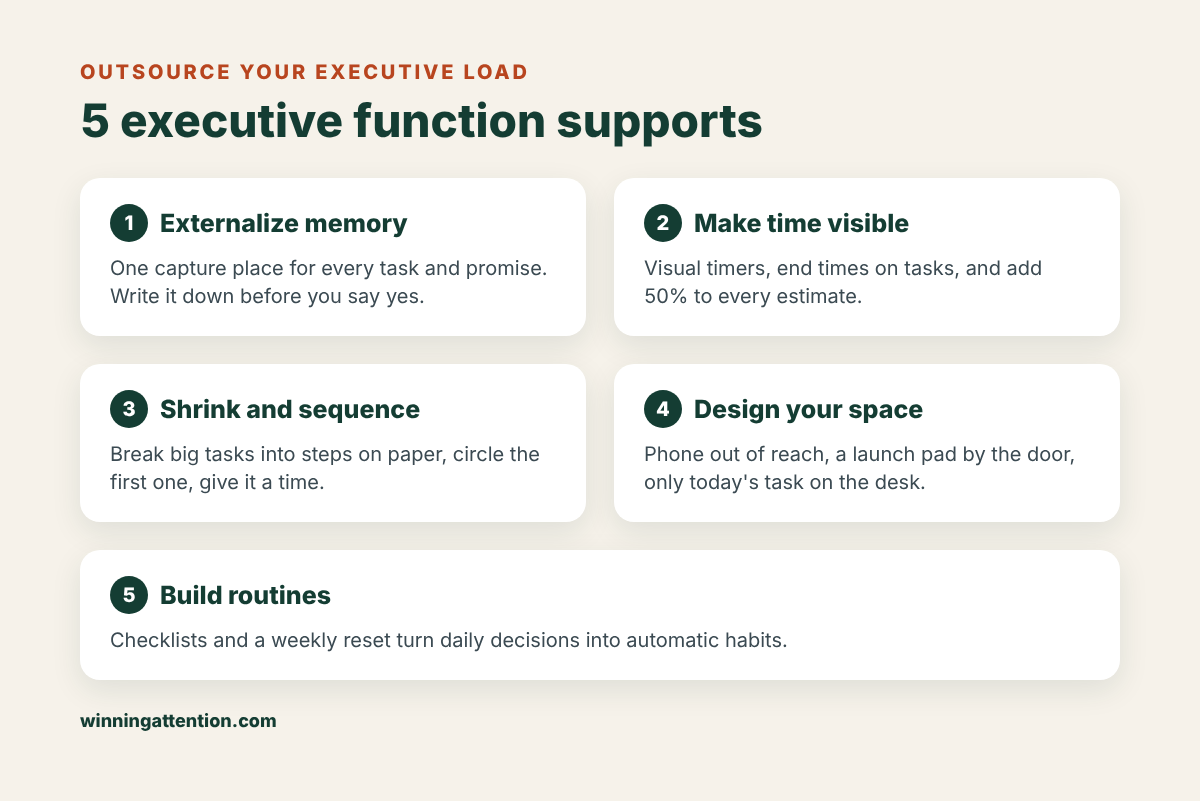
The core idea is simple: if a skill is unreliable inside your head, move it outside your head. Each step below takes one executive function that ADHD tends to strain and gives it an external support. Start with one step, practice it for a couple of weeks, then add the next. These are simplified versions of the ADHD executive function strategies taught, in various forms, in the skills programs described above.
Step 1: Externalize your working memory
Stop trusting your memory with anything that matters. Choose one capture place for all tasks, ideas and commitments: one notebook, or one app. Two systems means half your tasks are always in the other one. Capture things the moment they come up, and check the capture place at set times each day.
Examples
- Keep a small notebook or a single notes app on your phone’s home screen, and use nothing else for tasks.
- Put fixed appointments in a calendar with two alarms: one the day before and one with enough travel time.
- When someone asks you to do something, write it down before you say yes.
Step 2: Make time visible
Planning and time management depend on sensing how much time is passing and how much is left. When that sense is unreliable, use tools that show time instead of relying on feel.
Examples
- An analog clock or a visual countdown timer on your desk.
- Timers for any task where you tend to lose track, such as showering, social media or “just one more email.”
- Adding 50% to every time estimate, and writing the end time next to the task (“10:00 to 10:45”), not just the start.
Step 3: Shrink and sequence every task
Planning a multi-step task in your head taxes working memory and planning at the same time. Do it on paper instead. For any task bigger than about 30 minutes, write the steps down and circle the very first physical action. Then put that first action on a specific day and time, not just on a list. A short daily routine helps here; our guide on how to plan your day with ADHD shows a ten-minute version.
Example: breaking down “renew my passport”
- Find the old passport and put it on the desk (Monday, 7 p.m.).
- Look up the renewal form and print it (Monday, 7:10 p.m.).
- Get a photo taken (Wednesday, lunch break).
- Fill in the form and put everything in an envelope (Thursday, 7 p.m.).
- Mail it (Friday, on the way to work).
Step 4: Design your environment so inhibition has less to do
Every time you resist a distraction, you spend a bit of self-control. With ADHD, that supply runs low quickly. Instead of resisting harder, reduce how often you have to resist at all.
Examples
- Phone in another room, or in a drawer, during focus work.
- Website blockers scheduled for your most important work hours.
- A “launch pad” by the door for keys, wallet, badge and anything you need tomorrow.
- Only the current task’s materials on your desk; everything else in a box or another room.
Step 5: Turn repeated decisions into routines and checklists
Every decision draws on executive resources. Routines and checklists make decisions once, in advance, so you do not have to make them again every day. Attach each new routine to something you already do, and write it down where you will see it at that moment.
Examples
- A morning checklist taped inside the front door: keys, phone, lunch, meds if prescribed, bag.
- A five-minute shutdown at the end of the workday: tick off what is done, move the rest to tomorrow, clear the desk.
- A 15-minute weekly reset: empty bags and inboxes into your capture place and look at the week ahead.
If you would like printable tools for Steps 1, 3 and 5, the free ADHD Daily Planner Starter Kit includes a one-page daily planner, a weekly energy tracker and a 2-minute reset card.
Supporting all five steps: protect the basics
Because stress, poor sleep, loneliness and lack of exercise all impair executive functions (Diamond, 2013), looking after these is not a luxury. It is part of the strategy. If your systems keep collapsing during busy or sleep-deprived weeks, that is not a personal failure. It is a sign to simplify the plan and protect recovery time.
Quick reference: ADHD executive function supports
Use this table to match the skill that is giving you trouble with a tool that takes some of the load.
| Executive function | How it can look with ADHD | External support to try |
|---|---|---|
| Working memory | Forgetting tasks, losing track mid-conversation | One capture notebook or app, written instructions, alarms labeled with the action |
| Inhibition | Impulsive replies, purchases, phone checking | Phone out of reach, site blockers, a 24-hour rule for non-essential purchases |
| Planning | Not knowing where to start on big projects | Break tasks into steps on paper, circle the first action, schedule it |
| Time management | Chronic lateness, underestimating tasks | Visual timers, end times on tasks, add 50% to estimates |
| Task initiation | Putting off boring or unclear tasks | Five-minute first steps, if-then plans, working alongside someone |
| Cognitive flexibility | Derailed by changes in plans | A flexible block in the day, a written “plan B” for important tasks |
| Organization | Piles, lost items, missed paperwork | A launch pad by the door, one inbox tray, a weekly reset |
Putting it together: a worked example
Here is how the approach might look for a fictional example: Priya, a 41-year-old nurse and parent of two, who was diagnosed with ADHD last year. She is good at her job, where shifts are structured and checklists are everywhere. At home, it is a different story: permission slips go unsigned, bills are paid late, and she regularly loses her car keys.
- One capture place (week 1). Priya replaces three notebooks, a whiteboard and her phone’s reminders with one small notebook she keeps in her bag. Every request from her kids’ school goes in it the moment she reads it. She checks it each morning with coffee.
- Visible time (week 2). She puts a visual timer on the kitchen counter for the evening routine: 20 minutes for dinner cleanup, 10 minutes for school bags. The kids can see it too, and it ends the nightly negotiation over “five more minutes.”
- Shrink and sequence (week 3). The overdue task of switching the family to a new health insurance plan has sat for two months. Priya writes five tiny steps, circles “find the email from HR,” and schedules it for Tuesday at 8 p.m.
- Environment (week 4). She installs a hook and a small tray by the front door. Keys, wallet and badge go there every time she walks in. Lost-keys mornings drop from several a week to rare.
- Routines (week 5). A Sunday 15-minute reset: she empties her bag, copies the week’s school events into the family calendar, and pays any bills due that week. She tapes a short checklist for it to the inside of a cupboard door.
Priya’s working memory has not changed. What changed is how much she asks of it. By the end of five weeks, many of the tasks that used to depend on her remembering at the right moment are now handled by systems she can see. That is what good ADHD executive function support looks like in practice.
Can adults improve executive functioning skills?
Yes, in the sense that matters most: adults can get much better at managing ADHD executive function challenges and at reaching their goals despite them. The research summarized above suggests that structured, skills-based programs help many adults with ADHD, while generic brain training does little for everyday life.
A few principles make progress more likely:
- Practice in real life, not on an app. Skills seem to stick when you practice them in the situations where you need them, such as at your desk, in your kitchen or at the front door.
- Change one thing at a time. Adding five new systems at once is itself a heavy executive load. One habit, practiced for two or three weeks, beats five abandoned ones.
- Expect lapses and plan restarts. Systems will break during busy weeks. The skill is noticing and restarting, not never slipping.
- Use other people. Shared calendars, a friend you check in with, or working alongside someone are all legitimate external supports.
- Treat it as support, not a test. Using alarms, lists and checklists is not cheating. It is how executive function works best for many brains, with or without ADHD.
Common mistakes to avoid
- Trying to fix it with willpower. ADHD executive function difficulties are not a motivation problem. Trying harder with the same unreliable tools usually leads to the same result, plus more guilt.
- Building a complicated system. A color-coded, multi-app setup is itself an executive function challenge. The best system is the simplest one you will actually use.
- Relying on brain-training apps. Short-term gains on the game rarely transfer to real tasks. Spend the time on practical strategies instead.
- Keeping the plan in your head. If it is not written down and visible, assume it will be forgotten.
- Assuming a normal test score settles it. Formal tests and daily functioning often disagree. Your real-world difficulties are worth taking seriously.
- Ignoring sleep, stress and mood. When these are off, every executive skill suffers. Sometimes the most useful strategy is to rest, simplify or get support for mood.
When to talk to a professional
The strategies in this guide can make daily life easier, but they are not a treatment for ADHD on their own and they cannot tell you what is causing your difficulties. Talk to a doctor, psychologist or other qualified clinician if executive function problems are affecting your work, studies, finances, relationships or safety; if you have never been assessed and recognize yourself here; or if your difficulties came on recently, are getting worse, or come with low mood, anxiety, memory changes or sleep problems. Executive dysfunction can be linked to ADHD, depression, autism, anxiety, sleep disorders and other medical conditions, and sorting these out is a job for a professional. Evidence-based options for adult ADHD include medication, CBT and skills-based programs like those described above, and many people benefit from a combination.
Frequently asked questions
What is ADHD executive function?
Executive functions are the mental skills you use to manage yourself toward a goal, including inhibition, working memory and cognitive flexibility, plus planning and organization built on top of them. “ADHD executive function” usually refers to the way ADHD makes these skills less reliable, so that knowing what to do does not always translate into doing it. The effects vary a lot from person to person.
Is ADHD an executive function disorder?
Partly. Research shows that groups of people with ADHD have medium-sized weaknesses in executive functions, especially inhibition, working memory, vigilance and planning. But these weaknesses are not found in everyone with ADHD, so researchers describe executive difficulties as one important part of ADHD rather than its single cause.
What are examples of executive dysfunction in ADHD?
Common examples include forgetting appointments unless they are written down, struggling to start boring or unclear tasks, underestimating how long things take, losing items, getting derailed when plans change and acting on impulses before thinking. Many adults also describe many half-finished projects and last-minute rushes.
Is executive dysfunction ADHD, autism or depression?
It can be any of these, and more. Meta-analyses show executive function weaknesses in ADHD, autism and depression, and the conditions often occur together. Executive function tests alone cannot tell them apart, so a qualified clinician should assess the full picture, including history, mood and other symptoms.
How do you manage executive dysfunction with ADHD?
The most practical approach to ADHD executive function problems is to move the work outside your head: one place to capture tasks, visible timers, tasks broken into small scheduled steps, an environment with fewer distractions and routines with checklists. Structured skills-based therapy for adult ADHD has research support, and many people combine strategies with medication under a clinician’s care.
Can adults improve executive functioning skills?
Adults can get much better at managing executive function challenges, especially by practicing practical strategies in real-life situations. Studies of computerized working memory training show little benefit beyond the trained tasks, while skills-based programs for adult ADHD show more meaningful improvements in symptoms and daily functioning.
Sources
- Diamond A. Executive functions. Annual Review of Psychology. 2013;64:135–168. PubMed
- Barkley RA. Behavioral inhibition, sustained attention, and executive functions: constructing a unifying theory of ADHD. Psychological Bulletin. 1997;121(1):65–94. PubMed
- Willcutt EG, Doyle AE, Nigg JT, Faraone SV, Pennington BF. Validity of the executive function theory of attention-deficit/hyperactivity disorder: a meta-analytic review. Biological Psychiatry. 2005;57(11):1336–1346. PubMed
- Boonstra AM, Oosterlaan J, Sergeant JA, Buitelaar JK. Executive functioning in adult ADHD: a meta-analytic review. Psychological Medicine. 2005;35(8):1097–1108. PubMed
- Toplak ME, West RF, Stanovich KE. Practitioner review: do performance-based measures and ratings of executive function assess the same construct? Journal of Child Psychology and Psychiatry. 2013;54(2):131–143. PubMed
- Snyder HR. Major depressive disorder is associated with broad impairments on neuropsychological measures of executive function: a meta-analysis and review. Psychological Bulletin. 2013;139(1):81–132. PubMed
- Demetriou EA, Lampit A, Quintana DS, et al. Autism spectrum disorders: a meta-analysis of executive function. Molecular Psychiatry. 2018;23(5):1198–1204. PubMed
- Melby-Lervåg M, Redick TS, Hulme C. Working memory training does not improve performance on measures of intelligence or other measures of “far transfer”: evidence from a meta-analytic review. Perspectives on Psychological Science. 2016;11(4):512–534. PubMed
- Solanto MV, Marks DJ, Wasserstein J, et al. Efficacy of meta-cognitive therapy for adult ADHD. American Journal of Psychiatry. 2010;167(8):958–968. PubMed
- Knouse LE, Teller J, Brooks MA. Meta-analysis of cognitive-behavioral treatments for adult ADHD. Journal of Consulting and Clinical Psychology. 2017;85(7):737–750. PubMed
Turn this into a daily plan
Get the free ADHD Daily Planner Starter Kit: a one-page daily planner, a weekly energy tracker and a 2-minute reset card.