You know the task matters. You know the deadline is real. You may even have cleared your afternoon for it. And still, hours later, the document is unopened, the dishes are done, your inbox is tidy, and you feel worse than when you started. If that loop sounds familiar, you are probably dealing with ADHD procrastination, and it has very little to do with being lazy.
Research on procrastination and on adult ADHD points to the same handful of drivers: tasks that feel unpleasant, rewards that feel far away, attention that drifts, and strong emotions that push you toward quick relief. This guide explains why ADHD procrastination happens, what the research says actually helps, and a five-step method you can use the next time you are stuck staring at a task you cannot make yourself begin.
The short version: ADHD procrastination is a problem of starting and of managing feelings, not a problem of caring. Name what makes the task feel bad, shrink the first step until it takes five minutes, bring the reward and the deadline closer to now, tie the start to a specific cue, and restart without punishing yourself when you slip.
Why ADHD procrastination happens: what the research says
Everyone procrastinates sometimes. Procrastination becomes a bigger problem when it is chronic, when it costs you money, jobs, grades or relationships, and when it happens even for tasks you genuinely want to get done. That is the pattern many adults with ADHD describe, and research is starting to explain why.
Procrastination is a self-regulation problem, not a character flaw
The best-known review of procrastination research is a meta-analysis that pooled 691 correlations from studies of general (non-ADHD) samples. It found that the strongest and most consistent predictors of putting things off were how unpleasant the task felt (task aversiveness), how far away the deadline or reward was, low confidence in one’s ability to do the task (self-efficacy), and impulsiveness, along with facets of conscientiousness such as self-control, distractibility and organization (Steel, 2007). Traits that people often blame, such as rebelliousness, showed only a weak connection.
Look at that list again with ADHD in mind. Distractibility, impulsiveness and disorganization are close cousins of core ADHD symptoms. In other words, the ingredients that make anyone more likely to procrastinate are the same areas where ADHD makes life harder. The review described procrastination as a “quintessential” failure of self-regulation, and that framing matters: it points to skills and supports, not to blame.
Inattention is the symptom most linked to procrastination
Procrastination is not listed as an official ADHD symptom, but studies keep finding a connection. In a small study of 54 university students with varying levels of ADHD-type behaviors, the researchers expected impulsivity to drive procrastination. Instead, once the overlap between symptom types was accounted for, only inattention was linked to general procrastination (Niermann & Scheres, 2014). The authors called the finding preliminary, since the students were not formally diagnosed.
A larger preregistered survey of 640 adults found the same pattern: ADHD inattention symptoms were positively associated with procrastination. Three factors helped explain the link: sensitivity to delay, seeing the task as low in value, and difficulty with flexible goal adjustment (Netzer Turgeman & Pollak, 2026). That is useful, because each of those three things is something you can work on directly, as you will see in the method below.
“Later” feels much smaller than “now”
Most people prefer a reward today over a bigger reward next month. Researchers call this delay discounting, and people with ADHD tend to show more of it. A meta-analysis of 21 investigations with 3,913 participants found a medium-sized difference between people with and without ADHD (d = 0.43), with no significant difference between children and adults (Jackson & MacKillop, 2016).
For procrastination, this means the payoff of finishing a report next week barely registers against the instant relief of checking your phone right now. It also explains why a looming deadline suddenly works: when the consequence is close enough to feel, your brain finally treats it as real. Many adults with ADHD notice that their sense of time itself is slippery, which makes distant deadlines feel even more abstract. If that sounds like you, our guide to ADHD time blindness goes deeper.
Procrastination is often about feelings, not tasks
One of the most helpful ideas in procrastination research is that putting things off is often a way of managing mood. Researchers have argued that procrastination has “a great deal to do with short-term mood repair and emotion regulation”: when a task feels aversive, avoiding it brings quick relief, and the cost is handed to your future self (Sirois & Pychyl, 2013).
This matters for ADHD because emotional regulation is often harder. A meta-analysis of 13 studies with 2,535 participants found that adults with ADHD showed substantially higher levels of emotion dysregulation than healthy controls (Hedges’ g = 1.17), and that more severe ADHD symptoms went along with more emotion dysregulation (r = 0.54) (Beheshti et al., 2020). When boredom, frustration, shame or fear of failure hit harder, the pull toward instant relief is stronger too.
The cost adds up
ADHD procrastination is not a harmless quirk. In an online survey of 132 adults, higher ADHD symptoms were linked to more procrastination and to lower quality of life, and procrastination helped account for the link between ADHD symptoms and poorer quality of life (Netzer Turgeman & Pollak, 2025). The study was cross-sectional, so it cannot prove cause and effect, but it fits what many people live with: missed deadlines, late fees, stalled projects and a constant background hum of guilt.
ADHD procrastination vs. laziness: what is the difference?
From the outside, ADHD procrastination and laziness can look the same: the task is not getting done. From the inside, they feel very different.
- Laziness usually means you do not much care about the task and are comfortable not doing it. You are not suffering over it.
- ADHD procrastination usually means you do care, often a lot. You think about the task constantly, feel guilty and anxious, and may spend more energy avoiding it than the task itself would take. You are stuck, not relaxed.
Another clue is that ADHD procrastination is uneven. You may struggle for weeks to send a two-line email, then work for six hours straight on something that interests you, or finish a huge project overnight once panic kicks in. That pattern fits what the research describes: interest, urgency and emotional relief move the needle, while abstract importance often does not.
The “lazy” label does real harm. It turns a skills problem into a moral one, which adds shame, which makes the task feel even more aversive, which leads to more avoidance. Dropping the label is not about excusing yourself. It is about choosing strategies that actually work.
What helps with ADHD procrastination: the treatment evidence
There are no large trials of “procrastination treatment” specifically for adults with ADHD. The strongest evidence comes from cognitive-behavioral therapy (CBT) programs for adult ADHD, which almost always include procrastination as a core target alongside planning, organization and unhelpful thinking patterns.
- CBT for adults already on medication. In a randomized trial of 86 adults with ADHD who still had significant symptoms despite medication, 12 individual sessions of CBT led to better symptom outcomes than an attention-matched relaxation and education program. On the ADHD rating scale, 67% responded to CBT versus 33% in the comparison group, and responders maintained their gains over 6 and 12 months (Safren et al., 2010).
- The bigger picture. A meta-analysis of 32 studies of CBT for adult ADHD found small-to-medium benefits compared with control groups for symptoms (g = 0.65) and for daily functioning (g = 0.51) (Knouse et al., 2017). Effects were smaller in studies that used active control groups, which is a reminder that results vary.
- If-then plans. Outside ADHD research, a large meta-analysis of implementation intentions, plans in the form “when X happens, I will do Y”, found that they improve goal attainment compared with setting a goal alone (Gollwitzer & Sheeran, 2006). This is one of the simplest tools for the “starting” problem.
Put together, the research suggests a practical recipe: make tasks less aversive, make rewards and consequences feel closer, make the start automatic, and handle the emotions that drive avoidance. The method below is built from those ingredients. It is a self-help structure, not a replacement for professional care.
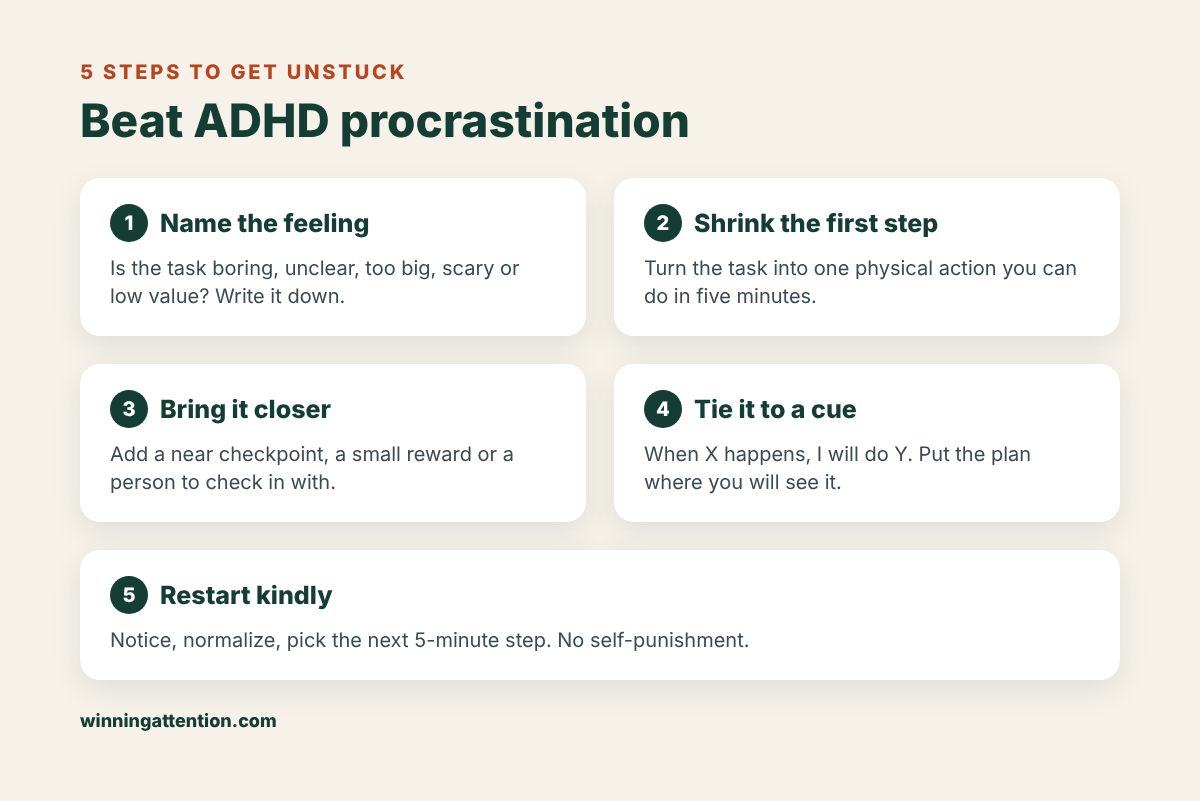
How to stop procrastinating with ADHD: a 5-step method
Use these steps whenever you notice you have been circling a task. The first time, it may take 10 minutes. With practice, you can run through it in two or three.
Step 1: Name what makes the task feel bad
Before trying to force yourself to start, ask one honest question: what exactly feels bad about this task? Write the answer down in a few words. Most stuck tasks fall into one of a few categories.
- Boring: repetitive, low-stimulation work like expense reports or filing.
- Unclear: you do not know what the first step is, or what “done” looks like.
- Too big: the whole task is in your head at once, and it is overwhelming.
- Emotionally loaded: it involves possible criticism, conflict, money worries or a past failure.
- Low value: you cannot see why it matters, or it matters to someone else more than to you.
Naming the feeling does two things. It reminds you that the problem is the mood, not your character. And it tells you which of the next steps to lean on hardest, because a boring task needs a different fix than a scary one.
Example: naming the stuck point
“Call the insurance company” might be stuck because it is emotionally loaded (you are worried they will say no) and unclear (you are not sure which number to call or what documents you need). Now you know the problem is not the phone call itself.
Step 2: Shrink the first step to five minutes
Vague, large tasks are the natural habitat of ADHD procrastination. Rewrite the task as the smallest visible physical action you could do in five minutes or less. Not “do taxes” but “find last year’s tax return and put it on the desk.” Not “write the essay” but “open a document and write three bad sentences.”
The goal of the first step is not progress. It is ignition. Once you are moving, the task usually feels less threatening and continuing is easier than starting. If you often freeze completely at this stage, our article on ADHD task paralysis has more ways to get unstuck.
Examples of five-minute first steps
- “Clean the kitchen” becomes “load the top rack of the dishwasher.”
- “Update my resume” becomes “open my resume and change the date on my current job.”
- “Reply to the difficult email” becomes “write a one-line subject and the greeting, then save as draft.”
- “Plan the project” becomes “list the three parts of the project on a sticky note.”
Step 3: Bring the reward and the deadline closer to now
Because a distant payoff feels small, the fix is to create a nearer one. You are not trying to want the task more in the abstract. You are adding something that matters today.
- Make a near deadline. Split one far deadline into small, dated checkpoints, and tell someone about the first one.
- Add a small immediate reward. Pair the task with something you enjoy, such as a favorite drink, a playlist or a podcast reserved only for that type of task.
- Add accountability. Work alongside a friend in person or on a video call, a practice often called body doubling. Telling someone “I will send you a screenshot of the first page by 11:00” turns a vague future consequence into a present one.
- Connect it to a reason you care about. If the task feels low value, write one sentence about what finishing it gives you: less stress, money, freedom, keeping a promise to someone you love.
These strategies map directly onto two of the factors that explained the link between inattention and procrastination in adults: sensitivity to delay and low perceived task value (Netzer Turgeman & Pollak, 2026).
Step 4: Tie the start to a specific cue
“I will do it this afternoon” is a wish. “When I come back from lunch and sit down, I will open the budget spreadsheet and fill in this month’s rent” is a plan. If-then plans link a cue you will definitely meet (a time, a place, an action you already do) to the five-minute first step from Step 2, so starting stops being a decision you have to make in the moment.
Examples of if-then plans for ADHD procrastination
- “When I pour my first coffee, I will open the report and read the last paragraph I wrote.”
- “If I catch myself opening social media during my work block, I will close the app, stand up, and write the next single step on a sticky note.”
- “When the 3:00 alarm labeled ‘insurance call’ goes off, I will dial the number written on the alarm.”
- “When I get home and put my keys down, I will spend five minutes on the laundry pile before sitting on the couch.”
Write the plan where you will see it at the moment of the cue: on the alarm label, a sticky note on your laptop, or the top line of today’s page in your planner.
Step 5: Restart without punishment
You will slip. Everyone does, and with ADHD it will happen often. What matters is how fast you restart. Harsh self-criticism feels like it should motivate you, but it mostly adds another bad feeling to the task, and avoiding bad feelings is exactly what drives procrastination in the first place (Sirois & Pychyl, 2013).
Try a short reset instead:
- Notice: “I have been avoiding this for the last hour.”
- Normalize: “That makes sense. This task feels unclear and a bit scary.”
- Next step: “What is the five-minute version I can do right now?”
Then set a timer and do only that. Treat each restart as a skill you are practicing, not proof that you have failed.
Match the strategy to the reason you are stuck
Different kinds of ADHD procrastination need different first moves. Use this table as a quick reference once you have named the stuck point in Step 1.
| Why the task feels bad | What it sounds like | Try this first |
|---|---|---|
| Boring | “I just can’t make myself do this.” | Pair it with music or a treat, set a 10-minute timer, work next to someone else |
| Unclear | “I don’t even know where to start.” | Write the very first physical action, or ask someone what “done” looks like |
| Too big | “There’s no point starting, I’ll never finish.” | Break it into three parts and schedule only the first one |
| Emotionally loaded | “What if it goes badly?” | Name the fear, do the smallest step, plan a kind reset for afterward |
| Low value | “Why does this even matter?” | Write one sentence on what finishing gives you, add a near deadline |
| Far deadline | “I have weeks, I’ll do it later.” | Create dated checkpoints and tell someone about the first one |
Putting it together: a worked example
Here is how the method might look for a fictional example: Marcus, a 34-year-old sales manager with ADHD, who has put off his tax paperwork for six weeks. The filing deadline is in three weeks. Every evening he plans to “start the taxes,” and every evening he does something else.
- Name the feeling (2 minutes). Marcus writes: “Unclear (I don’t know what documents I need), too big, and emotionally loaded (I’m scared I owe money).” Seeing the words on paper makes it clear that the real problem is fear and fog, not lack of effort.
- Shrink the first step (1 minute). The five-minute version is: “Find last year’s return in the email folder and print the first page.” That is it.
- Bring it closer (3 minutes). He texts a friend: “I’m sending you a photo of my tax folder by Thursday 8 p.m. Hold me to it.” He splits the job into three checkpoints: gather documents (Thursday), enter income (Sunday), review and file (next Wednesday). He also writes one sentence on why it matters to him: “Getting this done means I stop feeling sick every time I see the word ‘tax.’”
- Tie the start to a cue (1 minute). “When I finish dinner on Thursday, I will put the laptop on the kitchen table and open my email folder.” He sets a phone alarm for 7:30 p.m. labeled with the first step.
- Restart without punishment. On Thursday he gets distracted by a game after finding the old return. At 8:15 he notices, says to himself, “OK, I drifted, that happens,” and asks what the next five-minute step is: “Download two pay statements.” He sends his friend the photo at 8:40, forty minutes late, and counts it as a win.
Marcus does not suddenly enjoy doing taxes. But a task that sat untouched for six weeks moves forward in three short sessions, because each session started with something small, specific and close.
How to manage ADHD procrastination without medication
Medication is one evidence-based option for ADHD, and the right choice for you is a decision to make with a clinician. Whether or not you take medication, there are many non-medication supports that target the drivers of procrastination. In the CBT meta-analysis mentioned above, the participant’s medication status did not change how much people improved from before to after treatment (Knouse et al., 2017).
Build structure around your day
A lot of procrastination happens in unstructured time, when there is no clear signal about what comes next. A simple daily routine that names one important task and blocks out time for it reduces the number of decisions you have to make. Our guide on how to plan your day with ADHD walks through a ten-minute daily planning method. If you want a printable version, the free ADHD Daily Planner Starter Kit includes a one-page daily planner, a weekly energy tracker and a 2-minute reset card that pairs well with Step 5 above.
Use your environment
- Remove the easiest escape. Put your phone in another room or use a site blocker during your work block. The fewer quick-relief options within reach, the less you have to resist.
- Make the task the most visible thing. Leave the folder open on the desk, the guitar out of its case, the running shoes by the door.
- Change location. Many people find that a library, a café or a different room helps them start tasks they avoid at home.
Work in short, timed sprints
A defined end point makes starting less daunting. Try a 10- or 25-minute timer, then a real break. Knowing you are allowed to stop when the timer ends lowers the emotional cost of beginning, and many people find they keep going once they are in motion.
Look after the basics
Poor sleep, skipped meals and high stress make every self-regulation task harder, including starting work you dislike. Fixing them will not solve everything, but if your procrastination is noticeably worse on bad-sleep days, that is useful information.
Get structured help
CBT and similar skills programs for adult ADHD are designed to address procrastination directly, including the unhelpful thoughts (“I have to do it perfectly or not at all”) that keep you stuck. Some people do this one-to-one with a therapist, others in groups or with an ADHD coach. The trial and meta-analysis evidence summarized above is strongest for structured CBT delivered by trained clinicians.
Common mistakes to avoid
- Waiting to feel motivated. With ADHD, motivation often shows up after you start, not before. Begin with the five-minute step and let motivation catch up.
- Relying on panic as a system. Last-minute adrenaline can work, which is why it is tempting. But it is exhausting, it leaves no room for mistakes, and it trains your brain to wait for a crisis.
- Making the to-do list longer. Adding more tasks or more detailed plans can feel productive while delaying the real work. One clear next step beats a perfect list.
- Using shame as fuel. Calling yourself lazy makes tasks feel worse, and worse-feeling tasks get avoided more.
- Trying a new system every week. Searching for the perfect app can become its own form of ADHD procrastination. Give one simple approach at least three weeks.
- Ignoring the emotional part. If you only ever try harder or schedule more, but never address the fear or frustration attached to a task, you will keep running into the same wall.
When to talk to a professional
Self-help strategies can make a real difference, but they are not a treatment for ADHD on their own. Talk to a doctor, psychologist or other qualified clinician if procrastination is putting your job, studies, finances, health or relationships at risk, if you have never been assessed for ADHD but recognize yourself in this article, or if avoidance comes with persistent low mood, anxiety, hopelessness or trouble sleeping. Procrastination can also be part of depression and anxiety, and a professional can help sort out what is going on. Evidence-based options include medication, CBT and structured skills programs, and many people benefit from a combination.
If you ever have thoughts of harming yourself, contact emergency services or a crisis line right away. In the US and Canada you can call or text 988.
Frequently asked questions
Is procrastination a symptom of ADHD?
Procrastination is not listed as an official ADHD symptom, but research consistently links it to ADHD, especially to inattention. Studies suggest that sensitivity to delay, seeing tasks as low in value and difficulty regulating emotions help explain why adults with ADHD procrastinate more. That is why procrastination is a common focus of CBT for adult ADHD.
Why do people with ADHD procrastinate?
People with ADHD tend to discount future rewards more steeply, so a distant deadline feels less real than an immediate distraction. Many also experience stronger emotional reactions, which makes avoiding an unpleasant task feel like quick relief. Add inattention and difficulty breaking big tasks into steps, and starting becomes much harder.
What does ADHD procrastination feel like?
Many people describe it as being stuck while caring deeply: you want to do the task, you think about it constantly, and you still cannot begin. It often comes with guilt, anxiety and frustration, and then a sudden burst of action when the deadline gets close enough to feel urgent.
What is the difference between ADHD procrastination and laziness?
Laziness usually means not caring about a task and being comfortable leaving it undone. ADHD procrastination usually involves caring a lot, feeling distressed about avoiding the task and spending energy on the avoidance itself. The problem is starting and managing feelings, not a lack of values or effort.
How do you stop procrastinating with ADHD?
Start by naming what makes the task feel bad, then shrink the first step to something you can do in five minutes. Bring the reward and deadline closer with checkpoints, accountability or a small treat, and link the start to a specific cue with an if-then plan. When you slip, restart quickly without harsh self-criticism.
How can you manage ADHD procrastination without medication?
Useful non-medication strategies include a simple daily plan with one priority, short timed work sprints, body doubling, removing easy distractions and if-then plans for starting. Structured CBT for adult ADHD has the strongest research support among non-medication approaches. Talk to a clinician about which options suit you.
What is ADHD procrastination called?
There is no separate official term. People often use phrases like “ADHD procrastination,” “task paralysis” or “executive dysfunction” to describe it, and researchers typically study it simply as procrastination linked to ADHD symptoms. Whatever you call it, the strategies that help are similar.
Sources
- Steel P. The nature of procrastination: a meta-analytic and theoretical review of quintessential self-regulatory failure. Psychological Bulletin. 2007;133(1):65–94. PubMed
- Niermann HC, Scheres A. The relation between procrastination and symptoms of attention-deficit hyperactivity disorder (ADHD) in undergraduate students. International Journal of Methods in Psychiatric Research. 2014;23(4):411–421. PubMed
- Netzer Turgeman R, Pollak Y. What are you waiting for?! Roles of motivation, goal orientation, and emotion regulation in explaining the link between ADHD and procrastination. Journal of Attention Disorders. 2026;30(5):694–704. PubMed
- Jackson JN, MacKillop J. Attention-deficit/hyperactivity disorder and monetary delay discounting: a meta-analysis of case-control studies. Biological Psychiatry: Cognitive Neuroscience and Neuroimaging. 2016;1(4):316–325. PubMed
- Sirois F, Pychyl T. Procrastination and the priority of short-term mood regulation: consequences for future self. Social and Personality Psychology Compass. 2013;7(2):115–127. DOI
- Beheshti A, Chavanon ML, Christiansen H. Emotion dysregulation in adults with attention deficit hyperactivity disorder: a meta-analysis. BMC Psychiatry. 2020;20(1):120. PubMed
- Netzer Turgeman R, Pollak Y. Adult ADHD-related poor quality of life: investigating the role of procrastination. Scandinavian Journal of Psychology. 2025;66(5):729–737. PubMed
- Safren SA, Sprich S, Mimiaga MJ, et al. Cognitive behavioral therapy vs relaxation with educational support for medication-treated adults with ADHD and persistent symptoms: a randomized controlled trial. JAMA. 2010;304(8):875–880. PubMed
- Knouse LE, Teller J, Brooks MA. Meta-analysis of cognitive-behavioral treatments for adult ADHD. Journal of Consulting and Clinical Psychology. 2017;85(7):737–750. PubMed
- Gollwitzer PM, Sheeran P. Implementation intentions and goal achievement: a meta-analysis of effects and processes. Advances in Experimental Social Psychology. 2006;38:69–119. DOI
Turn this into a daily plan
Get the free ADHD Daily Planner Starter Kit: a one-page daily planner, a weekly energy tracker and a 2-minute reset card.