You look up from your screen and it is somehow 4:30. The “quick” email took an hour, the appointment you had plenty of time for is in ten minutes, and the drive takes twenty. If that sounds familiar, you have met ADHD time blindness: the everyday experience of losing track of time, misjudging how long things take, and feeling the future only when it is suddenly here.
Time blindness is not an official diagnosis, and it is not a character flaw. It is a popular name for something researchers have measured for decades: people with ADHD, on average, perceive and manage time less accurately than people without it. This guide covers what the research actually says, what time blindness looks and feels like, whether there is a test, and a practical five-step method for managing it day to day.
The short version: you cannot fix your internal clock by trying harder, but you can stop relying on it. Make time visible, measure how long tasks really take, plan backward from deadlines with built-in buffers, and use if-then cues so that “later” becomes a specific moment you will notice.
What is ADHD time blindness?
ADHD time blindness describes difficulty sensing the passage of time and using that sense to guide behavior. In practice it shows up in three ways: underestimating how long tasks take, losing track of time while absorbed in something, and struggling to act on future deadlines until they feel urgent.
The term itself comes from clinicians and the ADHD community rather than from diagnostic manuals. Researchers tend to use more technical labels such as time perception, time estimation, time reproduction and temporal processing. Those terms describe specific lab tasks, but together they map closely onto what people mean when they say “I have no sense of time.”
What ADHD time blindness looks like
From the outside, time blindness is easy to mistake for not caring. Common patterns include:
- Running late regularly, even for things you are looking forward to.
- Starting to get ready at the time you should be leaving.
- Saying “five minutes” and meaning it, then finishing forty minutes later.
- Missing deadlines that felt far away until, suddenly, they were tomorrow.
- Losing whole afternoons to one absorbing task while other plans quietly expire.
- Being early for some things out of anxiety, then late for everything else.
What ADHD time blindness feels like
From the inside, many adults describe time as having only two zones: now and not now. Anything in the “not now” zone, whether it is next month’s tax deadline or a dentist appointment on Friday, feels vague and weightless. Then it crosses into “now” and becomes an emergency.
Others describe time as elastic. Ten minutes of a boring task can feel like an hour, while an hour of something interesting disappears. There is often a layer of shame on top: you know you “should” be able to judge time, other people seem to manage, and repeated lateness can strain work and relationships. Understanding the research can take some of that shame out of the picture and point toward strategies that actually fit.
Is ADHD time blindness real? What the research says
Yes, in the sense that matters: differences in time perception between people with and without ADHD are among the more consistent findings in ADHD neuropsychology. The word “blindness” is an exaggeration, though. People with ADHD can tell time; what tends to differ is how accurately and consistently they sense it, especially when they are not looking at a clock.
Large studies show a consistent gap
The biggest summary so far is a 2024 meta-analysis that pooled 824 effect sizes from studies of time perception in ADHD. It found an average difference of Hedges’ g = 0.688 between people with and without ADHD, which researchers usually describe as moderate to large. The size of the difference depended partly on the age of the sample, and the gap was present across the lifespan, not only in childhood (Metcalfe et al., 2024).
A separate 2022 meta-analysis of 55 studies looked at timing over very short intervals, from milliseconds up to several seconds. Compared with people without ADHD, those with ADHD had more trouble telling apart very brief durations, were more variable when estimating durations of several seconds, and showed patterns in time estimation and production consistent with an “accelerated internal clock” (Marx et al., 2022). Those are lab tasks measured in seconds, not hours, but they suggest the difference starts at a basic level.
Studies in adults with ADHD
Much of the early research focused on children, so adult studies matter here. In one well-known study, 104 young adults with ADHD and 64 adults without ADHD estimated and reproduced time intervals. The ADHD group made shorter reproductions of 15- and 60-second intervals and made larger reproduction errors, and these differences held up after the researchers accounted for IQ, depression, anxiety and oppositional symptoms. The ADHD group also gave larger verbal time estimates, though that difference disappeared once IQ was taken into account (Barkley, Murphy & Bush, 2001).
The adult picture is not perfectly tidy. A 2023 review of a decade of adult studies concluded that research on time perception in adult ADHD is still scarce, and that while some studies found clear deficits in time estimation, time reproduction and time management, others did not find a clear link. The studies also differed a lot in design and methods (Mette, 2023). Honest summary: the overall gap is well supported, but not every adult with ADHD will show it on every type of task.
Not everyone with ADHD has the same time problems
ADHD is not one uniform profile. A study of 71 children and teens with ADHD (ages 6 to 17) measured three areas: inhibitory control, timing, and reactions to waiting. The three turned out to be largely independent, and substantial groups of young people with ADHD had problems in only one of them (Sonuga-Barke, Bitsakou & Thompson, 2010). The study was in children, but the takeaway is useful for adults too: time blindness is common in ADHD, not universal, and it may sit alongside other difficulties rather than explain all of them.
What causes ADHD time blindness?
There is no single agreed cause, but several research threads fit together well.
Self-regulation across time
An influential theory by Russell Barkley describes ADHD as, at its core, a difficulty with behavioral inhibition: pausing long enough to let internal information guide action. In this model, inhibition supports executive functions such as working memory and the self-regulation of motivation and arousal, and the theory predicts problems in using a sense of time and the future to direct behavior (Barkley, 1997). In everyday terms, the future is harder to hold in mind strongly enough to compete with whatever is happening now.
Working memory
Keeping track of time usually means holding something in mind while doing something else: “I started at 2:00, I need to leave at 3:15.” In the 2024 meta-analysis, working memory helped explain the size of the time perception gap, although that link showed up in samples under 18 rather than in adults (Metcalfe et al., 2024). For adults, it still makes practical sense to take the timekeeping job off your mental notepad and put it somewhere visible.
The pull of “now” over “later”
Time blindness also has a motivational side. In delay discounting tasks, people choose between a smaller reward now and a larger one later. A meta-analysis of 25 case-control comparisons with 3,913 participants found that people with ADHD discounted delayed rewards more steeply than controls, with a medium effect size (d = 0.43), and the difference did not depend on whether participants were children or adults (Jackson & MacKillop, 2016). When future payoffs feel smaller, future deadlines also tend to feel less real until they are close.
The 2022 timing meta-analysis points in a similar direction. In time reproduction tasks, people with ADHD tended to count more slowly at short intervals, linked to distraction, and faster at long intervals, which the authors linked to delay aversion: waiting feels more unpleasant, so time seems to drag (Marx et al., 2022).
Interest and hyperfocus
Many adults notice that time blindness is worst at the two extremes: deeply absorbing tasks, where hours vanish, and dull tasks, where minutes crawl. Attention is pulled toward what is interesting in the moment, and the background job of checking the clock is the first thing to drop. This is a common clinical description rather than a precisely measured finding, but it explains why strategies need to work without relying on you remembering to check the time.
Is there an ADHD time blindness test?
There is no single validated “time blindness test” that diagnoses anything, and online quizzes cannot tell you whether you have ADHD. Researchers measure timing with structured lab tasks: time discrimination (which of two tones was longer), time estimation (saying how long something lasted), time production (pressing a button after a set time) and time reproduction (copying a duration you just experienced) (Marx et al., 2022). These tasks are used in research and sometimes in neuropsychological assessment, not as standalone diagnostic tools.
If you are curious about your own patterns, a simple self-check can be informative, as long as you treat it as self-knowledge and not a diagnosis:
- The one-minute check. Start a stopwatch without looking at it, and stop it when you think 60 seconds have passed. Repeat a few times, on different days.
- The task log. For one week, write down how long you expect five routine tasks to take, then time them. Note the gap.
- The departure audit. Track when you intended to leave for appointments and when you actually left.
If you are consistently far off, that is useful data for planning. If time problems are affecting your work, money or relationships, an evaluation by a qualified clinician is the right next step, because ADHD diagnosis involves much more than any single test.
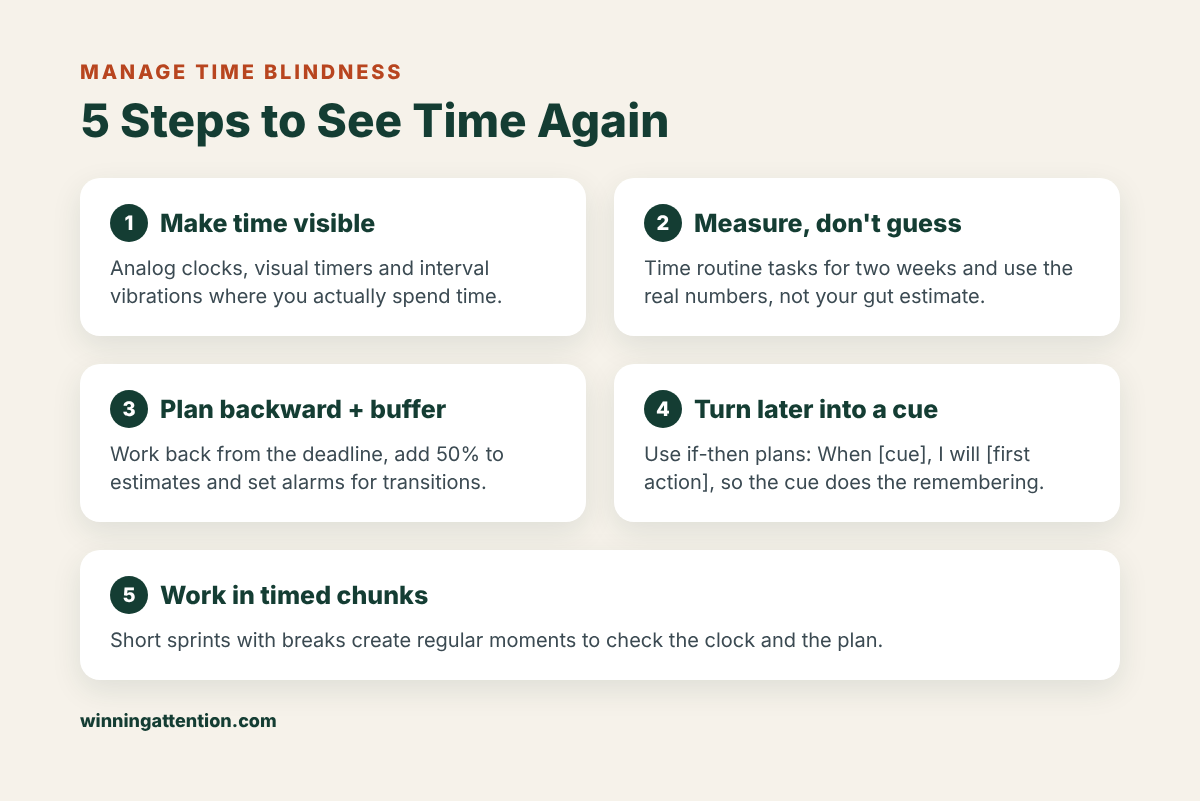
How to manage ADHD time blindness: a 5-step method
People often ask how to get rid of time blindness for good. Honestly, the realistic goal is to manage it, because nothing here will rewire your internal clock. What does help is changing your environment so that you need your internal clock less. Structured skills programs for adults with ADHD focus heavily on exactly this. In a randomized trial of 88 adults with ADHD, a 12-week group program built around time management, organization and planning led to greater improvement in inattention symptoms than supportive therapy (Solanto et al., 2010). The five steps below borrow those principles for self-help use.
Step 1: Make time visible
If your sense of time is unreliable, put time where your eyes already are. The goal is to see time passing without having to remember to check it.
There is some direct evidence for this idea, though it comes from children. In a randomized controlled study of 38 children with ADHD aged 9 to 15 who were already on stable medication, combining time-skill training with time-assistive devices improved their time-processing ability and parent-rated daily time management at 24 weeks, compared with education alone. The children’s own ratings of their daily time management did not change significantly (Wennberg et al., 2018). Adult trials of specific time aids are limited, so treat this as encouraging rather than conclusive.
Examples of visible time
- An analog clock in every room you work in, including the bathroom where you get ready.
- A visual countdown timer that shows a shrinking colored disc, so you can see time running out at a glance.
- A smartwatch or phone setting that vibrates every 15 or 30 minutes as a gentle “time check.”
- Calendar blocks with color, so the shape of your day is visible rather than a list of words.
Step 2: Measure, don’t guess
Your gut estimate of “how long this takes” is the weakest link. Replace it with data. For two weeks, time the tasks you do often: showering and dressing, the commute, weekly reports, grocery shopping, answering email. Write the real numbers on a list you keep with your planner.
After a few days you will probably notice a pattern, such as consistently underestimating admin tasks by half or forgetting that “leaving the house” includes finding keys, shoes and a charger. That pattern becomes your personal correction factor.
Example: building a time reference list
- “Getting ready for work: I think 20 minutes. Actually 38 minutes on average.”
- “Weekly expense report: I think 15 minutes. Actually 45 minutes.”
- “Drive to the office: maps says 22 minutes. Door to desk is 35.”
Step 3: Plan backward with buffers
Instead of asking “when should I start?”, start from the moment something must be done and work backward, adding your real task times and a buffer. A rule of thumb many people use is to add 50% to any estimate, plus a fixed transition buffer of 10 to 15 minutes between activities.
Example: backward planning for a 10:00 appointment
- Appointment starts: 10:00.
- Arrive and park: 9:50 (10-minute buffer).
- Leave the house: 9:15 (real door-to-door time is 35 minutes).
- Start getting ready: 8:35 (real getting-ready time is about 40 minutes).
- Stop whatever you are doing: 8:30, with an alarm labeled “STOP and start getting ready.”
Notice that the critical alarm is not the appointment time. It is the moment you need to stop the previous activity. That transition point is where time blindness does the most damage.
Step 4: Turn “later” into a specific cue
“I’ll do it later” is a promise to a part of the day that, with time blindness, may never feel real. Replace it with an if-then plan, also called an implementation intention: “When [specific cue], I will [specific first action].”
A meta-analysis of 94 independent tests found that forming implementation intentions had a positive effect of medium-to-large size on goal attainment (d = .65), and that these plans helped people initiate goal-directed action (Gollwitzer & Sheeran, 2006). These studies were not specific to ADHD, but the logic fits time blindness well: the cue does the remembering, so you do not have to feel the right moment arrive.
Examples of time-anchored if-then plans
- “When my 8:30 alarm rings, I will close the laptop and walk to the bathroom.”
- “When I sit in the car after work, I will check tomorrow’s calendar before I start the engine.”
- “If the timer goes off and I am mid-task, I will write the next step on a sticky note and stand up.”
Step 5: Break the day into short, timed chunks
Long stretches of unstructured time are where hours disappear. Short, timed work periods create regular “surface for air” moments when you can check the clock and your plan. Many people use 25-minute sprints with a 5-minute break; if that feels too long, start with 10 or 15 minutes.
Chunking also helps with the “not now” problem. A project due in three weeks feels abstract; a 25-minute block today to outline section one is concrete. For a full version of this approach, see How to Plan Your Day with ADHD, which walks through a ten-minute daily planning routine built around blocks and sprints.
Example: protecting yourself from hyperfocus
- Set a timer before you start anything you find absorbing, such as gaming, scrolling, coding or a hobby project.
- Put the device that rings across the room, so you have to stand up to turn it off.
- Decide in advance what you will do when it rings: “save, stand up, check the calendar.”
ADHD time blindness in real life: a worked example
Here is how the method could look for a fictional example. Marcus is a 34-year-old project coordinator with ADHD. He is often 15 to 20 minutes late to morning meetings, misses expense deadlines, and loses evenings to video games he meant to play “for half an hour.”
- Visible time. Marcus puts an analog clock in the bathroom and the kitchen, and sets his watch to vibrate every 30 minutes during work hours. At first the vibrations are annoying; after a week he notices them as a cue to glance at his calendar.
- Measurement. For two weeks he times his morning routine and his commute. He thought getting ready took 20 minutes. It averages 41. His “15-minute” commute is 27 minutes door to desk.
- Backward planning. For his 9:00 meeting, Marcus now works backward: arrive 8:50, leave 8:20, start getting ready 7:40, stop scrolling at 7:35. He sets a single alarm at 7:35 labeled “Phone down, shower now.”
- If-then plans. For expense reports he writes: “When I get back from lunch on Friday, I will open the expense app and photograph every receipt in my wallet.” The plan is tied to a cue he already experiences every week.
- Timed chunks. In the evening, he sets a 45-minute timer on the other side of the room before starting a game. When it rings, he saves and checks whether anything needs doing before bed.
After a month, Marcus is not always on time, and some weeks the system slips. But he is late far less often, his expense reports go in on Fridays, and when things go wrong he can see where: usually a skipped alarm or a missing buffer. That is the realistic goal for managing ADHD time blindness: fewer surprises, faster recovery, and less self-blame.
Tools that support people with time blindness
No tool fixes ADHD time blindness on its own, but the right tools make the five steps easier to keep up. Here is a quick comparison of common options.
| Tool | What it helps with | Watch out for |
|---|---|---|
| Analog wall clock | Seeing time pass at a glance; sensing “how much is left” | Only works where you can see it, so place several |
| Visual countdown timer | Making a block of time feel concrete and finite | Easy to ignore if it never makes a sound |
| Labeled phone alarms | Transitions: stopping one thing to start the next | Too many alarms become background noise |
| Interval vibrations (watch) | Breaking hyperfocus with regular time checks | Can feel intrusive; adjust the interval |
| Color-blocked calendar | Seeing the shape of the day and week | Needs a daily look to be useful |
| Paper daily plan | Keeping priorities and time blocks in view all day | Must stay open on the desk, not in a bag |
If you like working on paper, the free ADHD Daily Planner Starter Kit includes a one-page daily planner with time blocks, a weekly energy tracker and a 2-minute reset card for when the day gets away from you.
Is ADHD time blindness a disability?
Time blindness on its own is not a separate diagnosis or a recognized disability category. It is a description of one way ADHD can affect daily life. ADHD itself, however, can significantly limit functioning at work, school and home, and in some situations it may qualify someone for accommodations. Whether that applies to you depends on how much your symptoms affect you and on the rules where you live, study or work.
If time problems are causing real impairment, it is reasonable to ask about accommodations such as written deadlines, reminders before key dates, flexible start times or extra time on timed tasks. A clinician who knows your history, or a school or workplace disability office, can explain the process where you are.
Common mistakes when managing time blindness
- Trying to “just be more aware.” Willpower does not change how you perceive time. External cues do the job your internal clock struggles with.
- Setting alarms for the event instead of the transition. An alarm at 10:00 for a 10:00 meeting is too late. Set it for when you need to stop what you are doing.
- Trusting your first estimate. Use your measured times, then add a buffer. If you have not measured yet, add 50%.
- Using a single clock in one room. Time awareness has to be where you are, including the places where you tend to lose track.
- Stacking appointments back to back. With time blindness, one delay cascades. Leave white space between commitments.
- Treating every slip as failure. Look at what broke (a missing alarm, an unrealistic estimate) and adjust the system rather than blaming yourself.
- Collecting apps instead of using one. A new timer app feels productive, but a simple setup used daily beats a complex one used for a week.
When to talk to a professional
The strategies in this guide are self-help tools, not a treatment for ADHD. Consider talking to a doctor, psychologist or other qualified clinician if time problems are affecting your job, studies, finances, health or relationships; if you have never been assessed but recognize many ADHD traits; or if you are dealing with low mood, anxiety or burnout alongside these difficulties.
Evidence-based options for adults with ADHD include medication, cognitive-behavioral therapy and structured skills programs focused on time management, organization and planning, and many people benefit from a combination. A clinician can help you work out what fits your situation.
Frequently asked questions
What is ADHD time blindness?
ADHD time blindness is a popular term for difficulty sensing and managing time, such as underestimating how long tasks take, losing track of time, and struggling to act on future deadlines until they feel urgent. It is not an official diagnosis, but it reflects measurable differences in time perception that research has found in people with ADHD.
Is ADHD time blindness real?
Yes. A 2024 meta-analysis of 824 effect sizes found a moderate-to-large average difference in time perception between people with and without ADHD, across the lifespan. Not every person with ADHD shows the same timing difficulties, and adult research is still more limited than research in children.
What causes ADHD time blindness?
There is no single agreed cause. Leading explanations include difficulties with self-regulation and working memory, which make it harder to keep the future in mind, and a stronger pull toward immediate rewards, shown by steeper delay discounting in people with ADHD. Interest and boredom also seem to change how fast time feels.
What does ADHD time blindness feel like?
Many adults describe time as having only two settings, “now” and “not now,” so future tasks feel unreal until they become urgent. Others notice that time flies during absorbing activities and drags during dull ones. Repeated lateness and missed deadlines often bring frustration and shame as well.
How do you manage ADHD time blindness?
Rely less on your internal sense of time and more on external structure. Make time visible with clocks and timers, measure how long tasks really take, plan backward from deadlines with buffers, use if-then plans tied to clear cues, and break the day into short timed chunks.
Is there a test for time blindness?
There is no single validated test that diagnoses time blindness. Researchers use lab tasks such as time estimation, production and reproduction, and clinicians may include timing in a broader assessment. Self-checks like timing your routine tasks can be useful for planning, but only a qualified clinician can assess ADHD.
Is ADHD time blindness a disability?
Time blindness itself is not a separate diagnosis or disability category. ADHD can significantly affect daily functioning, and depending on its impact and local rules, it may qualify someone for accommodations at school or work. A clinician or disability office can explain the options where you live.
Sources
- Metcalfe KB, McFeaters CD, Voyer D. Time-perception deficits in attention-deficit/hyperactivity disorder: a systematic review and meta-analysis. Developmental Neuropsychology. 2024;49(1):1–24. PubMed
- Marx I, Cortese S, Koelch MG, Hacker T. Meta-analysis: altered perceptual timing abilities in attention-deficit/hyperactivity disorder. Journal of the American Academy of Child and Adolescent Psychiatry. 2022;61(7):866–880. PubMed
- Barkley RA, Murphy KR, Bush T. Time perception and reproduction in young adults with attention deficit hyperactivity disorder. Neuropsychology. 2001;15(3):351–360. PubMed
- Mette C. Time perception in adult ADHD: findings from a decade, a review. International Journal of Environmental Research and Public Health. 2023;20(4):3098. PubMed
- Sonuga-Barke E, Bitsakou P, Thompson M. Beyond the dual pathway model: evidence for the dissociation of timing, inhibitory, and delay-related impairments in attention-deficit/hyperactivity disorder. Journal of the American Academy of Child and Adolescent Psychiatry. 2010;49(4):345–355. PubMed
- Barkley RA. Behavioral inhibition, sustained attention, and executive functions: constructing a unifying theory of ADHD. Psychological Bulletin. 1997;121(1):65–94. PubMed
- Jackson JN, MacKillop J. Attention-deficit/hyperactivity disorder and monetary delay discounting: a meta-analysis of case-control studies. Biological Psychiatry: Cognitive Neuroscience and Neuroimaging. 2016;1(4):316–325. PubMed
- Solanto MV, Marks DJ, Wasserstein J, et al. Efficacy of meta-cognitive therapy for adult ADHD. American Journal of Psychiatry. 2010;167(8):958–968. PubMed
- Wennberg B, Janeslätt G, Kjellberg A, Gustafsson PA. Effectiveness of time-related interventions in children with ADHD aged 9–15 years: a randomized controlled study. European Child and Adolescent Psychiatry. 2018;27(3):329–342. PubMed
- Gollwitzer PM, Sheeran P. Implementation intentions and goal achievement: a meta-analysis of effects and processes. Advances in Experimental Social Psychology. 2006;38:69–119. DOI
Turn this into a daily plan
Get the free ADHD Daily Planner Starter Kit: a one-page daily planner, a weekly energy tracker and a 2-minute reset card.