You know you are capable. You have had days where you solved in two hours a problem that had stalled your whole team for a week. And then there are the other days: forty browser tabs, a half-written email, a meeting you forgot, and a sinking feeling at 4 p.m. that nothing important got done. If that swing sounds familiar, ADHD productivity at work is probably less about effort and more about how your workday is built.
This guide looks at what research says about ADHD at work, why ordinary productivity advice often misses the mark, and what tends to help instead. You will find a five-step daily system, a sample schedule, practical ADHD tips for the workplace, and a plain-language look at disclosure and accommodations.
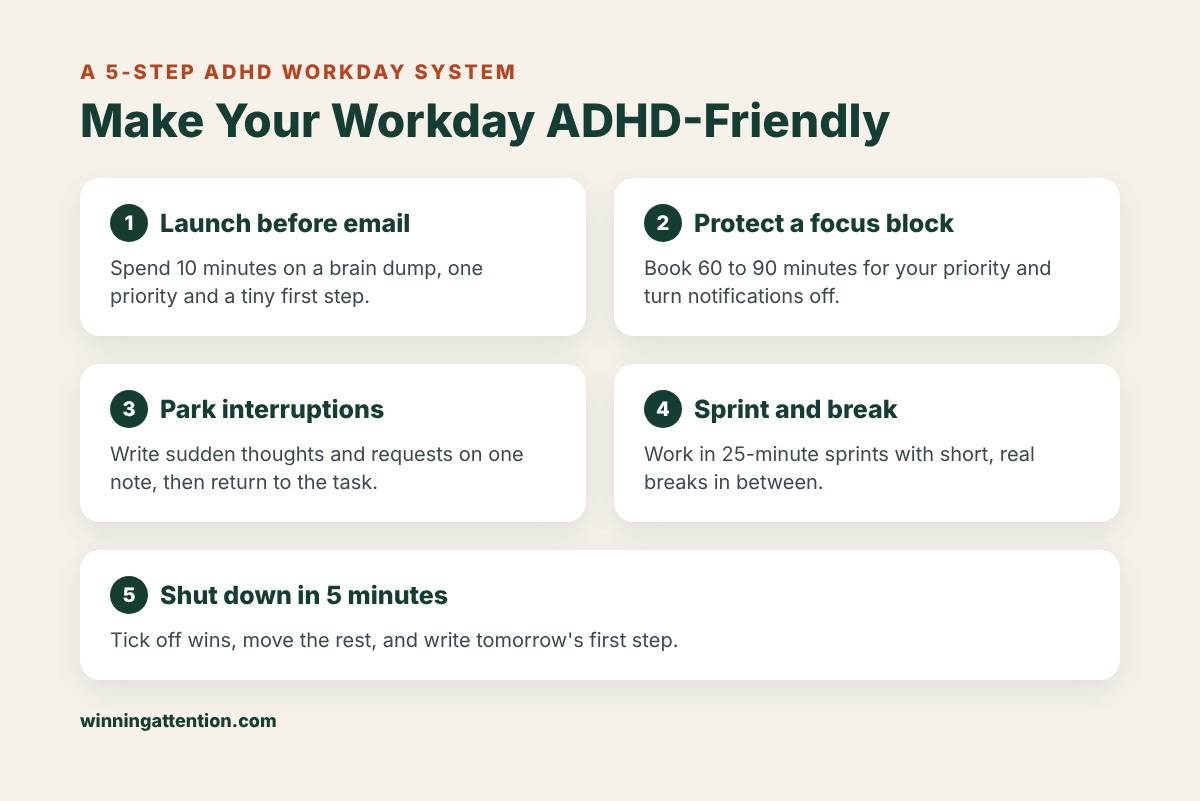
The short version: stop relying on memory and willpower. Start each workday with a 10-minute launch routine before you open email, protect one focus block for your most important task, catch interruptions on a single note instead of acting on them, work in short sprints with deliberate breaks, and close the day with a five-minute shutdown that parks tomorrow’s first step on paper.
Why ADHD productivity at work is so hard
ADHD is not a problem of laziness or intelligence. It affects the self-management skills that most office jobs, and ADHD productivity in general, quietly depend on: starting tasks, holding priorities in mind, estimating time, and steering attention back after a distraction. Work is full of exactly those demands, which is why so many adults first notice their symptoms most clearly on the job.
What large studies say about ADHD and work
The scale of the issue is bigger than many people realize. A World Health Organization survey of 7,075 workers aged 18 to 44 in 10 countries estimated that an average of 3.5% of workers met criteria for adult ADHD. Compared with otherwise similar coworkers, workers with ADHD lost about 22 extra days of role performance per year, and the effect did not differ by occupation, education, age or gender. Only a small minority of those workers had ever been treated for ADHD (de Graaf et al., 2008).
A review of research on occupational health came to a similar conclusion. Adults with ADHD had higher rates of unemployment, and those who were employed reported more workplace impairment and reduced productivity, along with issues such as irritability and low frustration tolerance. The review also noted a higher risk of accidents and injuries, and a substantial economic cost from absenteeism and lost productivity (Küpper et al., 2012).
Those numbers describe averages, not destinies, and they say nothing about your individual ADHD productivity ceiling. They are useful mainly because they make one thing clear: if work feels harder for you than it seems to be for others, you are not imagining it, and it is worth building a system around the problem instead of blaming yourself for it.
The gap between what you can do and what gets done
One of the most telling findings comes from a study that compared 1,231 adults from the community with 134 adults diagnosed with ADHD at an outpatient clinic. People with ADHD reported work problems especially in not meeting their own standards and perceived potential. Those problems showed up less often as poor performance reviews or job loss. Symptoms of inattention were strongly linked to work problems, while scores on lab tests of attention and executive function did not meaningfully predict how people functioned at work (Fuermaier et al., 2021).
In other words, many adults with ADHD keep their jobs and even do well on paper, but at a high personal cost: late nights catching up, constant self-criticism, and the sense of always running behind their own ability. Improving ADHD productivity is often less about pleasing a manager and more about closing that painful gap.
Interruptions cost more than they seem
Modern workplaces are built on interruptions: chat pings, email alerts, quick questions, and meetings scattered across the day. A well-known experiment on office work found that when people were interrupted, they compensated by working faster, but they paid for it with more stress, frustration, time pressure and effort (Mark et al., 2008). That study was not about ADHD, but the pattern matters even more if returning to a task after a distraction is already hard for you.
With ADHD, an interruption does not just pause the task. It can erase the mental thread entirely. You come back to the document and have to rebuild where you were, what you were about to write, and why it mattered. Ten small interruptions can quietly eat a whole morning.
Support at work is still patchy
Research on how to support adults with ADHD in the workplace is surprisingly thin. A systematic review that synthesized 143 studies found that most of them tested medication, and very few examined interventions designed for the work context itself. The psychosocial approaches that did show promise shared a few ingredients: group-based support, involving people from the person’s own network, and a good working relationship with the professional. The authors also flagged disclosure and self-awareness as barriers to getting support at all (Lauder et al., 2022).
An international consensus statement by clinicians, occupational health specialists and disability advisors reached a similar view: occupational health services were often treated as a last resort rather than a way to make positive workplace changes, and professionals rarely worked together on employment issues for adults with ADHD (Adamou et al., 2013). Until that changes, much of the practical work of building an ADHD-friendly workday falls to you.
What the research says improves ADHD productivity
The strongest non-medication evidence for adults comes from structured skills programs, usually delivered as cognitive-behavioral therapy (CBT). These programs do not try to make you “try harder” or treat ADHD productivity as a character issue. They teach concrete systems for organization, planning and handling distraction, then help you practice them until they become routine.
- CBT alongside medication. In a randomized trial of 86 adults who still had significant ADHD symptoms despite medication, 12 sessions of CBT led to greater improvement than an attention-matched program of relaxation with educational support. On the ADHD rating scale, 67% responded to CBT versus 33% in the comparison group, and responders kept their gains at 6 and 12 months (Safren et al., 2010).
- The broader evidence. A meta-analysis of 32 studies found that CBT for adult ADHD had small-to-medium effects compared with control groups on both symptoms (g = 0.65) and everyday functioning (g = 0.51). Studies with active control groups showed smaller effects, which is a useful reminder that these are real but modest gains, not miracles (Knouse et al., 2017).
- Parking unfinished tasks. In a series of experiments, unfinished goals kept intruding on people’s thoughts and hurt their performance on unrelated tasks. Simply making a specific plan for when and how to deal with the goal removed those effects (Masicampo & Baumeister, 2011). The participants did not have ADHD, but the finding supports writing tasks down with a clear next step instead of carrying them in your head.
- Short breaks protect focus. In a study of a long, monotonous attention task, people who briefly switched their attention to a different goal a couple of times did not show the usual decline in performance over time, while those who stayed on the task without a break did (Ariga & Lleras, 2011). Again, this was not an ADHD sample, but it supports planned breaks over “pushing through.”
The method below borrows from these ingredients: one capture place, a daily planning routine, protected time for important work, deliberate breaks and an end-of-day shutdown. It is a self-help structure that can sit alongside professional care. It is not a replacement for assessment or treatment.
A 5-step ADHD productivity system for your workday
The system takes about 15 minutes a day in total: 10 at the start, 5 at the end. The rest of the day runs on a few simple rules. Try it for three weeks before you judge whether it improves your ADHD productivity; most new routines feel clunky for the first several days.
Step 1: Launch your day before you open email
Email and chat are other people’s priorities arriving in a stream, and they are one of the biggest drains on ADHD productivity. If you open them first, your day gets planned by whoever wrote to you last. Instead, spend the first 10 minutes of your workday on a short launch routine:
- Brain dump. Write every task, worry and loose end onto one page or one note. Do not sort yet.
- Pick one priority. Ask: “If only one thing moves forward today, which one would matter most?” Write it at the top.
- Check the calendar. Look at meetings and fixed commitments so nothing surprises you at 2 p.m.
- Write the first step. Turn your priority into a tiny, visible action, such as “open the budget file and fill in the March column.”
If you already use a daily plan, this is the same idea applied to a work context. The guide on how to plan your day with ADHD goes deeper into the planning page itself.
Example of a launch note
- Priority: client report draft (due Thursday).
- First step: open last quarter’s report and copy the section headings into a new file.
- Fixed: 11:00 team stand-up, 15:00 call with vendor.
- Parked for the admin block: expense claim, reply to HR, book training.
Step 2: Protect one focus block
Your most important task needs a protected window, ideally 60 to 90 minutes at the time of day when your attention is usually best. For many adults with ADHD that is late morning, but notice your own pattern rather than following a rule.
Protecting the block means making it visible to others and to yourself. Put it in your calendar as a real appointment. Set your chat status to “focusing, back at 11:00.” Close email entirely, not just minimized. If your job allows it, move to a quieter spot or use noise-reducing headphones.
Scripts for protecting your time
- “I am in a focus block until 11. Can I get back to you right after?”
- “Could we move this to the afternoon? Mornings are when I do my deepest work.”
- “Is this urgent, or can it go on my list for today’s admin time?”
Most colleagues respect a clear, friendly boundary, especially when you reliably follow up when you said you would.
Step 3: Catch interruptions instead of acting on them
Keep one “parking lot” note open next to your work: a sticky note, a text file, or a page in your notebook. When a thought, request or idea pops up during a focus block, write it there in a few words and return to your task. Do not research it, reply to it, or “just quickly” do it.
This works with your ADHD instead of against it. The idea is captured, so your brain can stop holding it, and the task in front of you keeps its momentum. At the next break or during the admin block, empty the parking lot: do, schedule, delegate or delete each item.
Reducing interruptions at the source
- Turn off email and chat notifications during focus blocks; check them at set times instead.
- Keep your phone in a drawer or another room while you focus.
- Batch quick requests: tell your team you will answer non-urgent messages at, say, 11:30 and 16:00.
- Close unrelated browser tabs before each sprint. Bookmark them in one folder if closing them feels risky.
Step 4: Work in sprints and take breaks on purpose
Long stretches of unstructured time are hard with ADHD, and they are where ADHD productivity tends to leak away. A timer gives the work a clear edge. Set it for a sprint, often 25 minutes, work on one thing only, then take a 3 to 5 minute break that is genuinely different: stand up, refill water, look out the window, stretch. Then start the next sprint.
If 25 minutes feels impossible on a hard day, start with 10. If you tend to hyperfocus, the timer protects you in the other direction, reminding you to eat, move and check whether you are still working on the right thing. Hyperfocus feels productive, but it can swallow a whole afternoon on a task that was not the priority.
When you cannot start at all
Sometimes the plan is clear and you still freeze. That is common, especially for tasks that are boring, vague or emotionally loaded. Shrink the first step until it feels almost silly (“open the file and type the title”), commit to just one 10-minute sprint, or work alongside a colleague. The article on ADHD task paralysis covers more ways to get unstuck.
Step 5: Shut down the day in five minutes
Many adults with ADHD either stop abruptly when the energy runs out or keep working late because nothing feels finished. A short shutdown ritual gives the day a clear ending:
- Tick off what you finished. Seeing progress matters.
- Move unfinished items to tomorrow’s list.
- Write tomorrow’s first step for your priority, as specifically as you can.
- Glance at tomorrow’s calendar.
- Close every tab and app. Say or write “done for today.”
This is where the research on plan making is most useful. Writing down a specific plan for an unfinished task helps stop it from looping in your head, so it is less likely to follow you into the evening (Masicampo & Baumeister, 2011). It also makes tomorrow’s launch much faster.
A worked example: one Tuesday at the office
Here is how the system might look in practice for a fictional example: Marcus, a 34-year-old marketing coordinator with ADHD who works a hybrid schedule. On Tuesday he is in the office.
- Launch, 8:50 to 9:00. Before opening email, Marcus writes a brain dump: campaign brief for Friday, 40 unread emails, update the social calendar, approve two invoices, prepare slides for Thursday, reply to his manager about vacation dates. He picks the campaign brief as his priority. His first step: “Open the template and write three bullet points for the target audience.”
- Focus block, 9:00 to 10:30. He books the time in his calendar, sets his chat status to “focusing until 10:30,” puts on headphones and starts a 25-minute timer. When a colleague asks about lunch plans, he smiles and says, “Can I catch you at 10:30?”
- Parking lot. During the first sprint, Marcus remembers he never sent the vendor contract. Instead of opening email, he writes “vendor contract” on his parking-lot note and goes back to the brief.
- Breaks. After each sprint he stands, refills his water bottle and comes back. By 10:30 he has three sprints done and a rough draft of the brief.
- Admin block, 11:00 to 11:45. He opens email, sends the vendor contract first, approves the invoices and replies to his manager. He leaves 30 emails unread on purpose; none are urgent.
- Afternoon. Meetings, the social calendar, and a second short sprint on the brief.
- Shutdown, 17:00. He ticks off the brief draft, moves the slides to Wednesday’s list, and writes Wednesday’s first step: “Paste brief feedback into the draft and fix the headline.”
Marcus did not clear his inbox, and the slides did not move. But the most important task made real progress, nothing urgent was missed, and he left on time without a list of open loops spinning in his head. That is what good ADHD productivity looks like on an ordinary day.
A sample ADHD-friendly workday
Adjust the times to your own job and energy. The structure matters more than the exact clock.
| Time | Block | What happens |
|---|---|---|
| 8:50–9:00 | Launch | Brain dump, one priority, calendar check, first step written down |
| 9:00–10:30 | Focus | The priority task in 25-minute sprints, notifications off |
| 10:30–11:00 | Buffer | Break, movement, empty the parking lot |
| 11:00–11:45 | Admin | Email, chat, calls, forms and quick approvals, batched |
| 12:00–13:00 | Lunch | A real break away from the desk |
| 13:00–16:00 | Meetings and flexible work | Collaboration, smaller tasks, a second sprint if possible |
| 16:00–16:30 | Admin | Second check of messages, follow-ups |
| 16:55–17:00 | Shutdown | Tick off, move the rest, write tomorrow’s first step |
If you want a ready-made page for the launch and shutdown routines, the free ADHD Daily Planner Starter Kit includes a one-page daily planner, a weekly energy tracker and a 2-minute reset card you can keep on your desk.
ADHD at work: finding a setup that fits
There is no list of “ADHD jobs,” and research has not identified one ideal career. But how well a job fits your attention style can make a big difference to your ADHD productivity and to how capable you feel. Instead of asking “which job is right for ADHD,” it is usually more useful to ask which features of a role help or hurt you.
Features that many adults with ADHD find easier
- Variety and clear short-term goals. Work that changes through the day and has visible finish lines can be easier to engage with than long, open-ended projects with distant deadlines.
- Interest and meaning. Many adults with ADHD find it much easier to focus on work they care about. Interest is not a luxury here; it is part of how attention works for them.
- External structure. Regular check-ins, shared deadlines and clear expectations can act like scaffolding.
- Some movement. Roles that involve moving around, talking with people or hands-on work suit some people better than long hours at a desk.
Features that often make things harder
- Constant interruptions with no protected time.
- Large amounts of detailed, repetitive paperwork with little support.
- Vague goals and infrequent feedback.
- Open-plan offices with lots of noise and visual distraction.
You may not be able to change jobs, but you can often change parts of the job: which tasks you take on, when you do them, and where you sit while doing them.
Does working from home help or hurt with ADHD?
Both, depending on the person and the setup. Home can mean fewer interruptions, more control over noise and lighting, and the freedom to move, pace or take short breaks without anyone noticing. It can also mean no external structure, no colleagues to work alongside, and a laundry basket, fridge and phone competing with the work.
If you work remotely, add the structure an office would have provided:
- Keep a consistent start time and a short “commute” ritual, such as a walk around the block, to mark the beginning and end of the day.
- Work in one dedicated spot, even if it is just one end of the kitchen table.
- Use virtual coworking or a video call with a colleague to work alongside someone.
- Schedule your focus block and shutdown in your calendar exactly as you would in the office.
Hybrid arrangements let some people put deep-focus work on home days and collaboration on office days. Notice which environment suits which kind of task for you, and plan your week around that.
ADHD tips for the workplace: disclosure and accommodations
Whether to tell your employer about ADHD is a personal decision, and there is no single right answer. Research has highlighted disclosure as one of the barriers that stops adults with ADHD from getting support at work (Lauder et al., 2022), but disclosure also carries real considerations about privacy, workplace culture and how a manager might respond.
Questions to think through before you disclose
- What do you need? Be clear about the specific changes that would help. “I need fewer interruptions in the morning” is easier to act on than “I have ADHD.”
- Can you ask without disclosing? Many adjustments, such as written instructions or a quieter desk, can be requested as a work preference without naming a diagnosis.
- Who should you tell? Some people tell HR only, some tell their direct manager, some tell trusted colleagues and no one else.
- What is the culture like? Consider how the organization has handled other health or disability requests.
Workplace accommodations people commonly discuss
Research on which specific workplace accommodations work best for ADHD is still limited, so treat the list below as ideas to explore rather than proven treatments. Examples that are commonly discussed include:
- A quieter workspace, noise-cancelling headphones, or permission to work from home for focus tasks.
- Written instructions and meeting notes in addition to verbal ones.
- Breaking larger projects into smaller milestones with regular check-ins.
- Flexible start times or scheduling demanding work at your best time of day.
- Permission to use timers, reminders, task-management tools or speech-to-text software.
- Protected calendar time with no meetings.
Where to find reliable information in the US and Canada
In the United States, the Americans with Disabilities Act (ADA) generally requires many employers to provide reasonable accommodations for qualified employees with disabilities, and ADHD can be covered in some situations. How the law applies depends on your circumstances, so this article cannot give legal advice. A good starting point is the Job Accommodation Network (JAN), a free service that offers guidance on accommodations and the ADA. In Canada, rules vary by province and sector; your provincial human rights commission or the Canadian Human Rights Commission are useful places to start. For advice about your specific situation, speak with HR, a union representative or an employment lawyer.
How to stop getting distracted at work with ADHD
Distraction is the most common complaint people raise about ADHD productivity at work, but it is not a single problem. It helps to notice what kind of distraction is pulling you away, because each kind needs a different fix.
- External distractions (noise, people, notifications): change the environment. Headphones, a different seat, notifications off, phone out of reach.
- Digital rabbit holes (news, social media, “quick” searches): use website blockers during focus blocks, and keep your phone physically away from your desk.
- Internal distractions (sudden ideas, worries, remembering other tasks): write them on the parking-lot note and return to the work.
- Boredom (the task is dull): add novelty or urgency. Set a short timer and race it, switch locations, pair the task with music, or work alongside someone.
- Unclear next step (you do not know what to do next): stop and write the next physical action before you continue.
- Tiredness: take a real break, move, drink water, and eat. Long-term, look at sleep; it has a big effect on attention.
Time blindness also plays a role. If an hour disappears without you noticing, a visible timer or analog clock on your desk can help. The article on ADHD time blindness explains why time can feel so slippery and how to make it more visible.
Common mistakes that undermine ADHD productivity
- Starting the day in your inbox. It feels productive, but it hands your priorities to other people. Launch first, then open email.
- Saying yes to every meeting. Scattered meetings break the day into pieces too small for real work. Ask for agendas and protect one focus block.
- Building a complicated system. Elaborate apps and color codes are fun to set up and hard to maintain. Start simple: one list, one calendar, one parking-lot note.
- Relying on memory for “small” things. Small tasks are the easiest to forget. Write them down anyway.
- Working late to make up for a scattered day. It can become a cycle: late nights lead to tired mornings and more scattered days. Use the shutdown instead.
- Comparing yourself with neurotypical coworkers. Your process may look different. Judge your system by whether the important work moves forward.
- Giving up after a bad week. Every system breaks sometimes. Restart with tomorrow’s launch rather than trying to catch up on everything you missed.
When to talk to a professional
ADHD productivity strategies help many adults, but they are not a treatment for ADHD on their own. Talk to a doctor, psychologist or other qualified clinician if work problems are putting your job at risk, if you are regularly working late to keep up, if you have never been assessed but recognize yourself in this article, or if you are dealing with low mood, anxiety, burnout or poor sleep. Evidence-based options include medication, CBT and structured skills programs, and many people do best with a combination. An occupational health service or employee assistance program, if your employer has one, may also be able to help.
Frequently asked questions
How can I be more productive at work with ADHD?
Build your day around a few simple routines instead of willpower. Plan for 10 minutes before opening email, protect one focus block for your most important task, write interruptions on a single note, work in short timed sprints with breaks, and end with a five-minute shutdown. Structured CBT programs that teach these kinds of skills have research support for adults with ADHD.
What jobs or work setups suit people with ADHD?
Research has not identified one ideal job for ADHD. Many adults find it easier to focus in roles with variety, clear short-term goals, genuine interest and some external structure. Protected focus time and fewer interruptions often matter as much as the job title.
Should I tell my employer I have ADHD?
It is a personal choice with no single right answer. Think about what specific changes you need, whether you can ask for them without naming a diagnosis, and how your workplace has handled similar requests. For guidance in the US, the Job Accommodation Network (askjan.org) is a good starting point, and HR, a union representative or an employment lawyer can advise on your situation.
What workplace accommodations help with ADHD?
Commonly discussed examples include a quieter workspace or headphones, written instructions, regular check-ins on larger projects, flexible scheduling, protected meeting-free time, and permission to use reminder or task-management tools. Research on which accommodations work best is still limited, so focus on the specific problems you face.
How do I stop getting distracted at work with ADHD?
First notice what kind of distraction is pulling you away. Change the environment for noise and notifications, use blockers for digital rabbit holes, and write sudden thoughts on a parking-lot note instead of acting on them. For boring tasks, add a timer or work alongside someone.
Does working from home help or hurt with ADHD?
It can do both. Home often means fewer interruptions and more control over your environment, but also less structure and more temptations. If you work remotely, keep a fixed start time, a dedicated workspace, scheduled focus blocks and a clear end-of-day ritual.
Sources
- de Graaf R, Kessler RC, Fayyad J, et al. The prevalence and effects of adult attention-deficit/hyperactivity disorder (ADHD) on the performance of workers: results from the WHO World Mental Health Survey Initiative. Occupational and Environmental Medicine. 2008;65(12):835–842. PubMed
- Küpper T, Haavik J, Drexler H, et al. The negative impact of attention-deficit/hyperactivity disorder on occupational health in adults and adolescents. International Archives of Occupational and Environmental Health. 2012;85(8):837–847. PubMed
- Fuermaier ABM, Tucha L, Butzbach M, et al. ADHD at the workplace: ADHD symptoms, diagnostic status, and work-related functioning. Journal of Neural Transmission. 2021;128(7):1021–1031. PubMed
- Mark G, Gudith D, Klocke U. The cost of interrupted work: more speed and stress. Proceedings of the SIGCHI Conference on Human Factors in Computing Systems. 2008:107–110. DOI
- Lauder K, McDowall A, Tenenbaum HR. A systematic review of interventions to support adults with ADHD at work: implications from the paucity of context-specific research for theory and practice. Frontiers in Psychology. 2022;13:893469. PubMed
- Adamou M, Arif M, Asherson P, et al. Occupational issues of adults with ADHD. BMC Psychiatry. 2013;13:59. PubMed
- Safren SA, Sprich S, Mimiaga MJ, et al. Cognitive behavioral therapy vs relaxation with educational support for medication-treated adults with ADHD and persistent symptoms: a randomized controlled trial. JAMA. 2010;304(8):875–880. PubMed
- Knouse LE, Teller J, Brooks MA. Meta-analysis of cognitive-behavioral treatments for adult ADHD. Journal of Consulting and Clinical Psychology. 2017;85(7):737–750. PubMed
- Masicampo EJ, Baumeister RF. Consider it done! Plan making can eliminate the cognitive effects of unfulfilled goals. Journal of Personality and Social Psychology. 2011;101(4):667–683. PubMed
- Ariga A, Lleras A. Brief and rare mental “breaks” keep you focused: deactivation and reactivation of task goals preempt vigilance decrements. Cognition. 2011;118(3):439–443. PubMed
Turn this into a daily plan
Get the free ADHD Daily Planner Starter Kit: a one-page daily planner, a weekly energy tracker and a 2-minute reset card.