You sit down to answer “one quick email,” and when you look up, the stand-up started six minutes ago. You told your manager the report would take an afternoon, and on Thursday night you are still on page two. If that sounds familiar, you are dealing with time blindness at work: the gap between how long things feel like they take and how long they actually take, playing out in a place where clocks, calendars, and other people’s expectations are everywhere.
This guide is about the job itself. Not the theory of why ADHD brains experience time differently, but what to do on a Tuesday morning when you have three meetings, a deadline creeping closer, and a task you cannot size up. You will find a step-by-step system, specific tactics for meetings, deadlines, estimates, and transitions, plus language you can borrow when you talk to your manager or ask about workplace adjustments.
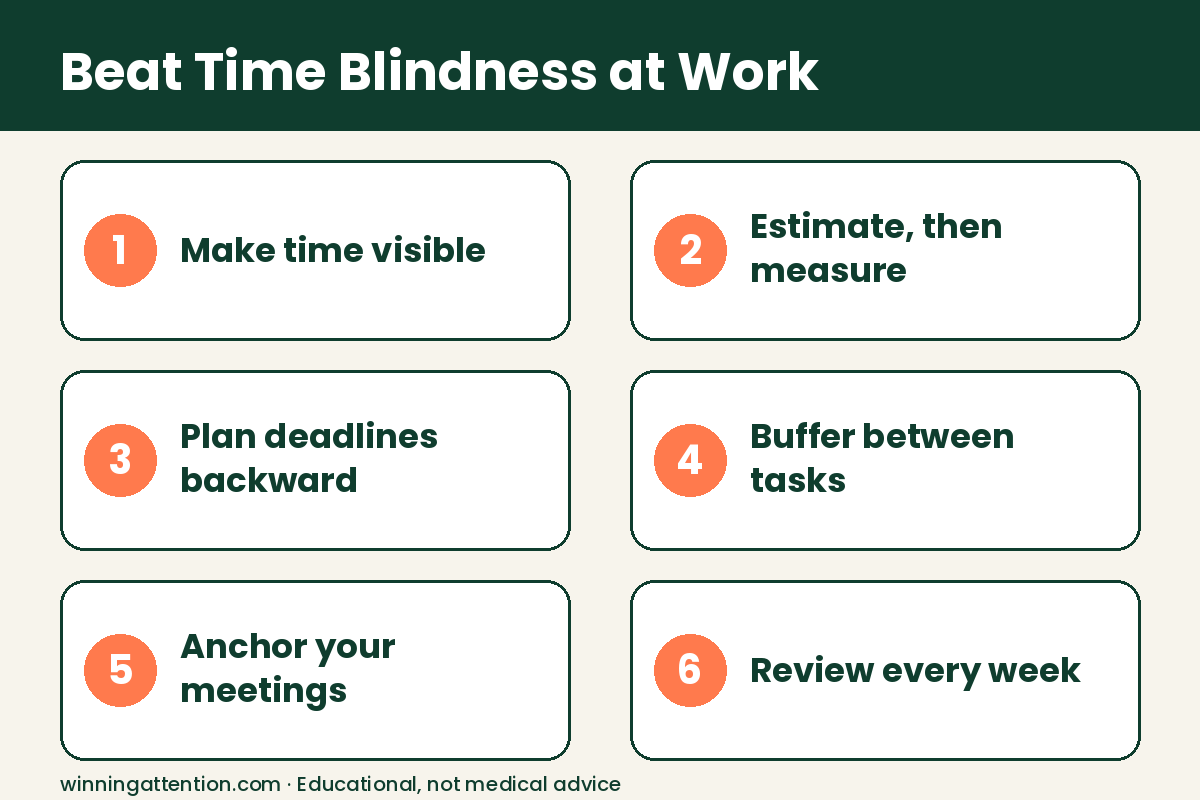
The short version: Stop relying on your internal sense of time at work and move time outside your head. Make the clock visible, log your estimates against reality, plan deadlines backward, protect buffers between tasks, and agree on clear check-ins with your manager. Small external structures beat willpower almost every time.

Why time blindness at work feels different
If you want the full background on what time blindness is and what the research says about it, start with our explainer on ADHD time blindness. Here, we will only touch on the parts that matter for your workday.
The short summary: studies of time perception in ADHD have found real differences on average. A 2024 meta-analysis that pooled hundreds of effect sizes across children and adults reported a moderate-to-large overall difference in time perception between people with and without ADHD. At the same time, a review focused only on adults found that the research is still fairly thin and the results are mixed: some studies show clear problems with time estimation and time management, while others do not. In plain terms, many adults with ADHD struggle with time, but not everyone in the same way.
Work raises the stakes for three reasons:
- Other people depend on your timing. At home, running late mostly affects you. At work, a missed handoff can block a teammate, delay a client, or make you look unreliable even when your work is excellent.
- Time is mostly invisible. Many jobs happen on a screen, where hours dissolve without the natural cues of a physical task. There is no pot boiling over to tell you twenty minutes passed.
- Deadlines are often far away. A project due in three weeks can feel like it is due “never” until suddenly it is due tomorrow.
The costs are real. In a large World Health Organization survey of workers across ten countries, adult ADHD was linked to roughly 22 extra days per year of lost work performance compared with similar workers without ADHD. A review of occupational health research also linked ADHD with workplace impairment and reduced productivity. None of this says anything about your talent or effort. It says the default workplace is not built around how your brain tracks time, so you need to build some of that structure yourself.
If you would like a guided path through this kind of system-building, our ADHD-friendly planning course walks through it step by step. It is optional; everything in this article works on its own.
Find your leak points first
Time blindness rarely shows up everywhere at once. It tends to leak out at specific moments. Before you change anything, spend three or four workdays noticing where time slips away. Keep a sticky note or a plain text file and jot a quick mark each time one of these happens:
- Start leaks: you know what to do but cannot begin, and twenty minutes vanish.
- Estimate leaks: a task takes much longer than you said it would.
- Transition leaks: you are late to meetings because you were absorbed in something else.
- Horizon leaks: a deadline you “had plenty of time for” turns into a last-minute scramble.
- Interruption leaks: a quick question from a coworker turns into an hour you never got back.
Most people find that one or two categories cause most of the pain. That tells you where to start. If starting is your biggest leak, shrink the first action until it feels almost silly, like opening the file and typing one heading. The system below focuses on the time side: seeing it, estimating it, and protecting it.
A six-step system for time blindness at work
Think of this as scaffolding. You do not need all six steps on day one. Pick the one that matches your biggest leak, run it for two weeks, then add another.
Step 1: Make time visible at your desk
The core idea is simple: if your internal clock is unreliable, put an external one where your eyes already are. Small clock in the corner of the screen is easy to ignore. Instead, try a visual timer that shows time shrinking, a physical clock placed directly beside your monitor, or a large on-screen countdown for focused blocks.
Go one step further and make time audible. A gentle chime every 30 minutes gives you a regular “where am I?” check. When it sounds, ask yourself one question: “Is this still the most important thing?” If yes, keep going. If not, switch.
Step 2: Estimate, then measure
Estimating tasks is one of the hardest parts of time blindness at work. You probably cannot fix your gut sense directly, but you can calibrate it with data. For two weeks, before each task, write down your estimate. When you finish, write down the actual time. A simple table works:
- Task: draft client summary. Estimate: 30 minutes. Actual: 75 minutes.
- Task: review pull request. Estimate: 20 minutes. Actual: 45 minutes.
- Task: update spreadsheet. Estimate: 15 minutes. Actual: 20 minutes.
Patterns appear fast. Many people discover a personal multiplier: certain types of tasks consistently take about twice as long as they guess, while routine tasks are closer to accurate. Once you know your multiplier for each type of work, apply it before you commit to anything. If your gut says “an hour,” and writing tasks usually run 2x, you tell your team “two hours” or “by end of day.”
Step 3: Plan every deadline backward
A due date by itself is just one point far in the future. Your brain needs checkpoints closer to “now.” When you receive a deadline, work backward from it:
- Write the final due date.
- Move it one or two days earlier as your personal deadline. This is your buffer.
- List the major chunks of work (research, first draft, review, final edits).
- Assign each chunk its own mini-deadline, working backward from your personal deadline.
- Put each mini-deadline on your calendar as an event with a reminder, not just as a note.
Now the project has several “nows” instead of one distant “later.” Each mini-deadline is close enough to feel real.
Step 4: Build buffers between everything
Back-to-back scheduling assumes that every task ends exactly on time and that switching costs zero minutes. For many people with ADHD, neither is true. Add 10 to 15 minutes of open space between meetings and focused blocks. Use that space to wrap up, write a quick “where I left off” note, grab water, and look at what is next.
If your calendar is controlled by others, you can still set meetings you own to end five or ten minutes early, and you can block small buffer slots yourself so they look taken.
Step 5: Turn meetings into anchors
Instead of letting meetings interrupt your day, use them as fixed landmarks. Plan your focused work in the gaps between them, and set two reminders for each meeting: one at 10 minutes before (start wrapping up) and one at 2 minutes before (stand up, open the link, walk to the room). More on this in the meetings section below.
Step 6: Review your week in 15 minutes
Once a week, look back at your estimate log and your calendar. Which tasks ran long? Which buffers saved you? What is coming up that needs a backward plan? A short weekly review keeps the system from quietly falling apart. Our guide to ADHD weekly planning has a full template if you want more structure.
Meetings: getting there on time and staying present
Meetings are where time blindness becomes most visible to coworkers. The good news is that they are also where small tactics make the biggest difference.
Getting there
- Use a two-alarm rule. One alert to start wrapping up, one to physically go. A single reminder that fires while you are mid-sentence often gets dismissed and forgotten.
- Stop at a natural pause, not a finish line. When the first alarm sounds, do not try to finish the task. Write one sentence about where you stopped so you can pick it back up later.
- Prep the link or room the night before. Knowing exactly where you are going removes a small but real source of delay.
- Join early on purpose. Aim to arrive two minutes early. If you run a little late, you are on time.
Staying present
Long meetings can also distort time in the other direction: a 60-minute call can feel endless, and your attention drifts. Keep a simple notes page open with three headings: decisions, my action items, and deadlines. Writing gives your attention somewhere to go, and capturing deadlines right away prevents them from evaporating.
Leaving with clear next steps
Before the meeting ends, say out loud: “Just to confirm, I am doing X by Thursday at noon.” This turns a fuzzy commitment into a specific time. Then immediately add that deadline to your calendar before you do anything else.
Deadlines and long projects
Long projects are where “now” and “not now” thinking causes the most trouble. A few tactics help bring distant deadlines closer.
Use a visible countdown
Write the number of working days left on a sticky note or whiteboard and update it each morning. “11 working days” feels very different from “due on the 24th.”
Ask for interim check-ins
If your manager only sees your work at the end, you lose the chance to catch problems early. Ask for a short check-in at the halfway point, or offer to share a rough draft early. This creates an outside deadline that pulls the work forward.
Notice procrastination patterns
Sometimes a deadline is not slipping because of time perception, but because the task feels unpleasant or overwhelming. If that sounds like you, name the feeling, then pick a five-minute first step you can do right now. Lowering the bar to start often matters more than any clock.
Transitions and hyperfocus on the job
Switching between tasks is one of the hidden time costs at work. Two patterns are especially common.
The slow start
After a meeting or break, it can take a long time to get back into focused work. A “where I left off” note helps a lot here. Before stopping any task, write one or two lines: what you just did and the very next action. When you come back, you read the note and start with that action instead of re-figuring everything out.
The hard stop
The opposite problem is getting so absorbed that you lose hours. Deep focus can be an asset at work, but it can also make you miss meetings, lunch, and other priorities. Set an alarm before you begin a focused block, place your phone or timer out of reach so you have to stand up to silence it, and decide in advance what you will do next. For more on working with intense focus rather than against it, see our guide to ADHD hyperfocus.
Talking to your manager about time blindness at work
You do not have to disclose a diagnosis to ask for support with time. Whether you share that you have ADHD is a personal choice, and there are reasonable arguments either way. Many people start by describing what helps them work well, without any medical labels.
Focus on outcomes, not explanations
Managers usually care most about results. Frame your requests around how they help you deliver:
- “I do my best work when deadlines are written down. Could you send a quick message after we agree on due dates?”
- “Would it be okay to do a short check-in halfway through bigger projects? It helps me catch issues early.”
- “I have found that I estimate better when I have a moment to check my notes. Can I get back to you by end of day with a timeline?”
- “Blocking focus time in the morning helps me get my deep work done. Could we schedule recurring meetings in the afternoon when possible?”
Bring a solution with the request
Instead of saying “I struggle with deadlines,” try “I have started breaking big projects into weekly milestones. Could we review them together on Mondays?” This shows initiative and makes it easy for your manager to say yes.
If you choose to disclose
If you decide to share your diagnosis, keep it brief and practical. You might say: “I have ADHD, and one way it affects me is that I can lose track of time. Here is what I am doing about it, and here is one thing that would help.” Pairing the disclosure with your own strategies keeps the conversation focused on solutions.
Workplace accommodations in general terms
In many countries, people with conditions that affect daily functioning may be entitled to reasonable workplace adjustments. The rules, terms, and process vary a lot by country, state, and employer, so this section is general information, not legal advice. Your HR team, an occupational health service, or a local disability rights organization can explain what applies to you.
An international consensus statement on ADHD and employment noted that occupational health services are often used as a last resort rather than as a way to make positive changes in the workplace. That is worth knowing: asking early, before problems pile up, is often more useful than waiting.
Time-related adjustments people commonly discuss with employers include:
- Written instructions and deadlines after verbal conversations.
- Regular, scheduled check-ins with a manager or mentor.
- Flexible start times or protected focus blocks.
- A quieter workspace or permission to use noise-reducing headphones.
- Permission to use visual timers, alarms, or reminder tools at work.
- Breaking large assignments into smaller pieces with interim due dates.
- Extra time for certain tasks where timing is not critical.
Continuous support matters too. A small qualitative study of young adults with ADHD found that routines, clear tasks that match their interests, and a trusted person providing ongoing support were seen as important for taking part in work. If your workplace offers a mentor, a coach, or an occupational specialist, that kind of steady contact may be worth asking about.
Where skills training fits
Strategies like the ones above are not just tips. Several structured programs teach versions of them, and some have been tested in trials.
In a randomized trial of 88 adults with ADHD, a 12-week group program focused on time management, organization, and planning led to greater improvement in inattention symptoms than supportive therapy. Another randomized trial of 86 adults who still had symptoms despite treatment found that 12 sessions of individual cognitive behavioral therapy improved symptoms more than relaxation with educational support, with gains maintained at 12 months.
A smaller pilot trial tested a group program targeting time management for adults with ADHD and reported reduced symptoms compared with usual care. And a recent pragmatic trial of a group-based time management program for adults with ADHD, autism, or other mental health conditions found that both the group program and individual occupational therapy improved time management skills.
The takeaway: time management is a learnable skill set, and you do not have to figure it all out alone. If you want structured help, ask your clinician whether a skills-based program, coaching, or occupational therapy might fit your situation.
A sample workday with time supports in place
Here is what a day might look like once a few of these tools are running. Adjust it to your role and schedule.
- 8:45 Open your day plan. Check today’s meetings and any mini-deadlines. Pick your top one or two tasks. For help building this habit, see our guide on how to plan your day with ADHD.
- 9:00 to 10:30 Focus block on your most important task. Visual timer running. Estimate written down.
- 10:30 Buffer. Log actual time. Write a “where I left off” note.
- 10:45 Message window. Answer email and chat in one batch.
- 11:20 First meeting alarm. Wrap up.
- 11:28 Second alarm. Join the meeting.
- 11:30 to 12:00 Meeting. Capture decisions, action items, deadlines.
- 12:00 Add new deadlines to the calendar right away. Then lunch.
- 1:00 to 2:30 Second focus block.
- 4:30 Shutdown routine: review what got done, update tomorrow’s plan, write a note for your future self.
Notice that none of these steps relies on “feeling” the passage of time. Every transition is cued by something outside your head.
Remote and hybrid work: extra tips
Working from home removes many of the natural cues an office provides: coworkers heading to a meeting, the lunch rush, people leaving at the end of the day. That can make time even harder to track.
- Create artificial cues. Use scheduled alarms for lunch and the end of the day, not just meetings.
- Try body doubling. Working alongside a coworker on a video call, even in silence, can add structure to unstructured hours.
- Separate work and home time. A short shutdown routine, like closing your laptop and taking a short walk, marks the end of the workday.
Time blindness at work: your next small step
Time blindness at work is frustrating, but it is also very workable once you stop expecting your internal clock to do a job it was never good at. Move time outside your head with visible clocks and alarms. Calibrate your estimates with real data. Turn distant deadlines into a series of close ones. Protect buffers between tasks. And when it makes sense, ask your manager for the small supports that help you do your best work.
Pick one step from this article and try it for two weeks. If you want ready-made pages for daily plans, estimate logs, and weekly reviews, grab our free printable ADHD planner kit. And if you would like more guidance building a planning system that fits your brain, our ADHD planning course is there as an optional next step.
This article is for educational purposes only and is not medical advice. Talk to your clinician for diagnosis, treatment, and personalized guidance.
Frequently asked questions
What does time blindness at work look like?
It often shows up as running late to meetings, underestimating how long tasks will take, losing track of time during focused work, and feeling surprised when deadlines arrive. Many people also find it hard to switch between tasks or to start work when a deadline still feels far away. It is a pattern of difficulty with sensing and managing time, not a lack of effort or care.
How can I estimate tasks better with ADHD?
Track your estimates against reality for two weeks. Write down how long you think each task will take, then record the actual time. Most people discover a personal multiplier for certain types of work. Apply that multiplier before you commit to a deadline, and give yourself permission to say, “Let me check and get back to you with a timeline.”
How do I stop being late to meetings?
Use two reminders: one about ten minutes before to start wrapping up and one about two minutes before to physically join. Stop at a natural pause rather than trying to finish your task, and write a quick note about where you left off. Preparing meeting links or room locations in advance also removes small delays that add up.
Should I tell my manager I have ADHD?
That is a personal decision, and there are reasonable arguments either way. You can ask for many helpful supports, like written deadlines or regular check-ins, without disclosing a diagnosis. If you do choose to share, keep it brief, explain how it affects your work, and pair it with the strategies you are already using and one specific request.
What workplace accommodations help with time blindness?
Common examples include written instructions and deadlines, scheduled check-ins, flexible start times, protected focus blocks, permission to use timers and reminders, and breaking large projects into smaller pieces. Rules and processes differ by country and employer, so speak with HR, an occupational health service, or a local disability rights organization about what applies to you.
Can time management skills really improve with ADHD?
Yes, for many people. Randomized trials of structured programs that teach time management, organization, and planning skills have found improvements in ADHD symptoms compared with control conditions. Results vary between individuals, so it helps to talk to your clinician about whether skills training, coaching, or occupational therapy might fit your needs.
Sources
- Metcalfe KB, McFeaters CD, Voyer D. Time-Perception Deficits in Attention-Deficit/Hyperactivity Disorder: A Systematic Review and Meta-Analysis. Dev Neuropsychol. 2024;49(1):1-24. PubMed
- Mette C. Time Perception in Adult ADHD: Findings from a Decade-A Review. Int J Environ Res Public Health. 2023;20(4):3098. PubMed
- de Graaf R, Kessler RC, Fayyad J, et al. The prevalence and effects of adult attention-deficit/hyperactivity disorder (ADHD) on the performance of workers: results from the WHO World Mental Health Survey Initiative. Occup Environ Med. 2008;65(12):835-42. PubMed
- Küpper T, Haavik J, Drexler H, et al. The negative impact of attention-deficit/hyperactivity disorder on occupational health in adults and adolescents. Int Arch Occup Environ Health. 2012;85(8):837-47. PubMed
- Adamou M, Arif M, Asherson P, et al. Occupational issues of adults with ADHD. BMC Psychiatry. 2013;13:59. PubMed
- Lyhne CN, Pedersen P, Nielsen CV, et al. Needs for occupational assistance among young adults with ADHD to deal with executive impairments and promote occupational participation – a qualitative study. Nord J Psychiatry. 2021;75(5):362-369. PubMed
- Solanto MV, Marks DJ, Wasserstein J, et al. Efficacy of meta-cognitive therapy for adult ADHD. Am J Psychiatry. 2010;167(8):958-68. PubMed
- Safren SA, Sprich S, Mimiaga MJ, et al. Cognitive behavioral therapy vs relaxation with educational support for medication-treated adults with ADHD and persistent symptoms: a randomized controlled trial. JAMA. 2010;304(8):875-80. PubMed
- Nakashima M, Inada N, Tanigawa Y, et al. Efficacy of Group Cognitive Behavior Therapy Targeting Time Management for Adults with Attention Deficit/Hyperactivity Disorder in Japan: A Randomized Control Pilot Trial. J Atten Disord. 2022;26(3):377-390. PubMed
- Lidström Holmqvist K, Wingren M, Udumyran R, et al. Effectiveness of a group-based time-management intervention: a pragmatic randomised controlled trial. Disabil Rehabil. 2026;48(14):4496-4512. PubMed
Turn this into a daily plan
Get the free ADHD Daily Planner Starter Kit: a one-page daily planner, a weekly energy tracker and a 2-minute reset card.