You have probably noticed it before. The laundry you have ignored for a week gets folded in twenty minutes when a friend is sitting on your couch. The report you could not start all morning starts flowing once a coworker sits down at the next desk. Many adults have a name for this now: body doubling. ADHD communities talk about it constantly, and if you searched for “body doubling ADHD,” you probably want to know two things: does it actually work, and how do you do it well?
This guide gives you an honest answer to the first question and a practical one to the second. You will learn what body doubling is, why the presence of another person may make hard tasks easier to start and finish, what the research does and does not say, and how to set up sessions in person or online. You will also learn the etiquette that keeps sessions comfortable for everyone, and the situations where body doubling is more likely to get in your way than help.
The short version: Body doubling means doing a task while another person is present, either in the room or on a video call, usually working on their own thing. Direct research on body doubling itself is limited, but related evidence on social presence, external structure, and reporting your progress to someone else suggests why it may help many people with ADHD get started and keep going. It works best with a clear task, a fixed time box, a short check-in at the start and end, and a partner who stays quiet and non-judgmental. It is a tool, not a fix for everything, and it can backfire if you feel watched or evaluated.
What is body doubling?
Body doubling is a simple idea: you work on a task while someone else is nearby. The other person, your “body double,” is not there to teach you, supervise you, or do the task with you. Most of the time they are working on their own task, reading, or just quietly existing in the same space. Their role is to be present.
That presence can look very different depending on your life. It might be a partner reading at the kitchen table while you pay bills. It might be a friend on a video call, both of you with cameras on and microphones muted, working side by side for an hour. It might be a scheduled online session with a small group of people you have never met, all quietly working toward their own goals. It can even be sitting in a library or a café where other people are working around you.
What body doubling is not
- It is not supervision. Your body double is not checking your work or keeping you on task. If they start doing that, it often turns into pressure rather than support.
- It is not collaboration. You are not working on the same project. Parallel work is the point.
- It is not socializing. Chatting can be part of the start and end of a session, but the middle is for work.
- It is not a replacement for a plan. Having someone there will not tell you what to do next. You still need to know which task you are tackling.
Think of body doubling as one support in a larger planning system. If you want a structured way to build that system, an ADHD-friendly planning course can walk you through it step by step, but you can absolutely start body doubling today without any special setup.
Why body doubling ADHD strategies may help: what the research does and doesn’t say
Let’s start with honesty. As of now, there is very little published research that studies body doubling directly, by that name, in adults with ADHD. “Body doubling” is a community term, and most of what you read about it comes from personal stories and coaching experience. Those stories are worth listening to, but they are not controlled studies.
What we do have is adjacent research: how the presence of others affects attention, how ADHD affects self-regulation without outside structure, and how reporting progress affects follow-through. None of it proves body doubling works, but it offers plausible reasons why it might, and hints about when it might not.
The presence of others can change how you perform
Psychologists call the finding that people often perform differently when others are around “social facilitation.” A meta-analysis that pooled 33 studies looked at performance on the Stroop task, a classic test of cognitive control in which you have to ignore a distracting cue. People showed less interference, meaning better control, when they did the task in the presence of others compared to alone. Interestingly, the effect was stronger with an attentive audience than an inattentive one, and it disappeared when the audience was evaluating the person (Garcia-Marques & Fernandes).
That last detail is important for body doubling. It suggests that a calm, attentive presence may support focus, while a judging presence may not. Good body doubling aims for the first and avoids the second.
What about virtual presence? A small randomized study in virtual reality found that simply adding computer-generated bystanders did not reliably improve performance. Instead, the participants’ sense that they were in realistic company with others seemed to matter more (Strojny et al.). This is one study in a very different setting from a video call, so you should not over-read it. But it fits with what many people report: an online session tends to work better when it feels like real people are there with you, not just a static image on a screen.
ADHD and the gap between knowing and doing
One influential theory describes ADHD as a difficulty with behavioral inhibition that has ripple effects on other executive functions, including working memory and the self-regulation of motivation and arousal (Barkley). In plain terms, you may know exactly what you need to do and still struggle to make yourself start or keep going when the task is boring and nobody else is around. If you want to go deeper into this side of ADHD, see this guide to ADHD task paralysis.
An older study in children points in a similar direction. Researchers gave attention tasks to hyperactive children and comparison children in two conditions: with the experimenter in the room and with the experimenter absent. When the experimenter was present, the two groups performed similarly. When the experimenter left, the hyperactive children’s performance dropped more than the comparison group’s (Draeger et al.). The authors described this as a difficulty applying skills rather than a lack of ability.
This was an older study of children, not of body doubling. Still, it captures something many adults with ADHD recognize: the context around you can shape whether you use the skills you already have. A body double is one way to add that external context on purpose.
Saying your goal out loud and reporting back
Many body doubling sessions start with each person stating what they will work on and end with a quick report. There is good evidence that this kind of progress monitoring helps. A large meta-analysis of 138 experimental studies found that interventions that increased how often people monitored their progress also improved goal attainment. The effects were larger when progress was reported to others or made public, and when it was physically recorded (Harkin et al.).
Body doubling packages these elements neatly: you write down your goal, you say it to someone, and you report back at the end. That is a light, friendly form of accountability, not a high-pressure one.
Making the start specific
Starting is often the hardest part. “If-then” plans, also called implementation intentions, are a well-studied way to make the start specific: “When the session begins, I will open the budget file and enter last week’s receipts.” A recent meta-analysis in children found a small-to-medium overall effect of implementation intentions on goal achievement, and in some analyses the effect was stronger in children with ADHD (Breitwieser & Reinelt). These were children, not adults, so treat it as encouraging rather than conclusive. A body doubling session gives you a natural “when” for your “if-then” plan.
Structured group support has evidence behind it
Body doubling is not therapy, but some evidence-based ADHD interventions share its ingredients: structured sessions, peers working on similar challenges, and regular check-ins. In a randomized trial, adults with ADHD in a group meta-cognitive therapy program focused on time management, organization, and planning showed greater improvement in inattention symptoms than those in a supportive group (Solanto et al.). A more recent study of a group program for college students delivered by video found improvements in ADHD symptoms and planning skills from before to after the program, although the authors note that randomized trials are still needed (Canu et al.).
How to set up a body doubling ADHD session, step by step
You do not need special equipment or a membership to try body doubling. You need a task, a person (or a small group), and a time box. Here is a simple six-step structure you can use for almost any session.
Step 1: Pick one concrete task
Before the session, choose one task and shrink it until it is obvious how to begin. “Work on taxes” is too vague. “Gather last year’s income forms into one folder” is a task you can start in the first minute. If you tend to freeze when choosing, write two or three options on paper and pick the one that feels slightly uncomfortable but doable. A simple daily page, like the one in this free printable ADHD planner kit, gives you a place to write the task down so it is not living only in your head.
Step 2: Choose your format and partner
Decide whether you will meet in person or online, and who you will work with. A good body double is someone who is reliable, does not mind quiet, and will not comment on how you work. That could be a friend, a partner, a sibling, a coworker, or a member of an online study or work group. If you are not sure, start with someone you feel completely relaxed around.
Step 3: Set a clear time box
Agree on a start time and a stop time. Many people like 25 to 50 minutes of work with a short break, or a single 60-minute block. Shorter sessions are easier to commit to, especially at first. Use a visible timer so you do not have to guess how much time is left.
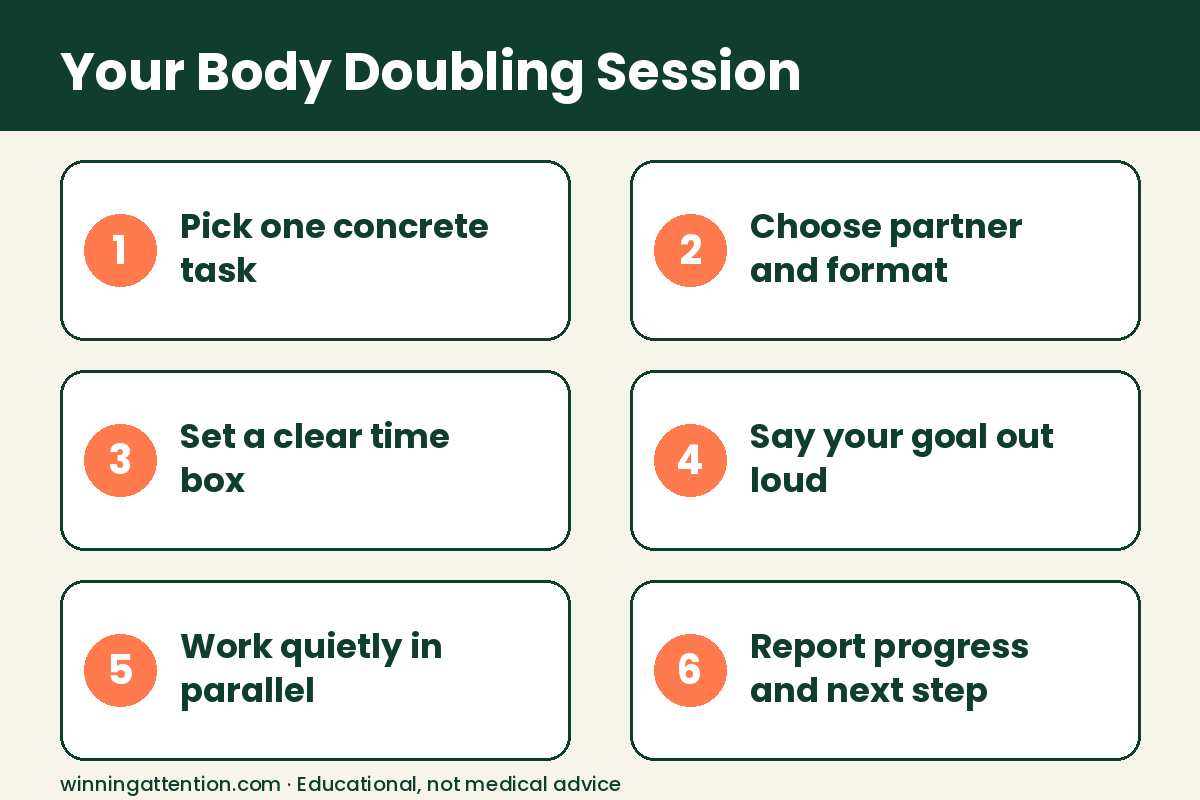
Step 4: Do a short opening check-in
Spend one or two minutes at the start. Each person says what they will work on and what “done” looks like for this session. Keep it brief and specific: “I’m going to reply to the three emails flagged from yesterday.” Saying it out loud turns a vague intention into a small commitment, and it gives you something concrete to report on later.
Step 5: Work in parallel, quietly
Now you both work on your own tasks. Avoid chatting during this part. If you get stuck, you can jot a note to ask about it during the break. If your mind wanders, simply notice it and return to the next small action. Your body double does not need to watch you. Their presence in the background is the whole point.
Step 6: Close with a quick report
When the timer ends, take a minute to share how it went. Did you finish? How far did you get? What is the next step? Keep this judgment-free. “I got halfway, and the next step is the second email” is a successful session. Write down your next step so you can start faster next time.
Body doubling in person
At home
Ask someone you live with to sit in the same room while you tackle a task. They might read, knit, answer messages, or do their own chores. This works especially well for household tasks you tend to avoid, like sorting mail or folding laundry. Be clear about what you need: “Can you just hang out in the kitchen while I do the dishes? You don’t have to help.”
At work
In an office, you might ask a coworker to sit near you while you power through a tedious task, or suggest a regular quiet working session for anyone on the team who wants it. Keep it voluntary and low-key. If you work remotely, a shared video room with colleagues can serve the same purpose. For broader ideas about structuring your workday, see this guide on improving focus with ADHD, which covers environment, distractions, and attention strategies in more depth.
Virtual body doubling
Online sessions make body doubling possible if you live alone or work remotely. They take a bit more setup to feel like real company.
One-on-one video calls
The simplest virtual version is a video call with a friend. You both join at a set time, do a quick opening check-in, mute your microphones, and work. Cameras on usually creates a stronger sense of presence. Position your camera so it shows your face or workspace without showing anything private, and close other windows that might tempt you.
Small group sessions
Some people prefer working alongside a small group: classmates, a peer support group, or an online community that hosts regular silent work sessions. Groups mean someone is almost always available, but large groups can feel anonymous, which may weaken the sense of being “with” people. If a big group feels like background noise, try a smaller one.
Camera on, camera off, or audio only
There is no single right choice. Camera on tends to create more presence, which may help with starting and staying on task. Camera off or audio only can feel safer if you get self-conscious. Some people use a phone call with both people on speaker, which works well for chores where you move around the house. Experiment and notice which version helps you actually do the task, not just which feels most comfortable.
Body doubling etiquette: keeping sessions comfortable
These guidelines work for both in-person and online sessions.
- Show up on time. A reliable start time is part of what makes the session work. If you need to cancel, let your partner know as early as you can.
- Keep check-ins short. One or two minutes at the start and end is plenty. Long chats eat into the work time.
- Stay quiet during work blocks. Mute your microphone online. In person, save comments for the break.
- Don’t monitor or critique. Your role is to be present, not to supervise. Never comment on how fast someone is working or how they are spending their time.
- Agree on boundaries. Decide in advance whether cameras are on, whether it is okay to step away, and what happens if someone finishes early.
- Make it reciprocal. If a friend body doubles for you, offer to do the same for them. Mutual sessions tend to last longer than one-sided favors.
Matching body doubling to the task
Body doubling tends to work best for certain kinds of tasks. In general, it seems most helpful for tasks that are boring, repetitive, or emotionally avoided, where the main challenge is getting started and sticking with it. Think paperwork, cleaning, emails, filing, studying routine material, or chores you keep putting off. If you notice a pattern of delay on these, the guide on ADHD procrastination explains more about why it happens.
It may be less helpful for tasks that need deep creative thinking, careful problem-solving, or quiet concentration where any presence feels distracting. For complex, high-stakes work, you might prefer a calmer form of body doubling, like a single quiet partner with cameras off, or you might do better alone.
When body doubling doesn’t help (or makes things worse)
Body doubling is not right for everyone or every situation. Here are the most common reasons it falls flat.
You feel watched or judged
Research on “choking under pressure” shows that being watched by someone, especially when you feel your performance is being evaluated, can reduce executive attention in some people rather than improve it (Belletier et al.). The social presence meta-analysis mentioned earlier also found the helpful effect disappeared when the audience was evaluative. If your body double makes you feel tested, the session may hurt more than help. Choose a different partner, turn the camera off, or switch to an ambient setting like a library.
Rejection sensitivity or social anxiety gets in the way
Some people with ADHD experience strong emotional reactions to perceived criticism or rejection. A small qualitative study of students with ADHD described how rejection sensitivity led to masking, withdrawal from others, and loneliness (Rowney-Smith et al.). If this sounds like you, a session that feels like a performance can drain energy instead of building it. Start with someone you trust deeply, keep check-ins minimal, and remember that it is fine to decide body doubling is not your tool. The guide on ADHD emotional regulation has more on managing these reactions.
The session turns into socializing
This is the most common way sessions fail. You meet, you chat, and an hour later nothing is done. Fix it by agreeing on a strict work block, using a visible timer, and saving conversation for after.
You only work when someone is there
Some people worry about becoming dependent on a body double. This is a reasonable concern if every task requires one. Body doubling is best used selectively, for the tasks you find hardest to start. Over time, you may notice you can begin some of those tasks alone, especially if you use the same opening routine: write the task, set the timer, state your goal.
Frequently asked questions
What does body doubling mean for people with ADHD?
Body doubling means doing a task while another person is present, either in the same room or on a live video call. The other person usually works on their own task and does not supervise you. Many adults with ADHD find that this quiet company makes it easier to start and stick with boring or avoided tasks, such as paperwork, cleaning, or emails.
Is there scientific evidence that body doubling works?
Direct research on body doubling by name is very limited. Most evidence is personal experience and community reports. Related research is more developed: studies show that the presence of others can affect cognitive control, that reporting progress to others supports goal attainment, and that external structure can help people with ADHD apply their skills. These findings suggest why it may help, but they do not prove it.
Does virtual body doubling work as well as in person?
For many people, live video sessions work well, especially with cameras on and a short check-in at the start and end. The key seems to be feeling that a real person is there with you. Recorded “work with me” videos help some people a little, but because there is no live person or check-in, they usually feel weaker than a real session.
How long should a body doubling session be?
There is no fixed rule. Many people start with 25 to 50 minutes of focused work, followed by a short break, or a single 60-minute block. Shorter sessions are easier to commit to and keep, especially when you are just starting. Use a visible timer, and choose a length where “done” is realistic for your task.
What should I say to my body double at the start?
Keep it short and specific. Say which task you will work on and what “done” looks like for this session, such as “I’m going to sort the mail pile and pay the two bills inside.” Then start the timer and work quietly. At the end, report briefly on your progress and name your next step, without judgment.
When is body doubling a bad idea?
It can backfire if you feel watched, evaluated, or anxious around your partner, since research suggests evaluative pressure can reduce attention rather than improve it. It may also be less useful for deep creative work that needs total quiet, or when the session keeps turning into socializing. If the task itself is unclear, plan the first steps before relying on company.
Final thoughts on body doubling with ADHD
Body doubling is one of the simplest strategies you can try: one task, one person, one timer. If you came here looking for body doubling ADHD advice, the honest summary is this. The direct research is still thin, but related evidence on social presence, external structure, and reporting progress to others offers sensible reasons why it may help, along with clear warnings about when it may not. The best way to find out is to run a few small experiments and notice what actually changes for you.
Start with a low-stakes task and someone you trust. Keep the session short, state your goal, work quietly, and report back. Adjust the format until it feels supportive rather than pressured. And remember that body doubling works best as part of a bigger planning routine, where you already know your next task before you sit down. If you want help building that routine, the structured ADHD planning course is one optional path.
This article is for educational purposes only and is not medical advice. If you think you might have ADHD, or you want support with treatment, please talk to your clinician.
Sources
- Garcia-Marques T, Fernandes AC. Meta-Analysis of Social Presence Effects on Stroop Task Performance. Psychol Rep. 2026;129(1):29-62. PubMed
- Strojny PM, Dużmańska-Misiarczyk N, Lipp N, et al. Moderators of Social Facilitation Effect in Virtual Reality: Co-presence and Realism of Virtual Agents. Front Psychol. 2020;11:1252. PubMed
- Barkley RA. Behavioral inhibition, sustained attention, and executive functions: constructing a unifying theory of ADHD. Psychol Bull. 1997;121(1):65-94. PubMed
- Draeger S, Prior M, Sanson A. Visual and auditory attention performance in hyperactive children: competence or compliance. J Abnorm Child Psychol. 1986;14(3):411-24. PubMed
- Harkin B, Webb TL, Chang BP, et al. Does monitoring goal progress promote goal attainment? A meta-analysis of the experimental evidence. Psychol Bull. 2016;142(2):198-229. PubMed
- Breitwieser J, Reinelt T. The effectiveness of implementation intentions in children: A systematic review and meta-analysis. Br J Psychol. 2026;117(4):1711-1758. PubMed
- Solanto MV, Marks DJ, Wasserstein J, et al. Efficacy of meta-cognitive therapy for adult ADHD. Am J Psychiatry. 2010;167(8):958-68. PubMed
- Canu WH, Flory K, Johnson MW, et al. Efficacy of a cognitive-behavioral group intervention for ADHD in college students via telehealth. J Am Coll Health. 2026;74(7):1845-1858. PubMed
- Belletier C, Davranche K, Tellier IS, et al. Choking under monitoring pressure: being watched by the experimenter reduces executive attention. Psychon Bull Rev. 2015;22(5):1410-6. PubMed
- Rowney-Smith A, Sutton B, Quadt L, et al. The lived experience of rejection sensitivity in ADHD – A qualitative exploration. PLoS One. 2026;21(1):e0314669. PubMed
Turn this into a daily plan
Get the free ADHD Daily Planner Starter Kit: a one-page daily planner, a weekly energy tracker and a 2-minute reset card.