If you have ADHD, you may know the feeling well: a small comment, a delayed train or a lost set of keys, and suddenly the frustration is enormous. It arrives fast, it fills the whole room, and it can take hours to fade. Afterward you might feel embarrassed or confused about why something so minor hit so hard. Problems with ADHD emotional regulation are one of the most common and least talked-about parts of living with ADHD as an adult.
You are not “too sensitive,” and it is not a personal failing. Researchers increasingly see emotional dysregulation as closely tied to ADHD itself, and there are practical, research-informed ways to make big feelings more manageable. This guide covers what emotional dysregulation in ADHD is, what the research says about why it happens and what helps, and a simple five-step method for the moment a feeling starts to take over.
The short version: intense, fast emotions are common in adults with ADHD and are linked to how ADHD affects attention and self-control. You cannot stop feelings from showing up, but you can learn to notice them earlier, name them, put a pause between the feeling and your reaction, check the story your mind is telling, and repair afterward. Skills-based therapy and ADHD treatment can both help, so talk to a clinician if emotions are affecting your life.
What is ADHD emotional regulation (and dysregulation)?
Emotional regulation is the ability to notice what you feel, tolerate it, and adjust how strongly and how long you react, so your emotions fit the situation and your goals. Emotional dysregulation is when that process is harder: emotions rise faster, peak higher, last longer, or push you into actions you would not have chosen with a cooler head.
In adults with ADHD, this often looks like:
- Low frustration tolerance. Small obstacles, such as a slow website or a form that will not submit, trigger outsized irritation.
- Quick anger or snapping. Saying something sharp before you have even registered that you are upset.
- Mood that shifts with events. Feeling great in the morning and flat or furious by lunch because of something that happened in between.
- Getting “stuck” in a feeling. Replaying a criticism or a mistake for hours or days.
- Strong reactions to perceived rejection or criticism. A short reply from a friend or a neutral comment from a boss can feel crushing.
- Overwhelm. When several feelings and demands pile up, everything shuts down at once.
Everyone has moments like these. The difference with ADHD emotional dysregulation is often how often they happen, how intense they feel and how much they interfere with work, relationships and self-esteem.
Is emotional dysregulation part of ADHD? What the research says
The official diagnostic criteria for ADHD focus on inattention, hyperactivity and impulsivity. Emotional symptoms are not on that list. But a growing body of research suggests they are closely tied to ADHD, and some experts argue they should be considered a core feature.
Emotional dysregulation is common and impairing
A major review in the American Journal of Psychiatry concluded that emotion dysregulation is prevalent in ADHD throughout the lifespan and is a major contributor to impairment (Shaw et al., 2014). In other words, for many people the emotional side of ADHD causes as much difficulty in daily life as the attention side.
A 2020 meta-analysis focused specifically on adults pooled 13 studies with 2,535 participants. Compared with healthy controls, adults with ADHD showed much higher levels of general emotion dysregulation (Hedges’ g = 1.17), and emotional lability, meaning quick and frequent mood changes, showed the strongest difference (g = 1.20). The more severe someone’s ADHD symptoms were, the more emotion dysregulation they tended to report (r = 0.54) (Beheshti, Chavanon & Christiansen, 2020). The authors concluded that their findings support emotion dysregulation as a core feature of ADHD.
Experts still debate how to define it
A 2019 practitioner review by a group of ADHD specialists found that emotional symptoms are common and persistent in both young people and adults with ADHD, and that they cause clinically significant impairment. The review argued that two specific patterns, emotional impulsivity (quick, strong emotional reactions) and deficient emotional self-regulation (difficulty calming down and getting back on track), may be specific enough to ADHD to be useful in diagnosis. It also noted that there is no consensus yet on how to define these patterns in a way that separates them from other conditions (Faraone et al., 2019).
So the honest answer to “is emotional dysregulation part of ADHD?” is: it is very common, it matters a lot, and many researchers think it belongs at the heart of ADHD, but it is not yet part of the official criteria.
Why feelings hit harder with ADHD
The American Journal of Psychiatry review suggested that emotion dysregulation in ADHD may come partly from differences in how attention is directed toward, recognizes and handles emotional information, involving brain networks that link emotion and self-control (Shaw et al., 2014). In everyday terms:
- The brakes engage late. The same self-control systems that help you pause before acting also help you pause before reacting. When those brakes are slower, the reaction can happen before the “wait a moment” thought arrives.
- Attention gets captured. A strong feeling can grab attention and hold it, which makes it hard to shift focus to something calmer or to see the bigger picture.
- Stress adds up. Many adults with ADHD carry a steady load of late bills, forgotten tasks and criticism. When your baseline stress is already high, it takes less to tip over.
ADHD and anger
Anger and irritability are among the most common emotional complaints in adult ADHD. Often the anger is less about the trigger and more about what it represents: another interruption, another mistake, another reminder that things are harder than they should be. Frustration that would be a small spark for someone else can land on a pile of dry kindling.
Understanding this does not excuse hurtful behavior, but it changes the strategy. Instead of only trying to “control your temper” in the heat of the moment, you can also lower the pile of kindling by reducing daily chaos, building in recovery time and learning to spot the earliest signs of rising frustration.
Rejection sensitivity and RSD: what we know and what we do not
You may have seen the term rejection sensitive dysphoria (RSD) on social media. It is used to describe intense emotional pain in response to real or perceived rejection, criticism or failure. Many adults with ADHD say the description fits them closely.
It is important to be clear about the evidence: RSD is not a formal diagnosis and does not appear in the official diagnostic manuals. Research on it as a distinct condition is limited. What is well documented is the broader pattern of emotional reactivity and difficulty calming down described above, which experts are still working to define precisely (Faraone et al., 2019). If the idea of RSD helps you make sense of your experience, that can be useful. Just treat it as a description, not a diagnosis, and talk to a clinician if rejection-related pain is affecting your relationships or mood.
What helps with ADHD emotional regulation: the evidence
Research on treatments that specifically target ADHD emotional regulation in adults is still developing. Most studies were designed to reduce core ADHD symptoms, with emotions measured as a secondary outcome. Even so, several approaches have promising evidence.
Skills-based therapy (CBT and DBT-based programs)
Cognitive-behavioral therapy (CBT) for adult ADHD teaches practical skills for organization, planning and managing unhelpful thoughts. A meta-analysis of 32 studies found that CBT produced small-to-medium benefits compared with control groups for ADHD symptoms (g = .65) and daily functioning (g = .51) (Knouse, Teller & Brooks, 2017).
Dialectical behavior therapy (DBT) focuses on skills for managing intense emotions, and DBT-based skills programs have been adapted for adult ADHD. In a Swedish randomized trial with 51 adults, a structured DBT-based skills training group was compared with a loosely structured discussion group. Among those who completed treatment and kept stable medication, ADHD symptoms improved significantly in the skills group but not in the comparison group, and participants rated the skills training as more logical and effective for ADHD-related problems (Hirvikoski et al., 2011). That trial measured ADHD symptoms rather than emotions directly, and it did not find a reduction in co-occurring conditions, so more research is needed on emotional outcomes specifically.
Mindfulness training
Mindfulness practice trains you to notice thoughts and feelings without immediately reacting to them, which is a core part of ADHD emotional regulation. In a small pilot trial at Duke University, adults with ADHD who took part in an 8-week mindfulness group (11 participants) reported improvements in ADHD symptoms, executive functioning and emotion dysregulation compared with a waitlist group (9 participants), with large effect sizes. The authors stressed that larger trials are needed (Mitchell et al., 2017).
A meta-analytic review of mindfulness-based therapies for ADHD found moderate effects on inattention (10 studies, d = -.66) and hyperactivity/impulsivity (9 studies, d = -.53) (Cairncross & Miller, 2020). That review looked at core ADHD symptoms rather than emotions, but it supports mindfulness as a reasonable option to discuss with a clinician.
Naming the feeling
One small, surprisingly useful skill is simply putting feelings into words. In a brain imaging study of adults without ADHD, labeling the emotion in a negative image reduced the response of the amygdala, a brain region involved in emotional reactions, and increased activity in a prefrontal region linked to regulation (Lieberman et al., 2007). The study was not about ADHD, but it suggests a reason why “I am feeling embarrassed and angry” can take some of the heat out of a moment.
Does ADHD medication help with emotions?
A systematic review and meta-analysis of nine randomized, placebo-controlled trials in adults with ADHD found that stimulants and atomoxetine had moderate effects on emotional lability (SMD = -0.41), while their effects on core ADHD symptoms were about twice as large (SMD = -0.8). The authors suggested that some people may need additional psychological support for emotional symptoms (Moukhtarian et al., 2017). The American Journal of Psychiatry review similarly noted that current ADHD treatments often also improve emotion dysregulation (Shaw et al., 2014).
Medication responses vary a lot from person to person, and some people notice changes in mood or irritability when starting or adjusting medication. This article does not give medication advice. If emotions are a big part of your ADHD, tell your prescriber, and discuss options and any side effects with them.
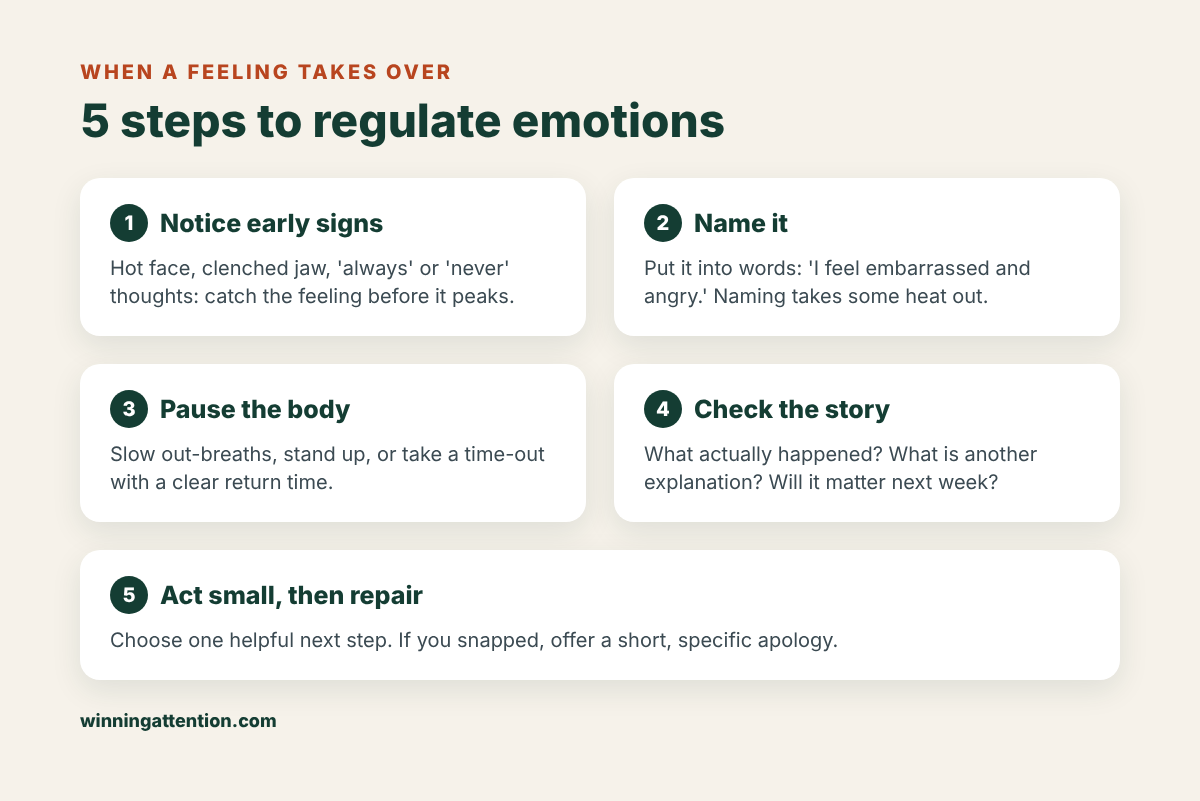
A 5-step method for ADHD emotional regulation in the moment
The following method pulls together ideas used in CBT, DBT-based skills training and mindfulness programs. It is a self-help structure, not a replacement for therapy. The goal is not to stop feeling. It is to create a small gap between the feeling and what you do next, so you get a choice.
Practice these emotional regulation steps on small frustrations first, like a slow line at the store. Skills are easiest to learn when the stakes are low, and they become more automatic with repetition.
Step 1: Notice the early signs
Emotions with ADHD often seem to go from zero to ten in a second, but there are usually early signals. The sooner you catch them, the more options you have.
Common early warning signs
- Body: hot face, clenched jaw, tight chest, fast heartbeat, restless legs.
- Thoughts: “always,” “never,” “this is ridiculous,” “they don’t care.”
- Behavior: typing faster and harder, sighing loudly, raising your voice, wanting to leave immediately.
For a week, jot down the first signal you noticed each time you got upset. Patterns appear quickly, and knowing your personal early signs makes the next steps much easier.
Step 2: Name it to tame it
Silently or out loud, put the feeling into words: “I am frustrated,” “I feel embarrassed,” “I am hurt and angry.” Try to be specific. “Bad” is less useful than “disappointed” or “anxious.”
Naming does two things. It shifts some attention from reacting to observing, and, as the labeling research above suggests, it may help reduce the intensity of the feeling. It also helps you notice when a single emotion is really two or three mixed together, such as anger on the surface and shame underneath.
Examples of naming
- “I am feeling really irritated that this meeting ran over.”
- “There is a lot of shame here because I forgot the deadline.”
- “I feel rejected because she did not reply, and I am anxious about what that means.”
Step 3: Pause the body
When emotions spike, the body is in charge. Give it something to do that slows things down before you speak or act.
- Slow your breathing. Breathe in for about four counts and out for about six. A longer out-breath feels calming for many people.
- Change your position. Stand up, step outside, get a glass of water or splash cold water on your face.
- Take a time-out with a return time. “I need ten minutes, then I want to finish this conversation.” The return time matters; it tells others you are not walking away from them.
- Move. A short walk, stretching or shaking out your hands can discharge some of the energy.
The aim is not to make the feeling disappear. It is to bring the intensity down from “ten” to something you can think through.
Step 4: Check the story
Strong emotions come with a story attached: “My boss thinks I am useless,” “My partner never listens,” “I always ruin everything.” CBT teaches you to notice these thoughts and test them rather than treat them as facts.
Questions to check the story
- What actually happened, in plain facts?
- What is another possible explanation?
- Am I using words like “always” or “never”?
- What would I say to a friend who told me this story?
- Will this matter in a week? In a month?
For example, “She did not reply, so she must be angry with me” might become “She did not reply yet. She is often busy at work in the afternoon. I can check in later if I am still worried.”
Step 5: Choose one small action, then repair if needed
Once the intensity has dropped, ask: what is one helpful thing I can do right now? It might be finishing the conversation calmly, sending a short message, taking a break, or doing nothing for the moment and revisiting it tomorrow.
If you reacted in a way you regret, repair is part of regulation, not a sign that it failed. A short, specific apology (“I am sorry I snapped at you earlier; I was frustrated about work and took it out on you”) rebuilds trust. Skip long explanations or harsh self-criticism; they tend to keep the emotion going.
Turn it into an if-then plan
Link the steps to a cue you already know, so you do not have to remember the whole method in the heat of the moment:
- “If I notice my jaw clenching in a meeting, I will name the feeling silently and take three slow breaths before speaking.”
- “If I feel the urge to send an angry email, I will save it as a draft and reread it after lunch.”
- “If I get home frustrated, I will take ten minutes on my own before starting a conversation.”
Lowering the baseline: daily habits that make big feelings smaller
In-the-moment skills are important, but ADHD emotional regulation is much easier when you are not already running on empty. Think of these as reducing the pile of kindling.
Protect sleep and meals
Many adults with ADHD notice they are far more irritable when they are tired or hungry. Regular meals and a consistent wind-down routine are basic, but they make a difference. If you tend to stay up late even when you are exhausted, the guide to ADHD bedtime procrastination has practical ideas.
Reduce daily chaos
Lost keys, missed appointments and last-minute rushes are emotional triggers in themselves. Simple planning systems reduce the number of small crises that set off frustration. A short weekly reset, which supports emotional regulation indirectly by cutting down on last-minute crises, is described in the guide to ADHD weekly planning.
Schedule recovery time
After demanding events, such as a long meeting, a family gathering or a difficult phone call, plan a short buffer before the next thing. Emotional reactions often show up at the end of the day, when reserves are lowest. A few minutes of quiet, a walk or music can help you reset.
Practice a short daily pause
Even five minutes a day of mindful breathing or simply sitting and noticing your thoughts can make it easier to catch emotions early. Mindfulness research in ADHD is still small, but the practice is low-risk and easy to try. Apps, short classes or a therapist trained in mindfulness can help you start.
Track your patterns
A simple note in your phone or planner, with the time, trigger, feeling and intensity from 1 to 10, can reveal patterns quickly: maybe Mondays are hardest, or late afternoons, or the hour after a certain meeting. Once you see the pattern, you can plan around it. If you want a structured place for this, the free ADHD Daily Planner Starter Kit includes a weekly energy tracker and a 2-minute reset card you can use when emotions start to rise.
Putting it together: a real-life example
Here is how the method might look for a fictional example: Priya, a 29-year-old nurse with ADHD, at the end of a long shift.
- The trigger. As Priya is about to leave, her manager mentions that one of her patient notes was incomplete. Priya feels a rush of heat in her face. Her first impulse is to say, “I was covering three patients alone. What do you expect?”
- Notice. She recognizes her early warning signs: hot face, tight chest and the thought “they never appreciate anything I do.”
- Name. Silently, she labels it: “I feel criticized and embarrassed, and underneath that, I am exhausted.”
- Pause. She takes two slow breaths and says, “Okay, thanks for telling me. Can I take a quick look?” That gives her a few seconds to steady herself.
- Check the story. Looking at the note, she sees one field was left blank. The facts: one missing field, mentioned in a neutral tone. Not “they never appreciate anything.”
- Act. She completes the field and says, “Got it, fixed. It was a busy shift.” She leaves on time.
- Afterward. In the car, she still feels a little rattled. Instead of replaying the conversation for an hour, she writes one line in her notes app: “End of shift, criticism, embarrassed, 7/10, came down to 3 after pausing.” She notices that end-of-shift feedback is a regular trigger and decides to ask her manager whether feedback can be given at the start of the next shift instead.
This is what ADHD emotional regulation looks like in real life. The feeling still showed up, and it still felt big. What changed was the gap between the feeling and the reaction. That gap is what emotional regulation skills build, a little at a time.
Common mistakes with ADHD emotional regulation
- Trying to suppress feelings. Emotional regulation is not the same as suppression. Pushing emotions down usually makes them come back stronger later. The goal is to notice and manage them, not to stop feeling.
- Waiting until you are at a ten. Skills work best when used early. Learn your early warning signs and practice on small frustrations.
- Making big decisions while flooded. Quitting a job, ending a relationship or sending a strongly worded email in the heat of the moment rarely goes well. Use a time-out with a return time.
- Harsh self-criticism after an outburst. Shame tends to fuel the next reaction. Repair, learn one thing, and move on.
- Blaming everything on ADHD, or nothing on it. ADHD can explain why emotions hit harder, but it does not remove responsibility for how we treat others. Both things can be true.
- Ignoring the basics. Poor sleep, skipped meals and nonstop schedules make regulation much harder. Lowering the baseline is just as important as in-the-moment skills.
- Self-diagnosing everything as RSD. Intense reactions to rejection are real and painful, but they can also be part of depression, anxiety or other conditions. A professional assessment can help tell them apart.
When to talk to a professional
Emotional ups and downs and emotional dysregulation are common with ADHD, but they can also overlap with or hide other conditions. Emotional symptoms are not unique to ADHD, and separating ADHD-related emotional reactivity from mood disorders is an important part of assessment (Faraone et al., 2019). Talk to a doctor, psychologist or other qualified clinician if:
- Low mood, hopelessness or loss of interest lasts for weeks rather than hours or days, which can be a sign of depression.
- Worry, fear or panic is constant or stops you from doing things, which can be a sign of an anxiety disorder.
- You have periods of unusually high energy, very little need for sleep, racing thoughts or risky behavior lasting days, which should be checked for bipolar disorder.
- Anger leads to aggression, damaged relationships, trouble at work or legal problems.
- You are using alcohol, cannabis or other substances to manage your emotions.
- Emotional reactions began or changed noticeably after starting or adjusting medication.
A clinician can help work out what is going on and discuss options such as therapy (including CBT, DBT-based skills training or mindfulness-based approaches), medication or a combination. You do not need to wait until things are severe to ask for help.
If you are in crisis or thinking about suicide or harming yourself, please reach out right away. In the US and Canada, you can call or text 988 to reach the 988 Suicide & Crisis Lifeline, available 24 hours a day. If you are in immediate danger, call 911 or go to the nearest emergency department.
Frequently asked questions
Is emotional dysregulation part of ADHD?
It is not in the official diagnostic criteria, but research shows it is very common in ADHD across the lifespan and a major source of difficulty. A meta-analysis of adults found much higher emotion dysregulation in people with ADHD than in people without it, and many experts think it should be considered a core feature.
Why do people with ADHD get frustrated or angry so quickly?
ADHD affects the self-control systems that help you pause before reacting, and strong feelings can capture attention and be hard to shift away from. Many adults with ADHD also carry a high level of everyday stress from missed tasks and criticism, so it takes less to tip into frustration.
What is rejection sensitive dysphoria and is it a diagnosis?
Rejection sensitive dysphoria, or RSD, is a popular term for intense emotional pain after real or perceived rejection or criticism. It is not a formal diagnosis, and research on it as a separate condition is limited. If rejection-related pain is affecting your life, talk to a clinician, who can also check for depression or anxiety.
How can adults with ADHD regulate emotions better?
Practice noticing early warning signs, name the feeling, pause your body with slow breathing or a short time-out, check the story your mind is telling, and then choose one small action or repair. Daily habits like regular sleep, meals and less chaos help too, and skills-based therapy such as CBT, DBT-based programs or mindfulness training has promising research support.
Does ADHD medication help with emotions?
A meta-analysis of trials in adults found that ADHD medications had moderate effects on emotional lability, smaller than their effects on core ADHD symptoms. Responses vary from person to person, so discuss emotional symptoms and any side effects with your prescriber.
When is it more than ADHD?
If low mood or loss of interest lasts for weeks, worry or panic is constant, you have days of unusually high energy with little sleep, or anger leads to aggression or substance use, talk to a clinician. These can be signs of depression, anxiety, bipolar disorder or other conditions that need their own assessment and treatment.
Sources
- Shaw P, Stringaris A, Nigg J, Leibenluft E. Emotion dysregulation in attention deficit hyperactivity disorder. American Journal of Psychiatry. 2014;171(3):276–293. PubMed
- Beheshti A, Chavanon ML, Christiansen H. Emotion dysregulation in adults with attention deficit hyperactivity disorder: a meta-analysis. BMC Psychiatry. 2020;20(1):120. PubMed
- Faraone SV, Rostain AL, Blader J, et al. Practitioner Review: Emotional dysregulation in attention-deficit/hyperactivity disorder – implications for clinical recognition and intervention. Journal of Child Psychology and Psychiatry. 2019;60(2):133–150. PubMed
- Knouse LE, Teller J, Brooks MA. Meta-analysis of cognitive-behavioral treatments for adult ADHD. Journal of Consulting and Clinical Psychology. 2017;85(7):737–750. PubMed
- Hirvikoski T, Waaler E, Alfredsson J, et al. Reduced ADHD symptoms in adults with ADHD after structured skills training group: results from a randomized controlled trial. Behaviour Research and Therapy. 2011;49(3):175–185. PubMed
- Mitchell JT, McIntyre EM, English JS, et al. A pilot trial of mindfulness meditation training for ADHD in adulthood: impact on core symptoms, executive functioning, and emotion dysregulation. Journal of Attention Disorders. 2017;21(13):1105–1120. PubMed
- Cairncross M, Miller CJ. The effectiveness of mindfulness-based therapies for ADHD: a meta-analytic review. Journal of Attention Disorders. 2020;24(5):627–643. PubMed
- Lieberman MD, Eisenberger NI, Crockett MJ, et al. Putting feelings into words: affect labeling disrupts amygdala activity in response to affective stimuli. Psychological Science. 2007;18(5):421–428. PubMed
- Moukhtarian TR, Cooper RE, Vassos E, Moran P, Asherson P. Effects of stimulants and atomoxetine on emotional lability in adults: a systematic review and meta-analysis. European Psychiatry. 2017;44:198–207. PubMed
Turn this into a daily plan
Get the free ADHD Daily Planner Starter Kit: a one-page daily planner, a weekly energy tracker and a 2-minute reset card.