It is 11:30 p.m. You are tired, you have work in the morning, and you meant to be asleep an hour ago. Yet here you are, one more video, one more chapter, one more scroll. Nothing is stopping you from going to bed except, somehow, you. If this happens most nights, you may be dealing with ADHD bedtime procrastination, and you are far from alone.
Staying up later than you intended is not just a bad habit or a lack of discipline. Research on adult ADHD points to real reasons why evenings are hard: sleep problems are common, the body clock often runs late, screens push it later still, and the self-control needed to stop a pleasant activity is at its lowest at the end of the day. This guide explains what bedtime procrastination is, why ADHD makes it more likely, and a five-step wind-down method you can start tonight.
The short version: set an alarm for when to start winding down, not just for bedtime. Close the day on paper so unfinished tasks stop looping, give yourself genuine free time earlier in the evening, make your phone harder to reach after a set hour, and keep your wake-up time steady. If you lie awake for long periods or feel exhausted despite trying, talk to a clinician.
Why do people with ADHD stay up late?
Many adults with ADHD stay up late for a mix of reasons. The evening is often the first quiet time of the day that feels like your own, so it is hard to give up. Stopping an interesting activity takes more effort, time blindness turns “ten more minutes” into an hour, and research suggests many people with ADHD have a later body clock. The steps below target each of these.
What is ADHD bedtime procrastination?
Researchers in the Netherlands introduced the term “bedtime procrastination” in 2014. They defined it as failing to go to bed at the intended time while no external circumstances prevent you from doing so. In their online survey of 177 adults, people who scored lower on measures of self-regulation reported more bedtime procrastination, and bedtime procrastination was linked to reports of insufficient sleep even after accounting for demographics and self-regulation (Kroese et al., 2014).
That definition matters. Bedtime procrastination is not the same as staying up because a baby woke you, or because a late shift ended at midnight. It is the gap between when you meant to go to bed and when you actually did, when nothing outside you was in the way. That study was not about ADHD, but the core ingredient, difficulty with self-regulation, is central to ADHD. “ADHD bedtime procrastination” is not a formal diagnosis; it is a useful name for a pattern many adults with ADHD recognize immediately.
Is “revenge bedtime procrastination” real?
The phrase “revenge bedtime procrastination” spread online to describe staying up late to reclaim personal time after a day that felt controlled by work or other people. It is not a clinical term, but research does support the idea behind it.
In a small interview study of 17 frequent bedtime procrastinators, researchers identified three different patterns (Nauts et al., 2019):
- Deliberate procrastination: people knowingly delayed bedtime because they felt they deserved some time for themselves. This is the closest match to “revenge” bedtime procrastination.
- Mindless procrastination: people lost track of time because they were absorbed in what they were doing.
- Strategic delay: people went to bed late because they felt they needed to in order to fall asleep. The authors noted that this may actually point to undiagnosed insomnia rather than procrastination.
Many adults with ADHD will recognize more than one of these. The evening feels like the only time that belongs to you, hyperfocus makes hours disappear, and if you have a history of lying awake, going to bed “too early” can feel pointless. Knowing which pattern drives your late nights helps you pick the right fix.
Why ADHD bedtime procrastination happens: what the research says
ADHD bedtime procrastination rarely has a single cause. Several factors stack on top of each other, and understanding them can take some of the shame out of the pattern.
Sleep problems are common in adult ADHD
A systematic review and meta-analysis of 42 studies on sleep in adults with ADHD and autism found that both groups had a similar profile compared with healthy controls: taking longer to fall asleep, poorer sleep efficiency, more awakenings during the night and lower self-rated sleep quality. Adults with ADHD also showed more periodic limb movements during sleep (Lugo et al., 2020).
Insomnia in particular is frequent. A review of the literature on adult ADHD and insomnia reported that studies found insomnia in 43% to 80% of adults with ADHD. The authors also noted that insomnia can be a side effect of some ADHD medications, and recommended that adults with ADHD be assessed for insomnia and that both conditions be treated (Wynchank et al., 2017).
When falling asleep is hard, it makes sense that bed feels less inviting. Why lie in the dark for an hour when you could be doing something interesting? That is how a sleep problem quietly turns into ADHD bedtime procrastination.
Your body clock may run late
Many adults with ADHD describe themselves as “night owls,” and research backs this up. In a study of 40 adults with ADHD, 31 reported chronic sleep-onset insomnia. Compared with healthy controls, those adults went to sleep and woke up later and showed a delayed onset of the sleep hormone melatonin, a marker of the body’s internal clock (Van Veen et al., 2010).
A systematic review of 62 studies involving 4,462 people with ADHD found consistent evidence that ADHD is associated with a later chronotype (“eveningness”) and with delays in circadian markers such as melatonin onset and sleep onset (Coogan & McGowan, 2017).
This has a practical meaning. If your internal clock is set later than your work schedule, you may genuinely not feel sleepy at 10:30 p.m. Staying up then feels natural, and the cost only arrives when the alarm rings. Some of what looks like ADHD bedtime procrastination is your biology pulling one way while your calendar pulls the other.
Evening screens push the clock later
Screens add another layer. In a controlled study, adults who read on a light-emitting e-reader in the hours before bed took longer to fall asleep, felt less sleepy in the evening, produced less melatonin, had a later body-clock timing and were less alert the next morning than when they read a printed book (Chang et al., 2015). The participants did not have ADHD, but if your clock already tends to run late, extra evening light is pushing in the wrong direction.
There is also the content itself. Phones and streaming apps are designed to be hard to put down: endless feeds, autoplay, and notifications that always offer one more thing. For a brain that seeks novelty and struggles to stop rewarding activities, that combination is especially sticky.
Self-control is lowest at the end of the day
Going to bed requires stopping something enjoyable for a benefit you will only feel tomorrow. That is precisely the kind of decision that ADHD makes harder. The original bedtime procrastination research linked the habit to lower self-regulation (Kroese et al., 2014), and for many adults with ADHD the evening is when the day’s demands have drained their energy and there is no external structure left to lean on. For people who take ADHD medication, it may also have worn off by then.
Time blindness and hyperfocus
The “mindless” type of bedtime procrastination, losing track of time while absorbed in an activity (Nauts et al., 2019), will sound very familiar to anyone with ADHD. Ten minutes on a game becomes ninety. You look up and it is 1 a.m. This is not a decision you made; it is a decision that never got made. The article on ADHD time blindness explains why time can feel so hard to track and how to make it more visible.
Lost sleep makes ADHD symptoms worse
The cycle feeds itself. In an experiment with 173 healthy people aged 17 to 45 who were randomized to a normal night’s sleep or a night of total sleep deprivation, sleep loss made performance on an executive-function task less stable. People with higher levels of everyday inattention, a trait related to ADHD symptoms, were more affected after sleep deprivation, but not after normal sleep (Floros et al., 2021). The participants did not have an ADHD diagnosis, but the finding suggests that people with attention difficulties may be especially vulnerable to the effects of a short night.
A tired brain then has a harder time with focus, planning and emotional control the next day, which makes the day feel more draining and the evening “me time” feel even more necessary. Breaking the cycle anywhere helps.
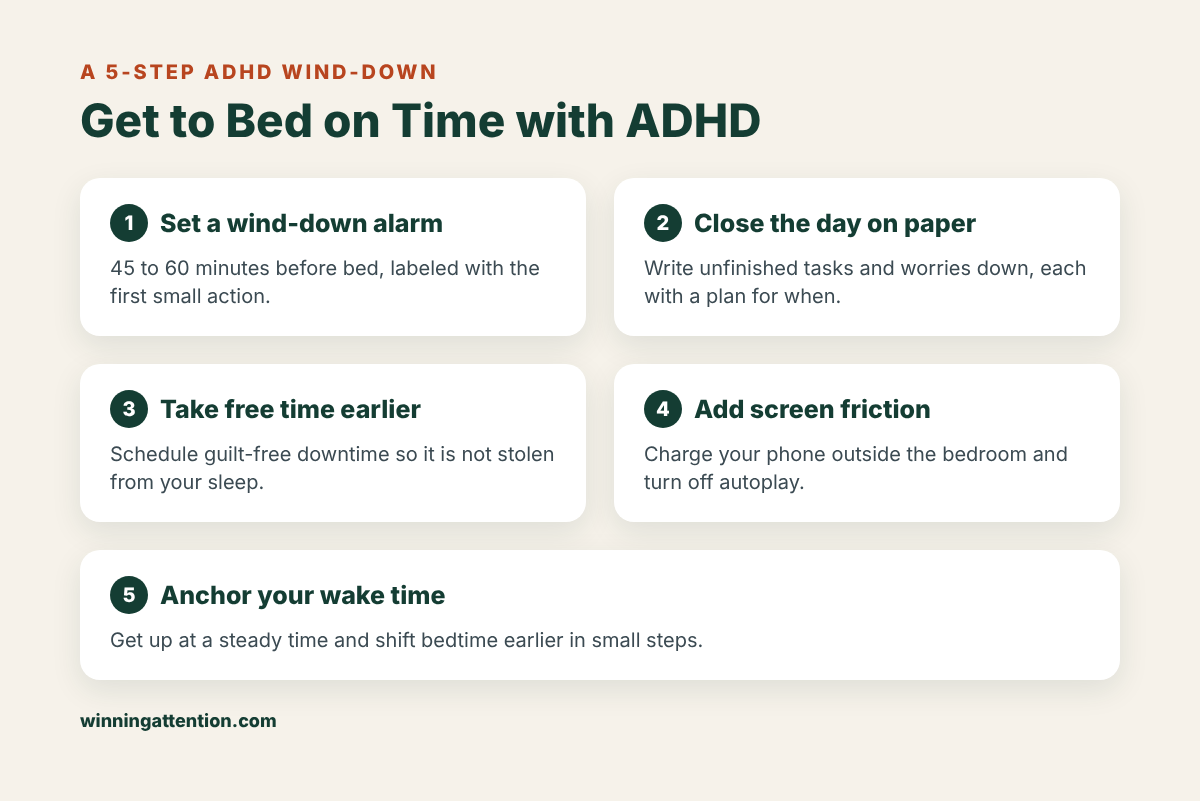
How to stop ADHD bedtime procrastination: a 5-step wind-down method
The goal of this method is not to beat ADHD bedtime procrastination with a perfect routine of candles and herbal tea. It is a few simple, visible cues that do the remembering and deciding for you, because at 11 p.m. your willpower is not going to do it. Start with one or two steps and add the rest over a couple of weeks.
Step 1: Set a wind-down alarm, not just a bedtime
Most people only think about when they should be asleep. With ADHD, the problem is usually the transition: stopping what you are doing and starting the move toward bed. Set a phone alarm or smart-speaker reminder for 45 to 60 minutes before your target bedtime, and label it with the first action, not a vague instruction.
Examples of useful wind-down alarm labels
- “10:15 – Finish this episode, no next one. Phone on charger in the kitchen.”
- “10:00 – Shower and brush teeth now. Book in bed after.”
- “10:30 – Lights down, laptop closed, write tomorrow’s list.”
The alarm interrupts mindless procrastination and makes time visible at exactly the moment it tends to disappear. If you snooze it every night, move it earlier or make the first step smaller.
Step 2: Close the day on paper
Racing thoughts are a common reason people delay going to bed. Unfinished tasks, emails you did not send and worries about tomorrow can make lying in the dark feel unbearable, so you reach for your phone to drown them out.
Try a five-minute “closing note” early in your wind-down. Write down anything unfinished, then add a specific plan for when you will deal with it. In a series of experiments, unfulfilled goals caused intrusive thoughts and interfered with other tasks, but making a specific plan for those goals removed the interference (Masicampo & Baumeister, 2011). The study was not about sleep or ADHD, but the principle fits: once a task has a plan, your mind can let go of it for the night.
A simple closing note
- Unfinished: reply to the landlord. Plan: 9:15 tomorrow, before opening work email.
- Worry: the presentation on Thursday. Plan: practice it once on Wednesday at lunch.
- Remember: buy dog food. Plan: added to the shopping list on my phone.
- Tomorrow’s first step at work: open the budget file.
Step 3: Give yourself real free time earlier
If your ADHD bedtime procrastination is mostly the “revenge” type, telling yourself to simply go to bed earlier will not work for long. The need underneath it, time that feels like your own, is real. Meet that need on purpose, earlier in the evening, so it does not have to be stolen from sleep.
- Schedule it. Put “free time, no chores” in your calendar from, say, 8:30 to 10:00 p.m., and protect it like an appointment.
- Make it genuinely restful. Many people find that an hour of something they truly enjoy feels better than three hours of half-attentive scrolling.
- Shrink evening obligations. If chores, admin or late work emails fill every evening hour, look for ways to move them earlier or batch them on one night.
- End the workday clearly. A short shutdown ritual at the end of the workday makes the evening feel more like yours. The guide to ADHD productivity at work describes a five-minute version.
Step 4: Make screens harder to reach
Willpower works best when it does not have to be used. Instead of resisting your phone in bed, make it physically harder to use after your wind-down alarm.
Ways to add friction to late-night screens
- Charge your phone outside the bedroom. Use an inexpensive alarm clock instead.
- Turn off autoplay on streaming services so each episode requires a deliberate choice.
- Use your phone’s built-in downtime or app limits for social media after a set hour.
- Swap the last 30 minutes of screen time for a printed book, a podcast with a sleep timer, a puzzle or light stretching.
- Dim the lights in your home in the last hour. Evening light from devices can delay your body clock (Chang et al., 2015).
If going screen-free feels impossible, start with one rule: no phone in bed. Even that small change separates “bed” from “endless feed.”
Step 5: Anchor your wake-up time
When you have stayed up too late, it is tempting to sleep in to make up for it. Unfortunately, a late wake-up tends to push the next night’s bedtime later too, and the cycle continues. A steadier wake-up time, including on most weekends, gives your body clock a consistent anchor.
Because research shows that many adults with ADHD have a delayed internal clock, researchers have suggested that measures to improve daily rhythms deserve closer study (Van Veen et al., 2010). In practical terms, a consistent wake time, getting outside or into bright light during the day, and keeping meals and activity at regular times are reasonable everyday habits. If your sleep timing is very far from what your life requires, ask a clinician about it rather than experimenting on your own.
A realistic way to shift earlier
- Move your target bedtime and wake time earlier by about 15 minutes every few days, not by two hours overnight.
- Keep the wind-down alarm moving with your bedtime.
- Accept that some nights will slip. Go back to the plan the next evening without trying to “make up” for it.
A worked example: breaking the 1 a.m. habit
Here is how the method might look for a fictional example: Priya, a 29-year-old nurse with ADHD who works day shifts and usually falls asleep around 1 a.m. even though she needs to be up at 6:15.
- Naming the pattern. Priya notices that her late nights are mostly “revenge” procrastination. After a hectic shift and an evening of chores, scrolling in bed is the only time that feels like hers. On some nights it turns mindless, and she looks up to find two hours gone.
- Wind-down alarm. She sets an alarm for 10:15 p.m. labeled “Phone on the kitchen charger. Shower now.” The first week she snoozes it twice, so she changes the label to something smaller: “Just plug the phone in.”
- Closing note. At 10:20 she spends five minutes writing tomorrow’s tasks and the two worries she keeps replaying about work, each with a time when she will deal with it.
- Free time first. Priya moves laundry and meal prep to Sunday afternoons, which frees 8:30 to 10:00 p.m. on weekdays for a show she loves and a call with a friend. Because she has already had real downtime, giving up the phone at 10:15 feels less like a loss.
- Friction. She buys a basic alarm clock and keeps her phone out of the bedroom. In bed she reads a paperback until she feels sleepy.
- Anchor. She keeps her 6:15 wake-up on workdays and wakes by 7:30 on days off instead of sleeping until noon. Each week she moves her lights-out time 15 minutes earlier.
After a month, Priya’s ADHD bedtime procrastination has not vanished, but she is falling asleep around 11:30 on most nights, and some nights still slip. But she wakes up less groggy, and the mid-afternoon crash at work is easier to manage. That is a realistic win.
An ADHD bedtime routine for adults: a sample evening
Adjust the times to your own schedule. What matters is the sequence: free time, wind-down cue, closing note, low light, bed.
| Time | Step | What happens |
|---|---|---|
| 6:00–7:30 p.m. | Dinner and essentials | Eat, quick chores, prepare anything needed for tomorrow |
| 7:30–9:30 p.m. | Protected free time | Something you genuinely enjoy, guilt-free |
| 9:30 p.m. | Wind-down alarm | Labeled with the first step: phone on the charger outside the bedroom |
| 9:35–9:45 p.m. | Closing note | Unfinished tasks and worries written down with a plan |
| 9:45–10:15 p.m. | Low-light routine | Shower, teeth, dim lights, clothes laid out |
| 10:15–10:45 p.m. | In bed, screen-free | Paper book, audio with a sleep timer, or quiet stretching |
| Same time daily | Wake-up anchor | Get up at a steady time and get some daylight early |
If you like having routines on paper, the free ADHD Daily Planner Starter Kit includes a weekly energy tracker you can use to notice how your bedtime affects your focus and mood the next day. For more on building habits that stick, see the guide to creating an ADHD routine.
ADHD and sleep: when the problem is not procrastination
Some late nights are not really procrastination at all. Remember the “strategic delay” pattern: people who stay up because going to bed early only means lying awake. The researchers who described it suggested that it may reflect undiagnosed insomnia (Nauts et al., 2019). Given how common insomnia is in adults with ADHD (Wynchank et al., 2017), this is worth taking seriously.
Signs that you may be dealing with a sleep problem rather than, or as well as, bedtime procrastination include:
- Regularly lying awake for a long time even when you go to bed tired.
- Waking often during the night or much earlier than you want.
- Feeling unrefreshed after what should be enough sleep.
- Loud snoring, gasping or pauses in breathing that a partner notices.
- Uncomfortable sensations or urges to move your legs in the evening or at night.
- Sleep problems that started or got worse after a change in ADHD medication.
The good news is that chronic insomnia has an effective first-line treatment that does not involve medication. The American College of Physicians recommends that all adults with chronic insomnia disorder receive cognitive behavioral therapy for insomnia (CBT-I) as the initial treatment (Qaseem et al., 2016). CBT-I is a structured program, usually delivered by a trained clinician or through a guided digital program, that works on sleep timing, habits and the thoughts that keep you awake. It is different from general sleep tips, so it is worth asking about specifically.
Common mistakes with ADHD bedtime procrastination
- Relying on willpower at 11 p.m. Self-control is at its lowest late at night. Put the decision earlier, in an alarm, a charging spot outside the bedroom, or a pre-planned routine.
- Trying to fix everything at once. A brand-new 12-step evening routine rarely survives the first week. Start with one change, such as the wind-down alarm, and add more once it sticks.
- Cutting out all evening enjoyment. If the evening is the only time that feels like yours, taking it away will backfire. Schedule real free time instead.
- Sleeping in to catch up. It feels kind in the moment, but it tends to push the next night later. Keep the wake time steadier.
- Using your phone as the bedside alarm. It invites “just one quick check.” A basic alarm clock removes the temptation.
- Treating it as a moral failing. Bedtime procrastination has real biological and psychological drivers. Shame tends to make evenings more stressful, not more disciplined.
- Ignoring possible sleep disorders. If you lie awake for long periods or feel unrefreshed despite enough time in bed, talk to a clinician instead of blaming yourself.
When to talk to a professional
Strategies for ADHD bedtime procrastination help many adults, but they are not a substitute for medical care. Talk to a doctor, sleep specialist or other qualified clinician if you regularly struggle to fall or stay asleep, feel very sleepy during the day, nod off while driving or at work, snore loudly or stop breathing during sleep, or have uncomfortable sensations in your legs at night. Also speak with your prescriber if you take ADHD medication and think it may be affecting your sleep; do not change the dose or timing on your own. If you are considering melatonin or any other sleep aid, discuss it with a clinician first, since the right choice depends on your health and other medications. Low mood, anxiety and stress can also disrupt sleep, and they deserve support in their own right.
Frequently asked questions
What is ADHD bedtime procrastination?
It is going to bed later than you intended when nothing outside you is preventing it, in the context of ADHD. It is not a formal diagnosis, but it describes a common pattern. ADHD can make it more likely because of difficulties with self-regulation, time blindness, a later body clock and frequent sleep problems.
Why do people with ADHD stay up late?
Several factors stack up. Research shows that many adults with ADHD have a delayed body clock and take longer to fall asleep, while evening screens can push the clock later still. Hyperfocus and time blindness make hours disappear, and the evening often feels like the only time that is truly yours.
Is “revenge bedtime procrastination” real?
It is a popular term, not a clinical one, but research supports the idea. In an interview study of frequent bedtime procrastinators, some people deliberately delayed bedtime because they felt they deserved time for themselves. Others lost track of time or stayed up because they expected to lie awake.
How do you stop bedtime procrastination with ADHD?
Move the decision earlier in the evening instead of relying on willpower at bedtime. Set a wind-down alarm labeled with a first step, write a closing note for unfinished tasks, schedule genuine free time earlier, charge your phone outside the bedroom and keep a steady wake-up time. Start with one change and build from there.
How does sleep affect ADHD symptoms?
Sleep loss makes attention, planning and emotional control harder for everyone. In one experiment, people with more everyday inattention showed less stable performance on an executive-function task after a night without sleep. Many adults with ADHD notice their symptoms are noticeably worse after short or poor-quality nights.
When should you talk to a doctor about sleep?
Talk to a clinician if you regularly lie awake, wake often, feel unrefreshed, are very sleepy during the day, snore loudly or have uncomfortable leg sensations at night. Also check in if your sleep changed after starting or adjusting ADHD medication. Cognitive behavioral therapy for insomnia (CBT-I) is the recommended first-line treatment for chronic insomnia in adults.
Sources
- Kroese FM, De Ridder DT, Evers C, Adriaanse MA. Bedtime procrastination: introducing a new area of procrastination. Frontiers in Psychology. 2014;5:611. PubMed
- Nauts S, Kamphorst BA, Stut W, De Ridder DTD, Anderson JH. The explanations people give for going to bed late: a qualitative study of the varieties of bedtime procrastination. Behavioral Sleep Medicine. 2019;17(6):753–762. PubMed
- Lugo J, Fadeuilhe C, Gisbert L, et al. Sleep in adults with autism spectrum disorder and attention deficit/hyperactivity disorder: a systematic review and meta-analysis. European Neuropsychopharmacology. 2020;38:1–24. PubMed
- Wynchank D, Bijlenga D, Beekman AT, Kooij JJS, Penninx BW. Adult attention-deficit/hyperactivity disorder (ADHD) and insomnia: an update of the literature. Current Psychiatry Reports. 2017;19(12):98. PubMed
- Van Veen MM, Kooij JJ, Boonstra AM, Gordijn MC, Van Someren EJ. Delayed circadian rhythm in adults with attention-deficit/hyperactivity disorder and chronic sleep-onset insomnia. Biological Psychiatry. 2010;67(11):1091–1096. PubMed
- Coogan AN, McGowan NM. A systematic review of circadian function, chronotype and chronotherapy in attention deficit hyperactivity disorder. ADHD Attention Deficit and Hyperactivity Disorders. 2017;9(3):129–147. PubMed
- Chang AM, Aeschbach D, Duffy JF, Czeisler CA. Evening use of light-emitting eReaders negatively affects sleep, circadian timing, and next-morning alertness. Proceedings of the National Academy of Sciences of the USA. 2015;112(4):1232–1237. PubMed
- Floros O, Axelsson J, Almeida R, et al. Vulnerability in executive functions to sleep deprivation is predicted by subclinical attention-deficit/hyperactivity disorder symptoms. Biological Psychiatry: Cognitive Neuroscience and Neuroimaging. 2021;6(3):290–298. PubMed
- Masicampo EJ, Baumeister RF. Consider it done! Plan making can eliminate the cognitive effects of unfulfilled goals. Journal of Personality and Social Psychology. 2011;101(4):667–683. PubMed
- Qaseem A, Kansagara D, Forciea MA, et al. Management of chronic insomnia disorder in adults: a clinical practice guideline from the American College of Physicians. Annals of Internal Medicine. 2016;165(2):125–133. PubMed
Turn this into a daily plan
Get the free ADHD Daily Planner Starter Kit: a one-page daily planner, a weekly energy tracker and a 2-minute reset card.