If you’ve tried every planner, app and productivity hack and still end up late, rushed or wondering where the afternoon went, you’re not lazy and you’re not broken. Most time advice is built for brains that feel time passing on their own. The ADHD time management strategies in this guide are built for brains that don’t, so they move time out of your head and into the world where you can see it, hear it and plan around it.
Below you’ll find ten practical strategies, each with simple steps and a realistic example. You don’t need all of them. Most adults with ADHD do best by picking two or three, testing them for a week or two, and keeping what sticks. Think of this as a menu, not a rulebook.
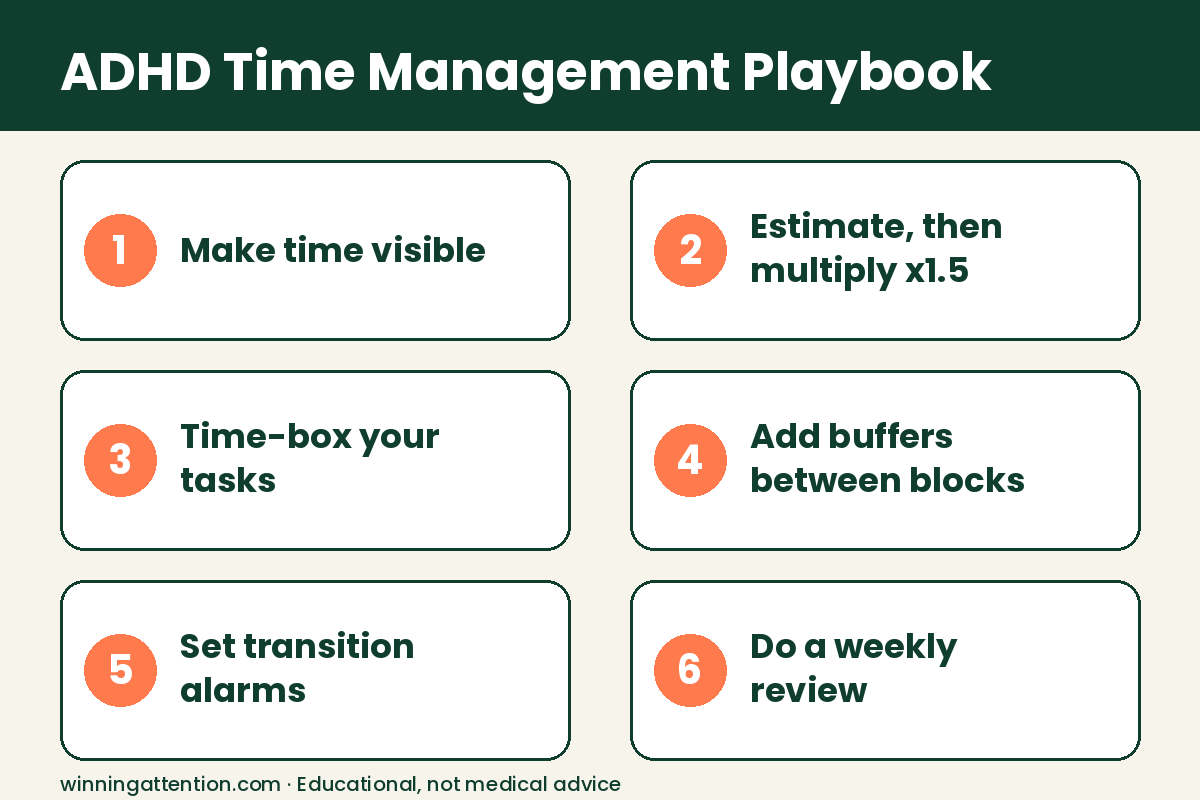
The short version: ADHD time management works best when you stop relying on your internal sense of time and start using external tools: visible clocks, time-boxes instead of open-ended to-do items, realistic estimates (your gut guess x1.5), buffers between tasks, transition alarms, one important task per day, and a short weekly review. Research on cognitive behavioral approaches for adult ADHD supports this skills-based, “make it external” approach.
Why does ADHD time management feel so hard?
Time management problems in ADHD aren’t a motivation issue. They are closely tied to how the ADHD brain tracks and predicts time. In an influential 1997 paper, psychologist Russell Barkley proposed that difficulties with behavioral inhibition in ADHD ripple out into executive functions, including the internal “sense of time” people use to plan ahead.
Later research has backed up the idea that timing is a real, measurable difference. A 2013 review in Neuropsychologia concluded that people with ADHD show consistent differences across several timing domains, from very short intervals all the way to long-range “temporal foresight.” A 2022 meta-analysis of 55 studies found that people with ADHD had more variability when estimating durations and less accurate time estimation and production on lab tasks.
For adults, this often shows up as a feeling that time moves faster than expected. A 2021 review of time perception in adult ADHD described exactly that, along with difficulty with “prospective” time tasks, meaning things you have to remember and do later. If you’ve ever looked up and found that “five minutes” was actually forty, this is what’s going on. (For a deeper dive into this piece specifically, see our guide to understanding ADHD time blindness.)
What this means for your strategy
If your internal clock is unreliable, the fix isn’t “try harder to feel time.” The fix is to build an external clock: tools and habits that tell you what time it is, how long things take, and what comes next, without depending on memory or willpower.
- Make time visible, so you don’t have to sense it.
- Make estimates realistic, so your plan matches reality.
- Make transitions loud, so switching tasks doesn’t rely on noticing.
- Make priorities small, so one good day doesn’t need a perfect day.
If you’d like a guided way to build these habits into a full system, our step-by-step ADHD planning course walks through the same principles one lesson at a time.
How is time management for adults with ADHD different?
Standard time advice usually assumes you’ll notice when you’re running late, remember the plan you made this morning, and feel the deadline approaching. ADHD-friendly time management assumes none of that and designs around it. Here’s how the two compare.
| Typical advice | ADHD-adapted version | Why it helps |
|---|---|---|
| “Keep a to-do list.” | Give each task a time-box on your calendar. | A list says what; a time-box also says when and how long. |
| “Estimate how long it takes.” | Estimate, then multiply by 1.5. | Corrects for the usual tendency to underestimate. |
| “Check the clock.” | Use analog clocks, visual timers and alarms. | Time becomes something you see and hear, not something you remember to check. |
| “Stay focused until you’re done.” | Set a transition alarm before the end. | Gives your brain a warning before it has to switch gears. |
| “Prioritize your list.” | Choose one important task per day. | Reduces decision load and makes “done” achievable. |
| “Plan your week on Sunday.” | Do a 15-minute weekly review with a checklist. | Short, repeatable and easier to restart after a missed week. |
10 ADHD time management strategies that work in real life
Each strategy below includes how to do it and what it can look like on an ordinary day. Start with whichever one addresses your biggest pain point, whether that’s lateness, missed deadlines or days that disappear.
1. Externalize time so you can see it
The foundation of every other strategy is making time physically visible. A phone clock hidden in your pocket doesn’t count. You want time in your line of sight while you work, cook and get ready.
How to do it:
- Put an analog clock in the rooms where you lose the most time (often the bathroom, kitchen and desk).
- Use a visual timer that shows time shrinking, like a colored disc or a countdown bar, for focused work.
- Write the “leave by” time, not just the appointment time, on a sticky note by the door.
Example: Jordan was routinely 10 to 15 minutes late to work. Jordan put a cheap analog clock on the bathroom wall and a note on the mirror reading “Out the door 8:05.” Seeing the minute hand move during the morning routine made it obvious when the shower was running long.
2. Estimate, then multiply by 1.5
Most people underestimate how long tasks take, and ADHD tends to widen that gap. Rather than fighting your estimates, correct them with a simple rule of thumb.
How to do it:
- Write down your gut estimate for a task (“Email reply: 10 minutes”).
- Multiply it by 1.5 and schedule that number instead (15 minutes).
- For one week, note the actual time next to your estimate. If you’re still running over, try x2 for that type of task.
Example: Priya thought a grocery run took 30 minutes. Tracking it twice showed it was closer to 50, including parking and the line. She now blocks 45 to 50 minutes and no longer cuts into her evening plans.
The x1.5 rule isn’t a scientific constant. It’s a starting correction. Your own tracked numbers are always better than any formula.
3. Time-box tasks instead of just listing them
A to-do list tells you what exists. A time-box tells you when it happens and when it stops. That second part matters, because open-ended tasks tend to either never start or never end.
How to do it:
- Pick three to five tasks for tomorrow.
- Give each one a block on your calendar with a start and end time.
- When the block ends, stop and decide: done, continue in a new block, or move to another day.
Example: Instead of “work on budget” sitting on a list for a week, Marcus blocked Tuesday 7:00 to 7:30 p.m. for “budget: update last month’s spending.” Thirty minutes felt doable, so he actually started.
Keep your list, too. The list is where tasks wait; the calendar is where a few of them get a real slot. Only move a task onto the calendar once you’re ready to give it a time.
4. Build buffers between everything
Back-to-back scheduling assumes every task ends on time and every transition is instant. With ADHD, neither is reliable. Buffers absorb the overflow so one delay doesn’t knock over the whole day.
How to do it:
- Add 10 to 15 minutes between calendar blocks, especially before anything that involves leaving the house.
- Keep one larger “catch-up” block (30 to 60 minutes) in the afternoon for anything that spilled over.
- If a buffer goes unused, enjoy it. It’s not wasted time; it’s insurance.
Example: Dana used to schedule meetings at 10:00, 10:30 and 11:00. Now she books 10:00 to 10:25 and 10:40 to 11:05. The gaps give her time to write notes, grab water and reset before the next call.
5. Use transition alarms, not just reminder alarms
A standard reminder goes off at the moment something starts, which is often too late. A transition alarm goes off before you need to switch, giving you time to wrap up and move.
How to do it:
- Set two alarms for anything time-sensitive: a “wrap-up” alarm (10 to 15 minutes before) and a “go now” alarm.
- Label them clearly, for example “Wrap up: save file, find keys” and “Leave now.”
- When the wrap-up alarm sounds, stop starting new things. Only finish or save what’s in front of you.
Example: Sam often got absorbed in work and missed school pickup by a few minutes. A 2:40 “wrap up: save and stand up” alarm plus a 2:50 “car keys, go” alarm turned a daily scramble into a predictable routine.
This one is especially useful if you tend to get absorbed in tasks for hours. Labeled alarms work better than generic beeps, because the label tells your brain exactly what to do next.
6. Plan backward from hard deadlines
Deadlines that feel far away can feel unreal until they’re suddenly tomorrow. Backward planning turns one distant deadline into several near ones.
How to do it:
- Write the deadline at the end of a page or calendar.
- List the steps needed, working backward from the finish.
- Give each step its own mini-deadline, with the first one in the next two or three days.
Example: A report due Friday became: Thursday, final proofread; Wednesday, draft complete; Tuesday, outline and data pulled; today, open the file and list sections. The first step is small enough to do now.
7. Schedule by energy, not just by time
An hour at 9 a.m. and an hour at 3 p.m. are not the same hour. Matching task type to your energy pattern can make the same work feel noticeably easier.
There’s some research behind this. A 2017 systematic review of 62 studies found consistent evidence that ADHD is associated with a later chronotype, meaning many people with ADHD tend toward being “evening types.” That doesn’t apply to everyone, which is why tracking your own pattern matters more than any general rule.
How to do it:
- For one week, rate your focus each morning, midday and evening on a 1 to 5 scale.
- Label your peak windows (high focus), steady windows (routine work) and low windows (easy or physical tasks).
- Put demanding thinking work in peak windows and admin, errands or chores in low windows.
Example: Alex noticed focus was low until about 10:30 but strong from 4:00 to 7:00 p.m. Alex moved email and filing to the morning and protected late afternoon for writing, which had been stalling for weeks.
8. Choose one important task per day
Long lists can create a sense that everything is urgent, which often leads to doing nothing or doing the easiest things first. Choosing one important task gives the day a clear center.
How to do it:
- Each evening (or first thing in the morning), ask: “If I only finish one thing tomorrow, what would make the biggest difference?”
- Write it at the top of your planner or on a sticky note on your screen.
- Put it in your best energy window, ideally before you open email or messages.
Example: On a busy Monday, Chris picked “send the client proposal” as the one task and did it at 9:15. The rest of the day was still busy, but the thing that mattered most was already done.
Everything else is a bonus. That shift in framing is often what makes a day feel successful rather than like a list of failures.
9. Shrink the start to two minutes
Sometimes the problem isn’t how long something takes. It’s getting started at all. A tiny, specific first action lowers the barrier enough to begin.
How to do it:
- Rewrite your task as a physical first step: “open the document,” “put the laundry basket by the machine.”
- Set a timer for two to five minutes and commit only to that.
- When the timer ends, decide freely whether to continue.
Example: “Do taxes” became “find last year’s tax folder and put it on the table.” That took 90 seconds, and once the folder was out, sorting the first few receipts felt much less heavy.
If getting started is your main struggle, our guide to breaking through ADHD task paralysis goes further into why starting feels frozen and what helps.
10. Do a 15-minute weekly review
Daily strategies drift without a regular reset. A short weekly review catches what slipped, updates your calendar and makes next week feel less like a surprise.
How to do it:
- Pick a fixed time, such as Sunday at 5 p.m. or Friday after lunch, and set a recurring alarm.
- Use the same short checklist each time: check the calendar for next week, list deadlines, pick one important task per day, and add buffers.
- Note one strategy that worked and one to adjust. Keep it to 15 minutes.
Example: Taylor’s review revealed a dentist appointment and a work deadline on the same Wednesday. Spotting it on Sunday meant moving a few blocks around instead of panicking midweek.
For a full walk-through of the weekly side of planning, see our guide to ADHD weekly planning.
How to put these strategies together into a simple system
Ten strategies can feel like a lot, and trying all of them at once is a common way to burn out on a new system. A better approach is to layer them gradually.
Week 1 and 2: the foundation
- Put one visible clock where you lose the most time.
- Pick one important task each day.
- Set transition alarms for your two most time-sensitive events.
Week 3 and 4: add structure
- Start time-boxing your important task and two or three others.
- Apply the x1.5 rule and track actual times for a few common tasks.
- Add buffers between calendar blocks.
Week 5 onward: refine
- Begin a 15-minute weekly review.
- Map your energy windows and move tasks accordingly.
- Keep what works, drop what doesn’t, and don’t be afraid to rotate tools when one starts to feel stale.
A paper or printable planner can make this easier, because it keeps everything in one visible place. If you’d like a template to start with, grab our free ADHD Daily Planner Starter Kit. And if you want to map out a full day using these pieces, our guide on how to plan your day with ADHD shows a day-planning flow step by step.
What a day can look like
Here’s an example of a workday using several strategies together:
- 8:00 Morning routine with an analog clock in view; “leave by 8:40” note on the door.
- 9:00–9:45 Time-box: the one important task (estimated 30 minutes, x1.5 = 45).
- 9:45–10:00 Buffer.
- 10:00–11:30 Meetings with 15-minute gaps.
- 1:30–2:00 Low-energy window: email and admin.
- 3:00–3:45 Catch-up block for anything that spilled over.
- 4:50 Transition alarm: “wrap up, write tomorrow’s one task.”
This isn’t meant to be followed exactly. It’s an illustration of how small strategies stack into a day that has a shape, without needing to be perfect.
Common ADHD time management mistakes (and easy fixes)
Planning the ideal day instead of the real one
It’s tempting to schedule the version of you who never gets distracted. Plan for the version who sometimes does. Leave about a third of the day unscheduled or use it as buffer.
Switching apps every time the novelty wears off
New tools feel exciting, and that feeling fades. Rather than starting over each time, keep the same core habits (one important task, time-boxes, weekly review) and only change the tool that holds them.
Treating a missed day as a failed system
Every system gets missed sometimes. The skill isn’t never falling off; it’s getting back on quickly. Your weekly review is the built-in restart button.
Relying on reminders you can dismiss
If you swipe away notifications without reading them, they aren’t working. Use labeled alarms, put the phone across the room, or pair an alarm with a physical cue like a sticky note.
Where does extra support fit in?
Many adults find that self-guided strategies help a great deal. Others benefit from structured support, and that’s worth knowing about.
Several studies have tested skills-based therapy that targets time management directly. A 2010 randomized trial of 88 adults found that a 12-week group program focused on time management, organization and planning led to greater improvement in inattention symptoms than supportive therapy. Another 2010 trial in JAMA found that 12 sessions of cognitive behavioral therapy helped adults who still had symptoms despite medication, with gains maintained at 12 months.
Looking across studies, a meta-analysis of randomized trials (published in 2020) found CBT for adult ADHD outperformed both waiting-list and active control conditions. A 2018 Cochrane review of 14 trials also found benefits, while noting that much of the evidence was low to moderate quality, so more research is still needed.
International consensus statements on adult ADHD also describe it as a real, well-studied condition that often continues into adulthood. If time struggles are seriously affecting your work, relationships or health, talk to your clinician. They can help you consider assessment, therapy, coaching or other treatment options that fit your situation. This article is educational and isn’t a substitute for professional care.
Your next step with ADHD time management strategies
You don’t need a perfect system to get better at managing time with ADHD. You need a few external supports that do the work your internal clock struggles with: something to make time visible, something to make estimates honest, something to signal transitions, and a short weekly reset to keep it all going.
Pick one strategy from this list today. Maybe it’s a clock on the bathroom wall or a single sticky note with tomorrow’s one important task. Try it for a week, notice what changes, then add the next piece. If you’d like structure and support as you build these ADHD time management strategies into a complete routine, explore our online ADHD planning course for adults.
Time management tools work best inside a steady rhythm. For a step-by-step template, read our guide to a daily routine for ADHD adults.
Frequently asked questions
What is the best time management strategy for ADHD?
There isn’t one best strategy for everyone. For many adults, the most useful starting point is making time visible, such as an analog clock or visual timer, combined with choosing one important task per day. These address two core challenges: losing track of time and struggling to prioritize. Test one or two strategies for a week before judging them.
Why do people with ADHD struggle with time management?
Research suggests ADHD is linked to differences in how the brain perceives and estimates time, along with executive function challenges like planning and working memory. Studies have found differences in time estimation and timing tasks in people with ADHD. This means time can feel like it passes faster or less predictably, which makes planning harder. It isn’t a character flaw.
How can adults with ADHD stop being late?
Plan around a “leave by” time instead of an arrival time, and add a buffer of 10 to 15 minutes. Use two labeled alarms: one to wrap up what you’re doing and one to walk out the door. Keep keys, bag and essentials in one spot by the exit. Track how long your routines actually take and adjust your estimates.
Does time-blocking work for ADHD?
Time-blocking can work well for ADHD when it’s flexible. Give each block a clear start and end, keep buffers between blocks, and include a catch-up block for overflow. Avoid scheduling every minute, since an overly rigid plan can fall apart after one delay. When a block ends, decide whether to continue, stop or reschedule rather than pushing through indefinitely.
What apps or tools help with ADHD time management?
The most helpful tools are usually simple: a visual timer, an analog clock, a calendar with alarms, and a paper or printable planner kept in sight. The specific app matters less than whether you’ll actually see and use it every day. Choose tools that make time visible and send labeled reminders, and stick with your core habits even if you switch tools.
Can therapy help with ADHD time management?
Yes, for many adults. Randomized trials of cognitive behavioral and meta-cognitive therapy, which teach time management, organization and planning skills, have found improvements in ADHD symptoms compared with control conditions. Results vary from person to person and evidence quality is mixed. If you’re interested, talk to your clinician about whether a skills-based approach is a good fit for you.
Sources
- Barkley RA. Behavioral inhibition, sustained attention, and executive functions: constructing a unifying theory of ADHD. Psychol Bull. 1997;121(1):65-94. PubMed.
- Noreika V, Falter CM, Rubia K. Timing deficits in attention-deficit/hyperactivity disorder (ADHD): evidence from neurocognitive and neuroimaging studies. Neuropsychologia. 2013;51(2):235-266. PubMed.
- Marx I, Cortese S, Koelch MG, Hacker T. Meta-analysis: Altered Perceptual Timing Abilities in Attention-Deficit/Hyperactivity Disorder. J Am Acad Child Adolesc Psychiatry. 2022;61(7):866-880. PubMed.
- Weissenberger S, Schonova K, Büttiker P, Fazio R, Vnukova M, Stefano GB, et al. Time Perception is a Focal Symptom of Attention-Deficit/Hyperactivity Disorder in Adults. Med Sci Monit. 2021;27:e933766. PubMed.
- Coogan AN, McGowan NM. A systematic review of circadian function, chronotype and chronotherapy in attention deficit hyperactivity disorder. Atten Defic Hyperact Disord. 2017;9(3):129-147. PubMed.
- Solanto MV, Marks DJ, Wasserstein J, Mitchell K, Abikoff H, Alvir JM, et al. Efficacy of meta-cognitive therapy for adult ADHD. Am J Psychiatry. 2010;167(8):958-968. PubMed.
- Safren SA, Sprich S, Mimiaga MJ, Surman C, Knouse L, Groves M, et al. Cognitive behavioral therapy vs relaxation with educational support for medication-treated adults with ADHD and persistent symptoms: a randomized controlled trial. JAMA. 2010;304(8):875-880. PubMed.
- Young Z, Moghaddam N, Tickle A. The Efficacy of Cognitive Behavioral Therapy for Adults With ADHD: A Systematic Review and Meta-Analysis of Randomized Controlled Trials. J Atten Disord. 2020;24(6):875-888. PubMed.
- Lopez PL, Torrente FM, Ciapponi A, Lischinsky AG, Cetkovich-Bakmas M, Rojas JI, et al. Cognitive-behavioural interventions for attention deficit hyperactivity disorder (ADHD) in adults. Cochrane Database Syst Rev. 2018;3(3):CD010840. PubMed.
- Faraone SV, Banaschewski T, Coghill D, Zheng Y, Biederman J, Bellgrove MA, et al. The World Federation of ADHD International Consensus Statement: 208 Evidence-based conclusions about the disorder. Neurosci Biobehav Rev. 2021;128:789-818. PubMed.
Turn this into a daily plan
Get the free ADHD Daily Planner Starter Kit: a one-page daily planner, a weekly energy tracker and a 2-minute reset card.