If you have a drawer full of half-used planners, you are not alone, and you are not bad at planning. Searching for the best planner for ADHD usually starts after the third or fourth notebook ends up abandoned by mid-February. The pages looked great in the store. Then real life happened, a few days went blank, and the guilt made it easier to stop opening it at all.
Here is the good news: the problem is rarely you, and it is rarely the specific product. It is usually a mismatch between how the planner is designed and how an ADHD brain actually handles time, memory and attention. Once you know which features matter, you can choose (or build) an ADHD planner for adults that feels like support instead of homework.
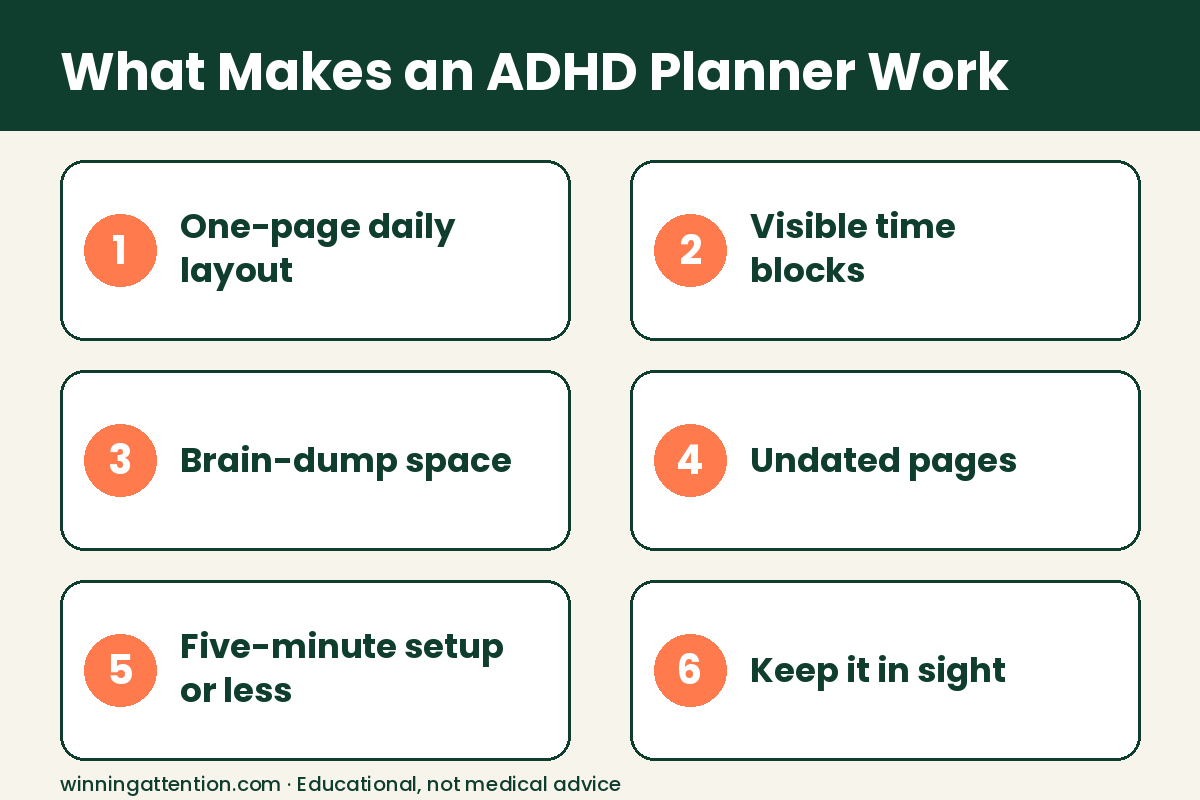
The short version: The best planner for ADHD is the one you will open every day without dread. Look for a one-page daily layout, a small number of visible time blocks, a brain-dump space, undated pages and almost zero setup. Paper and digital can both work; what matters is low friction and keeping the plan in sight. Test the format for free with a simple printable before spending money on anything fancy.
Why most planners don’t work for ADHD brains
Most planners are designed for people whose brains already do a lot of planning quietly in the background. They assume you will remember to open the book, estimate how long things take, and look ahead at the week without being reminded. For many adults with ADHD, those are exactly the steps that break down.
The planner asks for the skills ADHD makes harder
ADHD is closely tied to differences in executive function, the set of mental skills that help you hold goals in mind, organize steps and manage time. One influential model describes ADHD as a problem of self-regulation that affects working memory, the internal sense of time and goal-directed behavior. A large meta-analysis found that groups with ADHD show meaningful weaknesses on executive function tasks on average, though not every person with ADHD shows the same pattern.
Working memory deserves special attention. A meta-analytic review of adult studies found that adults with ADHD tend to perform worse on working memory tasks than adults without ADHD. In practice, that means the plan you made in your head at 8 a.m. can quietly evaporate by 10 a.m. A planner that keeps the plan on paper, in front of you, does that remembering for you.
Time is the other big one. In one study, young adults with ADHD were less accurate than peers when asked to reproduce time intervals. If “twenty minutes” and “two hours” feel roughly the same from the inside, a planner that asks you to estimate everything ahead of time is setting you up to miss. Our article on ADHD time blindness explains why this happens and how to work around it.
What a planner can actually do for you
A planner is a tool for what researchers call cognitive offloading: moving work out of your head and into the world so your brain does not have to hold it. A review of this research describes how people naturally use external aids, like notes and reminders, to reduce the load on internal memory. For an ADHD brain with limited working memory, that is not a crutch. It is the whole point.
Structured skills programs for adults with ADHD lean on this idea too. Cognitive behavioral programs that teach organization and planning, often built around a calendar and a single task list, have shown benefits for adults with ADHD in randomized trials. A meta-cognitive therapy program focused on time management, organization and planning also improved symptoms compared with a supportive control group. A planner will not replace treatment, but it is one of the practical tools those programs use.
If you want a guided version of that practical approach, our step-by-step ADHD planning course walks you through building a planning system around how your attention really works.
What to look for in the best planner for ADHD
Forget the aesthetic for a moment. Fancy covers, stickers and color-coded tabs are fun, but they do not predict whether you will still use the planner in six weeks. These six features do far more of the heavy lifting.
1. A one-page daily layout
Everything you need for today should live on a single page you can see at once. When the day is split across multiple sections, tabs or spreads, you have to remember where things are. That is exactly the working-memory demand you are trying to avoid.
A good one-page layout usually includes:
- One clearly marked “most important task” for the day
- A short list of time blocks, not a minute-by-minute grid
- A small space for appointments or fixed commitments
- A brain-dump box for anything that pops into your head
2. Visible time blocks
Because time can feel invisible with ADHD, the planner should make it visible. Instead of an hourly grid from 6 a.m. to 10 p.m., look for a few broad blocks, such as morning, afternoon and evening, or three focused work blocks. Fewer blocks means fewer decisions and less chance of the plan collapsing after one delay.
Time blocks also turn vague intentions into specific ones. “Work on the report” becomes “Report: first block, at my desk.” That shift matters, as you will see in the setup section below.
3. A brain-dump space
ADHD brains generate a constant stream of ideas, worries and “oh, I should also…” thoughts. Without a place to park them, they either hijack your attention or get lost. A dedicated brain-dump box lets you write the thought down and return to what you were doing.
The key is that the brain-dump is separate from your plan. It is a holding area, not a commitment. You can sort it later, once a day or once a week.
4. Undated pages
Dated planners come with a hidden cost: every skipped day becomes a visible blank page. For many adults with ADHD, those blanks trigger shame, and shame makes it harder to restart. Undated pages let you pick the planner back up after a rough week without facing a graveyard of empty dates.
5. Low friction
Friction is any small step that stands between you and using the planner. Think long setup instructions, many sections to fill in, a heavy binder, an app that takes six taps to open, or a page that takes fifteen minutes to complete. Each one is a chance to stop.
A practical test: can you fill out today’s page in five minutes or less? If not, the planner is probably asking for more than you can give on a hard day.
6. Portability and visibility
A planner only helps if you see it at the moment you need it. That might mean a single sheet on your desk, a small notebook in your bag or a widget on your phone’s home screen. If the planner lives in a drawer or behind three folders in an app, it is easy to forget it exists.
Red flags to watch for
Some features look helpful but often backfire for ADHD adults:
- Hourly grids for the whole day. They invite over-planning and fall apart after the first delay.
- Lots of required sections. Gratitude, habits, goals, meals and mood on one page can turn planning into a chore.
- Year-long dated layouts. Great on January 1; painful after a two-week gap.
- Heavy customization before day one. If you need a weekend to set it up, you may never start.
ADHD planner types compared: which format fits you?
There is no single right format. The best choice depends on your schedule, your environment and how your attention tends to work. This table compares the main options.
| Planner type | Works well when | Common ADHD pitfall | Tip to make it work |
|---|---|---|---|
| Daily (one page per day) | Your days vary a lot and you need a fresh, simple start each morning | Losing sight of deadlines later in the week | Pair it with a quick weekly look-ahead |
| Weekly (one spread per week) | Your schedule is fairly predictable and you like seeing the big picture | Too much on one spread; today’s priority gets buried | Circle or highlight one task per day |
| Paper | You remember better by writing and want fewer digital distractions | Leaving it at home or in a bag | Keep it open in one fixed spot |
| Digital (app or calendar) | You need reminders, alerts and access on your phone | Opening the app leads to other apps and notifications | Use one tool and put it on your home screen |
| Undated | You tend to skip days or restart often | Forgetting to write the date and losing track of time | Write the date first, every time |
| Dated | You use it daily and appointments drive your week | Blank pages trigger guilt and avoidance | Allow yourself to skip ahead without “catching up” |
| Time-blocking | You struggle to start tasks or underestimate how long things take | Overly detailed blocks that break after one delay | Use 3 broad blocks with buffer time |
Daily vs. weekly planners
Daily pages are usually friendlier to ADHD brains because they reduce what you see at once. You only deal with today. The trade-off is that upcoming deadlines can sneak up on you, so a short weekly check-in is helpful.
Weekly spreads show more context, which can help if your schedule is predictable. But they can also feel crowded. Many people get the best of both by using a daily page for action and a weekly view for orientation. Our guide to weekly planning with ADHD walks through a simple weekly check-in you can pair with any daily page.
Paper vs. digital planners
Paper is tangible, distraction-free and visible if you leave it open on your desk. Some people find that writing by hand helps them commit to a plan. The main risk is that paper cannot remind you of anything; if you do not look at it, it does nothing.
Digital tools can send alerts and live on the device you already carry everywhere. The risk is that your phone is also the most distracting object you own. A common hybrid: paper for the daily plan, a digital calendar for appointments and alarms.
Undated vs. dated planners
Undated planners are more forgiving. You can skip a weekend, a sick week or a chaotic month and simply start again on the next page. Dated planners are helpful if appointments run your life, but they work best when you give yourself explicit permission to leave blanks.
Time-blocking planners
Time-blocking means assigning tasks to specific chunks of the day. It makes time more concrete, which can help with starting and with estimating. For ADHD, the trick is to keep blocks broad and leave buffer room. Three blocks you actually use beat twelve you abandon by lunch.
Why ADHD adults abandon planners
Understanding why planners get dropped helps you choose one that lasts. These are the patterns that come up again and again.
The novelty wears off
A new planner is exciting. For an ADHD brain that is drawn to novelty, the first week can feel effortless. Then the newness fades and the planner becomes one more thing to remember. Expect this dip. It is normal, and it is why the setup steps below focus on habits rather than motivation.
It asks for too much
If the daily page takes 20 minutes, a busy morning will skip it. Then the next day feels harder to restart. A smaller page you complete most days is far more useful than a beautiful page you complete twice a month.
The plan was unrealistic
Writing ten tasks for a day that realistically fits three is a classic ADHD planning trap, often driven by optimism and time blindness. When most of the list stays undone, the planner starts to feel like a record of failure. Choosing one important task keeps the plan honest. Our article on building an ADHD-friendly to-do list goes deeper on trimming lists to a realistic size.
Out of sight, out of mind
If you have to remember to look at the planner, ADHD can make that unreliable. Many abandoned planners are not rejected; they are simply forgotten in a bag, a drawer or an unopened app.
The shame spiral
A few skipped days lead to guilt, guilt leads to avoidance, and avoidance leads to more skipped days. Undated pages, a quick reset routine and a “no catching up” rule all help break this loop.
How to set up a planner for ADHD adults so it actually sticks
The setup matters as much as the planner itself. These steps are designed to keep friction low and make the habit easier to restart when life gets messy.
Step 1: Start with the smallest version
Use only three things for the first two weeks: one important task, three time blocks and a brain-dump box. Ignore every other section. You can add more later if you want to, but most people find they do not need to.
Step 2: Give it one home
Decide where the planner lives and keep it there, open, every day. For paper, that might be next to your keyboard or coffee maker. For digital, put the planning tool on your phone’s first screen and remove competing apps from that spot.
Step 3: Plan at the same moment each day
Pick a moment you already do every day, such as pouring your first coffee, sitting down at your desk or finishing lunch. That existing habit becomes the cue for a two- to five-minute planning session. For a full morning walkthrough, see our guide on how to plan your day with ADHD.
Step 4: Turn tasks into if-then plans
Psychologists call these implementation intentions: plans that link a specific situation to a specific action. Research suggests they work partly by making the cue easier to notice and the response more automatic. Small studies in children with ADHD have also found that if-then plans changed performance on attention and inhibition tasks.
Examples of if-then plans for your planner
- If it is 9:00 a.m. and I am at my desk, then I open the report file before email.
- If I notice a random thought during a block, then I write it in the brain-dump box and keep going.
- If I finish my first time block, then I stand up, stretch and check the planner for block two.
You do not need to write an if-then plan for everything. One for your most important task is enough to make a difference in how easy it feels to start.
Step 5: Track energy, not just time
Many adults with ADHD have predictable high- and low-energy windows. A simple weekly energy tracker, where you rate your energy morning, afternoon and evening, helps you notice patterns. After a week or two, you can place demanding tasks in your best blocks and save admin for the low ones.
Step 6: Build in a reset
You will miss days. Plan for it. A two-minute reset is a short routine you can use any time the planner has slipped:
- Turn to a fresh page. Do not look back at the blanks.
- Write today’s date.
- Empty your head into the brain-dump box for 60 seconds.
- Pick one important task from the dump.
- Put it in the next available time block.
That is it. No catching up, no rewriting old lists. The goal is to get back into the habit, not to make the record perfect.
Test the format before you buy anything
Before investing in an expensive planner or a subscription app, it makes sense to test the format. You will learn more from one week of real use than from hours of comparing products online.
Our free ADHD Daily Planner Starter Kit was built around the features in this guide. It includes:
- A one-page daily planner with space for one important task, three time blocks and a brain-dump box
- A weekly energy tracker to spot your best and worst hours
- A 2-minute reset card for getting back on track after missed days
- A how-to page that explains how to use each piece in a few minutes
Print a week’s worth, keep it in one visible spot, and notice what works. If you find you prefer paper, you can keep printing it. If you miss reminders, you will know a digital tool might suit you better. Either way, you will make your next choice based on evidence from your own life.
When a planner isn’t enough
A planner is a helpful external tool, but it is not a treatment for ADHD. If planning problems are affecting your job, relationships or health, it is worth talking with a clinician who understands adult ADHD. They can help you explore evaluation, therapy and, if appropriate, medication options. Questions about medication belong with your clinician, not a planner guide.
Skills-based therapy is worth knowing about, too. A Cochrane review of cognitive-behavioral interventions for adults with ADHD found low-quality evidence that these approaches may help with core symptoms, and more research is still needed. Many of these programs include practical training in calendars, task lists and planning, the same skills a well-designed planner supports.
The bottom line on choosing the best planner for ADHD
The best planner for ADHD is not the prettiest or the most expensive. It is the one that fits on a single page, makes time visible, catches stray thoughts, forgives missed days and takes almost no effort to open. Start small, give it one home, plan at the same moment each day and use a quick reset when you slip.
Try the format first with the free printable ADHD planner kit, then build on what works. And if you want structured, step-by-step help turning that page into a reliable daily system, the Winning Attention ADHD planning course is designed to take you there at a pace that fits your brain.
This article is for educational purposes only and is not medical advice. If you have questions about ADHD symptoms, diagnosis or treatment, please talk to your clinician.
Frequently asked questions
What is the best planner for ADHD adults?
The best planner for ADHD adults is one you will use daily without dread. Look for a one-page daily layout, a few visible time blocks, a brain-dump space, undated pages and minimal setup. The specific brand matters far less than these features. Testing a simple printable for a week is a low-cost way to see which format suits you before you buy anything.
Is a paper or digital planner better for ADHD?
Neither is better for everyone. Paper is visible and free from notifications, which helps people who get pulled into their phones. Digital tools can send reminders and are always in your pocket. Many adults with ADHD use a hybrid: a paper page for the daily plan and a digital calendar for appointments and alarms. Choose the option you are most likely to see at the right moment.
Should I get a daily or weekly planner if I have ADHD?
Many adults with ADHD find a daily page easier because it shows only today and keeps decisions small. A weekly spread gives more context but can feel crowded and bury your priority. A practical approach is to use a daily page for action and add a short weekly check-in so upcoming deadlines do not catch you off guard.
Why do I keep abandoning planners?
Common reasons include fading novelty, pages that take too long to fill out, unrealistic daily task lists, keeping the planner out of sight and guilt after skipped days. These are design and setup problems, not character flaws. A smaller layout, undated pages, one fixed home for the planner and a quick reset routine make it much easier to keep going or restart.
Are undated planners better for ADHD?
For many people, yes. Dated planners turn every missed day into a visible blank page, which can trigger shame and avoidance. Undated pages let you skip a day or a week and simply start fresh on the next page. The trade-off is remembering to write the date, so make that the first thing you do each time you open it.
Can a planner replace ADHD treatment?
No. A planner is a helpful external tool that reduces the load on memory and makes time more visible, but it is not a treatment. If ADHD symptoms are affecting your work, relationships or well-being, talk with a clinician about evaluation and options, including therapy and medication. A planner works best as one practical support alongside professional care when needed.
Sources
- Barkley RA. Behavioral inhibition, sustained attention, and executive functions: constructing a unifying theory of ADHD. Psychological Bulletin. 1997;121(1):65-94. PubMed
- Willcutt EG, Doyle AE, Nigg JT, Faraone SV, Pennington BF. Validity of the executive function theory of attention-deficit/hyperactivity disorder: a meta-analytic review. Biological Psychiatry. 2005;57(11):1336-1346. PubMed
- Alderson RM, Kasper LJ, Hudec KL, Patros CH. Attention-deficit/hyperactivity disorder (ADHD) and working memory in adults: a meta-analytic review. Neuropsychology. 2013;27(3):287-302. PubMed
- Barkley RA, Murphy KR, Bush T. Time perception and reproduction in young adults with attention deficit hyperactivity disorder. Neuropsychology. 2001;15(3):351-360. PubMed
- Risko EF, Gilbert SJ. Cognitive offloading. Trends in Cognitive Sciences. 2016;20(9):676-688. PubMed
- Safren SA, Sprich S, Mimiaga MJ, Surman C, Knouse L, Groves M, et al. Cognitive behavioral therapy vs relaxation with educational support for medication-treated adults with ADHD and persistent symptoms: a randomized controlled trial. JAMA. 2010;304(8):875-880. PubMed
- Solanto MV, Marks DJ, Wasserstein J, Mitchell K, Abikoff H, Alvir JM, et al. Efficacy of meta-cognitive therapy for adult ADHD. American Journal of Psychiatry. 2010;167(8):958-968. PubMed
- Lopez PL, Torrente FM, Ciapponi A, Lischinsky AG, Cetkovich-Bakmas M, Rojas JI, et al. Cognitive-behavioural interventions for attention deficit hyperactivity disorder (ADHD) in adults. Cochrane Database of Systematic Reviews. 2018;3(3):CD010840. PubMed
- Webb TL, Sheeran P. Mechanisms of implementation intention effects: the role of goal intentions, self-efficacy, and accessibility of plan components. British Journal of Social Psychology. 2008;47(Pt 3):373-395. PubMed
- Paul I, Gawrilow C, Zech F, Gollwitzer P, Rockstroh B, Odenthal G, et al. If-then planning modulates the P300 in children with attention deficit hyperactivity disorder. NeuroReport. 2007;18(7):653-657. PubMed
Turn this into a daily plan
Get the free ADHD Daily Planner Starter Kit: a one-page daily planner, a weekly energy tracker and a 2-minute reset card.