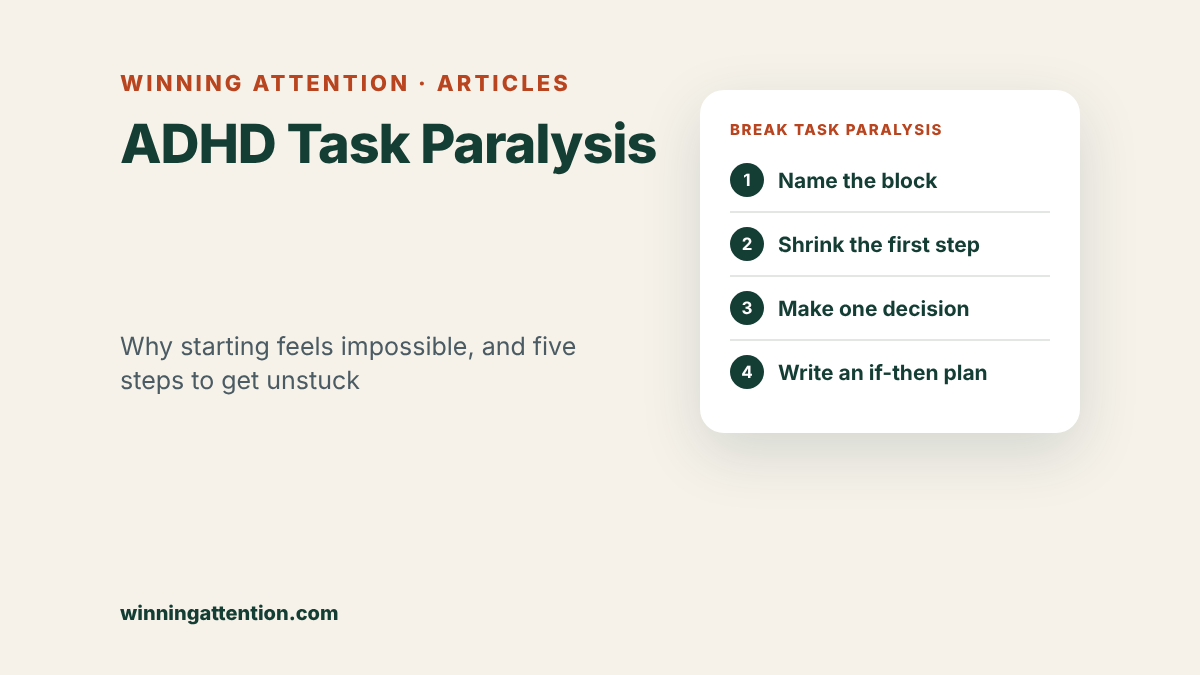
You know exactly what you need to do. The email is two lines long, the form takes ten minutes, the report has been on your list for a week. And yet you sit there, unable to start, while the clock moves and the guilt builds. Many people describe this as ADHD task paralysis: a frozen, stuck feeling that is not laziness and not a lack of caring.
“Task paralysis” is not a formal diagnostic term, and you will not find it in a diagnostic manual. But the experience it names connects to well-studied areas of ADHD research: executive function, emotion regulation, procrastination and the challenge of turning an intention into action. This guide explains what the research says, how task paralysis differs from ordinary procrastination, and a five-step method to get unstuck when you are frozen in front of a task.
The short version: you are rarely stuck on the whole task. You are stuck on an unclear first step, too many choices, or an uncomfortable feeling. Name what is blocking you, shrink the first step until it takes two minutes, decide in advance when and where you will do it, and start a short timer with permission to stop.
What is ADHD task paralysis?
ADHD task paralysis is a common name for the experience of being unable to start (or sometimes continue) a task even when you want to do it, know it matters, and have the time. It often comes with a sense of mental overload or freezing, and with a lot of inner pressure that does not turn into action.
What is it called?
You may hear several overlapping names: task paralysis, ADHD paralysis, task initiation problems, executive dysfunction or simply getting stuck. Clinicians and researchers more often talk about difficulties with task initiation, self-regulation and procrastination. None of these is a separate diagnosis. They describe a pattern that shows up in many adults with ADHD and, to a lesser degree, in people without ADHD.
What ADHD task paralysis feels like
People describe it in strikingly similar ways:
- “I know what to do, but my body will not start doing it.”
- “My head is full of everything I need to do, so I do none of it.”
- “I sit down, open the laptop, and then I am on my phone 40 minutes later.”
- “It is like a wall between me and the task, and the wall gets taller the longer I wait.”
- “I feel guilty all day about a ten-minute job.”
The feeling often has a physical side: restlessness, tension, heaviness or a fog. It is also tiring. Avoiding a task is not restful, because the task keeps tapping you on the shoulder.
What it looks like from the outside
From the outside, task paralysis can look like scrolling, tidying the wrong thing, doing easy tasks instead of the important one, or staring at a screen. That is why it is so often misread as laziness. The difference is that the person is usually distressed, wants to start, and is spending a lot of mental energy not starting.
Is ADHD task paralysis real? What the research says
There are no studies measuring “task paralysis” under that exact name, so any honest answer has to look at related research. That research consistently links ADHD with difficulty initiating and completing tasks, especially tasks that are unpleasant, unclear or far from a deadline.
Procrastination and ADHD symptoms
Several studies have looked at procrastination and ADHD symptoms together. In a study of 54 university students with varying levels of ADHD-related behaviors, inattention, rather than impulsivity or hyperactivity, was the symptom area linked to general procrastination (Niermann & Scheres, 2014). The authors also noted that procrastination is often addressed in therapy for adults with ADHD even though it is not an official ADHD symptom.
A study of 114 college students found that executive functions helped explain the link between ADHD symptoms and procrastination. Two areas stood out as the specific pathways: self-management of time, and organization and problem-solving (Bolden & Fillauer, 2020). In plain language, people with more ADHD symptoms tended to procrastinate more partly because organizing a task and managing time around it were harder.
Memory for intentions plays a role too. In a study of 29 adults with ADHD and 24 adults without ADHD, those with ADHD recalled and carried out fewer of their own real-life intentions, and their everyday prospective memory (remembering to do things in the future) partly explained the link between ADHD symptoms and procrastination (Altgassen, Scheres & Edel, 2019). These studies are small, and two used student samples rather than diagnosed adults, but they point in the same direction.
Why some tasks feel impossible to start
Procrastination research outside ADHD helps explain why certain tasks trigger paralysis. A large meta-analysis based on 691 correlations found that the strongest and most consistent predictors of procrastination included task aversiveness (how unpleasant a task feels), how far away the reward or deadline is, low self-efficacy (doubting you can do it well), and impulsiveness and distractibility (Steel, 2007). Several of those factors, especially impulsiveness and distractibility, overlap with ADHD traits.
The emotional side of being stuck
ADHD task paralysis is rarely just a planning problem. Emotion dysregulation, meaning difficulty managing the intensity of feelings, is increasingly seen as a core part of adult ADHD. A meta-analysis of 13 studies with 2,535 participants found that adults with ADHD had much higher levels of emotion dysregulation than healthy controls (Hedges’ g = 1.17), and that the severity of ADHD symptoms correlated with emotion dysregulation (r = 0.54) (Beheshti, Chavanon & Christiansen, 2020).
A major review reached a similar conclusion: emotion dysregulation is common in ADHD across the lifespan and is a major contributor to impairment (Shaw et al., 2014). When a task carries dread, boredom, fear of failure or shame from past attempts, those feelings can hit harder and last longer, and avoiding the task becomes a way to avoid the feeling.
What causes ADHD task paralysis?
There is no single cause, and the trigger can change from one task to the next. Putting the research together, most episodes of ADHD task paralysis come from one or more of these five sources.
1. An unclear first step
Tasks like “do taxes,” “sort out the garage” or “work on the thesis” are not really tasks. They are projects with dozens of hidden decisions. If your brain cannot see the first physical action, it has nothing to start. Difficulties with organization and problem-solving, which were one of the pathways linking ADHD symptoms and procrastination in the college study above (Bolden & Fillauer, 2020), make this breakdown step harder.
2. Too many choices at once
A long to-do list can freeze you just as much as a vague task. When ten things feel equally urgent, choosing one means not choosing nine, and the cost of picking “wrong” feels high. Many adults with ADHD describe this kind of decision overload as the moment they shut down. It is a common clinical observation rather than a precisely measured effect, but it explains why reducing choices is such a useful strategy.
3. Uncomfortable feelings attached to the task
Boredom, anxiety, perfectionism and memories of past failures all add weight. Task aversiveness and low self-efficacy are among the strongest predictors of procrastination in general (Steel, 2007), and with the stronger emotional reactions often seen in adult ADHD, those feelings can be enough to stop you before you start.
4. Rewards and deadlines that feel far away
A task due next month competes poorly with anything that feels good right now. In the procrastination meta-analysis, the delay before a task’s payoff was one of the consistent predictors of putting things off (Steel, 2007). Many people with ADHD only get moving when a deadline is close enough to create urgency, which works, but at a high cost in stress.
5. Too many open loops
Unfinished tasks do not sit quietly. In a series of experiments, unfulfilled goals caused intrusive thoughts and worse performance on unrelated tasks, but making a specific plan for each goal removed those effects, even before the goal was done (Masicampo & Baumeister, 2011). These studies were not in ADHD samples, but they suggest one reason why a head full of unplanned tasks can feel paralyzing: each one keeps pulling at your attention.
Task paralysis vs. procrastination: what’s the difference?
The two overlap a lot, and researchers often study ADHD task paralysis under the label of procrastination. In everyday use, though, people tend to mean slightly different things. The table below sums up the usual distinction. It is a practical guide, not a clinical definition.
| Ordinary procrastination | ADHD task paralysis | |
|---|---|---|
| What it feels like | “I don’t feel like it right now” | “I want to, but I can’t make myself start” |
| What you do instead | Something more enjoyable, often guilt-free in the moment | Often nothing useful; stuck, scrolling or frozen |
| Emotional tone | Mild reluctance | Overwhelm, distress, shame or fog |
| Usual trigger | Boring or unpleasant task | Unclear first step, too many choices, strong emotions |
| What tends to help | A reason to start or a reward | Smaller steps, fewer choices, external cues and support |
In short, procrastination is usually a choice to delay, while task paralysis feels like the choice is not available. Most people with ADHD experience both, sometimes on the same day.
Is task paralysis the same as executive dysfunction?
Not exactly. Executive functions are the mental skills that help you plan, organize, start, monitor and finish what you intend to do. Executive dysfunction is a broad term for difficulty with those skills. Task paralysis is one visible result of executive dysfunction, specifically the moment when planning, prioritizing and starting all break down at once.
The research above fits this picture: executive functions such as time management and organization helped explain the link between ADHD symptoms and procrastination (Bolden & Fillauer, 2020). But emotional factors matter too, which is why the method below works on both the practical and the emotional side of getting stuck.
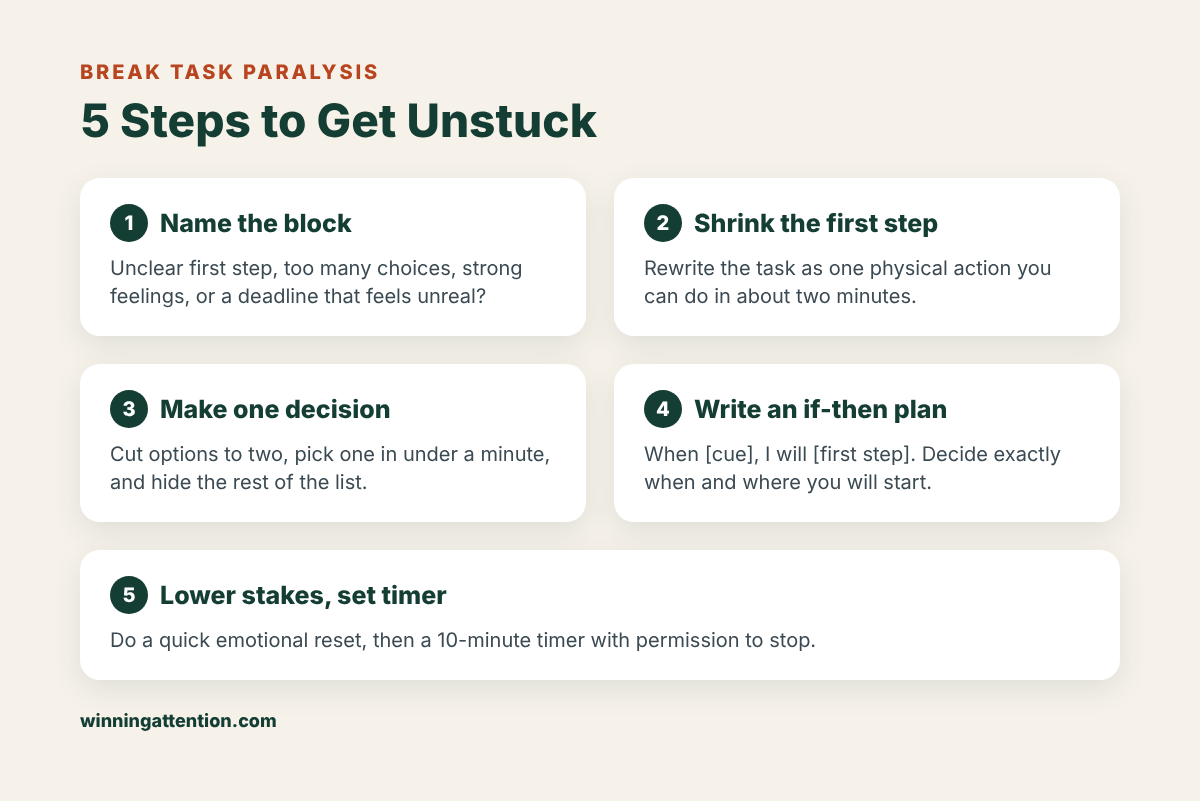
How to break ADHD task paralysis: a 5-step method
The following method is designed for the moment you are stuck. It takes about five minutes. Structured skills programs for adults with ADHD use many of the same ingredients: breaking tasks down, planning when to do them, and addressing the unhelpful thoughts that get in the way. In a randomized trial of 88 adults with ADHD, a 12-week group program teaching time management, organization and planning, while also targeting anxious and discouraging thoughts, improved inattention symptoms more than supportive therapy (Solanto et al., 2010).
Step 1: Name what is blocking you
Before trying to push through, take 30 seconds to ask: what exactly is making this hard? Pick the closest answer:
- “I don’t know where to start.” The first step is unclear (go to Step 2).
- “There’s too much, I don’t know what to do first.” Too many choices (go to Step 3).
- “I dread it.” The task carries strong feelings (go to Step 5 and use the emotional reset).
- “It’s not due for ages.” The deadline feels unreal (go to Step 4).
Naming the block turns a vague, global feeling of “I can’t” into a specific problem with a specific fix. It also takes some of the sting out of self-criticism, because you are solving a problem rather than judging yourself.
Step 2: Shrink the first step until it takes two minutes
Rewrite the task as the smallest physical action you could do in about two minutes. Not “write the report” but “open the document and type the title.” Not “clean the kitchen” but “put the dishes from the counter into the sink.”
Examples of two-minute first steps
- “Do my taxes” becomes “find last year’s tax return and put it on the desk.”
- “Reply to the difficult email” becomes “open the email and write one sentence, any sentence.”
- “Apply for the job” becomes “open the job ad and copy the requirements into a note.”
- “Book a doctor’s appointment” becomes “find the clinic’s phone number and put it on my screen.”
The two-minute step is not the whole job. It is the bridge from frozen to moving. Once you are moving, the next step is usually easier to see.
Step 3: Make one decision, then stop deciding
If you are frozen by choice, cut the options down to two and pick one in under a minute. If two options tie, choose the one with a real consequence if it slips (a deadline, a person waiting, money), or simply the one closest to hand. Then put the rest of the list out of sight.
Ways to reduce choices fast
- Cover your to-do list with a sticky note so only the top item is visible.
- Ask someone you trust, “Which of these two should I do first?” and accept the answer.
- Flip a coin between two equal tasks. If you feel disappointed by the result, do the other one.
- Decide that “good enough” applies to the choice itself: any start beats no start.
Step 4: Turn “soon” into an if-then plan
If you cannot start right now, or the deadline feels too far away to matter, decide exactly when and where you will take the first step. An implementation intention links a specific cue to a specific action: “When [cue], I will [first step].”
A meta-analysis of 94 independent tests found that implementation intentions had a positive effect of medium-to-large size on reaching goals (d = .65), and they were effective in helping people initiate goal-directed action (Gollwitzer & Sheeran, 2006). These studies were not limited to people with ADHD, but initiation is exactly where ADHD task paralysis bites. Making the plan also helps close the open loop, so the task stops nagging at you while you do other things (Masicampo & Baumeister, 2011).
Examples of if-then plans for getting unstuck
- “When I sit down after lunch, I will open the budget spreadsheet and fill in one row.”
- “When the kettle boils tomorrow morning, I will call the bank while the tea steeps.”
- “If I catch myself scrolling, I will put the phone in a drawer and do the two-minute step.”
Step 5: Lower the stakes and start a short timer
Set a timer for 10 minutes and give yourself permission to stop when it rings. That permission is important: it shrinks the commitment so the uncomfortable feeling does not have to be faced all at once. Many people find they keep going, but stopping is allowed.
A two-minute emotional reset
When dread or shame is the main block, try this before the timer:
- Stand up and move. Walk to another room, stretch, or drink a glass of water.
- Breathe slowly. Take a few breaths with longer exhales than inhales.
- Name the feeling. “I’m anxious this will be bad,” or “I’m bored and annoyed.” Naming it is not the same as obeying it.
- Lower the bar. Tell yourself that this first round is allowed to be messy, incomplete or bad.
- Start the timer and do the two-minute step.
Other ways to make starting easier
- Body doubling. Work alongside another person, in person or on a video call, even if they are doing something different.
- Change your setting. A different room, a library or a café can break the association between your desk and feeling stuck.
- Pair it with something pleasant. A specific playlist, a favorite drink, or a walk afterward.
- Tell someone. “I’m going to send the email by 3:00” creates gentle accountability.
Getting unstuck in real life: a worked example
Here is how the method might work for a fictional example. Priya is a 29-year-old graduate student with ADHD. Her literature review is due in two weeks, and for five days she has opened her laptop every morning and ended up doing everything except the review. She feels guilty, tired and increasingly anxious.
- Name the block (1 minute). Priya asks what is actually stopping her. Two answers: she does not know where to start, and she is afraid the review will not be good enough for her supervisor.
- Shrink the step (2 minutes). “Write the literature review” becomes “open a blank document and list the five papers I already know I’ll use.” That takes her about two minutes.
- One decision (1 minute). She has three possible sections to start. She picks the one with the most notes already and covers the other headings so she cannot see them.
- If-then plan. For the next day: “When I sit down at the library at 10:00, I will write three bullet points summarizing the first paper.” She puts it on a sticky note on her laptop.
- Lower the stakes and start. She tells herself the first draft is a “bad draft” no one will see, sets a 10-minute timer and starts. The timer rings; she keeps going for another 20 minutes.
The review is not finished that day. But Priya has moved from frozen to working, and the next morning starts with a clear first step instead of a wall. When she gets stuck again later in the week, she goes back to Step 1. Getting out of ADHD task paralysis is not a one-time fix; it is a skill you repeat.
How to prevent ADHD task paralysis before it starts
The five steps help in the moment. A few habits reduce how often you get stuck in the first place:
- Plan the day in blocks, not long lists. Choosing one main task and grouping the rest reduces the number of decisions you face later. The guide on How to Plan Your Day with ADHD walks through a ten-minute routine built on this idea.
- Write the first step next to every task. When you add something to your list, add its two-minute first step at the same time, while you still remember what it involves.
- Keep one capture place. Getting tasks out of your head and onto one page reduces the background noise of open loops.
- Schedule hard tasks for your best hours. Many adults with ADHD have a time of day when starting is easier. Protect it for the task you are most likely to avoid.
- Use a reset card. Keep a short written routine for when you feel stuck, so you do not have to remember the steps while overwhelmed.
If you want ready-made tools for this, the free ADHD Daily Planner Starter Kit includes a one-page daily planner, a weekly energy tracker and a 2-minute reset card designed for exactly these moments.
Common mistakes when trying to beat task paralysis
- Waiting to feel motivated. With ADHD task paralysis, motivation often shows up after you start, not before. Begin with the two-minute step and let momentum follow.
- Keeping tasks vague. “Work on project” invites freezing. Every task on your list should begin with a verb you could do in the next minute.
- Looking at the whole list when stuck. A full list adds choices. Hide everything except the next task.
- Using shame as fuel. Harsh self-talk can push you briefly, but it adds to the dread that caused the paralysis in the first place.
- Relying only on deadline panic. Last-minute urgency works, but it is exhausting and makes the next task feel even more threatening.
- Treating every stuck moment as the same. An unclear step, too many choices and strong emotions need different fixes. Start by naming which one it is.
- Trying a new system every week. New apps feel productive, but a simple routine practiced for several weeks does more.
When to talk to a professional
The strategies in this guide are self-help tools, not a treatment for ADHD. Consider talking to a doctor, psychologist or other qualified clinician if getting stuck is affecting your job, studies, finances, health or relationships; if you often feel overwhelmed, hopeless or anxious; or if you have never been assessed for ADHD but recognize yourself in this article.
There is good evidence for structured help. A meta-analysis of 32 studies of cognitive-behavioral therapy (CBT) for adult ADHD found small-to-medium benefits compared with control groups, both for ADHD symptoms (g = .65) and for daily functioning (g = .51) (Knouse, Teller & Brooks, 2017). Medication, CBT and skills-based programs are all options, and many people benefit from a combination. A clinician can help you decide what fits.
Frequently asked questions
What is ADHD task paralysis and what is it called?
ADHD task paralysis is a common name for being unable to start a task even when you want to and know it matters. It is not a formal diagnosis. Researchers usually study it under related terms such as task initiation difficulties, executive dysfunction and procrastination.
Is ADHD task paralysis real?
The experience is real, even though the term is informal. Studies link ADHD symptoms with more procrastination, weaker follow-through on everyday intentions and greater emotion dysregulation, all of which make starting tasks harder. Most of this research is still small or done in student samples, so more work is needed.
What causes ADHD task paralysis?
Common causes include an unclear first step, too many choices at once, strong uncomfortable feelings attached to the task, and deadlines or rewards that feel far away. Difficulties with time management, organization and emotion regulation, which are common in ADHD, make each of these harder to push through.
What does ADHD task paralysis feel like?
Many people describe knowing exactly what to do but being unable to make themselves start, often with a sense of overwhelm, fog or physical restlessness. It usually comes with guilt and frustration, and it can be tiring, because avoiding a task still takes mental energy.
How do you break ADHD task paralysis?
Name what is blocking you, shrink the first step until it takes about two minutes, cut your options down to one, and make an if-then plan for when you will start. Then set a 10-minute timer with permission to stop. Body doubling and a quick emotional reset can also help.
Task paralysis vs. procrastination: what’s the difference?
Procrastination usually feels like choosing to delay something you do not feel like doing. Task paralysis feels like wanting to start but being unable to, often with overwhelm or distress. The two overlap a lot, and most people with ADHD experience both.
Is task paralysis the same as executive dysfunction?
Not exactly. Executive dysfunction is a broad term for difficulties with planning, organizing, starting and finishing tasks. Task paralysis is one visible result of it, often combined with emotional factors such as dread or fear of failure.
Sources
- Niermann HC, Scheres A. The relation between procrastination and symptoms of attention-deficit hyperactivity disorder (ADHD) in undergraduate students. International Journal of Methods in Psychiatric Research. 2014;23(4):411–421. PubMed
- Bolden J, Fillauer JP. “Tomorrow is the busiest day of the week”: executive functions mediate the relation between procrastination and attention problems. Journal of American College Health. 2020;68(8):854–863. PubMed
- Altgassen M, Scheres A, Edel MA. Prospective memory (partially) mediates the link between ADHD symptoms and procrastination. ADHD Attention Deficit and Hyperactivity Disorders. 2019;11(1):59–71. PubMed
- Steel P. The nature of procrastination: a meta-analytic and theoretical review of quintessential self-regulatory failure. Psychological Bulletin. 2007;133(1):65–94. PubMed
- Beheshti A, Chavanon ML, Christiansen H. Emotion dysregulation in adults with attention deficit hyperactivity disorder: a meta-analysis. BMC Psychiatry. 2020;20(1):120. PubMed
- Shaw P, Stringaris A, Nigg J, Leibenluft E. Emotion dysregulation in attention deficit hyperactivity disorder. American Journal of Psychiatry. 2014;171(3):276–293. PubMed
- Masicampo EJ, Baumeister RF. Consider it done! Plan making can eliminate the cognitive effects of unfulfilled goals. Journal of Personality and Social Psychology. 2011;101(4):667–683. PubMed
- Gollwitzer PM, Sheeran P. Implementation intentions and goal achievement: a meta-analysis of effects and processes. Advances in Experimental Social Psychology. 2006;38:69–119. DOI
- Solanto MV, Marks DJ, Wasserstein J, et al. Efficacy of meta-cognitive therapy for adult ADHD. American Journal of Psychiatry. 2010;167(8):958–968. PubMed
- Knouse LE, Teller J, Brooks MA. Meta-analysis of cognitive-behavioral treatments for adult ADHD. Journal of Consulting and Clinical Psychology. 2017;85(7):737–750. PubMed
Turn this into a daily plan
Get the free ADHD Daily Planner Starter Kit: a one-page daily planner, a weekly energy tracker and a 2-minute reset card.