It can start with something tiny: one more email, a sink full of dishes, a text you forgot to answer. Suddenly everything feels like too much at once. Your thoughts race, your chest tightens, and the only options that seem possible are shutting down or running away. If you live with ADHD, you probably know this feeling well. Many adults call it ADHD overwhelm.
ADHD overwhelm is not a sign that you are lazy, weak or bad at life. Research on adult ADHD points to clear reasons why emotions, tasks and noise pile up faster for some brains, and it also points to practical ways to come back down. This guide covers what ADHD overwhelm is, why it happens, what studies say actually helps, and a five-step reset you can use in the moment.
The short version: when overwhelm hits, do not try to solve everything. Pause and name the feeling, calm your body with a few long exhales, empty your head onto one page, shrink the next action until it is almost too small to fail, and cut the input around you. Then, on calmer days, build habits that keep the pile from getting so high.
What is ADHD overwhelm?
ADHD overwhelm is not an official diagnosis. It is a plain-language name for a state many adults with ADHD describe: the sense that demands, feelings and information have gone past what you can handle right now, so your ability to think, plan and act seems to switch off. It often looks like freezing, procrastinating, crying, snapping at people or scrolling your phone for an hour without meaning to.
Everyone feels overwhelmed sometimes. What tends to be different with ADHD is how quickly it arrives, how intense it feels and how often it happens. A small trigger can tip a whole day. That pattern lines up with what researchers have found about emotion, attention and working memory in ADHD, which we will look at below.
What ADHD overwhelm feels like
People describe it in many ways, but a few experiences come up again and again:
- Mental static. Your mind feels full and noisy, yet you cannot hold a single clear thought long enough to act on it.
- Everything is urgent. Every task on the list seems equally important, so choosing one feels impossible.
- Body alarm. A racing heart, shallow breathing, tight shoulders, a hot face or a knot in the stomach.
- Shutdown or flight. You stare at the screen, go to bed in the middle of the day, or leave the room.
- A harsh inner voice. “Why can’t I just do this like everyone else?” often follows close behind.
Recognizing these signs early matters. The sooner you notice the wave, the smaller the reset you will need.
Why ADHD overwhelm happens: what the research says
There is no single cause of ADHD overwhelm. It usually comes from several pressures stacking up at once: strong emotions, too many open tasks, too much sensory input and too many decisions. Here is what research says about each one.
Emotions rise faster and hit harder
For a long time, ADHD was described only in terms of attention and hyperactivity. That view has changed. A major review in the American Journal of Psychiatry concluded that emotion dysregulation is common in ADHD across the lifespan and is a major contributor to the problems people experience in daily life (Shaw et al., 2014).
A 2020 meta-analysis put numbers on it. Pooling 13 studies with 2,535 participants, researchers found that adults with ADHD had much higher levels of emotion dysregulation than healthy controls (Hedges’ g = 1.17, a large difference). Emotional lability, meaning quick and intense shifts in mood, showed the strongest effect (g = 1.20). The more severe someone’s ADHD symptoms, the more emotion dysregulation they tended to report (r = 0.54) (Beheshti et al., 2020).
In everyday terms: if frustration, worry or disappointment arrives faster and louder, there is less room between “this is a lot” and “this is too much.” That is one of the main engines behind feeling overwhelmed with ADHD.
Too many open loops
Working memory is the brain’s short-term notepad. In ADHD it often has less room, which is one piece of the wider picture of ADHD executive function challenges. When dozens of tasks, reminders and worries live only in your head, they keep competing for that limited space.
Research outside ADHD shows how costly those open loops can be. In a series of experiments, unfinished goals caused intrusive thoughts during an unrelated reading task. When participants were allowed to make a specific plan for the unfinished goal, those interference effects disappeared, even though the goal itself was not yet done (Masicampo & Baumeister, 2011). The study did not look at ADHD, but it suggests something useful: getting a task out of your head and onto a plan can quiet the background noise.
The world can feel louder
Many adults with ADHD say that noise, bright light, clutter, scratchy clothes or busy rooms wear them down faster than other people. Research here is still young, but it supports the experience. In a study of 234 adults from the general population (not a clinical ADHD sample), people with more ADHD traits reported more sensory processing problems across all senses, and ADHD traits predicted those sensory difficulties (Panagiotidi et al., 2018). The authors suggested sensory difficulties could be part of the ADHD picture.
When your environment is already taking a large share of your attention, it takes much less for a task or a feeling to push you over the edge.
Too many decisions (and a note on “willpower”)
You may have heard that willpower is like a battery that runs down with every decision, an idea known as ego depletion. It is worth being honest about this one. When 23 laboratories ran a careful, preregistered replication with 2,141 participants, the effect was close to zero (d = 0.04, with a confidence interval that included zero) (Hagger et al., 2016). So it is not accurate to say that every choice drains a fixed tank.
What is still true, and does not depend on that theory, is that a long list of unmade choices keeps many open loops running at once. Each “should I do this or that first?” competes for the same limited working memory. Reducing choices helps not because willpower is a battery, but because fewer open questions leave more room to think.
The snowball effect
These pressures feed each other. A noisy office makes it harder to focus, so tasks slip. Slipped tasks become a longer list. A longer list triggers worry and self-criticism, and strong emotions make it even harder to start. Before long, you are not reacting to one task but to the whole pile, plus the shame about the pile. Breaking that loop at any point, whether the emotion, the list or the noise, makes the rest easier to handle.
What helps with ADHD overwhelm, according to studies
No study has tested a single “overwhelm protocol” for adult ADHD. But several lines of research point in the same direction: build skills for managing tasks, learn to notice and label emotions, and calm the body directly.
- Cognitive-behavioral therapy (CBT). A meta-analysis of 32 studies of CBT for adult ADHD found small-to-medium benefits compared with control groups for ADHD symptoms (g = 0.65) and for daily functioning (g = 0.51) (Knouse et al., 2017). These programs usually teach organization, planning and ways of handling unhelpful thoughts, all of which reduce the raw material of overwhelm.
- Mindfulness-based approaches. A meta-analysis of mindfulness-based therapies for ADHD found reductions in inattention (d = -0.66 across 10 studies) and in hyperactivity/impulsivity (d = -0.53 across 9 studies) (Cairncross & Miller, 2020). In a randomized trial of 81 medication-free adults with ADHD, an 8-week mindfulness program and structured psychoeducation both reduced symptoms, and mindfulness was not superior to psychoeducation (Hoxhaj et al., 2018). The takeaway: mindfulness can help, but learning about ADHD and how it works for you is also valuable.
- Putting feelings into words. In four experiments with adults (not an ADHD sample), people reported less distress when they labeled the emotion in a negative picture compared with just looking at it. Interestingly, participants did not expect labeling to help, even after it had (Lieberman et al., 2011).
- Breathing with long exhales. In a remote randomized study, five minutes a day of “cyclic sighing,” a breathing pattern that emphasizes long exhales, improved mood and lowered breathing rate more than the same amount of mindfulness meditation over one month (Balban et al., 2023). This study was not done in people with ADHD, so treat it as a promising tool rather than an ADHD-specific treatment.
The reset below combines these ingredients into a short routine you can use when overwhelm hits. It is a self-help structure, not a substitute for professional care.
How to manage ADHD overwhelm: a 5-step reset
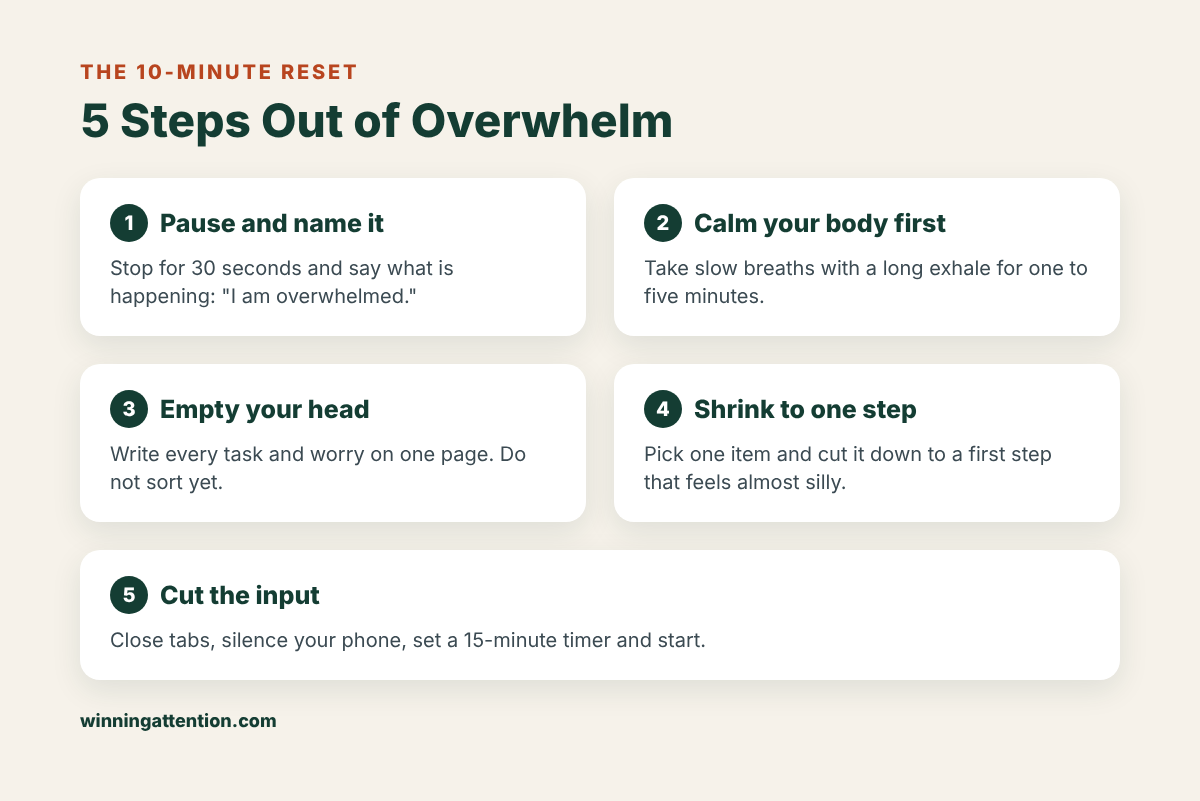
The full reset takes about ten minutes. The first two steps alone take two minutes and are often enough to take the edge off. You do not need to feel calm to begin; you only need to start Step 1.
Step 1: Pause and name it
Stop what you are doing, even for thirty seconds. Then say, out loud or in writing, what is happening: “I am overwhelmed.” If you can, add the main feeling underneath it.
This sounds almost too simple, but the labeling research above suggests that putting a feeling into words can turn down its intensity, even when it does not feel like it will help. Naming it also shifts you from being inside the wave to watching it, which is where choices become possible again.
Examples of quick labels
- “This is overwhelm. It will pass.”
- “I feel panicked about the deadline and guilty about the emails.”
- “Too much noise, too many tabs, not enough sleep.”
- “I’m frustrated, and I’m also tired.”
Step 2: Calm your body first
When your body is in alarm mode, planning is very hard. So deal with the body before the to-do list. The simplest tool is a slow breath with a long exhale.
How to do a cyclic sigh
- Breathe in through your nose.
- At the top, take a second, shorter sip of air to fully fill your lungs.
- Breathe out slowly through your mouth, making the exhale longer than the inhale.
- Repeat for one to five minutes, at a comfortable pace.
If breathing exercises make you feel more anxious, skip them. Other body-first resets include splashing cold water on your face, stepping outside for two minutes, stretching, or walking around the block. The goal is not perfect calm; it is to come down one notch so your thinking brain can come back online.
Step 3: Empty your head onto one page
Take a sheet of paper or open one note and write down everything that is pressing on you: tasks, worries, messages you owe, things you are afraid you will forget. Do not sort or judge. Just get it out.
This is the “open loops” idea in action. Once a task is on paper, your brain no longer has to keep reminding you about it. Many people are surprised to find that the list is shorter than it felt: twelve items, not a hundred. Seeing the real size of the pile is calming in itself.
Step 4: Shrink to one next step
Now look at the list and pick one item. Not the most important thing in your life, just one thing that would make the next hour better. Then shrink it down to a first step so small it feels almost silly.
Overwhelm feeds on size. “Do my taxes” is a mountain. “Find last year’s tax return and put it on the desk” is a pebble. If you notice you still cannot start, the step is not small enough yet. Our guide to ADHD task paralysis has more ways to get moving when you are stuck.
Examples of shrinking a task
- “Clean the kitchen” becomes “put the plates in the dishwasher.”
- “Answer all my email” becomes “reply to the one from my manager.”
- “Fix my finances” becomes “log into the bank and look at this week’s balance.”
- “Prepare the presentation” becomes “open the file and write three slide titles.”
Step 5: Cut the input
Before you start that tiny step, lower the noise around you for the next 20 to 30 minutes. Close tabs you do not need. Put your phone in another room or on do-not-disturb. Use headphones or earplugs if sound is bothering you. Clear just the area in front of you, not the whole room.
Then set a short timer, maybe 10 or 15 minutes, and do only the one step. When the timer goes off, check in: do you want to keep going, take a break, or pick the next step from your list? Any of those is a win.
Putting it together: one overwhelming afternoon
Here is how the reset might look in practice for a fictional example: Marcus, a project coordinator with ADHD, at 2:15 on a Thursday afternoon, in the middle of a classic bout of ADHD overwhelm.
- The trigger. Marcus gets a message from his manager asking for the budget update “by end of day.” He already has 40 unread emails, a meeting at 3:30, and he has not eaten lunch. He opens the spreadsheet, closes it, opens his inbox, closes it, and finds himself reading the news. His heart is pounding.
- Pause and name it (30 seconds). He notices he has opened the same three tabs four times. He writes on a sticky note: “Overwhelmed. Hungry. Scared about the budget.”
- Calm the body (2 minutes). He does six slow cyclic sighs at his desk, then gets a granola bar and a glass of water from the kitchen.
- Empty the head (3 minutes). On one page he writes: budget update, 40 emails, prepare for 3:30 meeting, call the dentist back, pay the electric bill, reply to his sister about the weekend. Six items, not sixty.
- One small step (1 minute). The budget update has a real deadline. He shrinks it to: “Copy last month’s numbers into this month’s tab.” Everything else can wait until after the meeting or tomorrow.
- Cut the input (1 minute). He closes his email, puts his phone face down, and sets a 15-minute timer.
By the end of the timer, the numbers are in and Marcus can see what is missing. The budget is not finished, but it is no longer a fog. He sends his manager a short note saying he will have it by 5:00 and goes into the meeting with a clearer head. The dentist and the electric bill go on tomorrow’s list. Nothing about the situation changed except how much of it he tried to hold at once.
Preventing ADHD overwhelm before it starts
The reset is for the moment overwhelm arrives. These habits help lower how often it shows up in the first place.
| Early warning sign | What it often means | A small response |
|---|---|---|
| Opening and closing the same apps or tabs | Too many open choices | Write the list down and pick one item |
| Snapping at people over small things | Emotional load is high | Name the feeling, take a short break |
| Rereading the same sentence again and again | Working memory is full | Brain dump, then return |
| Noise or light suddenly irritating | Sensory load is high | Headphones, a quieter room, dim the screen |
| Skipping meals or water | Body running on empty | Eat something simple before deciding anything |
| Saying “yes” to every request | Load is growing faster than capacity | Pause before agreeing: “Let me check and get back to you” |
Keep one trusted list
Use one notebook or one app for everything you need to do. When tasks are scattered across sticky notes, inboxes and your memory, you can never be sure what is on your plate, and that uncertainty itself feels heavy. A short daily plan built from that single list, like the method in our guide on how to plan your day with ADHD, keeps the pile visible and manageable.
Plan fewer things than you think you can do
With ADHD, time estimates are often optimistic. A day planned to the minute leaves no room for the inevitable delay, and the first delay can tip you into overwhelm. Choose one task that would make the day a win, and treat the rest as a bonus.
Protect the basics
Sleep, food, water and movement are not extras. When you are tired or hungry, your emotional fuse gets shorter. You do not need a perfect routine; small, steady anchors such as a regular bedtime or a walk at lunch make overwhelm less likely.
Practice the reset when you are calm
Skills are easier to use under stress if you have practiced them without stress. Try the cyclic sigh for a minute while waiting for the kettle. Do a two-minute brain dump on a quiet evening. That way the steps are familiar when you really need them. The free ADHD Daily Planner Starter Kit includes a printable 2-minute reset card you can keep on your desk as a reminder.
Is ADHD overwhelm a sign of burnout?
Not always, but it can be. Overwhelm is usually a short-term state: it comes on in a moment, peaks and then eases, especially once you reset. Burnout is a longer pattern of exhaustion that builds over weeks or months, where rest no longer seems to restore your energy and you feel detached or hopeless about work or daily life.
If you notice that overwhelm is happening most days, that you dread every morning, or that weekends and holidays do not help you recover, take it seriously. That is often a sign that the overall load is too high for too long, not that you need to try harder. It is a good moment to look at what can be dropped, delegated or postponed, and to talk to a professional.
Common mistakes to avoid
Most of these mistakes come from trying to think your way out of ADHD overwhelm while still flooded. Watch for them.
- Trying to fix everything at once. When you are overwhelmed, a big cleanup or full reorganization only adds to the load. Aim for one small step.
- Planning while flooded. Making decisions in alarm mode tends to produce panic plans. Calm the body first, then plan.
- Pushing through without breaks. Forcing yourself to keep going while overwhelmed often leads to a bigger crash later. A five-minute reset is usually faster in the long run.
- Treating escape as rest. Scrolling or bingeing a show can feel like a break, but it often leaves the pile untouched and adds guilt. Real rest is something that actually leaves you a bit restored.
- Talking to yourself like a harsh critic. Shame makes emotions louder, not quieter. Try speaking to yourself the way you would speak to a stressed friend.
- Waiting until you feel ready. With ADHD, motivation often follows action rather than coming first. Start tiny and let momentum do some of the work.
When to talk to a professional
Self-help strategies can make overwhelm more manageable, but they are not a treatment for ADHD on their own. Talk to a doctor, psychologist or other qualified clinician if overwhelm is affecting your work, relationships, finances or health, if it happens most days, or if you also have ongoing low mood, anxiety, sleep problems or panic attacks. Emotion dysregulation is common with ADHD, and evidence-based options such as medication, CBT and skills programs can help with it. If you ever have thoughts of harming yourself, contact a crisis line or emergency services right away; in the US and Canada you can call or text 988.
Frequently asked questions
What is ADHD overwhelm and is it real?
ADHD overwhelm is an informal name for the state where tasks, emotions and information feel like more than you can handle, so thinking and acting seem to shut down. It is not a separate diagnosis, but it is real: research shows that adults with ADHD experience much more emotion dysregulation than adults without ADHD, which makes this kind of overload more likely.
Why is everything so overwhelming with ADHD?
Several things stack up at once. Emotions tend to rise faster and more intensely, working memory has less room for open tasks, many people are more sensitive to noise and clutter, and unmade decisions keep competing for attention. Each of these lowers the threshold for feeling that everything is too much.
What does ADHD overwhelm feel like?
Many people describe a full, noisy mind that cannot settle on one thought, a sense that every task is urgent, and physical signs like a racing heart or tight chest. It often ends in freezing, avoiding, crying, snapping at people or escaping into a phone.
How do you calm ADHD overwhelm in the moment?
Start with the body and work up to the task. Pause and name the feeling, take a few slow breaths with long exhales, write everything on one page, pick one tiny next step, and cut the noise around you for 15 minutes. You do not need to feel calm before you begin.
How can I stop ADHD overwhelm from happening so often?
Keep one trusted list, plan fewer tasks than you think you can do, and protect sleep, food and movement. Practice reset skills when you are calm so they are easier to use under stress. If overwhelm is frequent, structured help such as CBT for adult ADHD has research support.
Is ADHD overwhelm a sign of burnout?
Not always. Overwhelm is usually a short-term state that eases after a reset, while burnout is a longer pattern of exhaustion that rest does not seem to fix. If you feel overwhelmed most days for weeks, it may be a sign of burnout, and it is a good idea to talk to a professional.
Sources
- Shaw P, Stringaris A, Nigg J, Leibenluft E. Emotion dysregulation in attention deficit hyperactivity disorder. American Journal of Psychiatry. 2014;171(3):276–293. PubMed
- Beheshti A, Chavanon ML, Christiansen H. Emotion dysregulation in adults with attention deficit hyperactivity disorder: a meta-analysis. BMC Psychiatry. 2020;20(1):120. PubMed
- Masicampo EJ, Baumeister RF. Consider it done! Plan making can eliminate the cognitive effects of unfulfilled goals. Journal of Personality and Social Psychology. 2011;101(4):667–683. PubMed
- Panagiotidi M, Overton PG, Stafford T. The relationship between ADHD traits and sensory sensitivity in the general population. Comprehensive Psychiatry. 2018;80:179–185. PubMed
- Hagger MS, Chatzisarantis NLD, Alberts H, et al. A multilab preregistered replication of the ego-depletion effect. Perspectives on Psychological Science. 2016;11(4):546–573. PubMed
- Knouse LE, Teller J, Brooks MA. Meta-analysis of cognitive-behavioral treatments for adult ADHD. Journal of Consulting and Clinical Psychology. 2017;85(7):737–750. PubMed
- Cairncross M, Miller CJ. The effectiveness of mindfulness-based therapies for ADHD: a meta-analytic review. Journal of Attention Disorders. 2020;24(5):627–643. PubMed
- Hoxhaj E, Sadohara C, Borel P, et al. Mindfulness vs psychoeducation in adult ADHD: a randomized controlled trial. European Archives of Psychiatry and Clinical Neuroscience. 2018;268(4):321–335. PubMed
- Lieberman MD, Inagaki TK, Tabibnia G, Crockett MJ. Subjective responses to emotional stimuli during labeling, reappraisal, and distraction. Emotion. 2011;11(3):468–480. PubMed
- Balban MY, Neri E, Kogon MM, et al. Brief structured respiration practices enhance mood and reduce physiological arousal. Cell Reports Medicine. 2023;4(1):100895. PubMed
Turn this into a daily plan
Get the free ADHD Daily Planner Starter Kit: a one-page daily planner, a weekly energy tracker and a 2-minute reset card.