You sit down to work, open the file, and ten minutes later you are reading about the history of a font, answering a message you did not need to answer, or staring at the same sentence for the fourth time. Then, later that night, you lose three hours to a project you actually care about. If ADHD focus feels unpredictable, that is because it often is.
This is not laziness, and it is not a sign that you simply need to try harder. Research on ADHD describes specific patterns behind the problem: a mind that wanders more, attention that locks on to what is interesting, and timing that does not match a typical nine-to-five day. This guide explains why you can’t focus with ADHD on some tasks, what studies say about non-medication strategies, and a six-step method for setting up a focus session that works with your brain instead of against it.
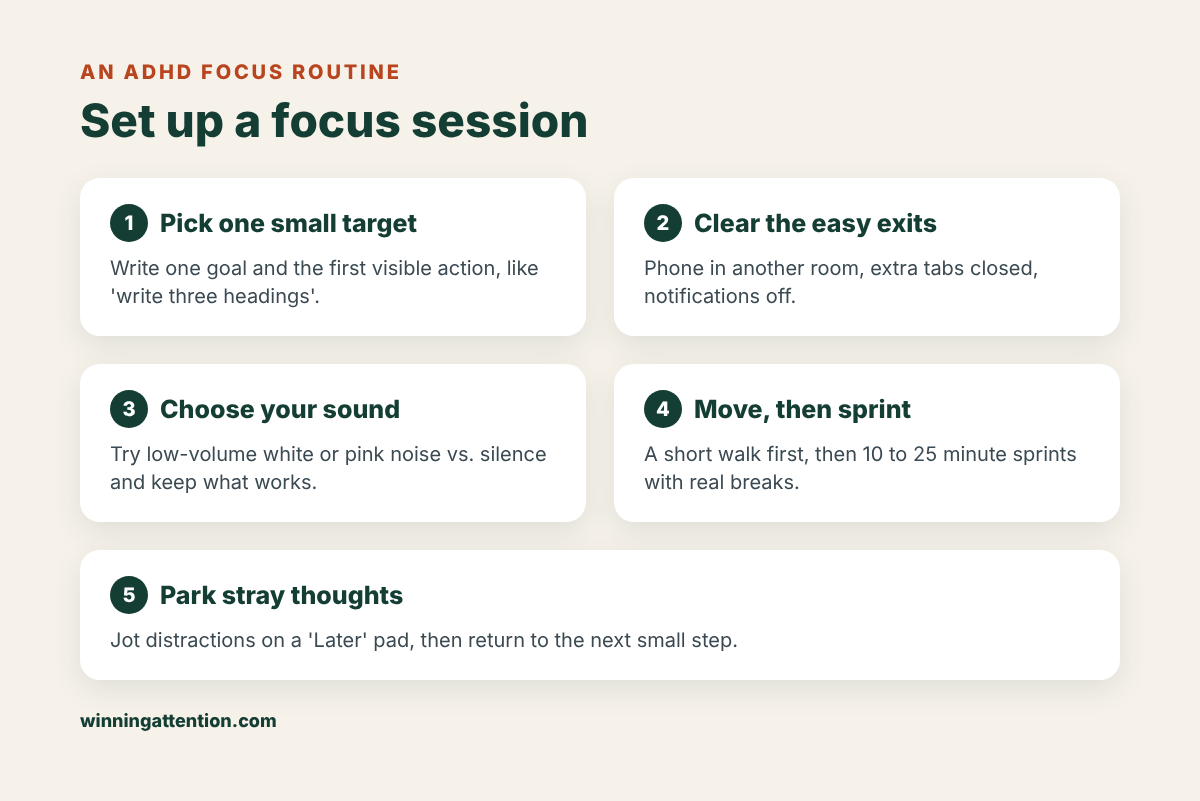
The short version: do not rely on willpower. Pick one small, visible target, put your phone out of sight, try steady background noise, move your body before hard work, and work in short timed sprints with planned breaks. Keep a pad nearby to park stray thoughts. Small, repeatable changes to your setup tend to beat big promises to concentrate harder.
Why ADHD focus works differently
The name “attention deficit” is a little misleading. Many adults with ADHD can pay intense attention, sometimes for hours. The harder part is steering attention: aiming it at a task that is important but not interesting, keeping it there, and bringing it back after a distraction. That is why ADHD concentration can look excellent in one setting and almost absent in another.
The mind wanders more, and more freely
Everyone’s mind wanders. With ADHD, it tends to wander more often and in a less settled way. A 2018 review of brain-imaging and behavioral research described excessive spontaneous mind wandering as a characteristic experience of people with ADHD, marked by constant mental activity that jumps between topics. The authors proposed that the brain network active during rest does not switch off as smoothly when a task begins, and competes with the networks that should be running the task (Bozhilova et al., 2018). This is a theory, not a settled fact, but it matches what many adults describe: it is not that nothing is happening in your head, it is that too much is.
In practice, this means that the moment a task gets slow, repetitive or unclear, your attention has somewhere more interesting to go. Strategies that make the task clearer and more stimulating, or that give stray thoughts somewhere to land, tend to help more than telling yourself to “just focus.”
Hyperfocus: the other side of the same coin
Many people with ADHD also report periods of intense, absorbed attention, often called hyperfocus. In two samples of adults (251 in a pilot and 372 in a replication), people with higher levels of ADHD symptoms reported more hyperfocus overall, including during school or work, hobbies and screen time (Hupfeld et al., 2019).
Hyperfocus shows that the ability to concentrate is there. The challenge is that it tends to switch on for what is interesting, new or urgent, and not necessarily for what is important. It can also make it hard to stop, eat, sleep or switch to the next commitment. A good focus routine has to do two jobs: help you start on dull tasks and help you stop when absorbing ones run too long.
Timing matters more than most advice admits
Many adults with ADHD are night owls. A review of circadian research noted that adults with ADHD often have sleep problems linked to a delayed internal body clock, and are often described as “evening” or “night” types (Kooij & Bijlenga, 2013). If your best ADHD focus arrives at 4 p.m. or 10 p.m., you are not imagining it. Forcing your most demanding work into your lowest-energy hours makes concentration harder than it needs to be.
Time itself can also feel slippery. If you often underestimate how long tasks take, the article on ADHD time blindness explains why and how to plan around it.
What research says about improving ADHD focus without medication
Medication and cognitive-behavioral therapy have the strongest evidence for treating ADHD overall. Alongside treatment, or while you are waiting for an assessment, several everyday strategies have research behind them. None of them is a replacement for care, and most of the effects are modest. But modest effects add up when you stack them.
Steady background noise can help some people
White noise sounds like static; pink noise has more low-frequency sound and resembles steady rain. A 2024 meta-analysis pooled 13 studies with 335 children and college-age young adults who had ADHD or high ADHD symptoms. White and pink noise produced a small but statistically significant improvement on laboratory attention tasks (g = 0.249). In people without ADHD, the same noise had a small negative effect (g = -0.212). No studies of brown noise were found (Nigg et al., 2024).
Two cautions. The studies used lab tasks, not real jobs, and they did not include older adults. And the authors stressed that safe volume levels still need study. If you try noise, keep the volume comfortable and low, and notice honestly whether it helps you, since effects vary from person to person.
Moving before hard work
Exercise has been studied for ADHD for years, mostly in children. A 2026 meta-analysis focused specifically on adults with ADHD. Across eight studies, a single bout of exercise had a moderate positive effect on inhibitory control, the ability to hold back an automatic response (g = 0.55), and a small benefit for core ADHD symptoms (g = 0.23). Results for longer-term exercise programs were mixed (Xu et al., 2026).
The practical takeaway is not “become an athlete.” It is closer to: a short walk, some stairs or a few minutes of movement before a demanding task may give you a small, short-lived boost. Check with a doctor before starting anything strenuous if you have health concerns.
Planned breaks protect attention
Pushing through for hours feels virtuous, but attention tends to slide on long, boring tasks. In a laboratory study of a long, monotonous attention task, people who briefly switched away from the task twice did not show the usual drop in performance over time, while those who kept going without a break did (Ariga & Lleras, 2011). The participants were not selected for ADHD, so treat this as a general principle: short, planned breaks help you stay on task, they are not a reward for having stayed on it.
Your phone: out of sight is safer than “just don’t check it”
In two experiments, researchers reported that the mere presence of people’s own smartphones reduced available cognitive capacity, even when participants did not check them, and that the cost was highest in people most dependent on their phones (Ward et al., 2017). This “brain drain” finding has been debated. A pre-registered direct replication of one of the original experiments found no difference in performance between phone locations (Ruiz Pardo & Minda, 2022).
So the honest summary is: the evidence that a silent phone on the desk drains attention is mixed. But a phone that buzzes, lights up or invites “just one quick check” is a reliable distraction for almost anyone, and especially for a brain that already wanders easily. Putting it in another room costs nothing and removes the decision.
Mindfulness training
Mindfulness is not about emptying your mind. In ADHD programs it usually means practicing noticing where your attention has gone, then bringing it back without judgment. A 2025 meta-analysis of 10 controlled studies in adults with ADHD found improvements in self-reported ADHD symptoms (SMD = 0.48), observer-rated symptoms (SMD = 0.32) and daily functioning (SMD = 0.56). It found no clear effect on measured mindfulness skills or mood, and the authors called for more high-quality trials (Kim & Jung, 2025).
These were structured programs, often run by trained facilitators over several weeks, not a single app session. Short practice at home may still help, but it is not the same thing as the programs that were studied.
How to focus with ADHD: a 6-step method
The method below turns those findings into a routine you can repeat. The whole setup takes about five minutes. The aim is not perfect concentration. The aim is to make starting easier, make drifting less costly, and make coming back automatic.
Step 1: Choose one target and write the first visible step
Vague tasks invite wandering. “Work on the report” gives your attention nothing to hold. Before you start, write one target for this session and the first physical action you will take: “Write the three section headings in the report,” or “Open the invoice spreadsheet and enter the first five receipts.”
A clear, small first step reduces the gap between sitting down and starting. If even that feels heavy, the guide to ADHD task paralysis covers how to shrink a step until it feels doable.
Examples of focus targets that work
- Too vague: “Study.” Better: “Read pages 40 to 46 and write three bullet points.”
- Too vague: “Emails.” Better: “Reply to the four oldest emails flagged as urgent.”
- Too vague: “Clean the kitchen.” Better: “Empty the dishwasher and wipe one counter.”
Step 2: Clear the space of easy exits
Your environment makes dozens of small decisions for you. Make the default choice the focused one.
- Put your phone in another room or a closed drawer, not face down beside you.
- Close every browser tab and app you do not need for the target.
- Turn off notifications on your computer for the length of the session.
- Keep only the materials for this one task on the desk.
This works because it removes the need to resist temptation over and over. Each time you have to say “no” to a distraction, you are spending attention you need for the task.
Step 3: Pick your sound on purpose
Decide what you will hear before you start, so you are not hunting for a playlist halfway through. Based on the research above, some people with ADHD find steady white or pink noise helpful. Others prefer instrumental music, a recording of a coffee shop, or silence with earplugs.
A simple sound experiment
- Try three sessions with low-volume pink or white noise and three sessions in silence.
- After each one, rate your focus from 1 to 5 and note how much of the target you finished.
- Keep whichever setting scored better for you. Skip music with lyrics if you are reading or writing; words tend to compete with words.
Step 4: Move for a few minutes first
Before a demanding block, take a brisk five- to ten-minute walk, climb a few flights of stairs, or do a short set of simple movements. Research in adults with ADHD suggests a single bout of exercise can give a modest, short-term lift to inhibitory control. It also works as a clear “start ritual” that tells your brain the focus block is about to begin.
Step 5: Work in short sprints with planned breaks
Set a visible timer for a short sprint. Twenty-five minutes is a common starting point, but 10 or 15 minutes is fine if that feels more realistic. When the timer ends, take a real break of three to five minutes: stand up, drink water, look out a window. Then start the next sprint.
The timer does two things for ADHD focus. It turns an open-ended task into a short, finite one, which makes starting less daunting. And it creates a stopping point, which protects you from hyperfocus swallowing the afternoon.
Sprint lengths to try
- Hard to start: 10 minutes on, 3 minutes off. Increase by five minutes once it feels easy.
- Typical day: 25 minutes on, 5 minutes off, with a longer break after three or four sprints.
- Prone to hyperfocus: 45 minutes on, 10 minutes off, with an alarm you must physically stand up to turn off.
Step 6: Catch the drift with a parking pad
Your mind will wander. Plan for it. Keep a sticky note or a small notepad next to you labeled “Later.” When a thought pops up (“I need to email Sam,” “what was that song?”), write three or four words on the pad and go back to the target. You do not need to act on it now, and you do not need to hold it in your head.
When you notice you have drifted completely, use a quick reset rather than self-criticism: look at your written target, read the last line you wrote, and do the very next small action. Noticing and returning is the skill. Every time you do it, you are practicing the same thing mindfulness programs train.
A focus session in practice: a worked example
Here is how the method might look for a fictional person, Marcus, an office administrator with ADHD who needs to finish a quarterly expense summary. He has been “about to start” for two days.
- Target (2 minutes). Marcus writes on a sticky note: “Expense summary: enter January receipts into the spreadsheet.” It is only one month of three, but it is clear and finishable.
- Clear the space (1 minute). His phone goes into his bag in the coat closet. He closes email and chat and leaves only the spreadsheet and the folder of receipts open.
- Sound (30 seconds). He has already learned that pink noise at low volume works better for him than music, so he starts the same track he always uses.
- Move (5 minutes). He walks down and up two flights of stairs and refills his water bottle. Coming back to the desk is the signal that the block has begun.
- Sprints. Marcus sets a 25-minute timer. Twelve minutes in, he remembers he forgot to book a car service. He writes “car service” on the “Later” pad and keeps going. At the timer, he takes a four-minute break to stretch, then starts a second sprint.
- Result. After two sprints, January is done and February is half-entered. The car service, a reply to a colleague and an idea for the weekend are all waiting on the pad for his admin time.
Notice what Marcus did not do. He did not try to finish the whole summary in one heroic session, and he did not rely on remembering to ignore his phone. He shaped the situation so that focusing was the easiest option. If you want to fit sessions like this into a full day, the guide on how to plan your day with ADHD shows how to build a day around one or two focus blocks.
ADHD focus techniques for different situations
The core method stays the same, but the details shift with the task. Use this as a starting point and adjust based on what you notice.
| Situation | What usually gets in the way | Try this |
|---|---|---|
| Boring admin (forms, invoices) | Low interest, easy to drift | Short sprints, steady noise, a small reward after each sprint |
| Reading or studying | Rereading the same line, mind wandering | Read with a pen, write one bullet per page, no lyrics |
| Writing | Blank-page freeze, perfectionism | Start with headings or a messy first paragraph, edit later |
| Meetings and calls | Zoning out, interrupting | Take brief notes, keep a “Later” pad for your own ideas |
| Open-plan office | Noise, people, visual movement | Headphones with steady noise, face a wall, book a quiet room for focus blocks |
| Working from home | Chores, snacks, the couch | Same desk and start ritual every day, phone in another room |
Whatever the situation, keep a note of what you tried and how it went. Patterns usually show up within a couple of weeks, and they are more useful than any general rule, including the ones in this table.
Caffeine and ADHD focus: what the evidence says
Many adults with ADHD say coffee helps them concentrate, and the question comes up often. The research is thinner than the popularity suggests. A 2023 meta-analysis of randomized trials in children with ADHD (seven trials with 104 children aged 5 to 15) found that, in the four trials that could be pooled, caffeine did not show a significant benefit over placebo for overall ADHD symptoms (Perrotte et al., 2023). The individual studies were small and the results were mixed, and these were children, so the findings may not apply directly to adults.
In short, there is no good evidence that caffeine is a treatment for ADHD. If you drink coffee or tea and wonder whether it helps or hurts your focus, sleep or anxiety, or whether it fits with any medication you take, talk to your doctor or pharmacist. Do not use caffeine as a substitute for assessment or treatment.
Common mistakes that make focus harder
- Waiting to feel ready. With ADHD, the feeling of focus often shows up after you start, not before. Begin with the smallest step and let momentum do some of the work.
- Trusting willpower over setup. Resisting a phone on the desk all afternoon is exhausting. Move the phone and the problem shrinks.
- Scheduling deep work at your worst time. If your best concentration is in the late afternoon, protect that window when you can, and use low-energy hours for routine tasks.
- Skipping breaks. Long, unbroken sessions tend to end in drifting or burnout. Planned short breaks keep you going longer.
- Treating every wandering thought as urgent. Write it down and keep going. The pad will hold it.
- Changing your system every week. New tools feel exciting, which is part of the trap. Give one simple routine two or three weeks before judging it.
- Using hyperfocus as a plan. Waiting for a deadline panic to produce concentration works sometimes, but it is costly. A timer and a clear target are more reliable.
A focus routine is easier to keep when it lives on paper rather than in your head. The free ADHD Daily Planner Starter Kit includes a one-page daily planner with a sprint tracker, a weekly energy tracker to spot your best focus hours, and a 2-minute reset card for when you drift.
When to talk to a professional
Focus strategies can make a real difference, but they are not a treatment for ADHD on their own. Talk to a doctor, psychologist or other qualified clinician if trouble concentrating is affecting your work, studies, relationships, money or safety, for example while driving. It is also worth seeking help if you have never been assessed and suspect ADHD, if your symptoms have changed, or if you are dealing with low mood, anxiety or sleep problems, which can also affect attention. Evidence-based options include medication, cognitive-behavioral therapy and skills-based programs, and many people benefit from a combination.
Frequently asked questions
Why can’t I focus with ADHD?
ADHD affects how attention is regulated, not just how much attention you have. Research describes more frequent, less settled mind wandering in ADHD, which makes slow or unclear tasks especially hard to stick with. Interest, urgency, timing of day and your environment all have a big influence on how well you can focus.
Can people with ADHD focus on things they like?
Yes. Many adults with ADHD experience hyperfocus, a state of intense, absorbed attention, and a study of adults found it was more common in people with higher ADHD symptoms. The difficulty is that it tends to switch on for interesting tasks rather than important ones, and it can be hard to stop.
How can I improve ADHD focus without medication?
Studies support a few practical habits: steady background noise for some people, a short bout of exercise before demanding work, planned breaks, removing your phone from sight, and structured mindfulness training. Effects are usually modest, so combine them in a simple routine. These strategies work alongside professional care, not instead of it.
Does music or background noise help ADHD focus?
A 2024 meta-analysis found that white and pink noise gave a small benefit on lab attention tasks for young people with ADHD or high ADHD symptoms, but a small negative effect for people without ADHD. Keep the volume low, compare a few sessions with and without noise, and avoid lyrics while reading or writing.
Does caffeine help ADHD focus?
The evidence is limited. A meta-analysis of trials in children with ADHD found no significant benefit of caffeine over placebo for overall symptoms, and good research in adults is scarce. Caffeine is not a treatment for ADHD, so ask your doctor or pharmacist if you have questions, especially if you take medication.
When can people with ADHD focus best?
It varies, but many adults with ADHD are evening types with a delayed body clock, so their best focus often comes later in the day. Track your energy for a week or two, then protect your strongest hours for the work that needs the most concentration.
Sources
- Bozhilova NS, Michelini G, Kuntsi J, Asherson P. Mind wandering perspective on attention-deficit/hyperactivity disorder. Neuroscience & Biobehavioral Reviews. 2018;92:464–476. PubMed
- Hupfeld KE, Abagis TR, Shah P. Living “in the zone”: hyperfocus in adult ADHD. ADHD Attention Deficit and Hyperactivity Disorders. 2019;11(2):191–208. PubMed
- Kooij JJ, Bijlenga D. The circadian rhythm in adult attention-deficit/hyperactivity disorder: current state of affairs. Expert Review of Neurotherapeutics. 2013;13(10):1107–1116. PubMed
- Nigg JT, Bruton A, Kozlowski MB, Johnstone JM, Karalunas SL. Systematic review and meta-analysis: do white noise or pink noise help with task performance in youth with attention-deficit/hyperactivity disorder or with elevated attention problems? Journal of the American Academy of Child & Adolescent Psychiatry. 2024;63(8):778–788. PubMed
- Xu S, Zhao C, Hu L. The effects of acute and chronic exercise on executive functions and core symptoms in adults with ADHD: a systematic review and meta-analysis. Psychology of Sport and Exercise. 2026;84:103088. PubMed
- Ariga A, Lleras A. Brief and rare mental “breaks” keep you focused: deactivation and reactivation of task goals preempt vigilance decrements. Cognition. 2011;118(3):439–443. PubMed
- Ward AF, Duke K, Gneezy A, Bos MW. Brain drain: the mere presence of one’s own smartphone reduces available cognitive capacity. Journal of the Association for Consumer Research. 2017;2(2):140–154. DOI
- Ruiz Pardo AC, Minda JP. Reexamining the “brain drain” effect: a replication of Ward et al. (2017). Acta Psychologica. 2022;230:103717. PubMed
- Kim HH, Jung NH. Mindfulness-based interventions for adults with ADHD: a systematic review and meta-analysis. Medicine (Baltimore). 2025;104(37):e44308. PubMed
- Perrotte G, Moreira MMG, de Vargas Junior A, et al. Effects of caffeine on main symptoms in children with ADHD: a systematic review and meta-analysis of randomized trials. Brain Sciences. 2023;13(9):1304. PubMed
Turn this into a daily plan
Get the free ADHD Daily Planner Starter Kit: a one-page daily planner, a weekly energy tracker and a 2-minute reset card.