You walk into the kitchen and forget why. You reread the same email four times and still have not replied. You know the bill is due Friday, you care about paying it, and somehow it is Saturday. If moments like these feel oddly specific to you, it helps to see them laid out clearly. This guide collects executive dysfunction examples from ordinary adult life, sorted by the mental skill that tends to slip, so you can finally put a name to what keeps happening.
Seeing your own patterns described plainly can be a relief. It turns a vague sense of “I am bad at life” into something smaller and more workable: “My working memory drops things when I get interrupted,” or “Starting is my sticking point, not finishing.” Once you can name the skill, you can pick a support that fits it, instead of trying harder at everything all at once.
The short version: Executive dysfunction shows up as everyday snags in seven broad skill areas: working memory, inhibition, planning, task initiation, time management, emotional regulation, and flexibility. Find the examples that sound like you, identify which skill is involved, and try one small external workaround at a time. Patterns that are frequent, long-standing, and disruptive are worth discussing with a clinician.
How to use these executive dysfunction examples
Executive functions are the mental management skills that help you hold information in mind, stop yourself before acting, organize steps, get going, keep track of time, steady your emotions, and adjust when plans change. If you want the plain-language background on what these skills are and why ADHD affects them, start with our overview of ADHD and executive function. This article does something different: it is a field guide of recognizable moments, each paired with a small fix.
A few things to keep in mind as you read:
- The skills overlap. Executive skills work together, and a single real-life struggle often involves several at once. Missing a deadline might be part time management, part task initiation, and part working memory. Do not worry about sorting perfectly; aim for “close enough to choose a workaround.”
- Everyone has some of these moments. What matters is how often they happen, how long they have been happening, and how much they cost you at work, at home, and in relationships.
- Daily life is the real test. Studies comparing lab tests of executive function with ratings of everyday behavior find that the two only loosely line up. In adults with ADHD, ratings of how executive skills work in daily life predicted job difficulties better than lab tests did. In other words, your lived examples are meaningful data.
Each section below gives you a short explanation of the skill, a list of examples, and a “try this” idea for each one. The workarounds are intentionally small. If you would like a more structured path for building these supports into a weekly rhythm, our ADHD-friendly planning course walks through it step by step, but nothing here requires it.
Working memory: executive dysfunction examples you might recognize
Working memory is your mental sticky note: the ability to hold a few pieces of information in mind while you use them. A meta-analysis of 38 studies found that working memory difficulties in ADHD persist into adulthood, for both verbal information (like a phone number) and visual-spatial information (like where you put something). When this skill slips, things fall out of your head the moment something else comes in.
What it looks like
- The doorway reset. You walk into a room with a clear purpose and arrive with nothing. Try this: say the goal out loud as you stand up (“scissors, scissors”) or carry a related object with you as a physical reminder.
- Losing the thread mid-sentence. You start explaining something and the point evaporates, especially if someone interrupts. Try this: in meetings, jot one keyword before you speak so you can glance back at it.
- Multistep instructions vanish. Someone gives you three steps and you only remember the first. Try this: ask, “Can I repeat that back to you?” or request the steps in writing. It is a reasonable, professional request.
- The half-done chore trail. You start laundry, notice dishes, start dishes, and the laundry sits wet for a day. Try this: set a single timer the moment you start any chore that has a waiting step.
- Forgotten follow-ups. You promise to send something “after lunch” and genuinely never think of it again. Try this: capture every promise in one place the second you make it, even mid-conversation.
The common thread is that your brain is being asked to store things it does not store reliably. The workaround is almost always the same: move the information out of your head and into the world, where it can wait for you.
Inhibition: examples of the “pause button” not engaging
Inhibition is your ability to stop or delay a response: holding back a comment, resisting a distraction, or not acting on the first impulse. In a meta-analysis of executive function tests in adults with ADHD, inhibition was one of the areas showing medium-sized differences compared with adults without ADHD. In daily life, this tends to show up as speed without a brake.
What it looks like
- Interrupting before you mean to. The thought feels urgent and leaves your mouth before the other person finishes. Try this: keep a notepad nearby during conversations and write the thought down instead of saying it immediately.
- The impulse purchase spiral. You add things to an online cart “just to look” and check out before thinking. Try this: make a rule that anything nonessential sits in the cart overnight before you can buy it.
- Tab and phone hopping. You open your phone to check one thing and surface twenty minutes later. Try this: put the phone in another room during focused work, or keep only essential tools on your home screen.
- Saying yes too fast. You agree to a favor or project before checking your calendar or energy. Try this: practice a default line: “Let me check and get back to you by tomorrow.”
- Sending the heated message. You fire off a reply while annoyed and regret the tone. Try this: write emotional messages as drafts and send them only after a short walk.
Many inhibition workarounds work by adding friction or delay. You are not trying to become a different person; you are building a small speed bump between the impulse and the action.
Planning and organization: when the steps will not line up
Planning is the ability to picture a goal, break it into steps, and put those steps in a sensible order. Organization is the physical and digital version: keeping your things and information arranged so you can find them. A large meta-analytic review of executive function in ADHD found planning among the areas with the most consistent differences, alongside working memory and response inhibition.
What it looks like
- The “where do I even start” freeze. A project feels like a solid wall instead of a series of steps. Try this: ask, “What is the very first physical action?” Write that action, and only that action, at the top of your list.
- Doing steps in the wrong order. You start painting before buying enough paint, or write the report before gathering the data. Try this: sketch a rough “before and after” line: what must exist before you can do this step?
- Piles instead of systems. Papers, mail, and clothes accumulate in “I will deal with it later” piles. Try this: give each category exactly one landing spot near where you use it, like a single tray by the door for mail.
- Losing important items repeatedly. Keys, wallet, and glasses go missing several times a week. Try this: pick one bowl or hook for each item and practice the “always here” habit for a few weeks.
Notice that most of these workarounds reduce the number of decisions you have to make in the moment. A fixed spot, a short list, or a single first step does the organizing ahead of time, so your brain does not have to do it under pressure.
Task initiation: knowing what to do and still not starting
Task initiation is the skill of getting yourself to begin, especially when a task is boring, unclear, or emotionally loaded. It is one of the most misunderstood executive skills because from the outside it can look like laziness. From the inside, it often feels like pushing against an invisible wall. In one small study of university students, self-reported inattention was linked with general procrastination, which fits what many adults with ADHD describe.
What it looks like
- Waiting mode. You have an appointment at 3 p.m. and cannot start anything all morning because you are “waiting.” Try this: set an alarm for when you actually need to leave, then pick a short, low-stakes task you are allowed to abandon.
- The email you cannot open. A message that might contain bad news sits unread for days. Try this: open it with a timer for two minutes, with permission only to read it, not to respond.
- Productive procrastination. You deep-clean the stove to avoid the tax form. Try this: put the avoided task first, but make it tiny: “Find the form and put it on the table.”
- Starting only at the last minute. Deadline pressure is the only thing that gets you moving. Try this: create earlier, artificial deadlines with someone else involved, such as sharing a draft with a colleague by Wednesday.
When starting feels completely impossible rather than just unpleasant, it may look more like ADHD task paralysis, which has its own set of strategies.
Time management: examples of time slipping away
Time management depends on sensing how much time has passed, estimating how long things will take, and keeping future deadlines feeling real today. Many adults with ADHD describe two kinds of time: “now” and “not now.” Anything in the “not now” zone feels abstract until it suddenly becomes urgent.
What it looks like
- The five-minute task that takes an hour. You consistently underestimate how long things take. Try this: time a few common tasks for a week and write down the real numbers. Use those, not your guesses.
- Chronic lateness by the same margin. You are almost always about ten to fifteen minutes late. Try this: plan your departure from the arrival time backward, including parking, walking, and finding your keys.
- Losing whole afternoons. You look up and it is dark outside. Try this: use a visible analog clock or a timer that shows time shrinking, so the passage of time is something you can see.
- Deadlines that sneak up. A due date three weeks away feels distant until it is three days away. Try this: put reminders at several points (two weeks, one week, three days) instead of one alert on the day.
- Overstuffed days. Your to-do list has twelve items and room for four. Try this: assign each task an estimated duration and add them up before the day starts. If the total exceeds your available hours, cut.
For a fuller explanation of why time feels slippery, see our article on ADHD time blindness. A structured study of adults with ADHD found that a group program teaching time management, organization, and planning strategies led to greater improvement in inattention symptoms than supportive therapy alone, which suggests these skills respond to practice and good supports.
Emotional regulation: when feelings take the wheel
Emotional regulation is the ability to notice a feeling, keep it in proportion, and choose how to respond. It is not always listed as a classic executive function, but researchers increasingly see it as closely tied to ADHD. A review in a major psychiatry journal described emotional dysregulation as common in ADHD across the lifespan and a major contributor to impairment. A meta-analysis focused on adults found that emotional dysregulation, especially rapid mood shifts, was markedly higher in adults with ADHD than in comparison groups.
What it looks like
- Small setbacks feel huge. A minor criticism ruins your whole day. Try this: write the facts of what happened in one column and your interpretation in another. Seeing them separately often shrinks the feeling.
- Frustration boils over quickly. A slow website or a lost item triggers a disproportionate burst of anger. Try this: notice the early body signal (tight jaw, hot face) and step away for two minutes before acting.
- Emotion blocks the task. You cannot start the report because thinking about it fills you with dread. Try this: name the feeling first (“I am anxious this will not be good enough”), then shrink the task to a version that feels safe to begin.
Our article on ADHD emotional regulation covers this area in more depth, including how feelings and follow-through affect each other.
Flexibility: getting stuck when plans change
Cognitive flexibility, sometimes called set shifting, is the ability to switch between tasks, ideas, or approaches, and to adapt when circumstances change. The meta-analysis of adults with ADHD mentioned earlier also found medium-sized differences in set shifting. Interestingly, flexibility problems in ADHD can look like two opposites: switching too much (jumping between tasks) or not being able to switch at all (getting stuck).
What it looks like
- Derailed by a change of plans. A canceled meeting or a moved appointment throws off your entire day. Try this: keep a short “backup list” of quick tasks you can do in any unexpected gap.
- Cannot stop the current task. You are absorbed in something and transitions feel almost painful. Try this: set a transition warning ten minutes before you need to switch, plus a “parking note” of where you left off.
- Stuck on one approach. You keep trying the same method on a problem even though it is not working. Try this: after three failed attempts, ask, “How would someone else solve this?” or take a short break and come back.
The “cannot stop” pattern often overlaps with intense absorption in interesting work, while the “too much switching” pattern looks more like scattered attention. Both respond well to clear transition cues and a written note of where you left off.
A simple method for turning your examples into workarounds
Recognizing yourself in a list is a good first step, but the real value comes from turning a pattern into a support. This five-step method keeps it small and testable. You do not need to fix every example at once; one well-chosen workaround practiced for a couple of weeks usually teaches you more than ten ideas tried for a day each.
Step 1: Catch one specific moment
Pick a recent, concrete moment instead of a general complaint. “I am disorganized” is too broad. “On Tuesday I could not find my badge and was late for my shift” is specific enough to work with. Write down when it happened, where you were, and what was going on around you.
Step 2: Name the skill involved
Look back at the seven sections above and choose the skill that fits best. The badge example is mostly organization (no fixed spot) with a bit of time management (no buffer). If more than one skill seems involved, choose the one that, if supported, would have prevented the problem earliest in the chain.
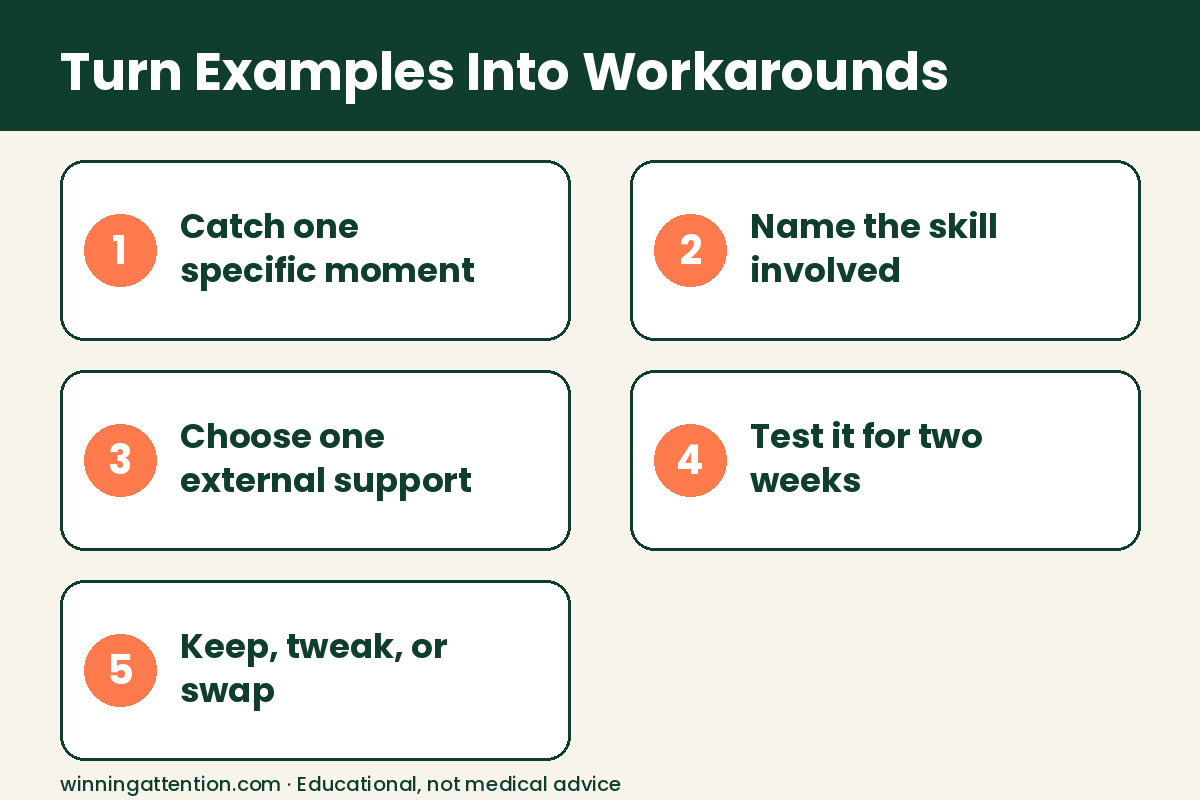
Step 3: Choose one external support
Executive skills work better when the environment does some of the remembering, stopping, and starting for you. Good supports tend to be visible, simple, and located exactly where the problem happens. For the badge, that might be a hook by the door. For the forgotten follow-up, it might be a single capture list you always carry. A printable layout can make this easier; our free printable ADHD planner kit includes simple pages for capturing tasks and estimating time.
Step 4: Test it for one to two weeks
Treat the workaround as an experiment, not a promise. Each day, note quickly whether you used it and whether the problem showed up. Expect the first few days to feel awkward. A support that seems silly often becomes automatic with repetition.
Step 5: Keep, tweak, or swap
At the end of the test, decide. If it helped, keep it and move on to a new example. If it partly helped, adjust one thing, like the location of a reminder or the time of an alarm. If it did nothing, it does not mean you failed; it means that tool did not fit your brain, and you can try a different support for the same skill.
Executive dysfunction examples vs. ordinary off days
Almost everyone forgets a name, loses their keys, or puts off an unpleasant task now and then. Lack of sleep, high stress, loneliness, and too little physical activity can all temporarily weaken executive skills in anyone. That is an important point: if your examples cluster around a stressful season, a new baby, or a stretch of poor sleep, those factors deserve attention first.
Patterns that may be worth discussing with a clinician tend to share a few features:
- They are long-standing. The difficulties have been present for years, often since childhood, rather than appearing suddenly.
- They show up in more than one area. Work, home, finances, and relationships are all affected, not just one domain.
- They have real costs. You have missed opportunities, faced repeated consequences, or feel constantly behind despite genuine effort.
- Effort alone has not changed them. You have tried planners, resolutions, and willpower, and the same patterns keep returning.
It also helps to know that executive function difficulties are not unique to ADHD, and not everyone with ADHD has them in every area. A large meta-analytic review concluded that executive function weaknesses are an important part of ADHD but are neither necessary nor sufficient to explain all cases. That is one reason why recognizing yourself in a list is a starting point for a conversation, not a diagnosis.
If you do want to bring this up with a professional, your notes from the method above are valuable. Concrete examples, with dates and consequences, give a clinician a much clearer picture than “I struggle with focus.”
Conclusion: your executive dysfunction examples are clues, not verdicts
The point of collecting executive dysfunction examples is not to build a list of everything that is wrong with you. It is to turn frustrating, repeated moments into useful clues. When you can say “that was working memory” or “that was a task initiation wall,” you can reach for a support that fits, instead of blaming yourself and trying the same thing harder.
Start with one example from this guide that made you think, “That is me.” Name the skill, pick one external workaround, and test it for a week or two. If you want help building these supports into a steady planning routine, the ADHD planning course offers an optional structured path, and the free ADHD planner kit gives you simple pages to start with today.
This article is educational and is not medical advice. If these patterns are affecting your life, talk to your clinician about diagnosis and treatment options that are right for you.
Frequently asked questions
What are common executive dysfunction examples in adults?
Common examples include walking into a room and forgetting why, struggling to start tasks you know are important, consistently underestimating how long things take, losing keys or documents often, interrupting before you mean to, and getting thrown off when plans change. Many adults also notice strong emotional reactions to small setbacks. The key is how often these moments happen and how much they affect your daily life.
Is executive dysfunction the same as ADHD?
No. Executive dysfunction describes difficulties with skills like working memory, planning, and self-control, and it is strongly associated with ADHD. However, research suggests not every person with ADHD has executive function weaknesses in every area, and these difficulties can also appear with stress, poor sleep, depression, anxiety, or other conditions. A clinician can help sort out what is behind your specific pattern.
How do I know which executive skill I am struggling with?
Start with a specific recent moment rather than a general feeling. Ask what broke down first: did you forget information (working memory), act too fast (inhibition), miss steps (planning), fail to begin (task initiation), lose track of time, get overwhelmed by feelings, or struggle to switch gears (flexibility)? Several skills often overlap, so choose the one where support would have helped earliest.
Can executive function skills improve in adulthood?
Many adults find that their daily functioning improves when they use external supports and structured strategies. In one randomized study, adults with ADHD who took part in a group program focused on time management, organization, and planning showed greater improvement in inattention symptoms than those in supportive therapy. Sleep, stress management, and physical activity can also make a noticeable difference in how well these skills work.
What is the best workaround for executive dysfunction?
There is no single best workaround because the right support depends on which skill is involved and how your brain works. In general, the most reliable workarounds move information and cues out of your head and into your environment: visible timers, one capture list, fixed spots for important items, and reminders placed right where the problem happens. Test one at a time and keep what helps.
When should I talk to a professional about executive dysfunction?
Consider talking to a clinician if your difficulties have been present for a long time, show up in several areas of life such as work, home, and relationships, and continue despite real effort. Bring concrete examples with dates and consequences. Those details help a professional understand your situation and discuss whether an evaluation for ADHD or another condition makes sense for you.
Sources
- Diamond A. Executive functions. Annu Rev Psychol. 2013;64:135-68. PubMed
- Willcutt EG, Doyle AE, Nigg JT, et al. Validity of the executive function theory of attention-deficit/hyperactivity disorder: a meta-analytic review. Biol Psychiatry. 2005;57(11):1336-46. PubMed
- Boonstra AM, Oosterlaan J, Sergeant JA, et al. Executive functioning in adult ADHD: a meta-analytic review. Psychol Med. 2005;35(8):1097-108. PubMed
- Alderson RM, Kasper LJ, Hudec KL, et al. Attention-deficit/hyperactivity disorder (ADHD) and working memory in adults: a meta-analytic review. Neuropsychology. 2013;27(3):287-302. PubMed
- Shaw P, Stringaris A, Nigg J, et al. Emotion dysregulation in attention deficit hyperactivity disorder. Am J Psychiatry. 2014;171(3):276-93. PubMed
- Beheshti A, Chavanon ML, Christiansen H. Emotion dysregulation in adults with attention deficit hyperactivity disorder: a meta-analysis. BMC Psychiatry. 2020;20(1):120. PubMed
- Niermann HC, Scheres A. The relation between procrastination and symptoms of attention-deficit hyperactivity disorder (ADHD) in undergraduate students. Int J Methods Psychiatr Res. 2014;23(4):411-21. PubMed
- Solanto MV, Marks DJ, Wasserstein J, et al. Efficacy of meta-cognitive therapy for adult ADHD. Am J Psychiatry. 2010;167(8):958-68. PubMed
- Barkley RA, Murphy KR. Impairment in occupational functioning and adult ADHD: the predictive utility of executive function (EF) ratings versus EF tests. Arch Clin Neuropsychol. 2010;25(3):157-73. PubMed
- Toplak ME, West RF, Stanovich KE. Practitioner review: do performance-based measures and ratings of executive function assess the same construct? J Child Psychol Psychiatry. 2013;54(2):131-43. PubMed
Turn this into a daily plan
Get the free ADHD Daily Planner Starter Kit: a one-page daily planner, a weekly energy tracker and a 2-minute reset card.