You know the scene. It’s 11:40 p.m., you meant to be asleep an hour ago, and you’re standing in the kitchen wondering where your keys are, whether you answered that email, and why you suddenly feel wide awake. An ADHD bedtime routine is not about willpower or a perfect “sleep hygiene” checklist. It’s a short, repeatable sequence that does the remembering, deciding, and transitioning for you, so your evening has a clear slope down toward sleep instead of a cliff you keep missing.
This guide walks you through that sequence step by step: a wind-down timeline you can set on your phone tonight, how to set up your bedroom so it works with your brain, a realistic plan for screens, a ten-minute “tomorrow-prep” that quiets the mental to-do list, a sample routine you can copy, and the practical tricks that help a routine survive past the first week. If your main struggle is why you keep staying up late even when you’re exhausted, that’s a slightly different problem, and we cover it in depth in our guide to ADHD bedtime procrastination. Here, the focus is on building the routine itself.
The short version: Pick a fixed wake time, count back to a target bedtime, and set a “last call” alarm about 90 minutes before it. Use that window for a fixed sequence: a quick reset and tomorrow-prep, a specific written to-do list, screens parked outside the bedroom, a warm shower, and a low-stimulation wind-down in a cool, dark room. Keep the steps visible, keep the wake time steady, and have a five-minute “minimum version” for bad nights.
Why an ADHD brain needs a different kind of bedtime routine
Most bedtime advice assumes that once you know what to do, you’ll do it. With ADHD, the hard part is noticing it’s time to stop, switching away from something interesting, and remembering the small steps in order.
Research backs up that sleep is a real pressure point for adults with ADHD. A meta-analysis of sleep studies in adults found that people with ADHD reported significantly more sleep problems than adults without ADHD on most self-report measures, and wrist-worn activity monitors showed longer time to fall asleep and lower sleep efficiency. The authors recommend that sleep problems be routinely screened for in adult ADHD assessments.
Timing is part of the story, too. A systematic review of 62 studies found consistent evidence that ADHD is associated with a later chronotype (being more of an “evening person”) and a delayed internal clock. In one study of adults with ADHD, most of the participants reported trouble falling asleep, and that group showed a later start and end to their sleep period and a later internal clock signal than adults without that sleep problem.
That’s why an effective routine for an ADHD brain tends to share a few features:
- External cues instead of internal ones. Alarms, lights, and visible checklists tell you it’s time, because your internal sense of time may not (more on that in our guide to ADHD time blindness).
- Fixed order, few decisions. Every choice you remove at 10 p.m. is one less chance to get sidetracked.
- Short steps with obvious “done” points. Big vague tasks like “get ready for bed” invite drifting. “Teeth, face, pajamas” does not.
- Built-in grace. A routine that only works on perfect nights isn’t a routine. It’s a wish.
If you’d like a bigger framework for planning your days and evenings around how your attention actually works, our ADHD-friendly planning course is an optional, structured way to build that system step by step. You don’t need it to use anything in this guide, though. Everything below works on its own.
The ADHD bedtime routine, step by step: a 90-minute wind-down timeline
Think of your evening as a runway rather than a light switch: a gradual descent with clear markers. The timeline below uses 90 minutes. Adjust the minutes to your life, but keep the order.
Step 1: Set your anchor (wake time first, bedtime second)
Start with the time you need to wake up on most days, not the time you’d like to fall asleep. Wake time is easier to control, because an alarm enforces it. Then count back roughly seven to nine hours, depending on how much sleep you tend to need, and that’s your target lights-out time. Count back another 90 minutes and you have your “last call.”
For example, if you wake at 7:00 a.m. and aim for about eight hours, your lights-out target is 11:00 p.m. and your last call is 9:30 p.m. Write those three times down somewhere you’ll see them. If your current bedtime is much later, move it earlier by about 15 minutes every few nights.
Step 2: The “last call” alarm (about 90 minutes before lights out)
This is the most important step, because it’s the one that solves the noticing problem. Set a recurring alarm with a label that tells you exactly what to do next, such as “Last call: close the laptop, start reset.” A label beats a generic beep, because when the alarm goes off you won’t have to remember what it was for.
When it rings, your only job is to stop what you’re doing and start the next step. If stopping mid-task feels unbearable, jot a one-line “parking note” about where you left off (“next: edit paragraph 3”) so your brain trusts it can pick up tomorrow.
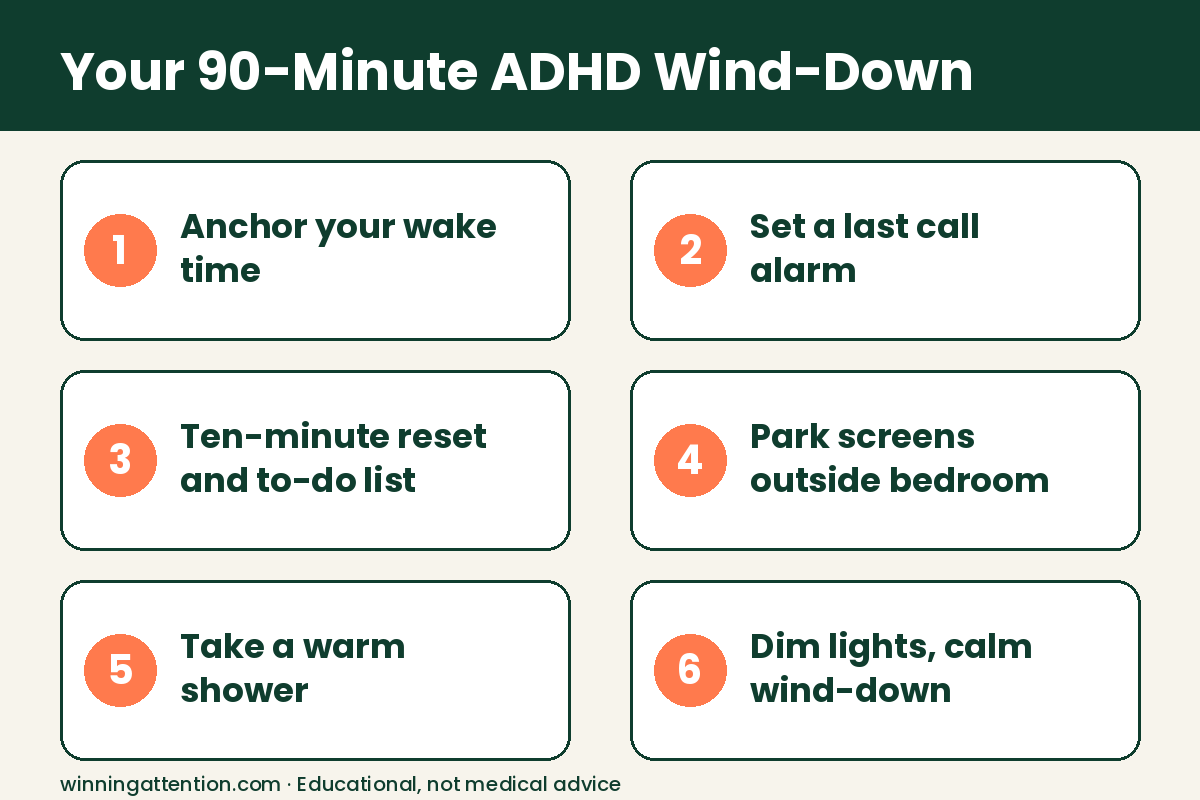
Step 3: Ten-minute reset and tomorrow-prep (75 minutes out)
This step handles the small tasks that otherwise pop into your head as you lie down. Set a timer for ten minutes and run through a short, fixed list:
- Launch pad: keys, wallet, bag, badge, and charger go in one spot by the door.
- Clothes: lay out tomorrow’s outfit, including shoes.
- Kitchen: one quick pass, such as dishes in the sink or dishwasher and a glass of water poured for the nightstand.
- Calendar glance: look at tomorrow’s first commitment and when you need to leave.
- Brain dump: write a specific to-do list for tomorrow (see below).
That last item has some interesting research behind it. In a sleep-lab study of healthy young adults, people who spent five minutes before bed writing a to-do list for the next few days fell asleep significantly faster than people who wrote about tasks they had already completed. The more specific their to-do lists were, the faster they fell asleep. The participants didn’t have ADHD, so treat this as a promising idea rather than a proven ADHD strategy, but it fits what many people with ADHD describe: unfinished tasks tend to loop at bedtime, and putting them on paper helps the loop slow down.
Keep the list concrete. “Email Dana about the invoice before 10 a.m.” works better than “work stuff.” If you want a ready-made format, the daily pages in our free printable ADHD planner kit include a space for exactly this kind of next-day list.
Step 4: Screens down and parked (60 minutes out)
About an hour before lights out, your phone, laptop, and tablet go to their overnight spot, ideally outside the bedroom. (A realistic screen plan is below.)
If you use your phone as an alarm, a plain alarm clock removes the biggest excuse for it to sleep next to you.
Step 5: Warm shower or bath (45 to 60 minutes out)
A warm shower is a useful anchor in an ADHD bedtime routine for two reasons. First, it’s a strong, physical transition: it’s hard to keep scrolling while you’re wet. Second, there’s some evidence it can help. A systematic review and meta-analysis found that a warm shower or bath taken one to two hours before bedtime, for as little as ten minutes, was associated with falling asleep faster, along with better self-rated sleep quality. The researchers think the effect comes from the drop in core body temperature that follows as your body releases heat. They also note that the research is still limited, so think of it as a helpful nudge, not a guarantee.
Fold your other “bathroom steps” into the same stop: teeth, face, skincare, pajamas.
Step 6: Low-stimulation wind-down (30 minutes out)
Now you need something to do that’s calm enough to let sleepiness arrive, but interesting enough that your brain doesn’t go hunting for stimulation.
Good options tend to be low-light, low-stakes, and easy to put down:
- A paper book or magazine, ideally something you’ve read before or that isn’t a page-turner.
- An audiobook or a calm podcast on a sleep timer, played from a device that stays across the room.
- Gentle stretching, a puzzle book, coloring, or a slow breathing exercise.
Step 7: Lights out (and what to do if sleep doesn’t come)
At your target time, lights go off. If you’re still clearly awake after what feels like a long while (don’t watch the clock, which tends to make things worse), it’s okay to get up, go to another dimly lit room, and repeat a quiet step from your wind-down list until you feel sleepy. Then try again. The idea is to keep your bed linked with sleep, not with frustration.
Setting up your bedroom so it does some of the work
Environmental changes only need to be made once, and then they keep working without any effort from you.
Light
Light is one of the strongest signals your internal clock uses to decide what time it is. In one study of college students, those with irregular sleep schedules had later internal clocks than regular sleepers, and computer modeling suggested this was mostly due to their different patterns of light exposure. For your evening, that means dimmer and warmer light as the night goes on, and real darkness at lights-out. Blackout curtains or an eye mask help if streetlights or early sunrise are a problem. In the morning, do the opposite: get bright light, ideally daylight, soon after you wake up. Our ADHD morning routine guide covers how to build that into the start of your day.
Temperature
A review of research on the thermal environment and sleep concluded that temperature is one of the most important environmental factors affecting sleep. In everyday conditions with bedding and clothing, heat exposure increased wakefulness and reduced deep sleep. Practically, a cooler room, breathable bedding, and layers you can kick off are a good place to start.
Noise and visual clutter
A steady background sound, such as a fan, can mask sudden noises that grab your attention. Clear the surfaces you can see from your pillow, too: a desk full of half-finished projects can start a train of thought you don’t want at 11 p.m. And keep the bed for sleep, not work or streaming, so it becomes a strong cue for switching off.
Screens at night: a realistic plan, not a ban
Screens are often the hardest part of an evening routine with ADHD: stimulating, endlessly novel, and always in reach. They’re also very common: in a national U.S. survey, nine out of ten people reported using some kind of electronic device in the hour before bed.
Two findings help explain why screens matter. In a controlled lab study, people who read on a light-emitting e-reader before bed took longer to fall asleep, felt less sleepy in the evening, had a later internal clock, and were less alert the next morning than when they read a printed book. And in that national survey, more interactive devices like phones, computers, and game consoles were more strongly linked with trouble falling asleep and unrefreshing sleep than passive ones like a TV.
So instead of an all-or-nothing rule, try a tiered plan:
Tier 1: Interactive screens end at last call
Email, social feeds, games, messaging, and anything with a “just one more” loop stop at your last call alarm. These are the ones most likely to grab your attention and keep it. App limits that start at that time can build in friction.
Tier 2: Passive screens, if any, end 30 to 60 minutes before lights out
If you want to watch something to wind down, pick a show you’ve seen before, watch it in a room other than your bedroom if you can, and turn off autoplay. A sleep timer on the TV helps, because stopping at 10:30 p.m. on willpower alone is a big ask.
Tier 3: The phone sleeps outside the bedroom
The single most effective change for many people is giving the phone a fixed overnight home, such as a charging spot in the kitchen or hallway. If you need to be reachable overnight, keep it face-down across the room with only priority contacts allowed through.
A sample ADHD bedtime routine you can copy
Here’s what the whole thing might look like for someone who wakes at 7:00 a.m. Use it as a starting template, then change the times and steps to fit your life.
The full weeknight version
- 9:00 p.m. Heads-up alarm: “30 minutes to last call. Start wrapping up.”
- 9:30 p.m. Last call alarm. Laptop closed, parking note written for anything unfinished.
- 9:30 to 9:40 p.m. Ten-minute reset: launch pad, clothes, kitchen pass, calendar glance, specific to-do list for tomorrow.
- 9:45 p.m. Phone and laptop go on the charger in the hallway. Plain alarm clock is set.
- 9:50 to 10:15 p.m. Optional passive screen time in the living room: one rewatched episode, autoplay off.
- 10:15 p.m. Warm shower, teeth, face, pajamas.
- 10:30 p.m. Into the bedroom. Lamp only. Paper book, stretching, or an audiobook on a timer.
- 11:00 p.m. Lights out.
- 7:00 a.m. Wake at the same time, open the curtains or step outside for daylight.
The five-minute minimum version
Some nights you’ll get home late, be completely drained, or realize at 12:30 a.m. that the evening slipped away. Instead of abandoning the routine, have a minimum version so small it’s almost impossible to skip:
- Phone on the charger outside the bedroom.
- Keys and bag at the door.
- Teeth brushed.
- One line on tomorrow’s list: the very first thing you need to do.
- Lights out, same wake time tomorrow.
Doing the minimum keeps the habit chain alive. You’re teaching your brain that bedtime always has a shape, even when the shape is small.
How to keep your ADHD bedtime routine consistent
Keeping a routine going after the novelty wears off is the real challenge with ADHD. These strategies make it easier to repeat than to skip.
Protect your wake time above everything else
If you only stick to one part of this guide, make it a steady wake time, including most weekends. Irregular sleep timing has been linked with a later internal clock, which can make it even harder to fall asleep at a reasonable hour. A big weekend sleep-in often makes Sunday night much harder.
Make the steps visible
Out of sight really is out of mind with ADHD. Post a short checklist where the routine happens: on the bathroom mirror, the inside of the front door, or your nightstand. Keep it to five to seven steps in plain words.
Chain steps to things you already do
Link each new step to something that’s already automatic. “When I plug in my phone in the hallway, I set out my keys.” “When I turn on the shower, I put on my sleep playlist.” These pairings, sometimes called habit stacking, reduce how much you have to remember. For more on building reliable sequences across your whole day, see our guide to building an ADHD routine.
Plan for the derailers in advance
Think about the three things most likely to knock you off course, then decide now what you’ll do when they happen. For example:
- “I got hyperfocused and missed last call.” Skip straight to the minimum version and keep tomorrow’s wake time.
- “I had a social event and got home at midnight.” Minimum version, then back to normal tomorrow night.
- “I’m wired and can’t settle.” Get out of bed, do one quiet step in dim light, and try again when sleepy.
Review once a week, change one thing
Once a week, take two minutes to ask: Which step keeps getting skipped? Which one helps the most? Then change just one thing, like moving last call 15 minutes earlier.
Don’t expect the basics to do everything
It’s worth being honest: general “sleep hygiene” tips are helpful, but they have limits. A review of the evidence found that while individual habits such as managing caffeine, alcohol, exercise, noise, and sleep timing are each linked with sleep, simply teaching people a list of sleep hygiene rules hasn’t been an effective treatment on its own for clinical sleep problems. A routine works best as a structure that makes those habits automatic.
When to talk to a professional
A good routine can make a real difference, but it isn’t the answer to every sleep problem. Consider talking to your clinician if you regularly take a long time to fall asleep despite a consistent routine, wake up many times a night, snore loudly or stop breathing during sleep (as noticed by a partner), feel restless or uncomfortable in your legs in the evening, or feel very sleepy during the day no matter how long you sleep. Sleep problems are common in adults with ADHD, and researchers recommend they be checked as part of an ADHD evaluation. If you’re on any treatment for ADHD and notice sleep changes, mention that too.
Conclusion: building your ADHD bedtime routine one night at a time
An ADHD bedtime routine works best when it takes the guesswork out of your evening. Start from a steady wake time, set a last call alarm about 90 minutes before lights out, and follow the same short sequence each night: reset and tomorrow-prep, a specific to-do list, screens parked, a warm shower, and a calm, dim wind-down. Set up your bedroom to be cool, dark, and quiet, keep the steps visible, and keep a five-minute minimum version ready for the nights that go sideways.
You don’t need to do all of this at once. Pick one step this week, probably the last call alarm, and add the next one when it feels steady. If you’d like guided support building planning habits that fit your brain, the ADHD planning course is there as an optional next step. And you can grab the free ADHD planner kit for an easy place to write tomorrow’s list tonight.
This article is for educational purposes only and isn’t medical advice. Please talk to your clinician for diagnosis, treatment, or any ongoing sleep concerns.
Frequently asked questions
How long should an ADHD bedtime routine be?
Many adults with ADHD do well with a wind-down window of 60 to 90 minutes before lights out, started by a clearly labeled alarm. The active steps themselves can be short: a ten-minute reset, a quick shower, and a calm activity. On rough nights, a five-minute minimum version keeps the habit going. Choose a length you can repeat most nights rather than one that only works when everything goes perfectly.
What time should I go to bed if I have ADHD?
Start from the time you need to wake up and count back the amount of sleep you tend to need, often seven to nine hours for adults. That gives you a target lights-out time. If your current bedtime is much later, shift it earlier gradually, about 15 minutes every few nights. Keeping your wake time steady, including on most weekends, usually matters more than hitting an exact bedtime.
Do I really need to stop using screens before bed?
A total ban isn’t necessary for most people, but timing and type matter. Research has linked light-emitting devices before bed with taking longer to fall asleep, and interactive devices like phones and computers with more sleep complaints than passive ones like TV. A practical approach is to end interactive screens at your last call alarm, keep any passive viewing short and outside the bedroom, and charge your phone in another room overnight.
What should I do to prepare for tomorrow before bed?
Spend about ten minutes on a fixed reset: put keys, wallet, and bag in one spot by the door, lay out clothes, do a quick kitchen pass, check tomorrow’s first commitment, and write a specific to-do list. A sleep-lab study in young adults found that writing a specific to-do list for five minutes before bed was linked with falling asleep faster than writing about completed tasks.
How do I stick to a bedtime routine when I keep forgetting it?
Rely on external cues instead of memory. Use a labeled alarm that tells you exactly what to do next, post a short visible checklist where the routine happens, and link each new step to something you already do automatically. Plan ahead for common derailers such as hyperfocus or late events, and keep a minimum version ready so one missed night doesn’t end the habit. Review once a week and change one thing.
What if I still can’t fall asleep after doing my routine?
If you’re clearly awake after a long while, get up, go to a dimly lit room, and do a quiet activity until you feel sleepy, then return to bed. Keep the next morning’s wake time the same. If trouble falling or staying asleep continues for weeks, or you notice loud snoring, restless legs, or heavy daytime sleepiness, talk to your clinician. Sleep problems are common with ADHD and worth checking properly.
Sources
- Díaz-Román A, Mitchell R, Cortese S. Sleep in adults with ADHD: Systematic review and meta-analysis of subjective and objective studies. Neurosci Biobehav Rev. 2018;89:61-71. PubMed
- Coogan AN, McGowan NM. A systematic review of circadian function, chronotype and chronotherapy in attention deficit hyperactivity disorder. Atten Defic Hyperact Disord. 2017;9(3):129-147. PubMed
- Van Veen MM, Kooij JJ, Boonstra AM, et al. Delayed circadian rhythm in adults with attention-deficit/hyperactivity disorder and chronic sleep-onset insomnia. Biol Psychiatry. 2010;67(11):1091-6. PubMed
- Scullin MK, Krueger ML, Ballard HK, et al. The effects of bedtime writing on difficulty falling asleep: A polysomnographic study comparing to-do lists and completed activity lists. J Exp Psychol Gen. 2018;147(1):139-146. PubMed
- Chang AM, Aeschbach D, Duffy JF, et al. Evening use of light-emitting eReaders negatively affects sleep, circadian timing, and next-morning alertness. Proc Natl Acad Sci U S A. 2015;112(4):1232-7. PubMed
- Gradisar M, Wolfson AR, Harvey AG, et al. The sleep and technology use of Americans: findings from the National Sleep Foundation’s 2011 Sleep in America poll. J Clin Sleep Med. 2013;9(12):1291-9. PubMed
- Haghayegh S, Khoshnevis S, Smolensky MH, et al. Before-bedtime passive body heating by warm shower or bath to improve sleep: A systematic review and meta-analysis. Sleep Med Rev. 2019;46:124-135. PubMed
- Okamoto-Mizuno K, Mizuno K. Effects of thermal environment on sleep and circadian rhythm. J Physiol Anthropol. 2012;31(1):14. PubMed
- Phillips AJK, Clerx WM, O’Brien CS, et al. Irregular sleep/wake patterns are associated with poorer academic performance and delayed circadian and sleep/wake timing. Sci Rep. 2017;7(1):3216. PubMed
- Irish LA, Kline CE, Gunn HE, et al. The role of sleep hygiene in promoting public health: A review of empirical evidence. Sleep Med Rev. 2015;22:23-36. PubMed
Turn this into a daily plan
Get the free ADHD Daily Planner Starter Kit: a one-page daily planner, a weekly energy tracker and a 2-minute reset card.