Most ADHD weekly planning starts the same way. On Sunday night you feel a burst of motivation, buy a new ADHD weekly planner or download a fresh app, and fill every slot from Monday to Friday. By Tuesday afternoon the plan is already out of date, by Wednesday you have stopped looking at it, and by the weekend it feels like proof that planning “doesn’t work for you.”
That cycle is not a character flaw. The way ADHD affects time, attention and motivation makes the usual advice (“just plan your week on Sunday”) fragile. But research on time management, goal setting and ADHD-specific skills programs points to a different kind of weekly plan: shorter, more visible, built with buffers, and designed to be restarted rather than followed perfectly. This guide explains why planning a week is harder with ADHD, what the studies say actually helps, and a simple 30-minute weekly reset you can use this weekend.
The short version: do not try to plan every hour of your week. Once a week, empty your head onto one page, look back at what happened last week, mark your fixed appointments, choose three priorities, give each one a time block with a buffer, and write one if-then plan for the hardest start. Then check in for two minutes each morning, and expect to reset midweek.
Why ADHD weekly planning is harder than it looks
A week is a long stretch of time to hold in mind. Daily planning only asks you to think a few hours ahead. Weekly planning asks you to predict how long things will take, how much energy you will have on Thursday, and what might go wrong in between. Each of those is a known pressure point for adults with ADHD.
Time is harder to feel and estimate
People with ADHD tend to perceive and judge time less accurately than people without ADHD. A 2024 meta-analysis that pooled 824 effect sizes found a moderate-to-large difference in time perception (mean g = 0.688), and the difference showed up in both children and adults (Metcalfe et al., 2024). If an hour and a half can feel like twenty minutes, it is very easy to pack a week with far more than will fit.
This is often called time blindness, and it is covered in more depth in our guide to ADHD time blindness. For weekly planning, the practical lesson is simple: your first estimate of how long a task will take is probably too short, so your plan needs space built in from the start.
Everyone underestimates, and ADHD adds to it
Underestimating time is not unique to ADHD. In classic studies of what psychologists call the planning fallacy, people repeatedly underestimated how long their own tasks would take, even when they knew similar tasks had taken longer in the past (Buehler, Griffin & Ross, 1994). Those studies were done with people without a known ADHD diagnosis. When you combine a universal tendency to be too optimistic with ADHD-related differences in time perception, the gap between the plan and reality can get wide very quickly.
One of the reasons the planning fallacy happens is that people picture the task going smoothly and forget to look at what happened last time. That is exactly why the weekly reset below starts with a short look back before you plan anything forward.
The week only exists in your head
Working memory, the mental notepad that holds information while you use it, is often stretched in ADHD. A weekly plan that lives in your head competes with every message, errand and new idea. Open loops pile up: the form you meant to send, the friend you meant to call, the bill due Friday. Each one quietly takes up attention until it is either done or written down in a place you trust.
“Now” beats “later”
Many adults with ADHD describe two modes: “not now” and “urgent.” A deadline on Friday barely registers on Monday, then suddenly takes over Thursday night. A good weekly plan pulls the future into the present by turning distant goals into small, visible steps with a day attached. Instead of “finish the report by Friday,” the plan says “Tuesday morning: outline the report.”
What research says about weekly planning and ADHD
There are no large trials of a specific “ADHD weekly planner” product. But several bodies of research point to the same ingredients, and most of them can be built into one short weekly routine.
Time management skills are linked to better outcomes
A meta-analysis that pooled studies of time management in general (not specifically ADHD) found that time management was moderately related to job performance, academic achievement and well-being, and moderately and negatively related to distress (Aeon, Faber & Panaccio, 2021). Interestingly, the authors noted that time management seemed to improve well-being, especially life satisfaction, even more than it improved performance. That is a useful reframe: the point of planning your week is not to squeeze in more work. It is to feel less chaotic.
Structured skills programs for adult ADHD include weekly planning
The strongest non-medication evidence for adult ADHD comes from structured cognitive-behavioral programs that teach organization, time management and planning. These programs teach practical skills such as organizing tasks, planning ahead and managing time, and they ask people to practice those skills between sessions.
- CBT for adults already on medication. In a randomized trial of 86 adults with ADHD who still had significant symptoms despite medication, 12 individual sessions of cognitive behavioral therapy produced better results than an attention-matched relaxation program. On the ADHD rating scale, 67% of the CBT group responded compared with 33% of the comparison group, and responders kept their gains at 6 and 12 months (Safren et al., 2010).
- Meta-cognitive therapy. A 12-week group program built around time management, organization and planning reduced inattention symptoms more than supportive therapy in 88 adults with ADHD (Solanto et al., 2010). The program also addressed discouraging thoughts that get in the way of self-management, such as “there is no point, I always fail.”
These are therapist-led programs, not self-help worksheets. Still, they show that planning skills are learnable and that practicing them on a regular schedule can make a real difference for adults with ADHD.
Specific goals work better than vague ones
A meta-analysis of 141 papers from randomized controlled trials found that setting goals had a small but real effect on behavior change (d = .34), with larger effects when goals were difficult, set publicly or shared as a group goal (Epton, Currie & Armitage, 2017). These studies were not about ADHD, but they support a simple principle for your week: choose a few clear, meaningful goals, and tell someone about them.
Reviewing your progress is powerful on its own
The weekly review is the part most people skip, and it may be the most important part. A meta-analysis of 138 randomized studies with nearly 20,000 participants found that interventions which increased how often people monitored their goal progress also improved goal attainment (d+ = 0.40). Progress monitoring had larger effects when the information was physically recorded and when results were reported or made public (Harkin et al., 2016). Again, this research was not ADHD-specific, but the message fits well: look back on paper, and do it regularly.
If-then plans help you start
Knowing what to do is different from starting it. Specific if-then plans, known as implementation intentions (“When it is Tuesday at 9:00 and I sit down at my desk, I will open the report outline”), link a cue to an action. A large meta-analysis of implementation intention studies found that forming these plans improved goal attainment compared with simply intending to reach the goal (Gollwitzer & Sheeran, 2006).
Writing a plan quiets the mental noise
In a series of experiments, unfinished goals kept intruding on people’s thoughts and hurt their performance on unrelated tasks. When participants wrote a specific plan for those goals, most of the interference went away, even though the goals were not yet done (Masicampo & Baumeister, 2011). For a busy ADHD brain, that is one of the hidden benefits of a weekly plan: you can stop carrying the whole week in your head.
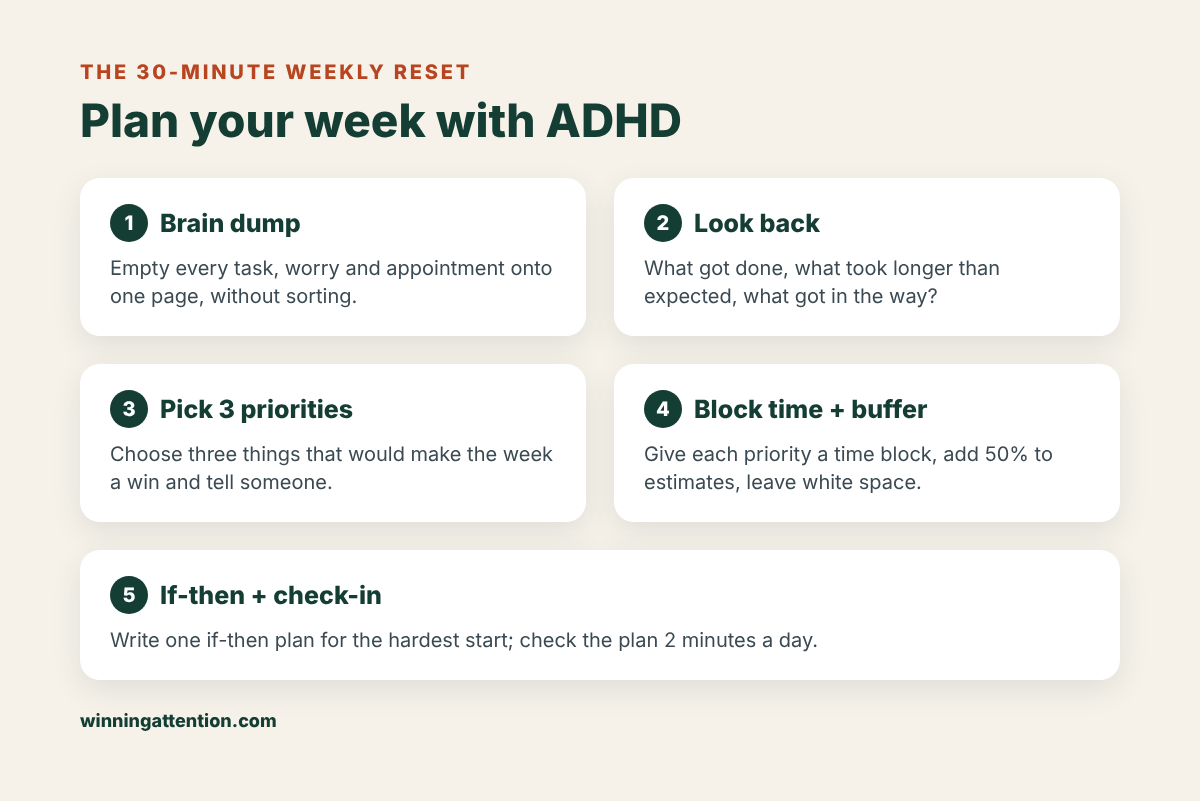
How to plan your week with ADHD: a 30-minute weekly reset
This method borrows the core ingredients above: capture everything in one place, look back before you look forward, set a few specific goals, schedule them with buffers, and use if-then plans to make starting easier. It takes about 30 minutes once you get used to it. The first time may take longer, and that is fine.
Pick one regular time for your weekly reset, such as Friday afternoon, Sunday late morning or Monday before work. Friday works well for many people because the week is still fresh in memory. Put it in your calendar as a recurring appointment with an alarm, just like a meeting.
Step 1: Brain dump everything (5 minutes)
Write down every task, appointment, worry and idea that is floating around for the coming week. Do not sort or judge yet. Check the obvious hiding places: your inbox, text messages, sticky notes, the bag you carry, the kitchen counter and your phone’s notes app.
The goal is one complete list in one place. It will probably be longer than feels comfortable. That discomfort is useful: it is easier to make honest decisions about a list you can see than about a fog of half-remembered tasks.
Prompts to help you empty your head
- What is due this week, at work, at home or for someone else?
- Who is waiting for a reply from me?
- What bills, forms or appointments are coming up?
- What have I been avoiding that keeps popping into my head?
- What do I need to buy, return or pick up?
Step 2: Look back at last week (5 minutes)
Before planning forward, spend five minutes on a quick weekly review. This is the step that protects you from the planning fallacy, because it reminds you what actually happened rather than what you hoped would happen.
Three weekly review questions
- What got done? Write down at least three things, even small ones. This counters the ADHD habit of remembering only what went wrong.
- What took longer than expected? Note one or two tasks and roughly how long they really took. Use this to adjust next week’s estimates.
- What got in the way? Late nights, too many meetings, a missing reminder, a task that was too vague? Pick one obstacle to plan around next week.
Keep the tone neutral, like a scientist looking at data. You are not grading yourself. You are collecting information so next week’s plan is a little more realistic.
Step 3: Mark your fixed commitments and your energy (5 minutes)
Open your calendar and block out everything that has a fixed time: work hours, meetings, appointments, school pick-ups, commutes, exercise classes and social plans. Then add the hidden time costs most plans forget: travel, getting ready, meals and the recovery time after draining events.
Next, note your energy pattern. Many adults with ADHD have clear high-focus windows (often late morning or evening) and low-energy slumps (often mid-afternoon). Mark two or three high-energy windows in the week. These are where your most important work should go.
Example: a quick energy map
- Monday: high energy 9:00–11:00; drained after the 3:00 team meeting.
- Wednesday: high energy 10:00–12:00; evening free.
- Friday: low energy all day; good for admin and the weekly reset.
If you want help seeing your patterns, a simple weekly energy tracker for a few weeks can show when you actually focus best, which is often different from when you think you do.
Step 4: Choose three priorities for the week (5 minutes)
Look at your brain dump and ask: if only three things move forward this week, which ones would make the biggest difference? Write those three at the top of your page.
Three is not a magic number, but it is small enough to hold in mind and large enough to feel like progress. Everything else on the list is still there; it just does not get prime time.
How to choose when everything feels important
- Pick anything with a real consequence if it slips: a deadline, money, health or a person waiting.
- Include at least one thing that matters to you personally, not just to your job or other people.
- If a priority is huge (“redo the website”), turn it into this week’s chunk (“draft the new home page text”).
- Tell one person your three priorities. Goal-setting research suggests public goals tend to work better.
Step 5: Give each priority a time block, plus a buffer (5 minutes)
A priority without a time is a wish. Put each of your three priorities into a specific block in your calendar, ideally in one of your high-energy windows. Then do two things that make the plan sturdier:
- Add 50% to your estimate. If you think the task needs two hours, block three. If last week’s review showed a task took twice as long as expected, double it.
- Leave white space. Keep at least one half-day, or a couple of open blocks spread across the week, completely unscheduled. That is where the overflow, surprises and slow days go.
As a rough guide, many people find it helps to schedule no more than about 60% of their available time and leave the rest flexible. This is a practical rule of thumb rather than a research finding, so adjust it after a few weeks of reviews.
What to do with everything else
- Admin tasks (emails, bills, forms) go into one or two batched admin blocks.
- Small errands go on a short “if I have time” list attached to your flexible blocks.
- Not this week items go on a “later” list you look at during next week’s reset. Moving something to “later” on purpose is a decision, not a failure.
Step 6: Write one if-then plan for the hardest start (3 minutes)
Look at your three priorities and ask which one you are most likely to avoid. Write an if-then plan for the very first step of that task:
“When it is Tuesday at 9:00 and I have poured my coffee, I will open the budget spreadsheet and fill in the first row.”
The cue (a time, a place, or something you already do) and the action (tiny and concrete) are what make it work. If you struggle to start tasks in general, the guide to ADHD task paralysis has more strategies.
More if-then examples for the week
- “When I sit down after lunch on Wednesday, I will call the insurance company before opening email.”
- “If I notice Thursday’s plan has fallen apart, I will do the 10-minute midweek reset before anything else.”
- “When I get home on Monday, I will put the library books by the front door.”
Step 7: Put the plan where you will see it (2 minutes)
A weekly plan you cannot see might as well not exist. Choose one visible home for it: a printed page on the fridge, a whiteboard above your desk, the first page of your notebook or a pinned note on your phone’s home screen. Then set up a two-minute daily check-in, ideally attached to something you already do, such as your first coffee.
The two-minute daily check-in
- Look at the week’s three priorities.
- Check today’s appointments and blocks.
- Pick today’s one most important task. The guide to planning your day with ADHD shows how to build the rest of the day around it.
Putting it together: a sample weekly reset
Here is what the method looks like for a fictional example: Marcus, a 34-year-old project coordinator with ADHD, doing his weekly reset on a Friday at 3:30 p.m.
- Brain dump (6 minutes). Marcus writes 22 items: client report due Thursday, quarterly budget numbers, reply to his manager about the training course, renew car registration, dentist appointment Tuesday, his sister’s birthday Saturday, return a package, call his landlord about the leaking sink, start running again, sort out the shared drive folders, and more.
- Look back (4 minutes). Last week he finished the vendor proposal and cleared his inbox twice. The budget numbers took about four hours, not the two he planned. The main obstacle: he kept answering messages during his focus time.
- Fixed commitments and energy (5 minutes). Team meetings Monday and Wednesday mornings, dentist Tuesday at 4:00, soccer Thursday evening. His best focus is 9:00–11:30 on days without meetings, so Tuesday and Thursday mornings are prime time.
- Three priorities (3 minutes). (1) Client report draft finished by Wednesday so there is time to review. (2) Quarterly budget numbers. (3) Personal: call the landlord about the sink. He texts his partner the list.
- Time blocks with buffers (6 minutes). Report: Tuesday 9:00–11:30 and Wednesday 1:00–3:00. Budget: Thursday 9:00–1:00, blocked for four hours this time based on last week’s review. Landlord call: Monday at lunch. Admin blocks Monday and Wednesday afternoons. Friday afternoon stays open as a buffer, plus the weekly reset.
- If-then plan (2 minutes). “When I sit down on Tuesday at 9:00, I will turn my phone face down, close chat, open the report template and write the three section headings.”
- Make it visible (1 minute). He writes the three priorities on a sticky note on his monitor and sets a daily 8:45 reminder labeled “2-minute check-in.”
Sorting the shared drive, returning the package and starting to run again went onto the “later” or “if I have time” lists. On Wednesday, a client emergency eats his afternoon block, so he does a 10-minute midweek reset and moves the rest of the report to Friday morning, using the buffer he left open. The week was not perfect, but the three things that mattered all moved forward.
A simple ADHD weekly schedule template
Here is one way to lay out a working week using the method above. Treat it as a starting point, not a rule. Shift the blocks to match your own energy, job and family responsibilities.
| Day | Focus block | Admin and errands | Buffer and check-ins |
|---|---|---|---|
| Monday | Priority 1, first chunk | Batch email and calls | 2-minute morning check-in |
| Tuesday | Priority 1 or 2, main session | Short admin block after lunch | 2-minute check-in; open late afternoon |
| Wednesday | Priority 2 | Errands and appointments | 10-minute midweek reset |
| Thursday | Priority 3 or catch-up | Batch email and forms | 2-minute check-in; open block |
| Friday | Wrap-up and loose ends | Light admin | 30-minute weekly reset; open afternoon |
| Weekend | Optional, only if you choose | Household tasks you planned | Rest is part of the plan |
Notice what is missing: an hour-by-hour grid. A weekly schedule built from a few big blocks is easier to remember and easier to rearrange when life happens. If you want ready-made pages to fill in, the free ADHD Daily Planner Starter Kit includes a one-page daily planner, a weekly energy tracker and a 2-minute reset card.
What to do when the week falls apart by Tuesday
It will happen. A sick child, a surprise deadline, a bad night’s sleep or a hyperfocus spiral can knock a careful plan off course in a day. With ADHD, the danger is not the disruption itself. It is the all-or-nothing thought that follows: “The week is ruined, so there is no point following the plan.”
A plan is a tool for making decisions, not a test you pass or fail. When the week goes sideways, use a short midweek reset instead of abandoning the plan:
- Stop and breathe for one minute. Overwhelm makes everything look equally urgent, and a short pause makes it easier to see what actually matters.
- Look at the three priorities only. Not the whole list. Which of the three still matters most this week?
- Move, shrink or drop. Move a block to your buffer time, shrink a priority to a smaller version (“outline” instead of “full draft”), or drop the least important one on purpose.
- Write the new next step. Make it tiny and give it a time today or tomorrow.
This takes about ten minutes, and it turns “I failed” into “I adjusted.” Over time, the midweek reset becomes part of the routine rather than an emergency.
Choosing an ADHD weekly planner: paper, digital or both
The best ADHD weekly planner is the one you will look at every day. There is no single right format, but each option has strengths.
Paper planners and printed pages
- Strengths: always visible on the desk or fridge, no notifications to swipe away, physically writing things down may make them stick. The progress monitoring meta-analysis above found larger effects when progress was physically recorded, although that did not specifically mean paper.
- Weaknesses: easy to leave at home, no automatic reminders, harder to move things around.
Digital calendars and apps
- Strengths: alarms and reminders, recurring events, access from anywhere, easy to drag blocks to a new day.
- Weaknesses: out of sight when the phone is in your pocket, notifications can become noise, and the temptation to keep switching apps.
A hybrid that works for many adults with ADHD
Use a digital calendar for anything with a fixed time (appointments, meetings, deadlines, the weekly reset itself) and a single paper page for the week’s priorities and blocks, kept where you will see it. Whatever you choose, keep one capture place for tasks. Two task lists means half your tasks are always in the other one.
What an ADHD weekly planner should include
- Space for a brain dump or a “later” list.
- Three short lines for the week’s priorities.
- A simple view of the week with room for a few blocks per day, not an hour-by-hour grid.
- A small weekly review box: what got done, what took longer, what got in the way.
- A place for one if-then plan.
- Very little else. Every extra field is one more reason to skip it.
Common weekly planning mistakes with ADHD
- Scheduling every hour. A full calendar breaks at the first delay. Plan a few blocks and protect your buffers.
- Skipping the look-back. Without a weekly review, you will keep making the same estimates and the same overpacked plans.
- Too many priorities. Ten priorities is a to-do list. Three priorities is a plan. If you need help trimming, ask which items would still matter a month from now.
- Planning only work. Rest, meals, exercise and relationships take time too. If they are not on the plan, they will be squeezed out first.
- Making the reset too long. A two-hour planning session feels productive but is hard to repeat. Thirty minutes you will actually do beats a perfect session you dread.
- Switching systems every few weeks. New tools feel exciting, which is part of the trap. Give one simple system at least a month before judging it.
- Treating a missed week as failure. If you skip a reset, do not try to catch up. Just do this week’s reset and move on.
When to talk to a professional
Weekly planning strategies help many adults, but they are not a treatment for ADHD on their own. If disorganization is affecting your job, finances, relationships or health, or if you are dealing with persistent low mood, anxiety or burnout, talk to a doctor, psychologist or other qualified clinician. Evidence-based options include medication, cognitive behavioral therapy and structured skills programs like the ones described above, and many people benefit from a combination. A clinician or ADHD-informed therapist can also help you adapt planning methods to your specific situation.
Frequently asked questions
How do you plan your week with ADHD?
Do a short weekly reset at the same time each week. Brain dump everything onto one page, review what happened last week, mark your fixed commitments and energy levels, choose three priorities, and give each a time block with a buffer. Write one if-then plan for the hardest start and keep the plan somewhere visible.
What is a weekly review and does it help with ADHD?
A weekly review is a short look back at what got done, what took longer than expected and what got in the way. Research outside ADHD shows that regularly monitoring progress, especially when it is written down, helps people reach their goals. Structured CBT-based programs for adult ADHD, which teach planning and time management skills, also have research support.
What should an ADHD weekly planner include?
Keep it simple: a space for a brain dump, three lines for the week’s priorities, a view of the week with a few blocks per day, a small weekly review box and room for one if-then plan. Avoid planners with lots of extra fields, because complexity makes it easier to give up.
How much should you schedule in a week?
Less than you think. Many people find it helps to schedule no more than about 60% of their available time and add 50% to each time estimate. Use your weekly review to adjust these numbers to your own pace.
What do you do when the week falls apart by Tuesday?
Do a 10-minute midweek reset instead of abandoning the plan. Look only at your three priorities, then move, shrink or drop one on purpose, and write a tiny next step with a time attached. A plan is a tool for decisions, not a test you pass or fail.
Digital calendar or paper weekly planner?
Both can work, and many adults with ADHD use a hybrid. A digital calendar handles fixed appointments and reminders well, while a paper page for weekly priorities stays visible on your desk or fridge. The best choice is the one you will actually look at every day.
Sources
- Metcalfe KB, McFeaters CD, Voyer D. Time-perception deficits in attention-deficit/hyperactivity disorder: a systematic review and meta-analysis. Developmental Neuropsychology. 2024;49(1):1–24. PubMed
- Buehler R, Griffin D, Ross M. Exploring the “planning fallacy”: why people underestimate their task completion times. Journal of Personality and Social Psychology. 1994;67(3):366–381. DOI
- Aeon B, Faber A, Panaccio A. Does time management work? A meta-analysis. PLoS One. 2021;16(1):e0245066. PubMed
- Safren SA, Sprich S, Mimiaga MJ, et al. Cognitive behavioral therapy vs relaxation with educational support for medication-treated adults with ADHD and persistent symptoms: a randomized controlled trial. JAMA. 2010;304(8):875–880. PubMed
- Solanto MV, Marks DJ, Wasserstein J, et al. Efficacy of meta-cognitive therapy for adult ADHD. American Journal of Psychiatry. 2010;167(8):958–968. PubMed
- Epton T, Currie S, Armitage CJ. Unique effects of setting goals on behavior change: systematic review and meta-analysis. Journal of Consulting and Clinical Psychology. 2017;85(12):1182–1198. PubMed
- Harkin B, Webb TL, Chang BP, et al. Does monitoring goal progress promote goal attainment? A meta-analysis of the experimental evidence. Psychological Bulletin. 2016;142(2):198–229. PubMed
- Gollwitzer PM, Sheeran P. Implementation intentions and goal achievement: a meta-analysis of effects and processes. Advances in Experimental Social Psychology. 2006;38:69–119. DOI
- Masicampo EJ, Baumeister RF. Consider it done! Plan making can eliminate the cognitive effects of unfulfilled goals. Journal of Personality and Social Psychology. 2011;101(4):667–683. PubMed
Turn this into a daily plan
Get the free ADHD Daily Planner Starter Kit: a one-page daily planner, a weekly energy tracker and a 2-minute reset card.