If your mornings feel like a daily emergency, you are not lazy and you are not alone. An ADHD morning routine has to work against a brain that wakes up slowly, a body clock that may run late, and a sense of time that goes quiet exactly when you need it most. That is why “just get up earlier” rarely fixes anything.
The good news: mornings are one of the most predictable parts of your day, which makes them one of the easiest to design for. In this guide you’ll learn why mornings are so hard with ADHD, a simple routine template you can set up this week, and versions for rushed workdays, slow days, and mornings after a bad night.
The short version: Stop relying on willpower at 7 a.m. Move decisions to the night before, keep everything you need for leaving at one launch pad, and write two versions of your routine: a 10-minute minimum and a full version for good days. Then put the steps where you can see them, use timers and anchors instead of guessing, and decide your first task before you go to bed.
Why is a morning routine so hard with ADHD?
Most morning advice assumes you wake up alert, know what time it is, and move smoothly from one task to the next. With ADHD, none of those are guaranteed. Several things tend to stack up in the first hour of the day.
Sleep inertia: your brain is still booting up
Sleep inertia is the groggy, slow, confused state right after waking. Research reviews describe it as a temporary dip in alertness and performance that fades over time after you wake up, and it tends to be stronger when you are short on sleep or wake during your body’s biological night.
In practice, this means the first stretch of your morning is the worst possible time to make decisions, remember multi-step plans, or solve problems. Anything that depends on clear thinking at 6:45 a.m. is fragile. Your routine should ask very little of your brain at the start and more as you warm up.
Delayed sleep timing: your body clock may run late
Many adults with ADHD report being “night owls,” and research backs up the pattern. Studies and reviews have found that ADHD is often associated with later sleep timing and a later chronotype, and one study found a delayed circadian rhythm in adults with ADHD who had chronic trouble falling asleep.
If your internal clock says it’s still the middle of the night when your alarm goes off, you’re waking up at a biological disadvantage. That doesn’t mean you’re doomed to bad mornings. It means your routine has to be built for a sleepy brain, and it’s worth talking with your clinician if your sleep timing is a persistent struggle.
Time blindness at 7 a.m.
Research on adult ADHD has linked the condition with differences in how time is perceived and estimated. In the morning, that shows up as “I have plenty of time” turning into “I’m late” with nothing in between. A five-minute scroll becomes twenty. A quick shower becomes a long one.
If this sounds familiar, our guide to how ADHD time blindness affects your day goes deeper. For mornings specifically, the fix is to make time visible and audible instead of trusting your internal sense of it.
Decision fatigue before breakfast
What to wear, what to eat, what to pack, which bag, which task first. Each choice is small, but your brain is still foggy, and every decision is a chance to stall or get pulled into something else. By the time you reach the door, you’ve already spent energy you needed for the actual day.
Transitions: the gaps between steps
ADHD often makes it hard to stop one thing and start the next. Mornings are basically a chain of transitions: bed to bathroom, bathroom to kitchen, kitchen to door. Every gap is a place where your phone, a stray thought, or a pile of mail can capture your attention. A good routine shrinks those gaps and gives you a clear cue for “what’s next.”
What makes a morning routine for ADHD actually work?
A routine that works for an ADHD brain looks different from a productivity influencer’s 5 a.m. ritual. It’s shorter, more external, and more forgiving. Here are the principles behind the template below.
- Fewer decisions in the morning. Anything you can decide the night before, decide the night before.
- Visible, not remembered. Steps live on a checklist you can see, not in your head.
- Time you can see and hear. Timers and anchors replace guessing.
- Two sizes. A minimum version for hard mornings and a full version for good ones, so “imperfect” never turns into “nothing.”
- A clear finish line. The routine ends with one defined first task, not a vague “start working.”
These ideas line up with what skills-based approaches for adult ADHD teach. Clinical trials of cognitive behavioral therapy and meta-cognitive therapy for adults with ADHD focused on practical skills such as planning, organizing, and managing time, and both found improvements compared with control conditions. If you want a structured way to build those skills across your whole day, not just mornings, our ADHD planning course for adults walks you through it step by step.
The ADHD morning routine template, step by step
This template has six parts. You don’t need all of them on day one. Start with steps 1 and 3, then add the others as they start to feel natural.
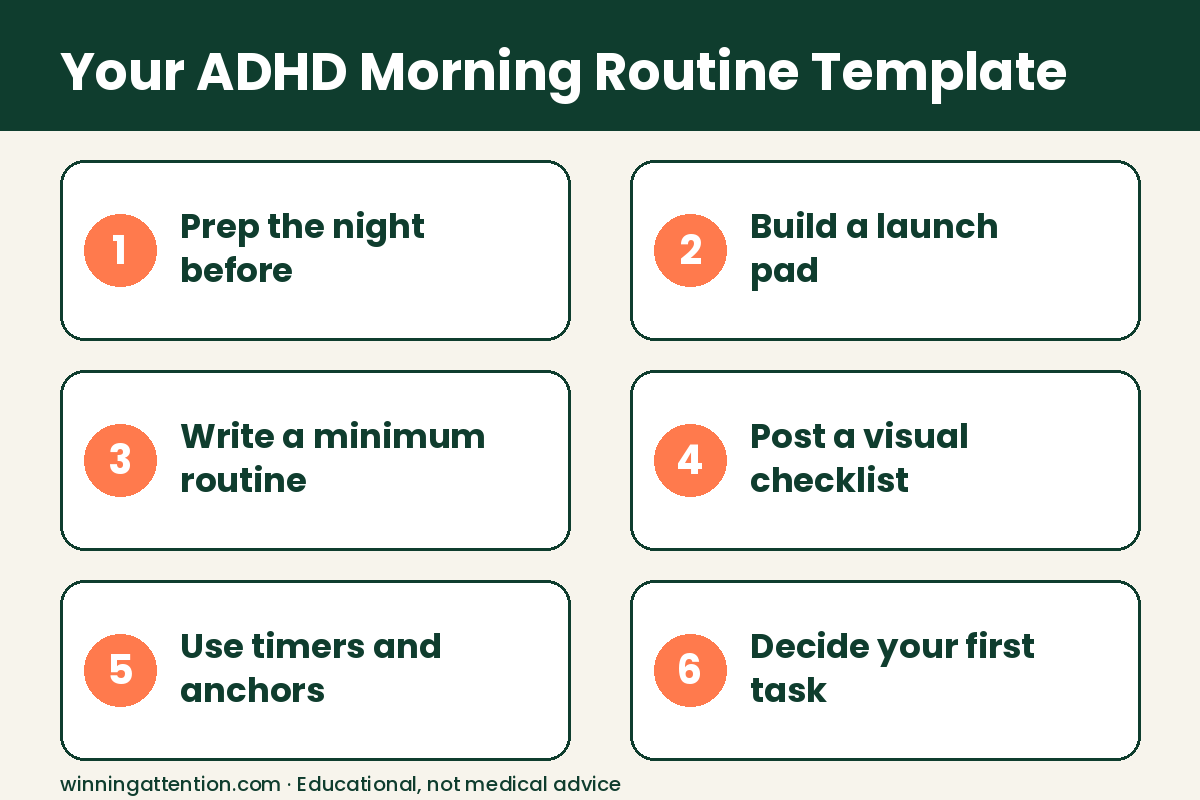
Step 1: Prep the night before
Your evening self is usually more alert than your morning self. Use that. A 10-minute evening reset takes decisions off your morning plate before your sleepy brain has to deal with them.
Your night-before checklist might include:
- Lay out tomorrow’s clothes, including shoes and anything weather-related.
- Pack your bag and put it at the launch pad (see step 2).
- Check tomorrow’s first appointment and the time you need to leave.
- Prep or choose breakfast: overnight oats, a grab-and-go option, or a written decision.
- Write your first task for tomorrow on a sticky note (see step 6).
- Plug your phone in away from the bed if you can.
Keep this list short enough that you’ll actually do it when you’re tired. If evenings are a struggle because you keep pushing bedtime later, read our guide to ADHD bedtime procrastination and how to break the cycle. A better morning often starts with a slightly earlier night.
Step 2: Build a launch pad
A launch pad is one fixed spot near your door where everything you need to leave the house lives. Keys, wallet, badge, bag, headphones, water bottle, anything you have to return or mail. If it leaves the house with you, it goes on the launch pad the night before.
Make it obvious and easy:
- Use a tray, basket, or hook by the door so items have a home.
- Put a charging cable there if you take your phone with you.
- Add a small “don’t forget” whiteboard or sticky note for one-off items.
- Rule of thumb: if you had to go back for it once this week, it belongs on the launch pad.
The launch pad turns “Where are my keys?” from a ten-minute search into a two-second grab. It also gives your routine a physical end point: when you’re at the launch pad, you’re leaving.
Step 3: Write a minimum viable routine and a full routine
This is the most important step. Most morning routines fail because they’re built for your best day. When you have a bad night or wake up late, the whole routine collapses, and you skip everything.
Instead, write two versions. The minimum viable routine is what you’ll do on your worst realistic morning. The full routine is what you do when you have time and energy. Both count as “doing your routine.”
Minimum viable routine (about 10–15 minutes)
- Get up at the first alarm and put feet on the floor.
- Bathroom: teeth, face, deodorant.
- Get dressed in the clothes you laid out.
- Drink a glass of water and grab a prepped breakfast.
- Take anything your clinician has prescribed, as directed.
- Launch pad, then out the door.
Full routine (about 45–60 minutes)
- Everything in the minimum routine.
- Shower.
- Sit-down breakfast.
- Five to ten minutes of movement, such as a short walk or stretching.
- A quick look at today’s plan and your first task.
- One small reset, like clearing the kitchen counter.
Your versions will look different, and that’s the point. Write yours down. When the morning goes sideways, you don’t have to decide what to cut. You just switch to the minimum.
Step 4: Make a visual checklist
A visual checklist moves the routine out of your working memory and into the room. Put it where the routine happens: on the bathroom mirror, the fridge, or the back of the bedroom door. Write it in the order you actually move through your home.
A few tips that make checklists easier to follow with ADHD:
- Keep it to 5–8 lines. Long lists get ignored.
- Start each line with a verb: “Brush,” “Dress,” “Grab.”
- Mark the minimum steps with a star so you can spot them at a glance.
- Use a dry-erase sheet in a sleeve so you can check items off every day.
If you’d like a ready-made layout, our free printable ADHD planner includes pages you can use for a morning checklist and your first task of the day.
Step 5: Use timers and anchors instead of guessing
Because time can be hard to feel with ADHD, give your morning external time cues. There are two kinds that work well together.
Timers show or announce how much time is left. Try a visual countdown timer in the bathroom, or a smart speaker set to announce reminders like “10 minutes until you leave.” Some people set a series of labeled alarms: “Shower now,” “Get dressed,” “Shoes on.”
Anchors are fixed events that tell you where you are in the morning. A playlist works well here: if you know the routine should be done by the fifth song, you can tell whether you’re on track without checking a clock. Other anchors include the coffee maker finishing, a podcast episode, or a family member leaving.
A useful rule: set your “leave” alarm 10 minutes before you actually need to walk out. That buffer absorbs the lost shoe, the forgotten lunch, and the surprise phone call.
Step 6: Follow the first-task rule
The morning routine doesn’t really end at the door. It ends when you start your first real task. Many people with ADHD get through the routine, sit down at work, and then lose an hour to email, messages, and “getting ready to get started.”
The first-task rule is simple: decide tomorrow’s first task the night before, write it down, and make it small and concrete. “Draft the first two slides” works. “Work on the presentation” doesn’t. When you sit down, you do that one task before opening anything else.
This works partly because it’s an if-then plan, also called an implementation intention: “When I sit down at my desk, I’ll open the slide deck and write the title slide.” Research on implementation intentions shows that linking a specific action to a specific situation helps people act on their intentions. If you freeze even with a clear first task, our guide to getting unstuck from ADHD task paralysis can help.
Sample ADHD morning routine for adults: example timelines
Here’s what the template can look like on three different kinds of mornings. Treat these as starting points and adjust the times to your own schedule, commute, and household.
| Time | Rushed workday (45 min) | Slow or work-from-home day (75 min) | After a bad night (20 min) |
|---|---|---|---|
| 0:00 | Alarm across the room; feet on the floor; open blinds | Alarm; open blinds; glass of water | Alarm; sit up; water from bedside |
| 0:05 | Bathroom basics; quick shower (timer: 8 min) | Short walk or stretching (10 min) | Bathroom basics only |
| 0:15 | Dress in laid-out clothes | Shower and get dressed | Dress in laid-out clothes |
| 0:20 | Grab-and-go breakfast; anything prescribed, as directed | — | Prepped breakfast; anything prescribed, as directed; launch pad |
| 0:30 | “10 minutes” alarm; check first task note | Sit-down breakfast | Out the door or to your desk |
| 0:40 | Launch pad; out the door | — | — |
| 0:50 | — | Five-minute counter reset; review today’s plan | — |
| 1:00 | — | Sit at your desk; start the first task before email | — |
The rushed workday morning
On a commute day, the goal is to get out the door on time with everything you need. You don’t need to add anything extra. Everything that can happen the night before should: clothes, bag, lunch, and your first-task note.
Two things matter most here. First, put your alarm across the room so getting up is the first step, not a negotiation. Second, use a timer for the shower, since that’s where many people lose track of time. The “10 minutes until leave” alarm is your safety net.
The slow or work-from-home morning
Slower mornings bring a different problem: no outside deadline. Without a commute, it’s easy to drift for two hours and then feel behind for the rest of the day. On these days, you still need an end point.
Create a “fake commute.” Take a short walk around the block, or simply change rooms and sit down at a set time. Then follow the first-task rule before you open email or messages. A start time you set the night before turns an open-ended morning into one with a clear edge.
The morning after a bad night
After poor sleep, sleep inertia tends to hit harder, and your capacity for decisions is lower. This is exactly what the minimum viable routine is for. Don’t try to “catch up” on the full routine. Do the starred steps, get to the launch pad, and go.
A few extra adjustments can help:
- Expect the first part of the morning to feel foggy and plan nothing hard for it.
- Make your first task even smaller than usual.
- Skip optional decisions, such as choosing a new outfit or trying a new breakfast.
- If bad nights are frequent, write down what’s happening and talk with your clinician.
Common morning derailers and how to handle them
Even a well-designed routine runs into trouble. Here are the most common snags, with a practical fix for each.
“I hit snooze again and again”
Snoozing gives your brain repeated chances to negotiate, and a groggy brain usually wins the argument. Move the alarm out of reach so you have to stand up to turn it off. Pair it with an immediate next step that’s easy, like opening the blinds or drinking the water you left on the dresser.
If you can’t get up on time no matter what you try, your sleep timing may be the real issue. That’s worth bringing up with your clinician rather than trying to fix with more alarms.
“I pick up my phone and lose 30 minutes”
Your phone is built to capture attention, and a just-waking ADHD brain is especially easy to capture. Charge your phone outside the bedroom and use a basic alarm clock. If you need your phone for alarms, move social and news apps off the home screen, or use a focus mode that holds them until your routine is done.
“I’m late even when I start on time”
This usually means a step takes longer than you think. For one week, time each step of your routine with a stopwatch, without changing anything. Most people find one or two “quick” steps that take twice as long as expected. Adjust your timeline to match reality, not hope.
“My household makes mornings chaotic”
Kids, partners, roommates, and pets all add variables. Share the plan: post the checklist where everyone can see it, give each person their own launch pad spot, and agree on who handles which steps. Protect your minimum viable routine first. You can’t help anyone else get out the door if you’re still looking for your own keys.
How to make your ADHD morning routine stick
Habits form through repetition in a consistent context. Research on habit formation suggests that when you repeat the same action in response to the same cue, it gradually becomes more automatic and needs less conscious effort. The catch is that this takes weeks to months, not days. Early on, the routine will still feel effortful, and that’s normal.
A few ways to give your routine the best chance:
- Start small. Begin with the night-before prep and the minimum viable routine. Add steps only once those feel steady.
- Keep the cue the same. Do the steps in the same order and place every day so each one triggers the next.
- Use if-then plans for weak spots. “If I’m still in bed 5 minutes after the alarm, then I switch to the minimum routine.”
- Count the minimum as a win. A 10-minute routine done consistently beats a perfect routine done twice a week.
- Review once a week. Ask what worked, what got skipped, and which one thing to change next week.
Mornings don’t exist in isolation. If you want to build a broader structure for evenings, weekends, and workdays, our guide to building an ADHD routine you can actually keep covers the bigger picture. Keep this morning template as one piece of that system.
The bottom line on building an ADHD morning routine
A good ADHD morning routine isn’t about discipline or waking up at 5 a.m. It’s about designing your morning for the brain you actually have: one that may wake slowly, run on a later clock, and lose track of time. Make decisions the night before, keep everything at a launch pad, write a minimum and a full routine, and use visible checklists, timers, and a clear first task.
Pick one step from this guide and try it for the next week. When you’re ready to build planning systems for the rest of your day, too, you can join the ADHD planning course and learn to plan your days, weeks, and projects in a way that fits how your brain works.
This article is for educational purposes only and isn’t medical advice. If you have questions about sleep, medication, or your ADHD symptoms, talk to your clinician.
Frequently asked questions
What is a good ADHD morning routine for adults?
A good ADHD morning routine for adults is short, visible, and built for a groggy brain. Prep clothes, bag, and breakfast the night before, keep everything you need at a launch pad by the door, and follow a 5–8 step checklist. Have a 10-minute minimum version for hard mornings and a fuller version for good ones, and end with one specific first task.
Why is it so hard to wake up with ADHD?
Several things can combine. Everyone experiences sleep inertia, the groggy phase right after waking, but research also links ADHD with later sleep timing and a later body clock. If your internal clock still says it’s night when your alarm rings, waking up feels much harder. If you struggle with this regularly, it’s worth discussing your sleep with your clinician.
How long should a morning routine for ADHD be?
There’s no single right length. Most people do best with two versions: a minimum viable routine of about 10–15 minutes that covers the essentials, and a full routine of about 45–60 minutes for days with more time. Time each step for a week to find out how long your routine really takes, then build your schedule around those numbers.
Should I check my phone first thing in the morning?
For many people with ADHD, checking the phone first thing is one of the biggest morning derailers, because it pulls attention into messages and feeds before the routine even starts. Try charging your phone outside the bedroom and using a separate alarm clock. If you need your phone, hide distracting apps or use a focus mode until your routine is done.
How do I stick to a morning routine with ADHD?
Start smaller than you think you need to, keep the steps in the same order and place every day, and put the checklist where you’ll see it. Use if-then plans for weak spots, such as switching to your minimum routine when you wake late. Count the minimum as a success, and review what worked once a week. Habits take weeks to months to form.
What should I do on mornings after I slept badly?
Switch to your minimum viable routine without guilt. Do only the essential steps, skip optional decisions, and plan nothing demanding for the first part of the morning, when grogginess is usually strongest. Make your first task smaller than usual. If poor sleep happens often, keep a simple record of your nights and talk with your clinician about what you’re noticing.
Sources
- Van Veen MM, Kooij JJ, Boonstra AM, Gordijn MC, Van Someren EJ. Delayed circadian rhythm in adults with attention-deficit/hyperactivity disorder and chronic sleep-onset insomnia. Biol Psychiatry. 2010;67(11):1091-1096. PubMed
- Bijlenga D, Vollebregt MA, Kooij JJS, Arns M. The role of the circadian system in the etiology and pathophysiology of ADHD: time to redefine ADHD? Atten Defic Hyperact Disord. 2019;11(1):5-19. PubMed
- Coogan AN, McGowan NM. A systematic review of circadian function, chronotype and chronotherapy in attention deficit hyperactivity disorder. Atten Defic Hyperact Disord. 2017;9(3):129-147. PubMed
- Tassi P, Muzet A. Sleep inertia. Sleep Med Rev. 2000;4(4):341-353. PubMed
- Hilditch CJ, McHill AW. Sleep inertia: current insights. Nat Sci Sleep. 2019;11:155-165. PubMed
- Ptacek R, Weissenberger S, Braaten E, Klicperova-Baker M, Goetz M, Raboch J, et al. Clinical implications of the perception of time in attention deficit hyperactivity disorder (ADHD): a review. Med Sci Monit. 2019;25:3918-3924. PubMed
- Wieber F, Thürmer JL, Gollwitzer PM. Promoting the translation of intentions into action by implementation intentions: behavioral effects and physiological correlates. Front Hum Neurosci. 2015;9:395. PubMed
- Gardner B, Lally P, Wardle J. Making health habitual: the psychology of ‘habit-formation’ and general practice. Br J Gen Pract. 2012;62(605):664-666. PubMed
- Safren SA, Sprich S, Mimiaga MJ, Surman C, Knouse L, Groves M, et al. Cognitive behavioral therapy vs relaxation with educational support for medication-treated adults with ADHD and persistent symptoms: a randomized controlled trial. JAMA. 2010;304(8):875-880. PubMed
- Solanto MV, Marks DJ, Wasserstein J, Mitchell K, Abikoff H, Alvir JM, et al. Efficacy of meta-cognitive therapy for adult ADHD. Am J Psychiatry. 2010;167(8):958-968. PubMed
Turn this into a daily plan
Get the free ADHD Daily Planner Starter Kit: a one-page daily planner, a weekly energy tracker and a 2-minute reset card.